Cost Engineering: Building Cost-Aware Enterprise Architecture
Cloud computing promised to transform capital expenditure into operational expenditure, converting large upfront investments into pay-as-you-go consumption. This promise has been fulfilled — but the consequence that many organisations did not anticipate is that pay-as-you-go means the bill changes every month, and without deliberate management, it changes upward.
Cloud cost overruns have become one of the most common complaints from enterprise leadership. Surveys consistently show that organisations exceed their cloud budgets by twenty to forty percent. The response has been the emergence of FinOps — the practice of bringing financial accountability to cloud spending. But FinOps as typically practiced focuses on optimising existing spending through reserved instances, rightsizing, and unused resource elimination. While valuable, this approach addresses symptoms rather than root causes.
The root cause of cloud cost problems is architecture. Systems designed without cost awareness produce spending patterns that are expensive to optimise after the fact. Cost engineering — embedding cost awareness into architecture decisions from the beginning — is more effective than retroactive cost optimisation.
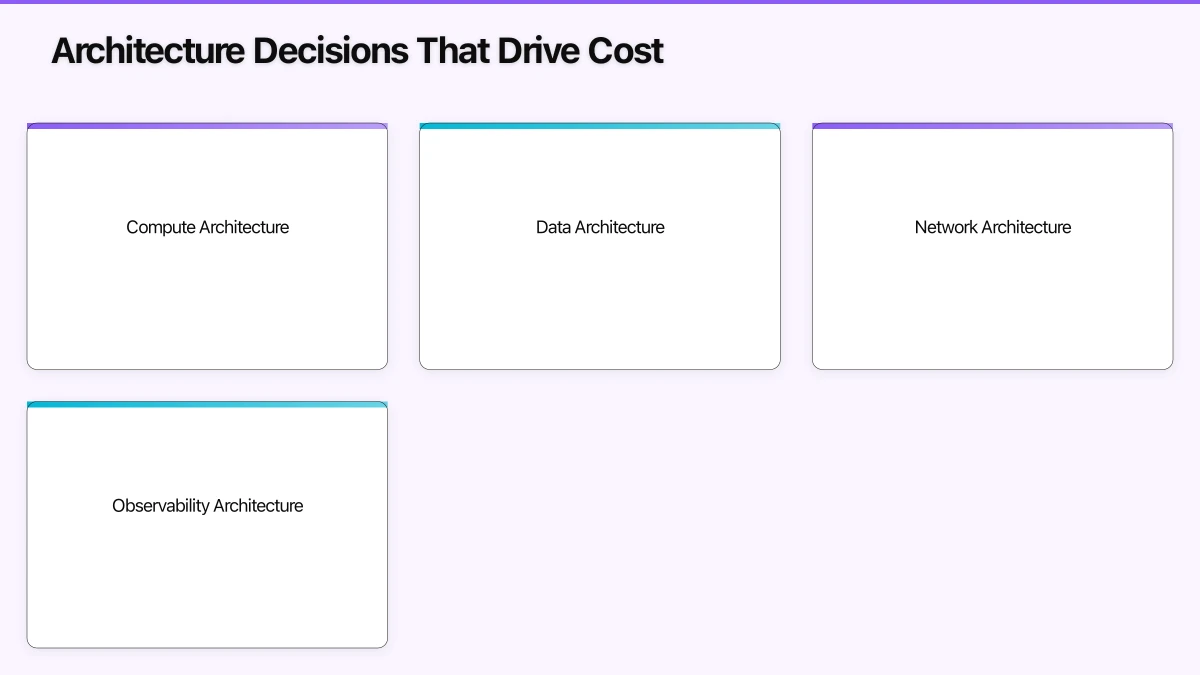
Architecture Decisions That Drive Cost
Several architectural patterns have outsized impact on cloud costs:
Compute Architecture: The choice between virtual machines, containers, and serverless functions has significant cost implications. Virtual machines provisioned for peak load but utilised at twenty to thirty percent average represent seventy to eighty percent waste. Container orchestration platforms like Kubernetes enable better utilisation through bin-packing but introduce management overhead. Serverless functions charge per invocation, eliminating idle cost but potentially becoming expensive at high volumes.
The cost-aware architect evaluates workload characteristics — steady-state vs. bursty, long-running vs. short-lived, CPU-intensive vs. memory-intensive — and selects compute models that match. A batch processing workload that runs for four hours per day is dramatically cheaper on spot/preemptible instances than on reserved instances sized for peak.
Data Architecture: Data storage and transfer costs are the most commonly underestimated cloud expenses. Object storage is cheap per gigabyte, but organisations that store everything forever accumulate significant costs. Data transfer between availability zones, between regions, and between cloud and on-premises environments incurs egress charges that add up rapidly.
Cost-aware data architecture implements tiered storage (hot, warm, cold, archive) with automated lifecycle policies that move data to cheaper tiers as it ages. It minimises cross-region data transfer through thoughtful workload placement. And it challenges the assumption that all data must be retained — deletion is the most effective cost optimisation.
Network Architecture: Cloud network pricing is complex and often surprising. Inter-availability-zone traffic, load balancer processing, NAT gateway throughput, and DNS queries all incur charges. An architecture that routes traffic through multiple hops between services accumulates network costs that a simpler topology would avoid.
Service mesh architectures, while valuable for observability and security, add sidecar proxies that increase network hops and associated costs. The cost-aware architect evaluates whether the benefits of service mesh justify the network cost overhead for each service, rather than applying it uniformly.
Observability Architecture: Monitoring and logging costs scale with the volume of telemetry data generated. An application that logs at DEBUG level in production, sends all metrics at one-second resolution, and traces every request generates telemetry that costs more to store and analyse than many organisations realise.
Cost-aware observability architecture applies appropriate sampling rates (not every trace needs to be captured), implements log level management (DEBUG logging disabled in production), and uses tiered retention (recent data in hot storage for real-time analysis, older data in cold storage for historical review).
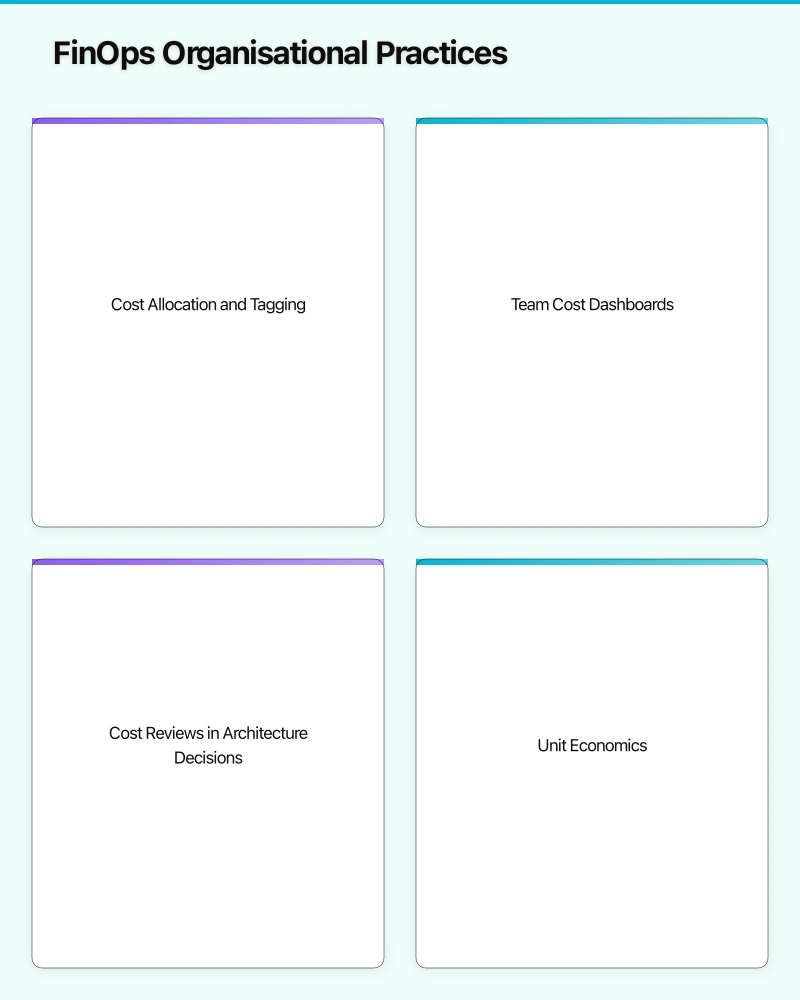
FinOps Organisational Practices
Cost engineering requires organisational practices that make cost visible and accountable:
Cost Allocation and Tagging: The foundation of cloud cost management is the ability to attribute costs to the teams, services, and business units that incur them. Consistent resource tagging — every cloud resource tagged with team, service, environment, and cost centre — enables cost allocation that drives accountability.
Tagging compliance is a persistent challenge. Automated tagging enforcement through infrastructure-as-code policies, tag validation in CI/CD pipelines, and regular compliance audits prevent the tag decay that undermines cost allocation.
Team Cost Dashboards: When engineering teams can see the cost of their services in real time, cost awareness becomes natural. A team that sees their service costs spike after a deployment change investigates and optimises. A team that never sees their costs has no incentive to manage them.
Cloud cost management platforms like CloudHealth, Cloudability, and Kubecost provide dashboards that attribute costs to teams and services. These dashboards should be accessible to engineering teams, not restricted to finance or management.
Cost Reviews in Architecture Decisions: Architecture decision records should include a cost analysis section that estimates the ongoing cloud cost implications of the decision. A technology choice that appears superior in features and performance may be significantly more expensive to operate. Making cost explicit in architecture decisions prevents surprises.
Unit Economics: Measuring the cloud cost per business unit — cost per transaction, cost per customer, cost per API call — connects cloud spending to business value. A service that costs fifty thousand dollars per month may be excellent value if it processes ten million transactions, or terrible value if it processes ten thousand. Unit economics enable meaningful comparison across services and over time.
Cost Optimisation Strategies
While architecture-level cost engineering is the most impactful approach, ongoing optimisation remains necessary:
Reserved Instances and Savings Plans: For steady-state workloads, committing to one or three-year terms reduces costs by thirty to sixty percent compared to on-demand pricing. The key is accurately identifying truly steady-state workloads and avoiding over-commitment that creates stranded reservations.
Rightsizing: Most cloud instances are over-provisioned. Analysing actual utilisation and resizing to match creates immediate savings. Cloud providers offer rightsizing recommendations, and tools like AWS Compute Optimizer provide data-driven suggestions.
Spot and Preemptible Instances: For fault-tolerant workloads — batch processing, CI/CD builds, development environments, stateless workers — spot instances provide sixty to ninety percent cost reduction. The architecture must tolerate interruptions, which means stateless design, checkpointing for long-running processes, and automated recovery.
Scheduled Scaling: Development and staging environments that run twenty-four hours a day but are used eight hours a day waste sixty-seven percent of their compute cost. Automated schedules that shut down non-production environments outside business hours produce immediate, significant savings.
Storage Lifecycle Management: Implementing automated transitions from standard to infrequent access to glacier/archive storage tiers reduces storage costs by fifty to eighty percent for data that is retained but rarely accessed.
Cost engineering is not about minimising spending — it is about maximising value per dollar spent. An organisation that reduces cloud costs by cutting capabilities has not improved; it has regressed. The goal is to deliver the same or better outcomes at lower cost through intelligent architecture, informed decisions, and continuous optimisation. The CTO who builds cost awareness into the engineering culture creates a sustainable economic model for cloud adoption that scales with the business rather than outpacing it.
For the practitioner’s view on cloud, IT, and cybersecurity, explore Cloud Geeks — where strategy meets infrastructure.
These insights are drawn from my work leading Ganda Tech Services — helping Australian businesses navigate digital transformation through cloud, web, and mobile.
About the Author
Ashish Ganda is the founder of Ganda Tech Services, a Sydney-based technology consultancy specialising in cloud infrastructure, web development, and mobile app solutions for Australian businesses.
Digital Transformation Roadmap 2026
A 12-month framework for Australian SMBs ready to modernise — phases, tools, and milestones.