Enterprise Architecture Modernization: Strategies for Legacy System Transformation
The Legacy Imperative
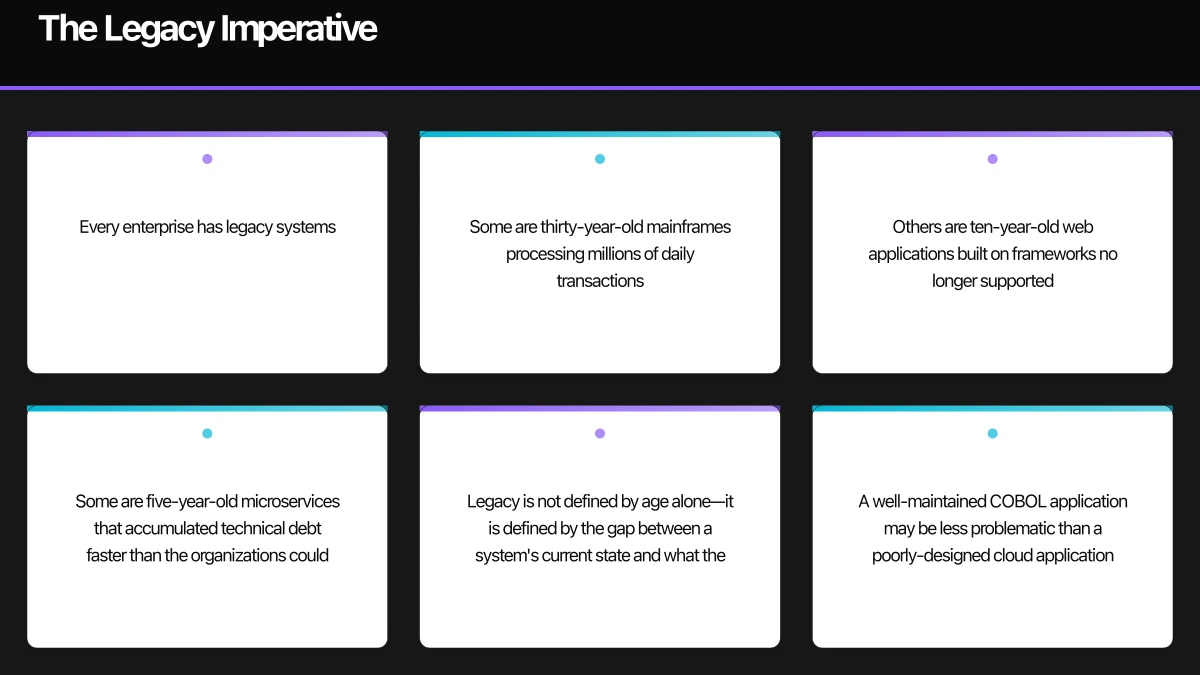
Every enterprise has legacy systems. Some are thirty-year-old mainframes processing millions of daily transactions. Others are ten-year-old web applications built on frameworks no longer supported. Some are five-year-old microservices that accumulated technical debt faster than the organizations could address it.
Legacy is not defined by age alone—it is defined by the gap between a system’s current state and what the business needs. A well-maintained COBOL application may be less problematic than a poorly-designed cloud application. Legacy emerges when systems cannot adapt to business requirements, when they become bottlenecks for change, when they accumulate operational risk, or when the skills to maintain them become scarce.
According to Deloitte’s 2023 Technology Leadership Survey, 78% of enterprises identify legacy modernization as a top-three technology priority. Yet the same survey reveals that 62% of modernization initiatives fail to deliver expected outcomes. The challenge is not recognizing the need—it is executing modernization successfully.
This analysis provides strategic guidance for CTOs leading legacy modernization, drawing on patterns from successful transformations and lessons from initiatives that struggled.
Understanding Your Legacy Estate
The Portfolio Perspective
Legacy modernization is not a single initiative—it is portfolio management. Every enterprise application portfolio contains:
Strategic systems: High business value, high change requirements. These deserve significant modernization investment. Modern architecture enables business agility.
Factory systems: High business value, low change requirements. These need reliability and maintenance, not modernization. Investment should focus on operational stability.
Support systems: Lower business value, varied change requirements. Candidates for rationalization—retire, replace with SaaS, or minimal investment maintenance.
Legacy debt: Systems that consume disproportionate maintenance resources relative to business value. Prime candidates for retirement or replacement.
Before launching modernization initiatives, assess the entire portfolio. Understand where systems fall in this matrix. Prioritize accordingly.
Technical Debt Taxonomy
Technical debt manifests in multiple forms:
Architectural debt: Monolithic designs that impede independent scaling and deployment. Tight coupling that propagates changes across systems. Hard-coded configurations that prevent environment flexibility.
Code debt: Poor code quality, inadequate testing, missing documentation. Duplicated logic, inconsistent patterns, outdated libraries. The accumulated result of “we’ll fix it later” decisions.
Infrastructure debt: Manual provisioning, inconsistent environments, inadequate monitoring. On-premises infrastructure when cloud would provide benefits. Unsupported operating systems and platforms.
Data debt: Inconsistent schemas, missing data quality, undocumented semantics. Redundant data stores, broken lineage, governance gaps.
Knowledge debt: Tribal knowledge in departing employees’ heads. Missing documentation, unclear business rules, archaeological layers of past modifications.
Different debt types require different remediation approaches. An honest debt inventory—uncomfortable as it may be—is essential for effective modernization planning.
Risk Assessment
Legacy systems create multiple risk categories:
Operational risk: System failures, performance degradation, security vulnerabilities. The probability and impact of incidents.
Compliance risk: Inability to meet regulatory requirements. Audit findings, potential penalties, business restrictions.
Business agility risk: Inability to implement business changes at required velocity. Competitive disadvantage from technology constraints.
Talent risk: Declining availability of skills to maintain legacy platforms. Key person dependencies for critical knowledge.
Vendor risk: End-of-life platforms, declining vendor support, licensing changes.
Quantify these risks where possible. Executive sponsorship for modernization often requires translating technical debt into business risk terms.
Modernization Strategies
The 6 Rs Applied to Legacy
The cloud migration “6 Rs” framework applies to legacy modernization:
Retain: Keep the system as-is. Valid for stable systems with low change requirements and manageable risk. Accept ongoing maintenance cost.
Retire: Decommission the system. Valid when business processes no longer need the functionality, or when functionality has been consolidated elsewhere.
Rehost: Move to modern infrastructure without application changes. Lift-and-shift to cloud or containers. Addresses infrastructure debt without touching application debt.
Replatform: Limited modifications to leverage modern platforms. Database migration to managed services, containerization with minimal code changes. Moderate modernization with moderate investment.
Refactor: Significant restructuring while preserving core functionality. Break monoliths into services, modernize code, improve architecture. Substantial investment for substantial improvement.
Replace: Implement new solutions to replace legacy functionality. Build new, buy packaged, or adopt SaaS. Most invasive but sometimes most effective.
Selecting the Right Strategy
Match strategy to system characteristics:
| System Characteristic | Recommended Approach |
|---|---|
| High value, high change rate, core IP | Refactor or rebuild |
| High value, low change rate | Rehost/replatform, or retain |
| Low value, any characteristic | Retire or replace with SaaS |
| Commodity function | Replace with packaged/SaaS |
| Undocumented business logic | Preserve, don’t rebuild |
| Strong vendor support available | Replace with package |
Avoid the trap of applying one strategy universally. Different systems warrant different approaches.
The Strangler Fig Pattern
For large, complex systems, the strangler fig pattern enables incremental modernization:
Concept: New functionality wraps and gradually replaces old functionality, like a strangler fig growing around a host tree.
Implementation:
- Identify a bounded context within the legacy system
- Build new implementation of that context
- Route traffic to new implementation
- Repeat for additional contexts
- Eventually retire the legacy system
Advantages:
- Incremental value delivery
- Reduced big-bang risk
- Learning incorporated into subsequent phases
- Maintains operational continuity
Considerations:
- Requires clean interfaces with legacy
- Extended coexistence of old and new
- Integration complexity during transition
The strangler fig pattern is particularly valuable for monolithic applications where complete replacement is too risky.
Event-Driven Decoupling
Event-driven architecture can decouple legacy systems without direct modification:
Change Data Capture (CDC): Capture database changes from legacy systems as events. Downstream services consume events without integration with legacy application code.
Event Sourcing Migration: New systems use event sourcing. Legacy events bridged through adapters. Enables gradual migration without tight coupling.
Anti-Corruption Layer: Translation layer between legacy and modern systems. Protects new systems from legacy data models and semantics.
These patterns enable modernization without invasive changes to legacy systems—valuable when legacy systems are fragile or poorly understood.
Mainframe Modernization
Mainframes deserve specific consideration—they remain the backbone of critical processes in financial services, insurance, healthcare, and government.
Mainframe Reality Check
Common misconceptions about mainframes:
“Mainframes are obsolete”: Modern mainframes are powerful, reliable platforms. The IBM z16, announced in 2023 and enhanced since, offers exceptional transaction processing, security, and AI capabilities.
“Mainframe talent doesn’t exist”: COBOL skills are indeed declining, but the talent market is not zero. Training programs, partnerships, and managed services provide options.
“Everything should move off mainframe”: Some workloads are genuinely well-suited to mainframe characteristics. Modernization should be driven by business requirements, not technology fashion.
Mainframe Modernization Approaches
Retain and modernize in place: Update COBOL code, implement CI/CD for mainframe, integrate with cloud services via APIs. Addresses some technical debt while preserving mainframe investment.
Rehost (emulation): Run mainframe workloads on x86/cloud using emulation technology. Micro Focus, LzLabs, and others provide platforms. Reduces hardware costs; doesn’t address application debt.
Refactor to modern languages: Automatic conversion of COBOL to Java or C#. Tools from various vendors. Produces functional but often unidiomatic code requiring subsequent cleanup.
Rewrite: Build new applications to replace mainframe functionality. Highest risk, highest potential benefit. Requires deep understanding of mainframe business logic.
Incremental decomposition: Strangler fig approach applied to mainframe. Extract functions incrementally, expose mainframe services via APIs, gradually shift functionality.
Most successful mainframe modernization programs use combinations of approaches—different strategies for different applications and different bounded contexts.
Organizational Dimensions
Skills and Capabilities
Modernization requires capabilities that legacy-focused organizations may lack:
Modern development practices: Agile methodologies, DevOps, CI/CD, test-driven development. Often unfamiliar to teams maintaining legacy systems.
Cloud and container expertise: Kubernetes, cloud services, infrastructure as code. New technology stacks require new skills.
Architecture skills: Microservices design, event-driven architecture, domain-driven design. Architectural patterns that differ from legacy approaches.
Product thinking: Product management for internal platforms, user experience design, iterative development. Different from project-based legacy maintenance.
Building these capabilities requires investment in training, hiring, and potentially partnering with organizations that have expertise.
Team Structure Evolution
Legacy maintenance typically operates in functional silos—database administrators, operations, development. Modernized systems benefit from different structures:
Product teams: Cross-functional teams owning specific business capabilities. Development, operations, and business expertise combined.
Platform teams: Teams providing shared capabilities (infrastructure, observability, security) as internal products for product teams.
Enabling teams: Teams that help other teams adopt new practices—coaching, consulting, hands-on assistance.
This transition is organizational change, not just technical change. It requires leadership commitment, cultural shift, and patience.
Managing the Transition
During modernization, organizations operate two worlds simultaneously:
Bimodal coexistence: Legacy systems continue operating while modern systems are built. Both require attention, resources, and coordination.
Integration complexity: Legacy and modern systems must interoperate during transition. Integration layer complexity can be substantial.
Resource competition: Modernization competes with maintenance and enhancement for limited resources. Prioritization is constant.
Timeline management: Modernization programs span years. Maintaining momentum, demonstrating value, and sustaining executive support through extended timelines is challenging.
Plan for these realities. Budget adequately. Set realistic expectations.
Implementation Approaches
Assessment and Planning
Before modernization execution:
Application portfolio assessment: Catalog applications with business value, technical condition, and change requirements. Tools like CAST, vFunction, or cloud provider migration assessment services can help.
Business process mapping: Understand the business processes that legacy systems support. Modernization must maintain or improve business capabilities.
Technical deep-dives: For high-priority systems, detailed technical assessment. Architecture, code quality, data dependencies, integration points.
Stakeholder alignment: Business and technology stakeholders must agree on priorities, timelines, and tradeoffs. Misalignment derails modernization programs.
Roadmap development: Multi-year modernization roadmap with dependencies, resource requirements, and milestones. Realistic timelines, not optimistic projections.
Execution Patterns
Successful modernization programs share common patterns:
Start with value, not complexity: Initial projects should demonstrate value quickly. Build credibility before tackling the hardest problems.
Measure progress: Define metrics for modernization success—deployment frequency, change lead time, defect rates, availability. Track and report.
Iterate and learn: Apply agile principles to modernization itself. Shorter cycles, frequent assessment, willingness to adjust approach.
Maintain operational excellence: Production systems must continue functioning. Operational incidents during modernization undermine confidence and consume resources.
Communicate constantly: Stakeholders need visibility into progress, challenges, and value delivery. Silence creates concern.
Managing Risk
Modernization carries inherent risk:
Technical risk: New technologies, new patterns, new integration points. Mitigate through proof of concepts, incremental implementation, and rollback capabilities.
Operational risk: Changes to production systems can cause incidents. Mitigate through thorough testing, canary deployments, and runbooks.
Business risk: Modernization might not deliver expected benefits. Mitigate through incremental value delivery and clear success metrics.
Resource risk: Key personnel leave, budgets are cut, priorities shift. Mitigate through documentation, knowledge sharing, and executive sponsorship.
Build risk awareness into modernization planning. Don’t ignore risks—manage them explicitly.
Measuring Modernization Success
Technical Metrics
Deployment frequency: How often can changes reach production? Modernization should enable faster deployment.
Lead time for changes: Time from commit to production. Should decrease as modernization progresses.
Change failure rate: Percentage of changes causing incidents. Should decrease or stay constant as velocity increases.
Mean time to recovery: How quickly are incidents resolved? Modern systems should recover faster.
Technical debt metrics: Code quality scores, security vulnerability counts, dependency currency. Should improve over time.
Business Metrics
Feature delivery velocity: Business features delivered per period. Modernization should enable faster feature development.
System availability: Uptime for business-critical systems. Should maintain or improve.
Operational costs: Total cost to run and maintain systems. May increase short-term, should improve long-term.
Business agility: Ability to respond to business changes. Harder to measure but ultimately most important.
Program Metrics
Modernization progress: Applications modernized, functionality migrated, technical debt reduced. Track against roadmap.
Budget and timeline: Variance from plan. Understand causes of variance.
Resource utilization: Capacity allocated to modernization vs. maintenance. Trending in right direction?
Stakeholder satisfaction: Are business stakeholders seeing value? Regular feedback collection.
Report metrics to executives regularly. Modernization programs need sustained support; visibility builds confidence.
Common Pitfalls
Patterns that undermine modernization success:
Big bang approaches: Attempting complete replacement in single effort. High risk, long time to value, frequent failure.
Underestimating complexity: Legacy systems accumulate business logic over decades. Understanding and replicating that logic takes longer than anticipated.
Neglecting data: Applications get attention; data architecture is neglected. Data problems persist into modernized systems.
Ignoring operations: Focus on building new systems without operational readiness. New systems that operators cannot manage effectively.
Losing business context: Technical modernization without understanding business value. Building elegant systems that don’t serve business needs.
Declaring victory prematurely: Initial success leads to reduced attention. Systems slip back into legacy patterns.
Learn from these patterns. Avoid the mistakes others have made.
Strategic Recommendations
For CTOs leading legacy modernization:
-
Take the portfolio view. Not every system needs modernization. Assess the entire portfolio, prioritize based on business value and risk, apply appropriate strategies.
-
Be honest about technical debt. Inventory debt across categories. Quantify where possible. Use business risk terms to communicate with executives.
-
Start with value, not complexity. Early wins build credibility and momentum. Tackle the hardest problems after establishing track record.
-
Invest in capabilities. Skills, tools, and practices for modern development are prerequisites for successful modernization. Build them deliberately.
-
Plan for the long term. Modernization programs span years. Set realistic timelines, maintain executive support, measure and communicate progress.
-
Balance modernization with maintenance. Legacy systems must continue operating during transformation. Resource both adequately.
-
Remember the business purpose. Technology modernization serves business objectives. Keep business outcomes central to planning and measurement.
Legacy modernization is among the most challenging initiatives technology leaders undertake. The organizations that succeed approach it systematically—with honest assessment, appropriate strategy selection, sustained investment, and relentless focus on business value.
For strategic guidance on enterprise architecture modernization and legacy transformation, connect with me to discuss approaches tailored to your organization’s specific context and portfolio.
Turning strategy into infrastructure? Cloud Geeks covers managed cloud, DevOps, and IT security for businesses putting digital plans into action.
I lead Ganda Tech Services, where we turn digital strategy into results through specialist cloud, web design, and mobile app teams across Sydney.
About the Author
Ashish Ganda is the founder of Ganda Tech Services, a Sydney-based technology consultancy specialising in cloud infrastructure, web development, and mobile app solutions for Australian businesses.
Digital Transformation Roadmap 2026
A 12-month framework for Australian SMBs ready to modernise — phases, tools, and milestones.