Enterprise API Monetization: A Strategic Guide to APIs as Products
APIs have evolved from technical integration mechanisms to strategic business assets. The most successful digital businesses treat APIs as products, building ecosystems of developers and partners who create value that would be impossible for the platform owner to build alone. For enterprise CTOs, understanding API monetization strategies has become essential as organizations explore new revenue streams and platform business models.
The opportunity is substantial. Salesforce generates over $7 billion annually from its platform ecosystem. Stripe’s API-first model has created a payments infrastructure powering millions of businesses. Twilio built a multi-billion dollar business making communications capabilities accessible through simple APIs. These examples demonstrate that APIs can be more than utility infrastructure; they can be the foundation of significant businesses.
Understanding API Business Models
API monetization takes multiple forms, from direct charging to indirect value creation. Selecting appropriate models requires understanding business objectives and market dynamics.
Direct Monetization Models
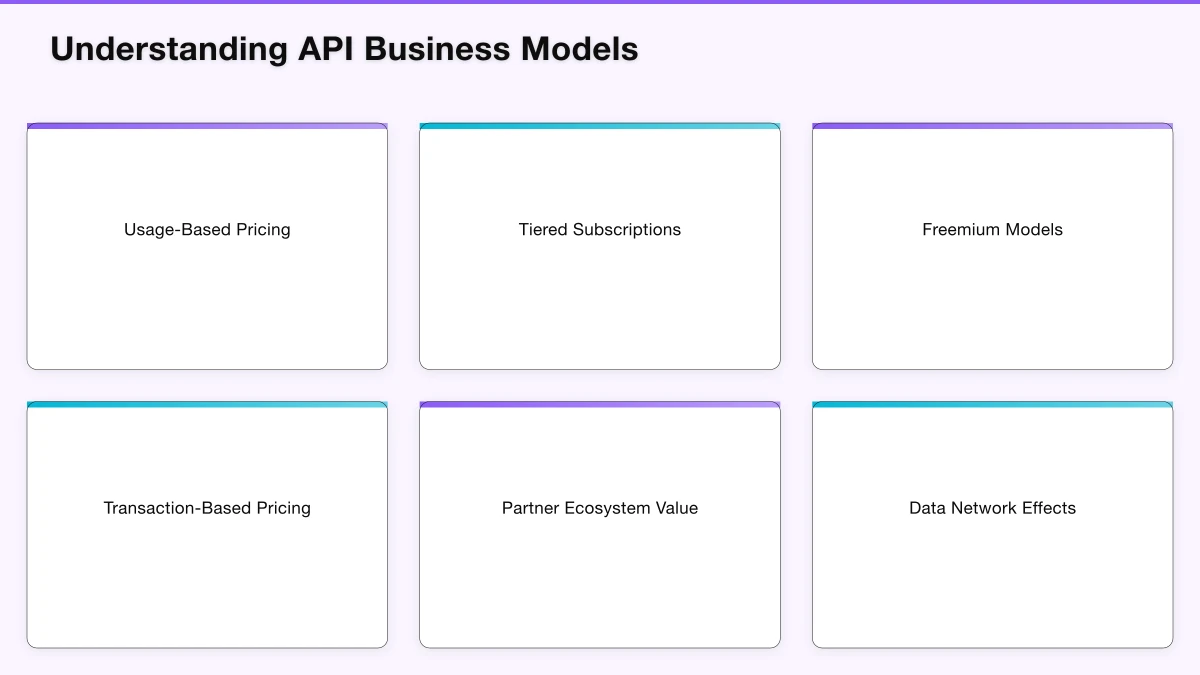
Usage-Based Pricing: Charging per API call, transaction, or resource consumption. This model aligns costs with value delivered and scales naturally with customer growth.
Twilio exemplifies usage-based pricing: pay per SMS sent, per voice minute, per video participant-minute. Customers start small, paying only for what they use, and costs grow proportionally with their success.
Tiered Subscriptions: Bundling API access into subscription tiers with varying limits, features, and support levels. This model provides revenue predictability while accommodating different customer segments.
Stripe offers graduated pricing: standard transaction fees for most customers, custom enterprise pricing for high-volume users, with premium features like advanced fraud detection available at higher tiers.
Freemium Models: Free tier for limited usage or features, paid tiers for higher volumes or advanced capabilities. This model reduces adoption friction while creating upgrade paths.
Google Maps Platform provides substantial free API access monthly, sufficient for many smaller applications, with usage-based fees above free tier limits. This approach enables widespread adoption while monetizing significant usage.
Transaction-Based Pricing: Taking a percentage of transaction value processed through the API. This model aligns API provider success directly with customer business success.
Payment APIs commonly use transaction-based pricing: Stripe charges a percentage plus fixed fee per transaction. The API provider benefits when customers process more payments.
Indirect Monetization Models
Partner Ecosystem Value: APIs enabling partners to extend platform capabilities, with value captured through core platform stickiness and marketplace fees rather than direct API charges.
Salesforce provides extensive APIs without direct charges, capturing value as partners build applications that make the core CRM more valuable, plus AppExchange marketplace commissions.
Data Network Effects: APIs generating data that improves core services. Each API interaction contributes data that enhances the platform for all users.
Google’s free Maps API usage generates location and navigation data improving core Maps products. The data value exceeds what direct API charges might generate.
Customer Acquisition: Free APIs attracting developers who bring their employers as customers. Developer advocacy creates enterprise sales opportunities.
AWS’s early strategy offered generous free tiers and developer-friendly APIs, knowing that developers would eventually bring enterprise workloads as their startups grew or they moved to larger organizations.
Differentiation and Lock-in: APIs creating switching costs. Customers integrating with proprietary APIs face migration costs that reduce churn.
Designing APIs as Products
Treating APIs as products requires product management discipline, not just technical implementation.
Product Management for APIs
Customer Discovery: Understanding who uses the API, what they’re building, and what problems they’re solving. API customers are developers, but developers serve diverse use cases requiring segmentation.
Value Proposition: Articulating why developers should choose this API over alternatives. Technical capability matters, but so do reliability, documentation quality, support, and ecosystem.
Roadmap Development: Planning API evolution based on customer needs, competitive dynamics, and strategic priorities. Balancing new capabilities against backward compatibility.
Success Metrics: Defining and tracking metrics indicating API product health: adoption, usage, retention, developer satisfaction, time-to-first-call, support burden.
API Product Lifecycle
Introduction: Launching new APIs with beta programs, early adopter engagement, and feedback incorporation. Setting expectations about stability and potential changes.
Growth: Scaling adoption through marketing, developer relations, documentation improvement, and capability expansion.
Maturity: Optimizing for reliability, efficiency, and customer success. Managing technical debt while maintaining backward compatibility.
Decline/Evolution: Deprecating outdated APIs gracefully, migrating customers to newer versions, maintaining legacy support commitments.
Versioning Strategy
API versioning decisions have long-term business implications:
Breaking Changes: Minimize breaking changes requiring customer code modifications. Each breaking change creates migration burden and potential customer loss.
Deprecation Policies: Clear timelines for API version retirement. Sufficient notice for customers to plan migrations.
Parallel Operation: Running multiple API versions simultaneously during transition periods. Balancing maintenance burden against customer convenience.
Developer Experience as Competitive Advantage
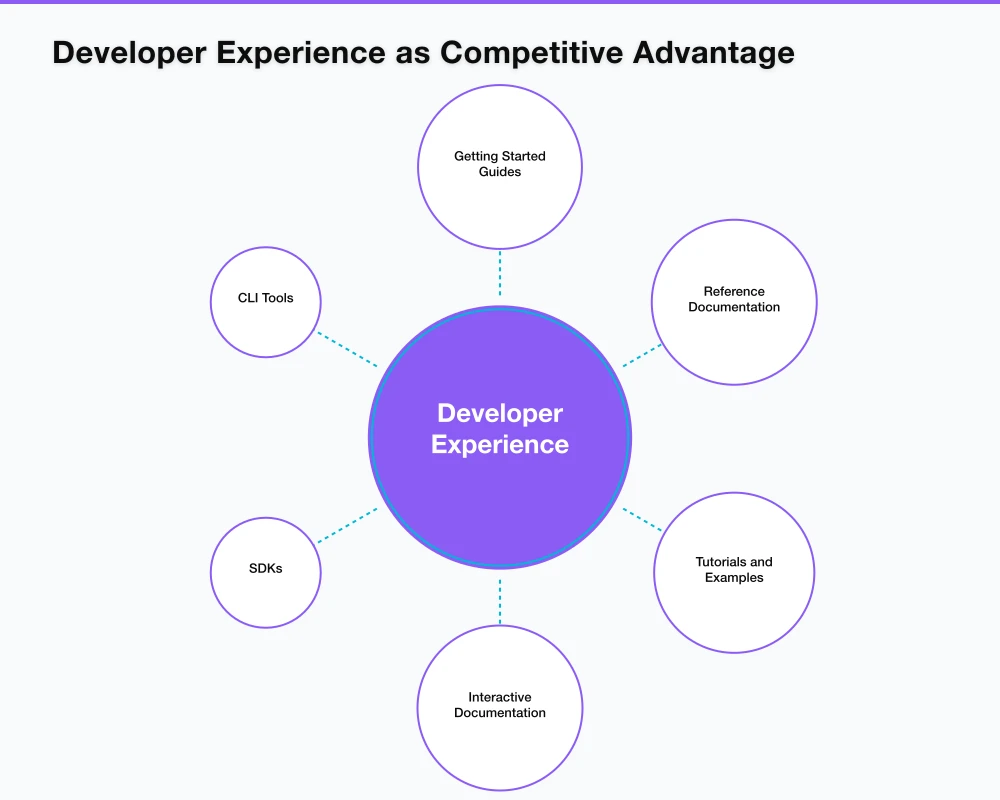
Developer experience differentiates API products. Developers choose APIs they enjoy using over technically equivalent alternatives.
Documentation Excellence
Getting Started Guides: Enabling developers to make first API call within minutes. Reducing time-to-value minimizes abandonment.
Reference Documentation: Complete, accurate, searchable API reference. Auto-generated from code ensures accuracy.
Tutorials and Examples: Step-by-step guides for common use cases. Code examples in multiple languages developers actually use.
Interactive Documentation: Try-it-now functionality enabling experimentation without local setup.
Developer Tooling
SDKs: Client libraries in popular languages reducing boilerplate and handling common concerns (authentication, error handling, pagination).
CLI Tools: Command-line interfaces for exploration and automation.
Testing Environments: Sandbox environments for safe experimentation without production impact or cost.
Debugging Tools: Request/response logging, error explanations, diagnostic endpoints.
Developer Support
Community Forums: Developer-to-developer support reducing direct support burden while building community.
Stack Overflow Presence: Monitoring and answering questions where developers naturally ask them.
Direct Support Channels: Premium support for paying customers with response time commitments.
Developer Relations: Advocates engaging developer community through content, events, and direct outreach.
Onboarding Optimization
The path from API discovery to first successful call determines adoption:
- Discovery: Developer finds API through search, recommendation, or marketing
- Evaluation: Developer assesses API fit for their needs through documentation review
- Registration: Creating account, obtaining credentials (minimize friction)
- First Call: Making initial successful API request (optimize for speed)
- Integration: Building actual functionality using the API
- Production: Deploying application using the API
- Expansion: Growing usage and adopting additional API capabilities
Each stage presents abandonment risk. Analytics tracking funnel progression identify improvement opportunities.
Pricing Strategy
API pricing significantly impacts adoption, revenue, and competitive positioning.
Pricing Principles
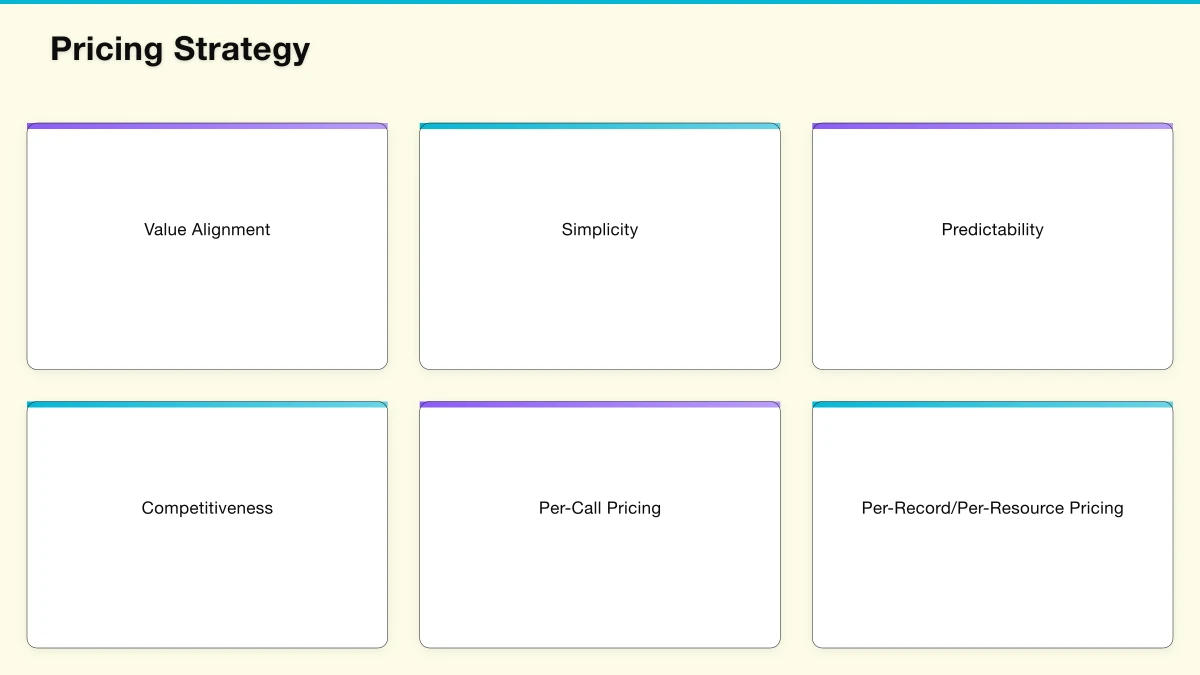
Value Alignment: Pricing should correlate with value delivered. Metrics customers understand and can predict enable budgeting and trust.
Simplicity: Complex pricing creates evaluation friction and surprise bills. Simple models enable faster adoption decisions.
Predictability: Customers need to forecast costs. Usage caps, spending alerts, and clear pricing help customers maintain control.
Competitiveness: Pricing must be defensible against alternatives including build-it-yourself, open-source, and competing commercial APIs.
Common Pricing Models
Per-Call Pricing: Simple but may not reflect value. A call returning one record costs the same as one returning thousands.
Per-Record/Per-Resource Pricing: Better value alignment for data APIs. Charges scale with data volume returned.
Per-Compute-Unit Pricing: For compute-intensive APIs, pricing by resource consumption (CPU, memory, time) reflects actual costs.
Outcome-Based Pricing: Charging for successful outcomes rather than attempts. Payment APIs might charge per successful transaction rather than per API call.
Free Tier Design
Free tiers drive adoption but require careful design:
Sufficient Value: Free tier must enable meaningful use. Restrictive free tiers fail to demonstrate API value.
Clear Upgrade Path: Obvious progression to paid tiers when needs exceed free limits.
Cost Control: Free tier usage must be sustainable. Rate limits, feature restrictions, and authentication requirements prevent abuse.
Conversion Optimization: Understanding what triggers free-to-paid conversion and optimizing for those behaviors.
Building API Ecosystems
Beyond individual API products, ecosystem development creates compounding value.
Partner Programs
Technology Partners: Integrations with complementary products expanding API reach.
Solution Partners: Consultancies and agencies building on the API, expanding implementation capacity.
Reseller Partners: Organizations selling API access to their customer base.
Partner programs require investment: enablement resources, technical support, commercial terms, and relationship management.
Marketplace Development
API marketplaces aggregate related APIs, simplifying discovery and integration:
Internal Marketplaces: Exposing organizational APIs to internal developers, enabling reuse and self-service.
External Marketplaces: Third-party marketplaces like RapidAPI aggregate APIs from multiple providers, providing distribution reach.
Platform Marketplaces: Platform-specific marketplaces (Salesforce AppExchange, Shopify App Store) reach customers within specific ecosystems.
Community Building
Developer communities create value beyond direct support:
Knowledge Sharing: Community members answer questions, reducing support burden.
Content Creation: Community-created tutorials, examples, and integrations expand API reach.
Feedback Loops: Engaged communities provide product feedback and feature prioritization input.
Hiring Pipeline: Community engagement identifies potential employees passionate about the technology.
Technical Foundations
Monetization requires technical infrastructure supporting business models.
Metering and Billing
Usage Tracking: Accurate, granular tracking of API consumption across all dimensions relevant to pricing.
Aggregation: Combining usage across billing periods, accounts, and products.
Invoice Generation: Producing clear, auditable invoices customers can understand and reconcile.
Payment Processing: Handling diverse payment methods, currencies, and payment terms.
Build-versus-buy tradeoffs apply: purpose-built billing platforms (Stripe Billing, Chargebee) provide sophistication that custom development struggles to match.
Rate Limiting and Quotas
Enforcement: Implementing limits corresponding to customer tiers and free tier restrictions.
Graceful Degradation: Returning clear error responses when limits are exceeded rather than failing mysteriously.
Burst Handling: Accommodating short-term spikes without strict per-second enforcement.
Upgrades: Enabling self-service limit increases for customers hitting limits.
Authentication and Access Control
API Keys: Simple authentication suitable for server-side use. Must be kept secret and rotatable.
OAuth 2.0: Standard authorization for user-delegated access. Required when APIs access user data.
JWT Tokens: Stateless authentication enabling scaling without centralized session storage.
Access Tiers: Restricting API features and capabilities based on subscription level.
Measuring API Product Success
Metrics guide API product management decisions.
Adoption Metrics
New Registrations: Rate of new API consumer signups.
Time to First Call: Duration from registration to first successful API call.
Activation Rate: Percentage of registrations making meaningful API usage.
Active Users: Consumers making API calls within measurement period.
Usage Metrics
Call Volume: Total API calls over time, by endpoint, by customer.
Error Rates: Failed calls as percentage of total, by error type.
Latency: Response time distributions and trends.
Data Volume: Records returned, data transferred.
Business Metrics
Revenue: Direct API revenue by customer, product, time period.
Customer Acquisition Cost: Marketing and sales expense per new paying customer.
Lifetime Value: Total revenue expected from average customer.
Churn Rate: Percentage of customers stopping API usage.
Quality Metrics
Availability: Uptime percentage against SLA commitments.
Developer Satisfaction: NPS, survey responses, support sentiment.
Documentation Coverage: Percentage of API surface with documentation.
Support Metrics: Ticket volume, resolution time, self-service success rate.
Common Challenges
API monetization presents recurring challenges:
Pricing Right
Setting prices too high inhibits adoption. Prices too low leave revenue on the table or attract wrong customers. Continuous experimentation and market feedback inform pricing evolution.
Scaling Developer Support
Growing API adoption creates support demand that doesn’t scale linearly with revenue. Investment in self-service, documentation, and community shifts support burden.
Maintaining Quality at Scale
Early-stage APIs can provide high-touch support and fast iteration. Scale demands operational maturity: monitoring, incident response, change management, backward compatibility discipline.
Competitive Response
Success attracts competition. Open-source alternatives, cloud provider offerings, and well-funded startups may target successful API products. Sustainable differentiation requires continuous investment.
Internal Competition
Organizations may struggle prioritizing external API products against internal integration needs. Clear API product ownership and P&L accountability help maintain focus.
Case Studies in API Monetization
Stripe: Developer Experience as Moat
Stripe built a payment processing business by making API integration dramatically simpler than incumbents. Beautiful documentation, excellent SDKs, and developer-focused design created word-of-mouth growth. Transaction-based pricing aligned Stripe’s success with customer success. The result: a platform processing hundreds of billions in payments annually.
Twilio: Communications API Platform
Twilio made telecommunications capabilities accessible through simple APIs. Usage-based pricing starting at fractions of cents per message enabled experimentation. Developer relations investment built community advocacy. The model scaled from startups to enterprises, with 300,000+ customer accounts.
Plaid: Financial Data API
Plaid connected applications to financial accounts through APIs, enabling fintech innovation. Usage-based pricing scaled with customer success. Strategic acquisitions expanded data coverage. The API product became critical infrastructure for financial services innovation.
Strategic Recommendations
For enterprise CTOs exploring API monetization:
Start with Value: Identify unique capabilities or data that external developers would pay to access. Not every internal API is a product opportunity.
Invest in Experience: Developer experience investment delivers outsized returns through adoption and retention.
Choose Business Model Carefully: Model selection affects customer perception, competitive positioning, and growth dynamics. Changing models later is difficult.
Build for Scale: Technical foundations (metering, billing, rate limiting) are difficult to retrofit. Design for scale from the start.
Think Ecosystem: Individual API products may have limited value. Ecosystem effects create defensible positions.
Measure Relentlessly: API products require different metrics than traditional software. Build measurement capability early.
Conclusion
API monetization represents a significant opportunity for enterprises with valuable capabilities or data. Successful execution requires treating APIs as products deserving product management discipline, developer experience investment, and business model sophistication.
The market for API products continues expanding as digital transformation drives integration needs. Organizations that master API productization will capture new revenue streams while building ecosystem positions that compound value over time.
References and Further Reading
- Jacobson, D., Brail, G., & Woods, D. (2012). “APIs: A Strategy Guide.” O’Reilly Media.
- Higginbotham, J. (2021). “Principles of Web API Design.” Addison-Wesley.
- Postman. (2025). “State of the API Report.” Postman.
- RapidAPI. (2025). “API Marketplace Trends.” RapidAPI.
- Gartner. (2025). “Market Guide for Full Life Cycle API Management.” Gartner Research.
- McKinsey & Company. (2024). “The Rise of API-First Business Models.” McKinsey Digital.
Thinking about adding mobile to your digital strategy? Awesome Apps covers app development, Flutter, React Native, and ASO for Australian businesses.
These insights are drawn from my work leading Ganda Tech Services — helping Australian businesses navigate digital transformation through cloud, web, and mobile.
About the Author
Ashish Ganda is the founder of Ganda Tech Services, a Sydney-based technology consultancy specialising in cloud infrastructure, web development, and mobile app solutions for Australian businesses.
Tech Stack Selection Guide 2026
Choose the right tools for your Australian business — without the vendor hype or overlapping spend.
Almost done
Check your inbox and click the confirmation link to get your download.