Digital Twin Technology: Enterprise Applications Beyond Manufacturing
Digital twin technology — the creation of a virtual representation of a physical entity that is continuously updated with real-world data — has its roots in manufacturing and aerospace. NASA used primitive digital twin concepts for space mission planning as early as the Apollo programme. Modern digital twins, enabled by IoT sensors, cloud computing, and advanced analytics, have become transformative tools for manufacturing organisations seeking to optimise production processes, predict equipment failures, and simulate operational changes.
But the concept’s applicability extends far beyond the factory floor. Any domain where physical assets or processes can be instrumented, modelled, and analysed stands to benefit from digital twin approaches. Supply chains, commercial buildings, urban infrastructure, healthcare facilities, energy grids, and retail environments are all emerging domains for enterprise digital twin adoption.
For the CTO, digital twins represent a convergence of several technology investments — IoT infrastructure, data platforms, analytics capabilities, and visualisation tools — into a coherent value proposition. The strategic question is where in the enterprise a digital twin approach will deliver the most significant return, and what technology architecture is needed to support it.
Architecture of a Digital Twin
A digital twin architecture consists of several interconnected layers that together create and maintain the virtual representation.
The physical layer encompasses the sensors, actuators, and instrumentation that capture data from the physical entity. For a building, this includes HVAC sensors, occupancy sensors, energy meters, and environmental monitors. For a supply chain, this includes GPS trackers, RFID readers, temperature sensors in cold chain logistics, and inventory scanning systems. The physical layer’s completeness determines the twin’s fidelity — aspects of the physical entity that are not instrumented cannot be represented in the twin.
The connectivity layer transports data from the physical layer to the digital platform. IoT protocols (MQTT, CoAP, AMQP), edge gateways that aggregate and pre-process sensor data, and network infrastructure (cellular, WiFi, LPWAN for low-power wide-area connectivity) provide the transport. For enterprise deployments, the connectivity layer must handle intermittent connectivity, secure data in transit, and support the data volumes generated by the instrumented environment.
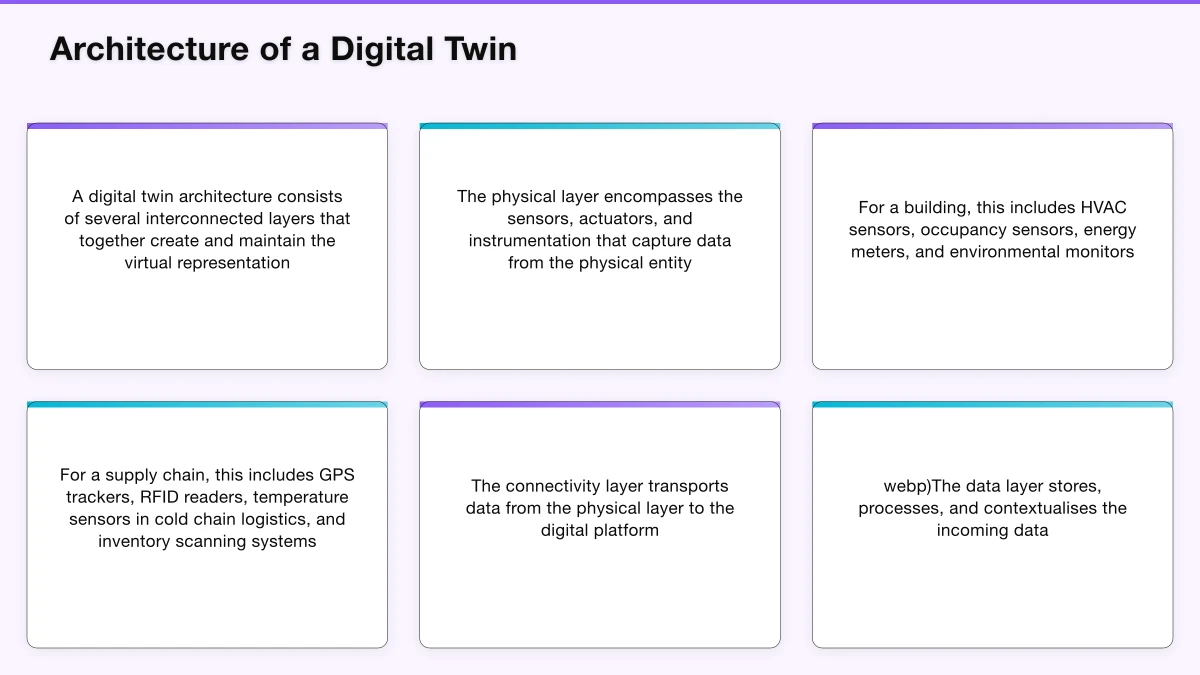
The data layer stores, processes, and contextualises the incoming data. Time-series databases (InfluxDB, TimescaleDB) store sensor readings efficiently. Event processing platforms (Apache Kafka, Azure Event Hubs) handle real-time data streams. Data lakes store historical data for training analytical models. The data layer must support both real-time queries (what is the current state of the physical entity?) and historical analysis (how has the entity behaved over time?).
The modelling layer creates the virtual representation. This ranges from simple state models (a dashboard showing current sensor readings mapped to a visual representation of the physical entity) to physics-based simulation models (computational fluid dynamics for airflow in a building, structural analysis for a bridge) to machine learning models (predictive maintenance algorithms trained on historical failure patterns). The modelling layer is where the twin’s analytical value is created, and it typically evolves in sophistication as the organisation gains experience with the technology.
The interaction layer provides the interfaces through which users and systems interact with the twin. 3D visualisation platforms (Unity, Unreal Engine, dedicated digital twin platforms like Azure Digital Twins or AWS IoT TwinMaker) provide immersive views of the physical entity’s state. Dashboard interfaces provide operational monitoring. API interfaces enable integration with other enterprise systems — a supply chain digital twin might feed demand predictions to the ERP system, or a building twin might adjust HVAC setpoints based on predicted occupancy.
Enterprise Applications
The applicability of digital twins across enterprise domains is expanding rapidly as the enabling technologies mature.
Supply chain digital twins model the end-to-end flow of goods from raw materials through manufacturing, distribution, and delivery. By integrating data from suppliers, logistics providers, warehouses, and retail locations, a supply chain twin provides visibility into current inventory positions, in-transit goods, and predicted delivery timelines. More importantly, it enables simulation: what happens to delivery timelines if a port is disrupted? How should inventory be redistributed if demand shifts between regions? The supply chain disruptions of 2020 and 2021 have elevated the strategic importance of this visibility and simulation capability.
Building and facilities digital twins model commercial real estate portfolios, integrating data from building management systems, occupancy sensors, and energy systems. Applications include energy optimisation (adjusting HVAC based on predicted occupancy and weather forecasts), space utilisation analysis (understanding how office space is actually used to inform real estate decisions), and predictive maintenance for building systems. With the workplace transformation driven by remote and hybrid work, understanding how physical spaces are used has become a pressing business question.
Healthcare facility digital twins model hospital operations — patient flow, resource utilisation, staffing requirements, and equipment availability. By simulating operational scenarios, healthcare administrators can optimise bed allocation, staffing schedules, and equipment maintenance. The pandemic has accelerated interest in this application, as healthcare systems seek to improve their ability to manage capacity during surges.
Infrastructure digital twins model urban and industrial infrastructure — bridges, roads, water systems, power grids — to monitor structural health, predict maintenance needs, and simulate the impact of environmental events. Governments and utilities are investing in these capabilities to manage aging infrastructure more effectively and to improve resilience against climate-related events.
Implementation Strategy
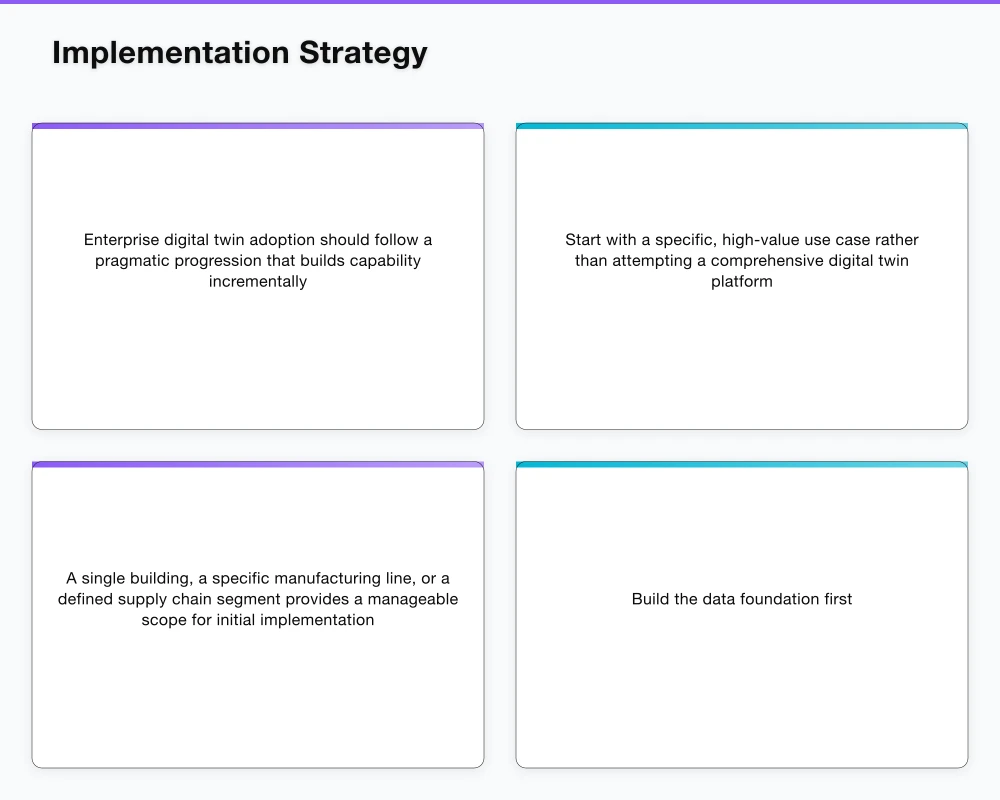
Enterprise digital twin adoption should follow a pragmatic progression that builds capability incrementally.
Start with a specific, high-value use case rather than attempting a comprehensive digital twin platform. Select a physical domain where instrumentation is feasible, where data is available or can be generated, and where the analytical value proposition is clear. A single building, a specific manufacturing line, or a defined supply chain segment provides a manageable scope for initial implementation.
Build the data foundation first. Before investing in sophisticated modelling and visualisation, ensure that sensor data is flowing reliably, stored appropriately, and accessible for analysis. Many digital twin initiatives stall because the data foundation is not solid — sensors are unreliable, data pipelines are fragile, or historical data is insufficient for model training.
Iterate on model sophistication. Start with a simple state model that provides real-time visibility, then add historical analysis, then predictive capabilities, then simulation. Each iteration delivers value while building the data and modelling foundations for the next.
Evaluate platform options carefully. Azure Digital Twins, AWS IoT TwinMaker, and specialist platforms like Bentley iTwin (for infrastructure) and Siemens MindSphere (for industrial) provide varying levels of pre-built capability. The choice depends on the domain, the existing cloud investment, and the required modelling sophistication. For organisations with strong engineering capability, building on open-source components provides flexibility at the cost of development effort.
Digital twin technology is reaching an inflection point where the enabling technologies are mature enough, and the business drivers are strong enough, to justify enterprise investment beyond traditional manufacturing applications. The CTO who identifies the right initial use case and builds the enabling architecture is positioning the organisation to leverage this technology as it matures and expands across enterprise domains.
Need to turn digital strategy into a web presence? Cosmos Web Tech covers website design, SEO, and e-commerce for Australian SMBs.
These insights are drawn from my work leading Ganda Tech Services — helping Australian businesses navigate digital transformation through cloud, web, and mobile.
About the Author
Ashish Ganda is the founder of Ganda Tech Services, a Sydney-based technology consultancy specialising in cloud infrastructure, web development, and mobile app solutions for Australian businesses.
Digital Transformation Roadmap 2026
A 12-month framework for Australian SMBs ready to modernise — phases, tools, and milestones.
Almost done
Check your inbox and click the confirmation link to get your download.