Edge Computing Strategy for Enterprise IoT Deployments
The premise of cloud computing — centralise compute in hyperscale data centres and access it over the network — has transformed enterprise technology. But this model has inherent limitations for workloads that require low latency, must operate with intermittent connectivity, generate data volumes that are uneconomical to transport, or must comply with data sovereignty requirements that prohibit cross-border data transfer.
Edge computing addresses these limitations by placing compute, storage, and intelligence at or near the point of data generation. For enterprise IoT deployments — manufacturing floors, retail locations, logistics networks, energy grids, and connected vehicle fleets — edge computing is not an alternative to cloud but a necessary complement. The architecture becomes a continuum from device to edge to cloud, with workloads placed at the tier that best serves their requirements.
The enterprise IoT market continues its rapid expansion. IDC projects that by 2025, there will be 41.6 billion connected IoT devices generating 79.4 zettabytes of data. The overwhelming majority of that data will need to be processed at or near its point of origin — the network bandwidth, latency, and cost economics of transporting it all to the cloud simply do not work. For CTOs with IoT-dependent business strategies, edge computing architecture is becoming a critical planning priority.
Architecture Patterns for Enterprise Edge
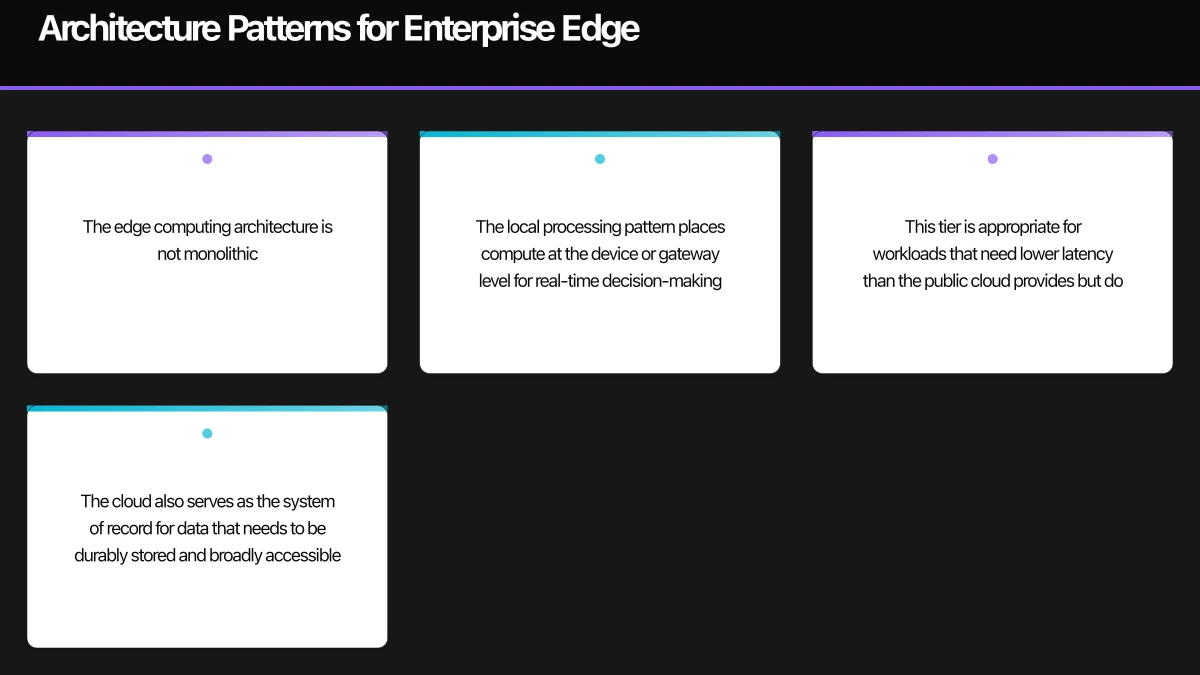
The edge computing architecture is not monolithic. Different deployment scenarios demand different architectural approaches, and most enterprise IoT deployments will employ multiple patterns simultaneously.
The local processing pattern places compute at the device or gateway level for real-time decision-making. In manufacturing, this means anomaly detection algorithms running on the production line, identifying quality issues within milliseconds and triggering corrective action before defective products progress further. In autonomous systems, this means perception and decision-making happening on-device with the sub-millisecond latency that safety-critical applications demand. The compute at this tier is constrained — limited power, thermal envelope, and physical space — requiring models and algorithms optimised for edge deployment.
The edge aggregation pattern places more substantial compute at a facility-level edge node — a server or cluster deployed in a factory, warehouse, distribution centre, or retail location. This tier aggregates data from multiple devices, performs local analytics, stores data for local access, and selectively forwards processed results or significant events to the cloud. The edge node is the primary data processing point for facility-level intelligence, and it must operate autonomously during cloud connectivity disruptions.
The regional edge pattern leverages compute capacity positioned between the facility and the public cloud — in telco points of presence, colocation facilities, or cloud provider edge locations. AWS Outposts, Azure Stack Edge, and Google Distributed Cloud Hosted represent the cloud providers’ offerings in this space, while telco operators are positioning 5G edge computing as a platform for enterprise workloads. This tier is appropriate for workloads that need lower latency than the public cloud provides but do not need to be at the facility level.
The cloud tier continues to serve workloads that benefit from centralised processing — training machine learning models on aggregated data from multiple edge locations, running enterprise-wide analytics, and providing centralised management and orchestration of the edge infrastructure. The cloud also serves as the system of record for data that needs to be durably stored and broadly accessible.
Data Architecture at the Edge
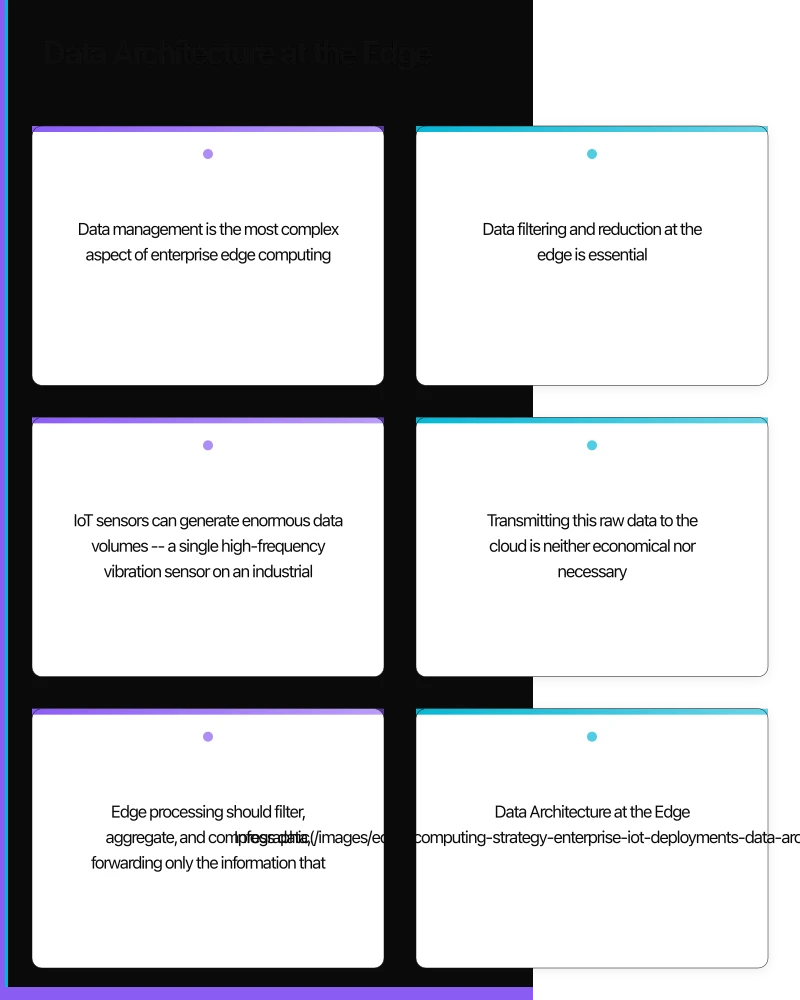
Data management is the most complex aspect of enterprise edge computing. The distributed nature of edge deployments creates challenges in data consistency, movement, governance, and lifecycle management that do not exist in cloud-centric architectures.
Data filtering and reduction at the edge is essential. IoT sensors can generate enormous data volumes — a single high-frequency vibration sensor on an industrial motor can produce gigabytes per day. Transmitting this raw data to the cloud is neither economical nor necessary. Edge processing should filter, aggregate, and compress data, forwarding only the information that has value for cloud-level analytics and storage. Defining what constitutes valuable data — and what can be discarded after local processing — requires close collaboration between data engineering and domain expertise.
Data sovereignty and privacy requirements increasingly dictate where data can be processed and stored. The European Union’s GDPR, Australia’s Privacy Act, and similar regulations around the world impose constraints on cross-border data transfer. Edge computing provides a mechanism for processing sensitive data locally and forwarding only anonymised or aggregated results. This is particularly relevant for IoT deployments in healthcare, retail (where customer tracking data is generated), and any context involving personal information.
Edge-to-cloud data synchronisation must handle intermittent connectivity gracefully. The edge node may lose cloud connectivity due to network disruptions, and the architecture must ensure that data is not lost during disconnected periods and that synchronisation resumes correctly when connectivity is restored. This requires local buffering with appropriate retention policies, idempotent data upload mechanisms, and conflict resolution strategies for any data that can be modified at both edge and cloud tiers.
Data lifecycle management across the edge-cloud continuum requires policies that govern retention at each tier. Raw sensor data might be retained at the edge for 24 hours (for local troubleshooting), aggregated metrics forwarded to the cloud and retained for 13 months (for trend analysis), and significant events retained in the cloud indefinitely (for compliance). These policies must be automated and consistently enforced across potentially thousands of edge locations.
Operational Governance at Scale
Operating thousands of edge nodes across geographically distributed locations is a fundamentally different challenge from operating a cloud environment. The operational model must address provisioning, monitoring, updating, and securing edge infrastructure without the assumption of reliable network connectivity or local technical staff.
Fleet management — the ability to manage edge nodes as a fleet rather than individually — is essential. Cloud providers offer fleet management capabilities (AWS IoT Greengrass, Azure IoT Edge, Google Cloud IoT), and specialised platforms like Balena and SUSE Edge provide similar functionality for self-managed deployments. Fleet management encompasses automated provisioning, remote configuration, software updates, health monitoring, and decommissioning.
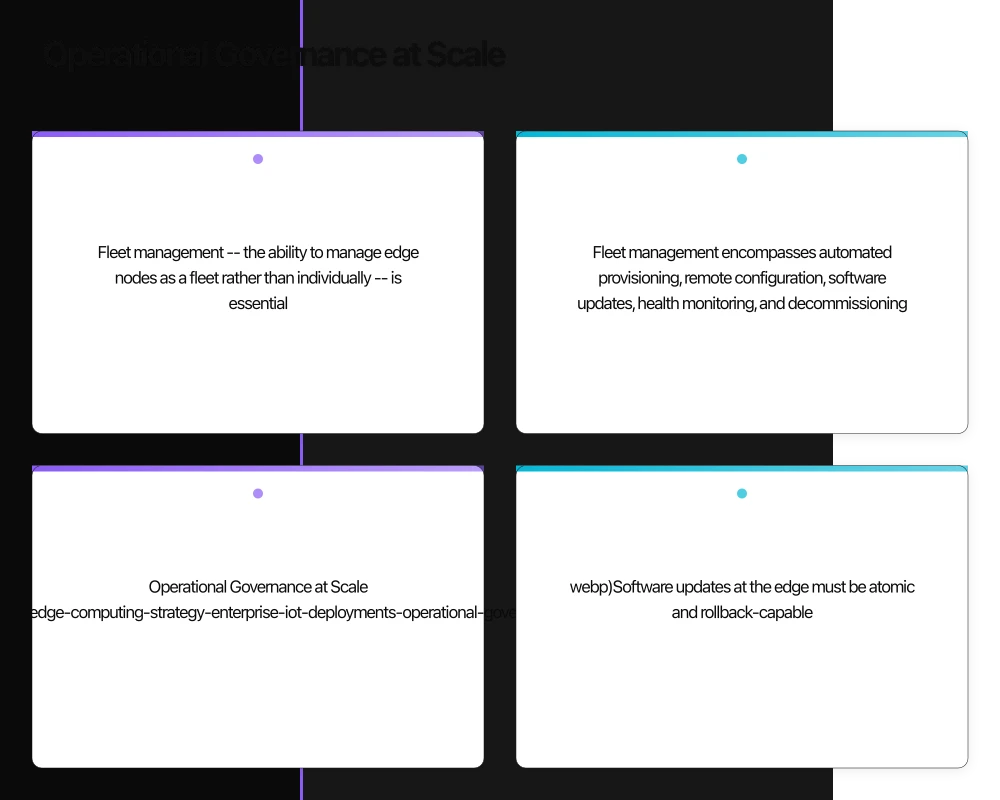
Software updates at the edge must be atomic and rollback-capable. A failed update to an edge node in a remote location can be catastrophic if it renders the node inoperable and there is no local staff to intervene. Over-the-air (OTA) update mechanisms must download updates while continuing to run the current version, verify integrity before applying, apply atomically (either completely or not at all), validate the new version post-update, and automatically rollback if validation fails.
Security at the edge introduces challenges beyond those of cloud-hosted systems. Edge nodes are physically accessible, creating risks of tampering. They may operate in environments without physical security controls. Hardware security modules (HSMs) or trusted platform modules (TPMs) provide hardware-rooted device identity and secure key storage. Secure boot ensures that only authorised software runs on the device. Network segmentation isolates edge nodes from broader facility networks. Certificate-based mutual TLS authenticates communication between edge nodes and cloud services.
Monitoring edge infrastructure requires accommodating intermittent connectivity. Edge nodes should cache monitoring data locally and forward it when connectivity is available. Cloud-based monitoring dashboards must distinguish between nodes that are offline (normal for some deployments) and nodes that are unhealthy. Alerting thresholds must account for the communication patterns inherent in edge deployments — a node that has not reported in five minutes might be normal for a battery-powered sensor but alarming for a facility-level compute node.
Strategic Planning for Edge Investment
Edge computing is a significant infrastructure investment, and CTOs must approach it with the same rigour applied to any major technology programme.
The business case must identify the specific workloads that benefit from edge processing and quantify the value. Latency reduction for time-sensitive processes, bandwidth cost savings from local data reduction, compliance enablement for data sovereignty requirements, and resilience improvement from autonomous local operation are the primary value drivers.
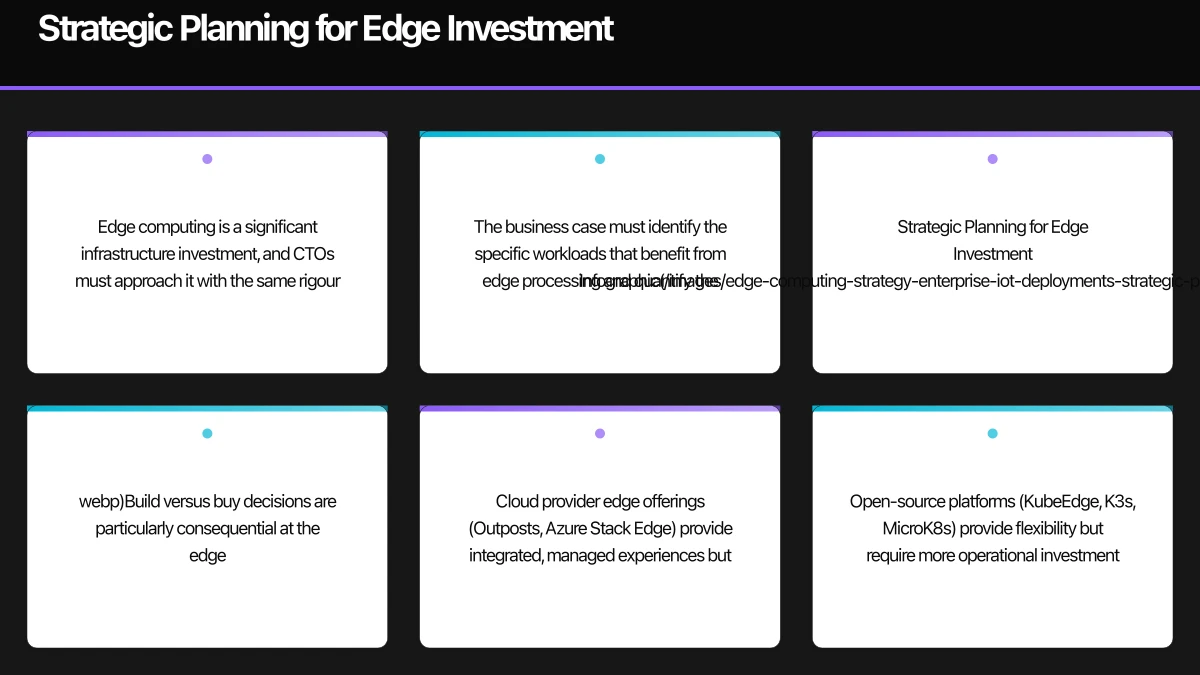
Build versus buy decisions are particularly consequential at the edge. Cloud provider edge offerings (Outposts, Azure Stack Edge) provide integrated, managed experiences but with vendor lock-in implications. Open-source platforms (KubeEdge, K3s, MicroK8s) provide flexibility but require more operational investment. Hardware selection — ruggedised for harsh environments, GPU-equipped for AI inference, compact for space-constrained locations — must match deployment conditions.
Phased deployment starting with a pilot location, expanding to a region, and then scaling to the full fleet allows the organisation to learn and refine its approach before committing to large-scale deployment. Each phase should have defined success criteria that validate both the technical architecture and the operational model.
The convergence of IoT proliferation, 5G network deployment, and maturing edge platforms is making edge computing increasingly accessible and capable. For enterprises with IoT-dependent strategies, the question is not whether edge computing is needed but how to deploy it in a way that is scalable, secure, and operationally sustainable. That is an architecture challenge worthy of strategic CTO attention.
Strategy needs execution. Cloud Geeks publishes practical cloud computing and cybersecurity guides for Australian businesses ready to act.
I lead Ganda Tech Services, where we turn digital strategy into results through specialist cloud, web design, and mobile app teams across Sydney.
About the Author
Ashish Ganda is the founder of Ganda Tech Services, a Sydney-based technology consultancy specialising in cloud infrastructure, web development, and mobile app solutions for Australian businesses.
Digital Transformation Roadmap 2026
A 12-month framework for Australian SMBs ready to modernise — phases, tools, and milestones.
Almost done
Check your inbox and click the confirmation link to get your download.