Data Governance Frameworks for Regulated Industries
Data governance in regulated industries operates under a fundamental tension. Regulators demand strict control over data — who can access it, how it is used, where it is stored, and how long it is retained. Meanwhile, the business demands that data be accessible, usable, and actionable to drive competitive advantage. The CTO’s challenge is to build a governance framework that satisfies both demands without sacrificing either.
The regulatory landscape continues to intensify. GDPR in Europe, CCPA and the emerging state-level privacy laws in the United States, Australia’s Privacy Act with its Notifiable Data Breaches scheme, and sector-specific regulations in financial services (APRA CPS 234, Basel III), healthcare (HIPAA, My Health Records Act), and telecommunications create a complex web of compliance obligations. Each regulation imposes specific requirements on data handling, and organisations operating across jurisdictions must satisfy all applicable requirements simultaneously.
Many enterprises approach this challenge reactively — scrambling to comply with each new regulation as it takes effect, creating point solutions that address specific requirements without building a coherent governance capability. This reactive approach is expensive, fragile, and increasingly inadequate as the regulatory environment becomes more complex.
A proactive governance framework establishes the organisational structures, policies, processes, and technologies needed to manage data responsibly as a first-class concern. When implemented well, this framework does not impede data utilisation — it enables it by providing the trust and transparency that allow data to flow to where it creates value while maintaining the controls that regulations and business ethics demand.
Framework Components
A comprehensive data governance framework for regulated industries consists of interconnected components that together provide the organisational capability to manage data responsibly.
Data classification is the foundation. Every data element must be classified according to its sensitivity, regulatory status, and business criticality. A classification taxonomy typically includes categories like public, internal, confidential, and restricted, with sub-classifications for personally identifiable information (PII), protected health information (PHI), payment card data, and other regulated data types. Classification drives all downstream governance controls — access policies, encryption requirements, retention periods, and cross-border transfer restrictions are all determined by the data’s classification.
Automated classification is essential at enterprise scale. Manual classification does not scale and deteriorates over time as data evolves. Tools that scan data stores, identify data patterns (credit card numbers, email addresses, national identifiers), and apply classifications automatically provide the foundation for consistent governance. Cloud providers offer native classification capabilities (Azure Purview, AWS Macie, Google Cloud DLP), and specialised platforms like BigID and Informatica provide cross-platform classification.
Data ownership and stewardship define the accountability model. Every data domain should have a designated data owner — typically a senior business leader who is accountable for the data’s quality, security, and appropriate use. Data stewards — typically data-literate professionals within the domain — execute the day-to-day governance activities under the owner’s direction. This model ensures that governance decisions are made by people who understand the data’s business context, not by IT teams applying generic rules.
Data cataloguing provides the discoverability layer. A data catalogue documents what data exists, where it is stored, how it is classified, who owns it, and how it can be accessed. For regulated industries, the catalogue also records the regulatory obligations associated with each data element — which regulations apply, what consent has been obtained, what retention requirements exist. Apache Atlas, Collibra, Alation, and the cataloguing features of cloud data platforms provide this capability.
Data quality management ensures that data is accurate, complete, consistent, and timely. In regulated industries, data quality has compliance implications — reporting inaccurate data to regulators can result in penalties, and decisions based on poor-quality data can create legal liability. Quality management includes defining quality rules for each data element, monitoring quality continuously, alerting when quality degrades, and remediating quality issues through defined processes.
Access Governance
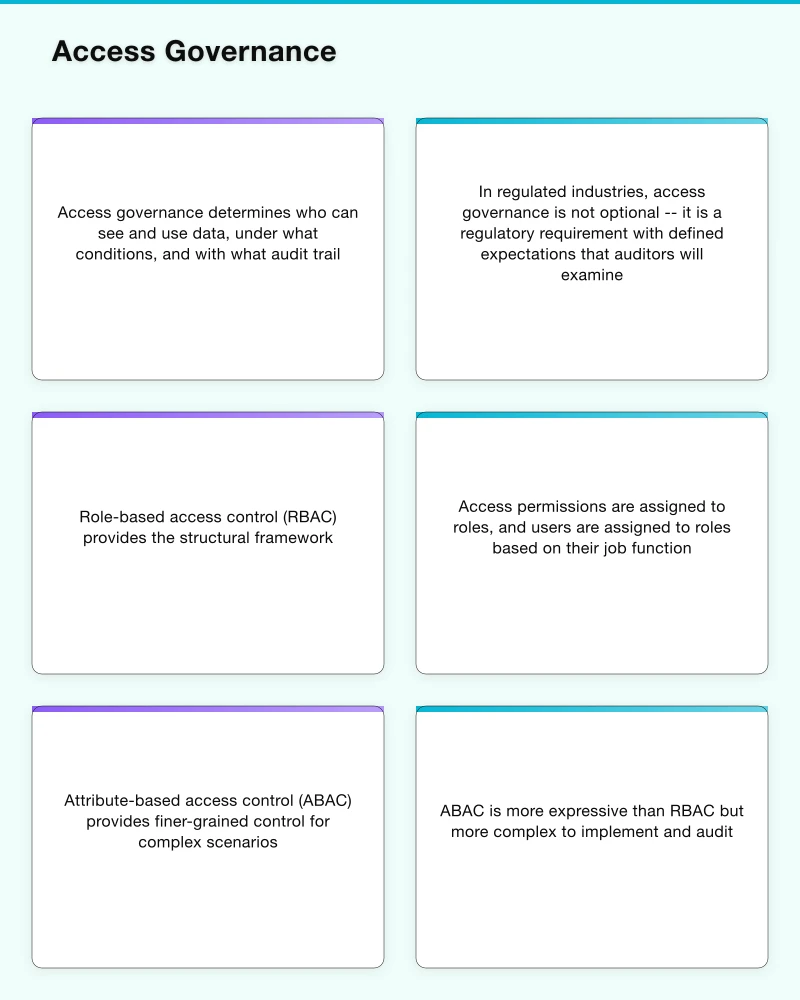
Access governance determines who can see and use data, under what conditions, and with what audit trail. In regulated industries, access governance is not optional — it is a regulatory requirement with defined expectations that auditors will examine.
Role-based access control (RBAC) provides the structural framework. Access permissions are assigned to roles, and users are assigned to roles based on their job function. This model is manageable at scale and auditable — an auditor can review the roles, their permissions, and the users assigned to each role to verify that access is appropriate.
Attribute-based access control (ABAC) provides finer-grained control for complex scenarios. Access decisions can consider attributes of the user (role, department, clearance level), attributes of the data (classification, jurisdiction, consent status), and attributes of the context (time, location, device). ABAC is more expressive than RBAC but more complex to implement and audit.
Data masking and anonymisation enable data utilisation while protecting sensitive elements. Dynamic masking applies transformation rules at query time, showing different views of the data based on the user’s access level — a customer service representative sees the last four digits of a credit card, while a fraud analyst sees the full number. Anonymisation permanently removes or transforms identifying elements, enabling data to be used for analytics and research without privacy risk.
Consent management is essential for organisations that process personal data under consent-based legal frameworks. The consent management system records what consent each individual has granted, for what purposes, and through what mechanism. This consent record is the legal basis for processing, and it must be queryable in real time — when a marketing system proposes to send a communication, it must verify current consent before proceeding.
Audit logging captures a comprehensive record of data access for regulatory examination. Every access to regulated data should be logged with the user identity, the data accessed, the time, and the action performed. These logs must be tamper-evident, retained for the period required by applicable regulations, and queryable for investigation and audit purposes.
Implementation Strategy
Implementing a data governance framework in a large enterprise is a multi-year programme that requires sustained executive sponsorship and cross-functional collaboration.
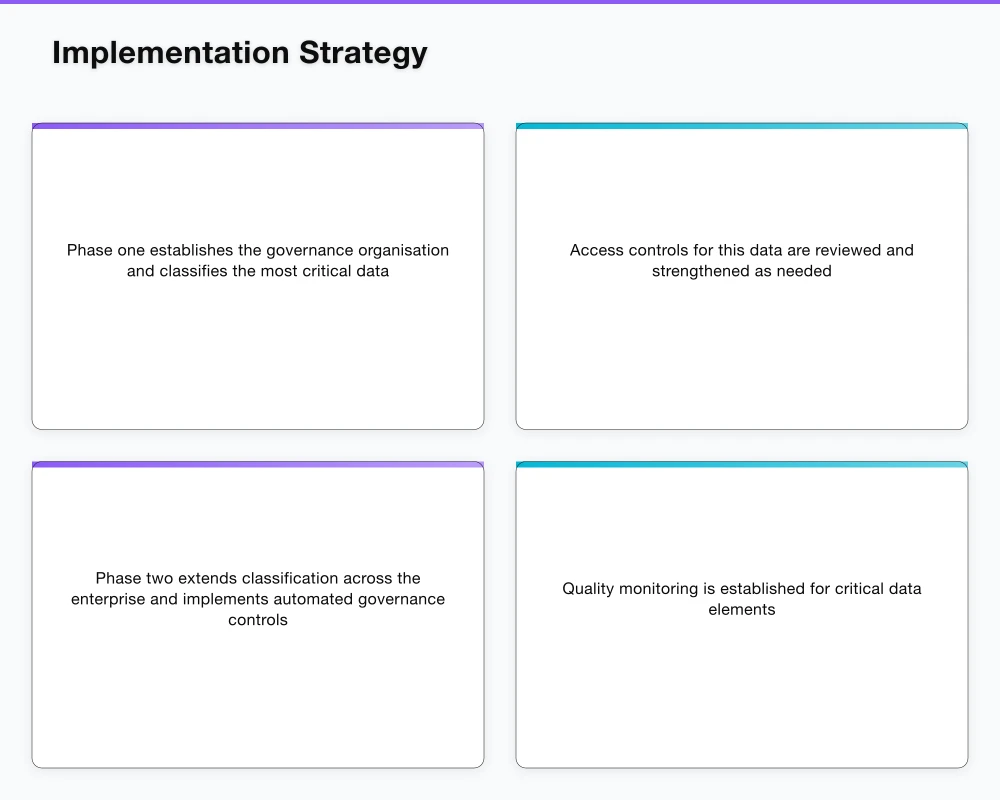
Phase one establishes the governance organisation and classifies the most critical data. The data governance council is formed, domain data owners are appointed, and classification is applied to the highest-risk data — customer PII, financial data, health records, and any data subject to specific regulatory requirements. Access controls for this data are reviewed and strengthened as needed.
Phase two extends classification across the enterprise and implements automated governance controls. Data cataloguing becomes operational, automated classification scanning covers major data stores, and policy-based access controls replace ad-hoc permission grants. Quality monitoring is established for critical data elements.
Phase three matures the framework with continuous improvement. Governance metrics are tracked and reported to executive leadership. Regulatory change management processes ensure that new requirements are incorporated into the framework. Advanced capabilities like automated consent management, data lineage tracking, and cross-border data transfer controls are implemented as needed.
Throughout this programme, the CTO must champion the principle that governance enables rather than constrains data utilisation. When governance is perceived as an obstacle, teams will find ways around it, creating shadow data stores and ungoverned data flows that increase rather than decrease risk. When governance is perceived as an enabler — providing trust, transparency, and clear rules of engagement — teams will adopt it as a natural part of their data practices.
The regulated enterprise that builds a mature data governance framework does not merely satisfy compliance requirements. It builds the trust and transparency foundation that enables data-driven innovation within responsible boundaries. That is governance as a competitive advantage, not merely a cost of doing business.
For practical mobile app development guidance, my team at Awesome Apps helps Australian businesses build iOS and Android applications.
I lead Ganda Tech Services, where we turn digital strategy into results through specialist cloud, web design, and mobile app teams across Sydney.
About the Author
Ashish Ganda is the founder of Ganda Tech Services, a Sydney-based technology consultancy specialising in cloud infrastructure, web development, and mobile app solutions for Australian businesses.
Digital Transformation Roadmap 2026
A 12-month framework for Australian SMBs ready to modernise — phases, tools, and milestones.
Almost done
Check your inbox and click the confirmation link to get your download.