CTO Succession Planning: Building Technology Leadership Continuity
Introduction
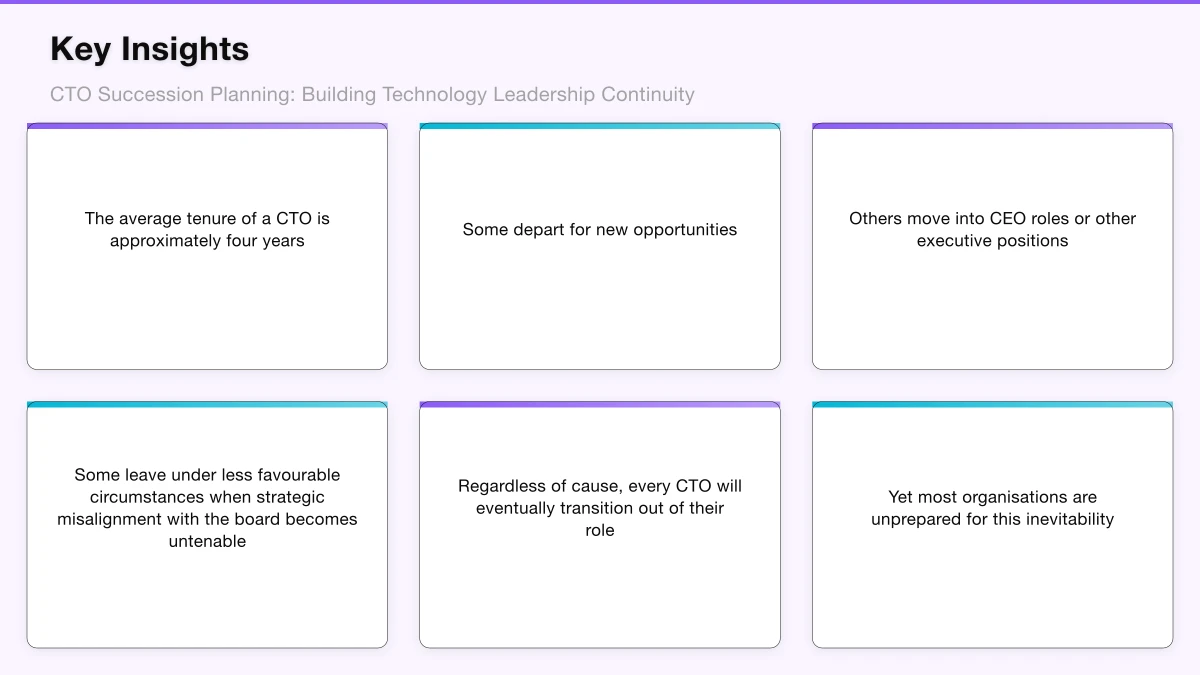
The average tenure of a CTO is approximately four years. Some depart for new opportunities. Others move into CEO roles or other executive positions. Some leave under less favourable circumstances when strategic misalignment with the board becomes untenable. Regardless of cause, every CTO will eventually transition out of their role.
Yet most organisations are unprepared for this inevitability. A Spencer Stuart survey found that only 35% of companies have a succession plan for their technology leadership positions, compared to 72% for CEO succession. This gap represents significant organisational risk at a time when technology capability increasingly determines competitive advantage.
The pandemic has amplified this risk. Digital transformation initiatives that were three-year roadmaps became three-month imperatives. Technology leaders have been stretched thin, and burnout has become endemic. The Great Resignation is hitting technology talent particularly hard, with CTO turnover accelerating across industries.
For current CTOs and the boards they serve, succession planning isn’t about premature departure planning—it’s about building the leadership depth that enables sustained technology excellence.
Why CTO Succession Is Different
Executive succession is never simple, but CTO succession presents unique challenges that distinguish it from other C-suite roles.
Technical Credibility Requirements
Unlike CFOs or CHROs, CTOs must maintain technical credibility with their engineering organisations. A CTO who can’t engage meaningfully in architectural discussions or evaluate technical trade-offs loses the respect of their teams. Yet technical excellence alone is insufficient—the role requires business acumen, communication skills, and executive presence that many purely technical leaders lack.
This dual requirement narrows the candidate pool significantly. The executive who can command a boardroom and dive deep into system design discussions is rare.
Rapid Domain Evolution
Technology domains evolve faster than any other business function. The skills that made a CTO successful five years ago may be partially obsolete today. A successor must not only master current technology but also demonstrate ability to learn and adapt as the landscape shifts.
Consider the capabilities a CTO needed in 2016 versus today. Cloud computing was significant but not dominant. Machine learning was emerging but not yet mainstream. Remote work was an accommodation, not an operating model. The CTO who thrived in that environment might struggle with today’s challenges—and vice versa.
Architecture and Talent Interdependence
The CTO’s decisions about technology architecture shape the talent the organisation can attract and retain. Engineers want to work with modern technology stacks. Technical debt accumulated under one CTO’s leadership constrains options for their successor. Succession planning must account for these interdependencies—a new CTO inheriting a legacy mess faces different challenges than one inheriting a modern platform.
Relationship Intensity
The CTO role is unusually relationship-dependent. Effectiveness depends on relationships with engineering teams, product leadership, the CEO, the board, key vendors, and often customers. These relationships don’t transfer automatically to a successor. A transition period during which the outgoing CTO helps the successor build these relationships is more critical than in roles with more transactional interactions.
The Succession Planning Framework
Effective CTO succession planning encompasses four interconnected elements: role definition, candidate development, transition planning, and contingency preparation.
Defining the Future Role
The first step is defining what you’re planning succession for. The CTO role varies dramatically across organisations, and it will likely evolve before succession occurs.
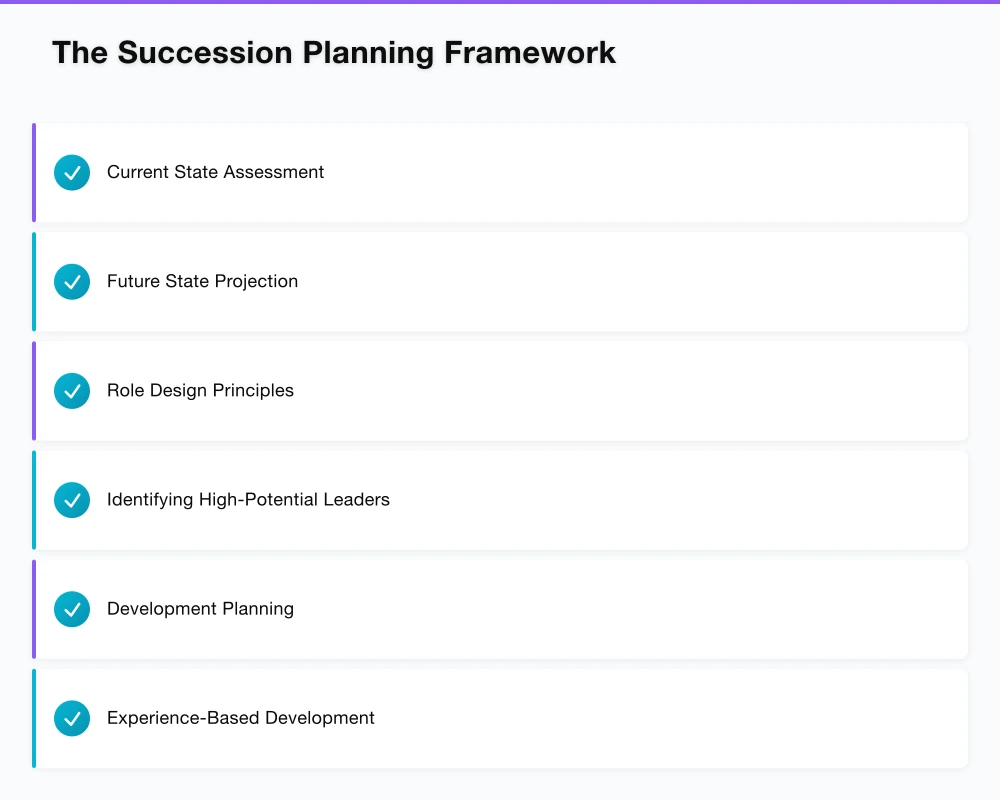
Current State Assessment
Document the current CTO’s actual responsibilities, not just the formal job description. Where do they spend their time? Which decisions do they make versus delegate? What relationships are most critical to their effectiveness?
Also assess gaps—areas where current coverage is weak due to the incumbent’s background, interests, or capacity constraints. These gaps represent either development areas for the incumbent or criteria for seeking different capabilities in a successor.
Future State Projection
Project how the role should evolve over the relevant planning horizon—typically three to five years.
- How will the technology landscape shift?
- What strategic initiatives will require technology leadership?
- How might organisational structure or scale change?
- What emerging capabilities will the role require?
This exercise often reveals that the future CTO role differs meaningfully from the current configuration. A company planning aggressive expansion might need a CTO with more M&A integration experience. One pursuing platform transformation might prioritise cloud-native architecture expertise.
Role Design Principles
With current and future state understood, establish principles for role design:
- Which responsibilities are truly CTO-level versus delegable to VPs?
- What organisational structure best supports the strategy?
- How should technology leadership interface with other executive functions?
- What board engagement model works for your governance structure?
Document these principles as criteria against which succession candidates can be assessed.
Developing Internal Candidates
Internal candidates offer significant advantages: known quantities with established relationships and organisational context. But they don’t develop automatically—deliberate investment is required.
Identifying High-Potential Leaders
Look beyond obvious candidates. The VP of Engineering might seem the natural successor, but the role requires capabilities beyond engineering management. Consider leaders from:
- Architecture and platform teams
- Infrastructure and operations
- Security and risk management
- Data and analytics
- Product technology partnerships
Assess candidates against future role requirements, not just current performance. High performance in a current role doesn’t guarantee readiness for the next level. Look for:
- Strategic thinking beyond functional boundaries
- Ability to influence without authority
- Communication effectiveness with diverse audiences
- Learning agility and comfort with ambiguity
- Executive presence and composure under pressure
Development Planning
For identified high-potential candidates, create development plans that build missing capabilities.
Experience-Based Development: Nothing substitutes for doing. Create opportunities for candidates to operate at the next level:
- Leading cross-functional initiatives
- Presenting to the board on technology topics
- Representing the company with key customers or partners
- Managing through a crisis or major incident
- Leading M&A technology integration
Exposure-Based Development: Broaden perspective through visibility to unfamiliar domains:
- Participation in executive leadership meetings
- Board observation opportunities
- External board positions at other companies
- Industry working groups and standards bodies
- Executive education programmes
Coaching and Mentoring: Provide structured support for development:
- Executive coaching focused on identified growth areas
- Mentoring relationships with executives inside or outside the company
- Peer learning with CTO-level leaders at other organisations
Track development progress formally, not just through casual observation. Regular development discussions should be calendar fixtures, not afterthoughts.
Managing the Talent Portfolio
Don’t put all eggs in one basket. Aim for multiple viable candidates at different stages of readiness:
- Ready-now candidates who could step in within months
- Ready-soon candidates who could be ready in 1-2 years with development
- Emerging candidates showing early potential for future development
This portfolio approach provides insurance against departures and creates healthy competition for development opportunities. But manage carefully—candidates who see themselves as heirs apparent and then get passed over often leave.
External Candidate Strategy
Even with strong internal development, external candidates may be needed—either because internal candidates aren’t ready or because the future role requires capabilities not present internally.
Building External Networks
Don’t wait until you need external candidates to start looking. Build ongoing relationships with potential future candidates:
- Track technology leaders at peer companies
- Engage with executives you meet at conferences and industry events
- Maintain relationships with strong candidates who weren’t selected in past searches
- Cultivate relationships with executive search firms specialising in technology roles
The CTO who actively networks isn’t being disloyal—they’re performing due diligence on the talent market and building insurance for the organisation.
Search Readiness
Prepare materials that enable rapid executive search launch if needed:
- Updated role specifications and success profiles
- Competitive compensation analysis
- Organisational and reporting structure documentation
- Candidate assessment criteria and interview processes
These materials become outdated quickly, so refresh them annually as part of succession planning review.
Transition Planning
Succession isn’t complete when a new CTO is named. The transition period determines whether the succession succeeds.
Transition Timeline
Plan transitions of three to six months when possible. Shorter timelines don’t allow adequate relationship transfer; longer timelines create ambiguity about decision authority.
Structure the transition in phases:
Weeks 1-4: Observation and learning. The successor shadows the incumbent, attends key meetings, and absorbs context without yet taking ownership.
Weeks 5-8: Guided ownership. The successor begins making decisions with the incumbent available for consultation. Key relationships are formally transitioned through joint meetings.
Weeks 9-12: Full ownership with backstop. The successor has full authority while the incumbent remains available for questions. The incumbent steps back from operational involvement.
Beyond Week 12: Clean break. The incumbent departs or moves to a clearly differentiated role. Continued involvement creates confusion about authority.
Knowledge Transfer
Document institutional knowledge that lives only in the outgoing CTO’s head:
- History and context behind key architectural decisions
- Relationship maps—who are the key influencers, what motivates them, what are the landmines?
- Strategic commitments made to customers, partners, or the board
- Ongoing initiatives and their status, risks, and dependencies
- Vendor relationships and contract status
- Pending decisions and the considerations involved
This documentation benefits the organisation regardless of succession—it surfaces single points of failure and creates organisational memory.
Stakeholder Communication
Plan communication carefully. The announcement should reach stakeholders in appropriate sequence:
- Executive team members individually
- Board members if not already involved in selection
- Direct reports and extended leadership team
- Broader organisation
- External stakeholders (customers, partners, vendors, investors)
Prepare talking points that explain the transition rationale, express confidence in the successor, and address likely questions.
Contingency Planning
Succession planning assumes orderly transitions. Reality often differs. CTOs get hired away with little notice. Health emergencies occur. Circumstances sometimes require immediate termination.
Emergency Succession
Identify interim solutions for unplanned departures:
- Which internal leaders could serve as acting CTO?
- What authority and support would they need?
- Who would backfill their current responsibilities?
- What processes exist for rapid executive search if needed?
Document emergency succession plans and review them annually. Make sure interim candidates know they’re designated—being thrust into an acting role without warning isn’t fair to them or the organisation.
Key Person Risk Mitigation
The best contingency planning is ensuring the organisation doesn’t depend critically on any single leader, including the CTO.
- Distribute architectural knowledge across multiple leaders
- Ensure multiple executives can credibly represent technology to the board
- Build executive relationships across the leadership team, not just with the CTO
- Create documentation and processes that survive individual departures
This risk mitigation makes succession easier while also making the current organisation more resilient.
The Board’s Role
Boards should actively engage in CTO succession planning, not delegate it entirely to the CEO or current CTO.
Oversight Responsibilities
The board should:
- Review CTO succession plans annually
- Meet internal succession candidates to form independent assessments
- Understand the external talent market and competitive dynamics
- Evaluate whether the current CTO’s development investments are adequate
Many boards now include technology experts who can evaluate succession candidates with appropriate technical lens. If your board lacks this expertise, consider adding it.
CEO Transition Implications
CTO succession planning connects to broader leadership succession. In an increasing number of companies, the CTO is a viable CEO successor. Technology leaders have become CEOs at Microsoft, Google, Amazon, and countless smaller companies.
Consider whether your CTO succession planning should develop candidates who could ultimately succeed to the CEO role. If so, development plans should include capabilities beyond the CTO remit—P&L management, customer relationships, and investor relations.
Common Pitfalls
Learn from others’ mistakes.
Waiting Too Long: Starting succession planning when departure is imminent leaves no time for candidate development. Start three to five years before anticipated transition.
Single Candidate Focus: Betting everything on one successor is risky. If that candidate leaves or underperforms, you’re back to zero. Maintain a portfolio of candidates.
Ignoring Culture Fit: Technical and business capabilities matter, but so does cultural fit. A successor who clashes with the executive team or engineering culture will fail regardless of individual capability.
Underestimating Onboarding: Even internal candidates need structured onboarding into the CTO role. Don’t assume institutional knowledge transfers automatically.
Neglecting the Incumbent: The outgoing CTO has an important role in transition success. Keep them engaged and motivated through the transition, even if the departure wasn’t their choice.
Confusing Succession with Replacement: Succession planning is about building leadership capacity, not just filling a box on an organisation chart. The process should strengthen leadership depth even if no transition occurs.
Practical Next Steps
For CTOs who want to strengthen their organisation’s succession readiness:
Immediate Actions
- Document your current role responsibilities, relationships, and institutional knowledge
- Assess internal candidates against future role requirements
- Identify gaps in your leadership portfolio
Near-Term Initiatives (3-6 months)
- Create development plans for high-potential internal candidates
- Build relationships with potential external candidates
- Establish emergency succession contingencies
Ongoing Practice
- Review succession plans annually with the board
- Update role requirements as strategy evolves
- Track candidate development progress
- Maintain external network relationships
Conclusion
Every CTO will eventually move on. The question is whether that transition will be an organisational crisis or an orderly handoff that maintains momentum.
Building succession readiness requires investment—time spent developing candidates is time not spent on other priorities. But the alternative is worse: scrambling to fill a critical role under time pressure, settling for available candidates rather than ideal ones, and losing months of execution during the transition.
The organisations that sustain technology excellence over decades are those that treat leadership development as a core competency. They produce leaders not just for their own needs but for the broader industry. Alumni networks become competitive advantages as former leaders maintain connections and refer opportunities back.
CTO succession planning isn’t about the CTO’s departure—it’s about the organisation’s future.
Looking to strengthen technology leadership succession at your organisation? Connect with me to discuss strategies for building leadership depth that ensures continuity.
Strategy needs execution. Cloud Geeks publishes practical cloud computing and cybersecurity guides for Australian businesses ready to act.
Ash Ganda is the founder of Ganda Tech Services, a Sydney-based technology consultancy delivering cloud, web, and mobile solutions for Australian businesses.
About the Author
Ashish Ganda is the founder of Ganda Tech Services, a Sydney-based technology consultancy specialising in cloud infrastructure, web development, and mobile app solutions for Australian businesses.
Digital Transformation Roadmap 2026
A 12-month framework for Australian SMBs ready to modernise — phases, tools, and milestones.
Almost done
Check your inbox and click the confirmation link to get your download.