The CTO's Guide to Sustainable Technology Practices
Sustainability is no longer a peripheral concern for technology leaders. ESG reporting requirements are tightening across major markets, institutional investors are scrutinising carbon commitments, and enterprise customers increasingly require sustainability disclosures from their vendors. For CTOs, this creates both an obligation and an opportunity: the same practices that reduce environmental impact frequently deliver significant operational and financial benefits.
The technology sector accounts for an estimated 2-3% of global carbon emissions — a figure comparable to the aviation industry. Data centres alone consume roughly 1% of global electricity. As organisations continue to digitise operations and expand their technology footprints, the environmental implications of architectural and operational decisions compound. The CTO who ignores sustainability is not just missing a moral imperative but overlooking a strategic lever for cost reduction and competitive differentiation.
Measuring What Matters: Technology Carbon Accounting
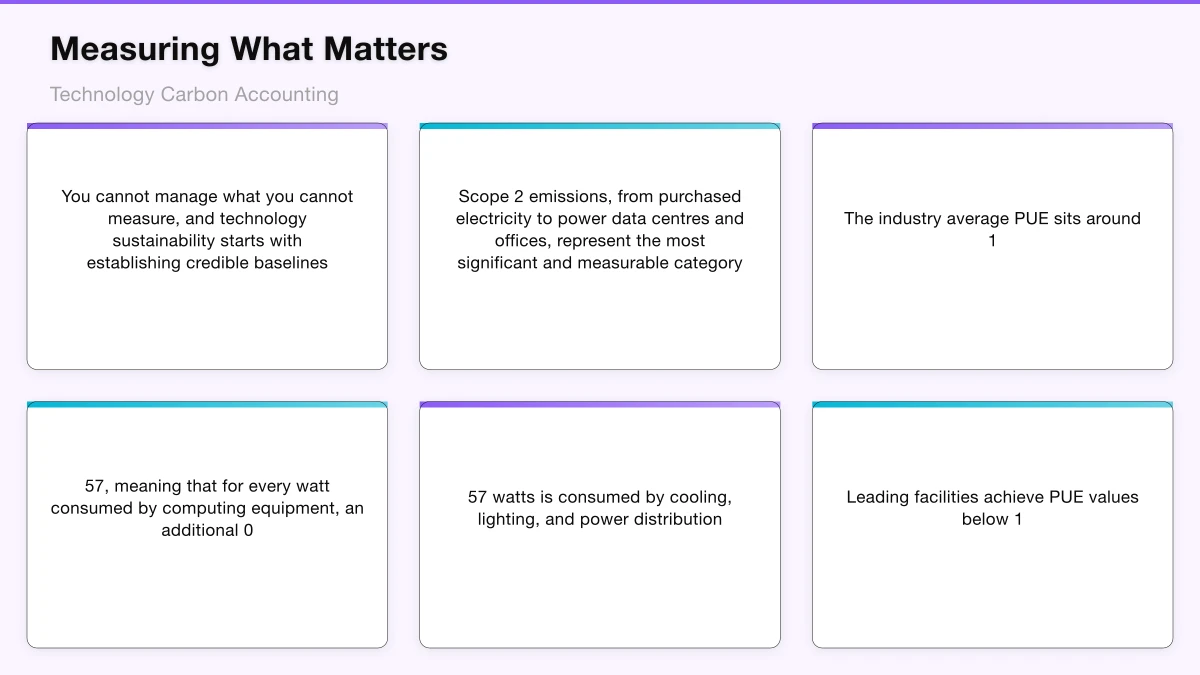
You cannot manage what you cannot measure, and technology sustainability starts with establishing credible baselines. The Greenhouse Gas Protocol categorises emissions into three scopes, and technology organisations must address all three to build a comprehensive picture.
Scope 1 emissions from technology operations are typically minimal — primarily diesel generators for backup power and refrigerant losses from cooling systems. Scope 2 emissions, from purchased electricity to power data centres and offices, represent the most significant and measurable category. Scope 3 emissions — embodied carbon in hardware manufacturing, supply chain impacts, and the energy consumed by end users running your software — are the most challenging to quantify but often the largest component.
For organisations operating their own data centres, measuring Scope 2 emissions requires tracking Power Usage Effectiveness (PUE), a ratio of total facility energy to IT equipment energy. The industry average PUE sits around 1.57, meaning that for every watt consumed by computing equipment, an additional 0.57 watts is consumed by cooling, lighting, and power distribution. Leading facilities achieve PUE values below 1.2, and organisations operating above the average should treat this as both an environmental and financial improvement opportunity.
Cloud-hosted workloads require a different measurement approach. Major cloud providers now offer carbon reporting tools — AWS Customer Carbon Footprint Tool, Google Cloud Carbon Footprint, and Microsoft Emissions Impact Dashboard — that estimate emissions based on resource consumption, data centre efficiency, and regional energy mix. These tools provide a starting point, but CTOs should validate the methodology and understand the assumptions underlying the estimates.
The measurement framework should extend beyond energy consumption to encompass hardware lifecycle impacts. Server manufacturing generates significant carbon emissions — estimates suggest that manufacturing a typical server produces 1,000-2,000 kg of CO2 equivalent. Extending hardware lifecycles from three to five years can reduce lifecycle emissions by 20-30%, though this must be balanced against the energy efficiency improvements in newer hardware generations.
Cloud Strategy as Sustainability Strategy
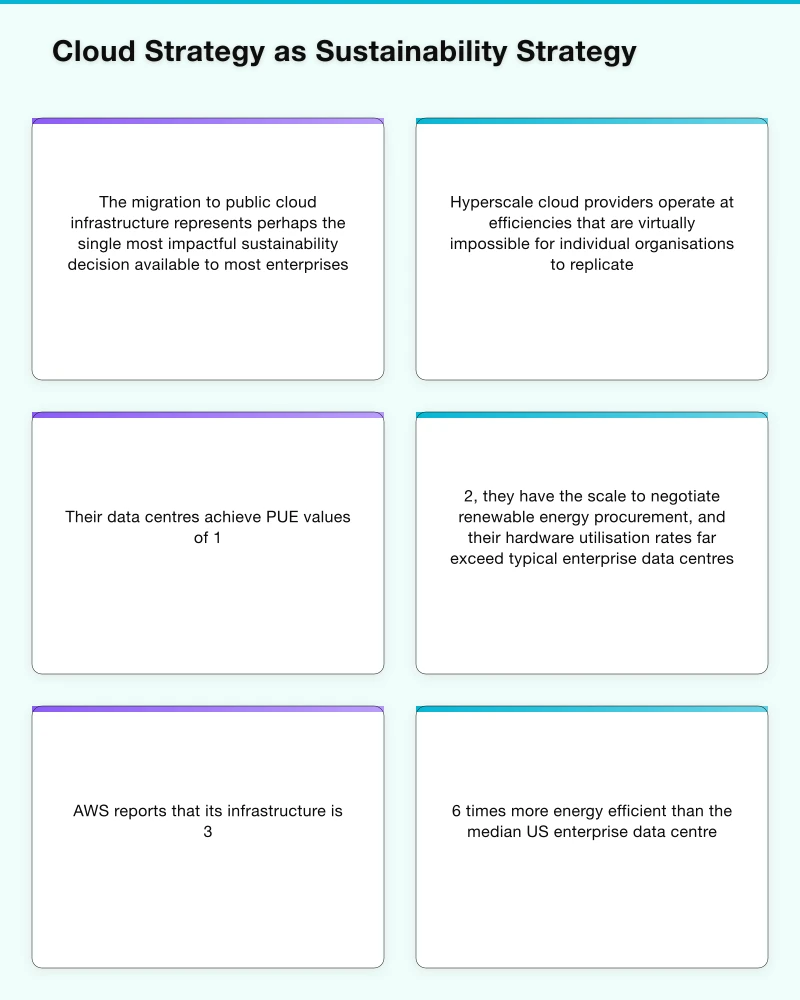
The migration to public cloud infrastructure represents perhaps the single most impactful sustainability decision available to most enterprises. Hyperscale cloud providers operate at efficiencies that are virtually impossible for individual organisations to replicate. Their data centres achieve PUE values of 1.1-1.2, they have the scale to negotiate renewable energy procurement, and their hardware utilisation rates far exceed typical enterprise data centres.
AWS reports that its infrastructure is 3.6 times more energy efficient than the median US enterprise data centre. Google has been carbon neutral since 2007 and matches 100% of its electricity consumption with renewable energy purchases. Microsoft has committed to being carbon negative by 2030. While these claims deserve scrutiny — carbon offsets and renewable energy certificates are not equivalent to direct renewable energy use — the directional advantage of hyperscale infrastructure is clear.
However, simply migrating to the cloud does not automatically deliver sustainability benefits. Overprovisioned cloud resources waste energy just as effectively as underutilised on-premises hardware. The cloud’s elasticity is a sustainability advantage only if organisations actually leverage it through right-sizing, auto-scaling, and shutting down non-production environments outside business hours.
Region selection is another significant sustainability lever. Cloud regions powered primarily by renewable energy have dramatically lower carbon intensity than those relying on fossil fuel generation. Deploying workloads in regions like GCP’s Finland (near-zero carbon) versus regions powered predominantly by coal can reduce associated emissions by 80% or more. For workloads without strict latency requirements, this is a straightforward optimisation.
Software architecture decisions also have material sustainability implications. Serverless architectures consume zero resources when idle, making them inherently more efficient for variable workloads. Container orchestration with Kubernetes enables bin-packing workloads onto fewer nodes. Event-driven architectures avoid the waste of polling-based systems that consume resources even when there is nothing to process. These patterns are not just good engineering — they are sustainable engineering.
Sustainable Software Engineering Practices
The energy efficiency of software is an underappreciated lever for sustainability. Poorly optimised code running at enterprise scale translates directly into unnecessary energy consumption. A database query that takes 100 milliseconds instead of 10 milliseconds may seem insignificant in isolation, but multiplied by millions of daily executions, the cumulative energy difference is substantial.
Performance optimisation is sustainability optimisation. Investing in query efficiency, caching strategies, algorithmic improvements, and payload compression reduces the computational resources required to deliver each unit of business value. Organisations should incorporate performance budgets into their development practices — not just for user experience but as a sustainability metric.
Data management practices carry significant sustainability implications. The marginal cost of storing data in the cloud is low enough that many organisations adopt a “keep everything” approach. But stored data requires energy for persistence, replication, and backup processing. Implementing data lifecycle policies that archive or delete data based on business value can significantly reduce storage-related emissions while also reducing costs.
The build and test infrastructure that supports software development is itself a meaningful energy consumer. CI/CD pipelines that rebuild and retest unchanged components waste computational resources. Implementing intelligent build caching, selective test execution based on change impact analysis, and right-sizing build agents can reduce CI/CD energy consumption by 40-60% while simultaneously accelerating feedback loops.
Remote work and distributed development practices also contribute to sustainability, primarily through reduced commuting emissions. Technology leaders who invest in robust remote collaboration tools and practices are making an indirect but meaningful sustainability contribution. The carbon savings from eliminating daily commutes for a technology team of 100 people can exceed 100 tonnes of CO2 annually.
Building the Business Case and Roadmap
Sustainability initiatives succeed when they align with financial incentives, and fortunately, most sustainable technology practices deliver direct cost savings. Cloud right-sizing reduces both carbon and cost. Energy-efficient software requires fewer compute resources. Extended hardware lifecycles defer capital expenditure. The sustainability business case is, in many cases, a cost optimisation business case with an additional ESG narrative.
Start by establishing the current baseline — energy consumption, cloud carbon footprint, hardware lifecycle metrics, and any other quantifiable sustainability indicators. Set targets that are ambitious but achievable, aligned with recognised frameworks like the Science Based Targets initiative (SBTi). Publish these targets externally to create accountability and signal commitment to customers, investors, and prospective employees.
Integrate sustainability metrics into existing technology governance processes. Architecture review boards should evaluate the carbon implications of design decisions. Procurement processes should weight vendor sustainability credentials. Capacity planning should incorporate energy efficiency alongside performance and cost. These integrations embed sustainability into decision-making without creating burdensome parallel processes.
Build sustainability awareness across engineering teams through education and tooling. Make carbon metrics visible in dashboards alongside availability, performance, and cost metrics. Celebrate teams that achieve meaningful efficiency improvements. Create internal communities of practice focused on sustainable engineering. Cultural change is slower than technical change, but it is ultimately more impactful.
Conclusion
Sustainable technology is not a constraint on innovation — it is a catalyst for better engineering practices, lower operational costs, and stronger competitive positioning. The practices that reduce environmental impact — cloud optimisation, efficient software, intelligent data management, right-sized infrastructure — are the same practices that distinguish high-performing technology organisations.
For CTOs in 2022, the question is not whether to pursue sustainability but how to embed it into the fabric of technology decision-making. The organisations that treat sustainability as a strategic priority will find themselves better positioned on cost, talent attraction, customer trust, and regulatory readiness. Those that treat it as an afterthought will face escalating pressure from all stakeholders as expectations continue to tighten.
The most effective approach is to start with high-impact, high-visibility initiatives — cloud optimisation, data lifecycle management, and renewable energy procurement — while building the measurement and governance foundations for long-term continuous improvement. Sustainability is a journey, not a destination, and the technology organisations that start that journey deliberately will compound their advantages over time.
For the practitioner’s view on cloud, IT, and cybersecurity, explore Cloud Geeks — where strategy meets infrastructure.
Ganda Tech Services is my technology consultancy, bringing together cloud infrastructure, web development, and mobile expertise for Australian businesses.
About the Author
Ashish Ganda is the founder of Ganda Tech Services, a Sydney-based technology consultancy specialising in cloud infrastructure, web development, and mobile app solutions for Australian businesses.
AI Strategy Primer for Australian Business Leaders
A practical framework for AI adoption in 2026 — cut through the hype and start with what matters.
Almost done
Check your inbox and click the confirmation link to get your download.