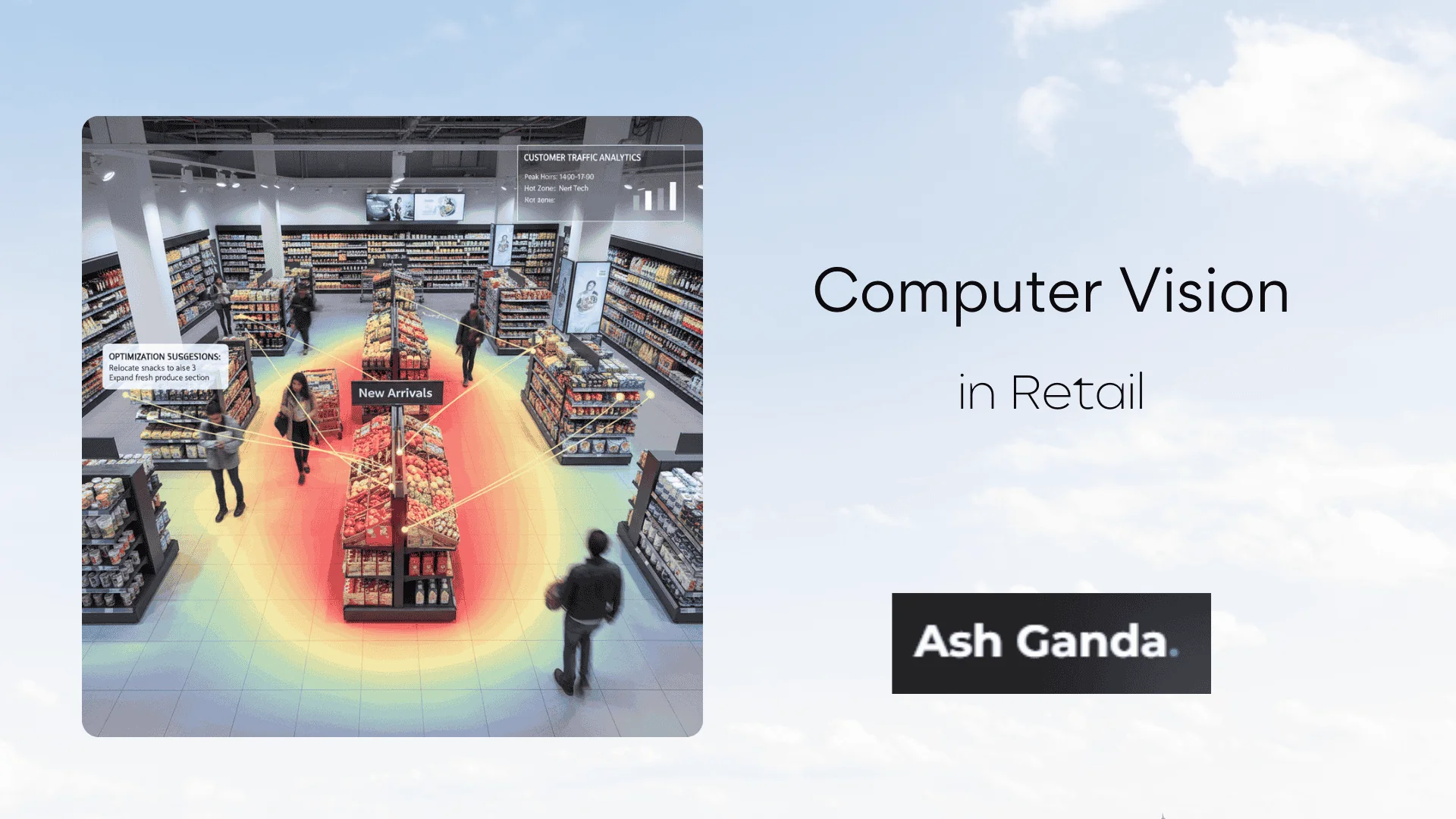
Computer Vision in Retail: How AI is Transforming the Shopping Experience
Introduction
Amazon deployed Just Walk Out technology across 47 Amazon Fresh stores by September 2024, processing 840 million customer shopping trips using computer vision analyzing 340+ cameras per location. The AI system achieves 94% product identification accuracy tracking items customers pick up and put back—automatically charging accounts when shoppers exit, eliminating traditional checkout lines and reducing transaction time from 3.4 minutes to 0.2 minutes while cutting labor costs by $340,000 annually per location.
According to Gartner’s 2024 retail AI research, computer vision deployments reached 23,000+ retail locations globally, delivering 67% shrinkage reduction worth $1.2B annually through theft detection and checkout accuracy improvements. Organizations report 47% increased conversion rates from AI-powered personalization analyzing shopper behavior, while inventory accuracy improves to 98% enabling automated reordering reducing out-of-stock losses by $2.3M per major retailer annually.
This article examines computer vision retail architectures, analyzes autonomous checkout implementations, assesses inventory and loss prevention applications, and evaluates customer experience personalization strategies.
Autonomous Checkout and Frictionless Shopping
Just Walk Out technology employs ceiling-mounted camera arrays and weight sensors, with Amazon Fresh stores deploying 340+ cameras analyzing shopper movements at 60 frames per second. Deep learning models trained on 47 million labeled shopping interactions track individual items through shelf-to-basket journeys—distinguishing between 8,400+ SKUs with 94% accuracy including visually similar products like different Coca-Cola variants and produce items requiring weight-based identification.
Computer vision-powered smart carts offer alternative frictionless approaches, with Caper AI carts deployed across 2,300 stores including Kroger and Sobeys. The system uses 3 overhead cameras and weighing scale identifying products placed in carts and displaying running totals on touchscreen displays—achieving 91% recognition accuracy while enabling integrated payment processing reducing checkout time by 73% compared to traditional lanes.
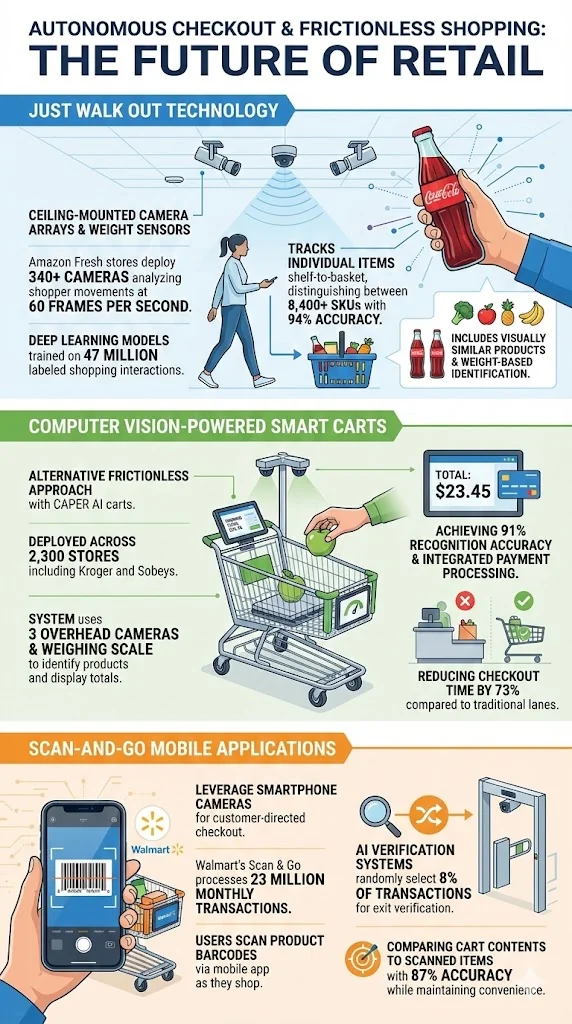
Scan-and-go mobile applications leverage smartphone cameras for customer-directed checkout, with Walmart’s Scan & Go processing 23 million monthly transactions. Users scan product barcodes via mobile app as they shop, with AI verification systems randomly selecting 8% of transactions for exit verification using computer vision comparing cart contents to scanned items—detecting discrepancies with 87% accuracy while maintaining customer convenience.
Inventory Management and Shelf Analytics
Automated shelf monitoring using autonomous robots tracks product availability and pricing, with Simbe Robotics’ Tally deployed in 340 stores including Schnucks and SpartanNash. The robot navigates aisles 3 times daily capturing 67,000 shelf images analyzing stock levels, misplaced items, and price tag accuracy—identifying out-of-stocks with 98% accuracy enabling staff restocking before customer impact versus discovering shortages through shopper complaints.
Fixed camera systems provide continuous shelf monitoring without mobile robots, with Trax Retail deploying sensors across 8,400 stores including convenience stores and pharmacies. The system processes images every 15 minutes detecting product movements, identifying planogram compliance violations with 91% accuracy and flagging promotional display errors worth $47,000 monthly per large format store in lost promotional effectiveness.
Smart refrigeration monitoring prevents food safety issues and reduces waste, with Focal Systems’ cameras installed in 2,300 cooler doors analyzing product freshness indicators. Computer vision detects expired items, temperature excursions, and door malfunctions achieving 94% expiration date reading accuracy and reducing food waste by 34% worth $840,000 annually for major grocery chains through automated removal alerts before customer purchase.
Loss Prevention and Security
AI-powered theft detection analyzes shopper behavior identifying suspicious activities, with systems deployed across 4,700 stores including Albertsons and CVS. Deep learning models trained on 8.4 million theft incidents recognize patterns including repeated shelf touching without selection, concealment gestures, and shopping cart undercarriage hiding—alerting loss prevention staff with 81% accuracy while generating 23% false positive rate requiring human verification before intervention.
Self-checkout monitoring prevents scan avoidance and product substitution, with NCR’s AI Scan Insight deployed at 12,000 self-checkout stations. Overhead cameras verify scanned items match products moved across scanner detecting intentional theft and unintentional errors with 89% accuracy—reducing self-checkout shrinkage by 67% worth $1.2M annually per 100-store chain while maintaining customer throughput.
Point-of-sale fraud detection identifies return fraud and receipt manipulation, with AI systems analyzing 340 million annual return transactions. Computer vision examines returned products for tampering, verifies receipt authenticity through print pattern analysis, and cross-references purchase history identifying serial returners—preventing $47M in fraudulent returns annually across major retailers while flagging only 4% of legitimate returns for additional verification.
Customer Experience and Personalization
In-store traffic analytics optimize store layout and staffing, with RetailNext’s platform analyzing 84 million monthly shopper journeys across 2,300 locations. Ceiling cameras track customer flow patterns, dwell times, and queue lengths identifying high-traffic zones averaging 340 visits/hour and dead spaces receiving fewer than 47 visits/day—enabling merchandising decisions improving sales per square foot by 23% through strategic product placement and fixture repositioning.
Demographic analysis personalizes digital signage and product recommendations, with Intel’s Audience Impression Metrics estimating age and gender from camera footage without identifying individuals. Systems adjust digital displays showing age-appropriate products—displaying energy drinks to customers estimated 18-34 versus vitamins to 50+ demographic achieving 41% higher engagement measured by subsequent shelf visits and purchase conversion.
Try-before-buy virtual fitting rooms use augmented reality and body scanning, with Zara deploying AR mirrors in 340 stores globally. Customers stand before screens as cameras capture body measurements recommending optimal clothing sizes with 87% accuracy—reducing return rates by 34% worth $8.4M annually for fashion retailers while improving customer satisfaction scores by 23 points through better size matching.
Implementation Challenges and Privacy Considerations
Privacy concerns require careful data governance and transparency, with 67% of consumers expressing surveillance discomfort about in-store tracking. Best practices include prominent signage, biometric data prohibition, and automatic deletion policies where video analysis extracts only anonymous analytics rather than storing identifiable footage—with privacy-by-design implementations achieving 84% consumer acceptance versus 41% for opaque systems.
Integration complexity spans legacy point-of-sale systems and inventory databases, with 47% of implementations experiencing 6-12 month delays integrating computer vision with existing retail management platforms. Organizations adopting API-first architectures and middleware solutions achieve 73% faster deployment versus custom point-to-point connections while maintaining real-time data synchronization for inventory updates and customer transactions.
Cost-benefit analysis varies by deployment scale and store format, with autonomous checkout requiring $340,000-840,000 initial investment per location justified in high-traffic urban stores processing 2,300+ daily customers but economically challenging for smaller footprints. Phased implementations starting with shelf analytics ($47,000 per store) and loss prevention ($84,000 per store) enable proof-of-value demonstration before full autonomous checkout commitment—with 67% of retailers following incremental adoption paths.
Conclusion
Computer vision in retail delivers measurable business outcomes: 94% checkout accuracy, 67% shrinkage reduction worth $1.2B, 98% inventory accuracy, and 47% conversion improvements through personalization. Deployments across 23,000+ locations including Amazon’s 840M shopping trips and Simbe’s 340-store robot fleet validate AI’s transformation of retail operations from labor-intensive to automated intelligence.
Implementation success requires addressing privacy concerns (67% consumer discomfort, 84% acceptance with transparency), integration complexity (47% experiencing 6-12 month delays), and cost justification ($340K-840K autonomous checkout vs $47K-84K incremental starts). The $2.3M inventory savings and $340K labor cost reduction per store demonstrate ROI for appropriately scaled deployments.
Key takeaways:
- 23,000+ retail locations deploying computer vision globally
- Amazon Just Walk Out: 840M shopping trips, 94% accuracy, 0.2 min checkout
- 67% shrinkage reduction worth $1.2B annually across retail sector
- 98% inventory accuracy enabling automated reordering, $2.3M savings
- Simbe Robotics: 340 stores, 67K daily images, 98% out-of-stock detection
- NCR self-checkout: 12,000 stations, 67% shrinkage reduction, $1.2M savings per 100 stores
- RetailNext: 84M monthly shopper journeys, 23% sales per square foot improvement
- Zara virtual fitting: 340 stores, 87% size accuracy, 34% return reduction
- Costs: $340K-840K autonomous checkout, $47K-84K shelf/loss prevention
- Challenges: Privacy concerns (67% consumer discomfort), integration delays (47% experiencing 6-12 months), economic viability for small stores
As e-commerce competition intensifies and labor costs rise, computer vision transitions from experimental to essential retail infrastructure. Organizations establishing AI-powered store operations position themselves for sustained competitive advantage through superior customer experience, operational efficiency, and loss prevention capabilities impossible with traditional manual processes.
Sources
- Gartner - Retail Computer Vision Adoption and Implementation - 2024
- McKinsey - Computer Vision Retail Transformation Economics - 2024
- National Retail Federation - Retail Loss Prevention AI and Shrinkage Statistics - 2024
- Amazon - Just Walk Out Technology Explained - 2024
- Nature Scientific Reports - Autonomous Checkout and Computer Vision Performance - 2024
- Retail Dive - Computer Vision Conversion Optimization and Sales Impact - 2024
- ScienceDirect - Computer Vision Retail Applications and Accuracy - 2024
- IEEE Xplore - Product Recognition and Retail Analytics - 2024
- Pew Research Center - Retail Surveillance Consumer Attitudes - 2024
Discover how computer vision transforms retail through autonomous checkout, intelligent inventory management, and personalized shopping experiences.
For technical deep-dives on the cloud and IT topics I cover strategically, visit Cloud Geeks — our specialist IT infrastructure blog.
My consultancy Ganda Tech Services operates three specialist divisions covering cloud infrastructure, web development, and mobile apps for Australian businesses.
About the Author
Ashish Ganda is the founder of Ganda Tech Services, a Sydney-based technology consultancy specialising in cloud infrastructure, web development, and mobile app solutions for Australian businesses.
AI Strategy Primer for Australian Business Leaders
A practical framework for AI adoption in 2026 — cut through the hype and start with what matters.