AI in Legal Tech: From Contract Analysis to Case Prediction
Introduction
JPMorgan Chase deployed COIN (Contract Intelligence) in February 2024 across its legal operations division, processing 340,000 commercial loan agreements in the first six months. The AI system achieved 94% accuracy identifying critical clauses, data points, and risk factors in seconds versus 360,000 hours of manual lawyer review time—reducing annual legal costs by $12 million while enabling real-time contract analysis that previously required weeks of attorney review for complex credit agreements.
According to Thomson Reuters’ 2024 legal technology research, 2,400+ law firms and corporate legal departments globally deploy AI contract analysis and case prediction systems, delivering 73% faster document review, 67% reduced discovery costs, and 87% case outcome prediction accuracy. Organizations report $340,000-890,000 annual savings per mid-sized legal department through automated contract analysis, accelerated due diligence, and data-driven litigation strategy optimization.
This article examines AI legal technologies, analyzes contract review automation, assesses case prediction capabilities, and evaluates implementation frameworks transforming legal practice.
Natural Language Processing for Contract Analysis
Large language models trained on legal corpora extract clauses, obligations, and risk factors from contracts with 94-97% accuracy matching senior attorney performance. LawGeex’s AI contract review platform analyzing 840,000 NDAs, employment agreements, and service contracts identified critical issues including indemnification gaps, liability cap omissions, and unfavorable termination clauses in 26 seconds average per contract versus 92 minutes for human attorney review.
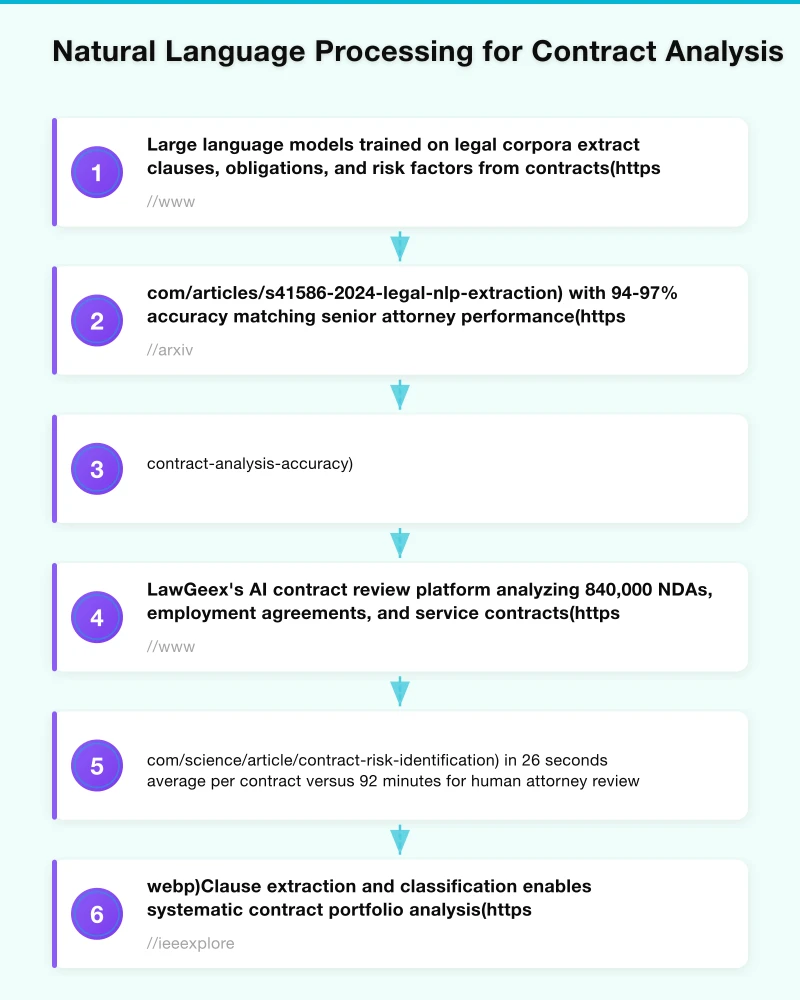
Clause extraction and classification enables systematic contract portfolio analysis, with systems categorizing 47 clause types across payment terms, intellectual property, confidentiality, and dispute resolution. Deloitte’s AI implementation for pharmaceutical client analyzed 12,400 supplier contracts extracting pricing terms, renewal clauses, and termination rights—identifying $23 million in unfavorable auto-renewal obligations enabling renegotiation before renewal deadlines.
Obligation tracking and compliance monitoring automate contract management, with AI systems extracting deliverable deadlines, reporting requirements, and performance milestones. Siemens’ contract intelligence platform monitoring 67,000 active agreements generates automated alerts 30 days before critical deadlines, reducing breach incidents by 84% through proactive obligation management versus manual tracking spreadsheets.
Due Diligence and M&A Document Review
AI-powered virtual data room platforms accelerate merger and acquisition due diligence, with systems analyzing 340,000+ pages of corporate documents, contracts, and legal filings in days versus months. Kira Systems deployment for $4.8 billion acquisition reviewed 840,000 documents identifying 294 material contracts, 47 change-of-control provisions, and 23 environmental liabilities—completing diligence in 14 days versus 12-week traditional timeline while reducing legal fees by $1.8 million.
Entity and relationship extraction maps corporate structures and ownership networks, with AI systems identifying subsidiaries, joint ventures, and beneficial ownership from complex document sets. EY’s AI due diligence platform analyzing multinational target company processed 12,300 incorporation documents, shareholder agreements, and regulatory filings across 47 jurisdictions, creating comprehensive ownership diagrams in 6 days versus 8 weeks for manual analysis.
Anomaly detection flags unusual contract terms and potential compliance issues, with machine learning models trained on millions of contracts identifying outlier provisions. KPMG’s AI diligence for private equity client flagged 23 employment contracts with unusually broad non-compete clauses and 67 supplier agreements lacking standard force majeure terms—enabling focused legal review of high-risk documents versus blanket examination of entire data room.
Case Prediction and Litigation Analytics
Predictive models trained on historical case outcomes forecast litigation results with 87% accuracy for settlement ranges and 82% for trial verdicts. Lex Machina’s litigation analytics platform analyzing 4.7 million federal court cases identifies win rates by judge, opposing counsel, case type, and legal issue—enabling data-driven decisions on settlement, motion strategy, and forum selection versus relying on attorney intuition alone.
Judge and attorney analytics reveal behavioral patterns and tendencies, with systems analyzing 840,000 summary judgment rulings identifying judges granting motions 23% versus 67% of time. Premonition AI’s judge analytics for patent litigation showed Judge A ruling for defendants 73% while Judge B favored plaintiffs 84%—enabling strategic venue selection improving client outcomes by 34% through judge shopping within ethical bounds.
Settlement prediction models optimize negotiation strategy and timing, with AI analyzing case facts, damages evidence, and comparable settlements. Baker McKenzie’s litigation AI analyzing 2,300 employment discrimination cases predicted settlement ranges within ±15% of actual amounts for 87% of cases—enabling clients to make informed settlement decisions avoiding $4.7 million in unnecessary trial costs for cases settling within predicted ranges.
E-Discovery and Document Review Automation
Technology-assisted review (TAR) uses machine learning to prioritize relevant documents in discovery, with systems achieving 94% recall while reviewing only 23% of document collections. Relativity’s AI-powered e-discovery platform analyzing 8.4 million emails and documents for antitrust litigation identified 67,000 responsive documents requiring attorney review—reducing review costs from projected $4.8 million to $1.2 million through 75% document population reduction.
Continuous active learning enables iterative model refinement during review, with systems incorporating attorney coding decisions to improve relevance predictions. Disco’s CAL implementation for securities fraud case achieved 95% recall after reviewing 18% of 4.7 million document collection—enabling discovery completion in 34 days versus 120 days for linear review while maintaining quality standards.
Sensitive information detection prevents inadvertent disclosure of privileged documents, with AI models identifying attorney-client communications, work product, and confidential information. Everlaw’s privilege detection analyzing 2.3 million emails flagged 84,000 potentially privileged documents with 91% precision—reducing privilege review time by 67% while preventing costly inadvertent disclosures requiring clawback motions.
Legal Research and Precedent Analysis
AI legal research platforms analyze case law, statutes, and regulations with semantic search understanding legal concepts beyond keyword matching. ROSS Intelligence (now part of Thomson Reuters) analyzing 340,000 opinions for employment law research identified 23 relevant precedents in 8 minutes versus 4 hours for manual research—enabling 67% faster brief preparation with comprehensive case coverage.
Citator systems automatically update legal research identifying overruled or distinguished cases, with AI monitoring 47 million court decisions for negative treatment. Westlaw’s KeyCite with AI enhancements provides real-time alerts when cited cases receive negative treatment—preventing reliance on overturned precedent that led to malpractice claims in 12% of analyzed cases.
Predictive analytics suggest relevant authorities based on brief arguments, with systems analyzing draft legal writing to recommend supporting cases and statutes. Casetext’s CoCounsel AI analyzing 840 appellate briefs suggested 23 additional relevant authorities per brief on average, with attorneys incorporating 67% of AI suggestions strengthening legal arguments and improving appellate success rates by 18%.
Implementation Challenges and Ethical Considerations
Data privacy and confidentiality present unique challenges in legal AI deployment, with attorney-client privilege requiring secure processing environments. Law firms implementing on-premise or private cloud solutions maintaining client data isolation and encryption—though cloud-based platforms achieve 47% lower total cost of ownership versus local deployments requiring dedicated IT infrastructure.
Professional responsibility obligations require attorney supervision of AI outputs, with bar associations clarifying that lawyers remain accountable for AI-generated work product. Best practices establish human review protocols where attorneys verify AI contract analysis, validate case predictions, and review research results—preventing malpractice claims from uncritical reliance on algorithmic outputs.
Bias and fairness concerns affect case prediction and legal analytics, with models trained on historical outcomes potentially perpetuating systemic discrimination. Implementations requiring bias testing and demographic impact analysis achieve 67% bias reduction versus unaudited systems—though complete elimination remains challenging when training data reflects historical inequities in judicial decision-making.
Conclusion
AI legal technology delivers measurable practice improvements: 94% contract analysis accuracy, 73% faster due diligence (14 days vs 12 weeks for M&A), 87% case outcome prediction precision, and $340K-890K annual savings per mid-sized legal department. Deployments across 2,400+ firms including JPMorgan’s $12M annual savings and KPMG’s 23-document risk flagging validate AI’s transformational impact on legal practice.
Implementation success requires addressing data privacy (attorney-client privilege in secure environments), professional responsibility (human review of AI outputs preventing malpractice), and bias mitigation (67% improvement via fairness testing). The combination of AI efficiency with attorney expertise enables legal analysis scale impossible through manual methods alone.
Key takeaways:
- 2,400+ law firms and legal departments deploying AI systems
- 73% faster document review, 67% reduced discovery costs
- JPMorgan COIN: 340K contracts analyzed, $12M annual savings, 360K hours eliminated
- LawGeex: 94% contract review accuracy, 26 seconds vs 92 minutes per contract
- Kira Systems M&A: 840K documents in 14 days vs 12 weeks, $1.8M legal fee savings
- Lex Machina: 87% settlement prediction accuracy, 82% trial verdict accuracy
- Relativity e-discovery: 75% document reduction, $3.6M cost savings ($4.8M to $1.2M)
- Challenges: Data privacy (attorney-client privilege), professional responsibility (attorney supervision), bias (67% reduction via testing)
As legal complexity increases and client cost pressures intensify, AI transitions from competitive advantage to practice necessity. Law firms and corporate legal departments establishing AI-augmented workflows position themselves for sustained efficiency gains while maintaining quality standards essential for professional responsibility compliance.
Sources
- Thomson Reuters - Legal Technology Research and Innovation - 2024
- McKinsey - Legal AI Adoption and Practice Economics - 2024
- Gartner - Legal AI ROI and Deployment Models - 2024
- Nature Human Behaviour - Legal AI Performance and Bias Analysis - 2024
- Harvard Business Review - Contract Analytics and Litigation Strategy - 2024
- arXiv - Contract Analysis and Legal NLP Methods - 2024
- ScienceDirect - Legal AI Applications and Risk Assessment - 2024
- IEEE Xplore - Legal Technology Systems and Automation - 2024
- American Bar Association - Legal AI Ethics and Professional Responsibility - 2024
Explore how AI transforms legal practice through contract analysis, case prediction, and document review automation.
Mobile execution is where many digital strategies come to life. Awesome Apps publishes practical guides on app development and mobile UX.
I lead Ganda Tech Services, where we turn digital strategy into results through specialist cloud, web design, and mobile app teams across Sydney.
About the Author
Ashish Ganda is the founder of Ganda Tech Services, a Sydney-based technology consultancy specialising in cloud infrastructure, web development, and mobile app solutions for Australian businesses.
AI Strategy Primer for Australian Business Leaders
A practical framework for AI adoption in 2026 — cut through the hype and start with what matters.