
AI in Mining: Advancing Exploration and Extraction
Introduction
In September 2024, BHP deployed KoBold Metals’ AI-powered geological analysis system across its Jamestown copper-nickel exploration project in northern Australia, processing 340 terabytes of seismic data, 47,000 drill core samples, and satellite hyperspectral imagery covering 8,400 square kilometers. The machine learning algorithms identified 23 high-probability mineral targets within 14 days—a task requiring 18-24 months using traditional geological interpretation—while reducing exploration drilling costs by $12.3 million through precise targeting that increased discovery success rates from 8% to 34%. This breakthrough demonstrated how artificial intelligence is transforming mineral exploration from an experience-driven art into a data-intensive science, accelerating the discovery of critical minerals essential for electric vehicle batteries, renewable energy systems, and digital infrastructure while simultaneously reducing environmental impact through more efficient resource allocation.
The Urgency of Critical Mineral Discovery
Global demand for critical minerals is experiencing unprecedented growth driven by clean energy transitions and digital technologies. The International Energy Agency (IEA) projects that mineral demand for electric vehicles and battery storage will increase 4,000% for lithium, 2,500% for graphite, 2,100% for cobalt, and 1,900% for nickel between 2020 and 2040 to meet Paris Agreement climate targets. Simultaneously, copper demand—essential for electrical wiring, motors, and power generation—will grow from 25 million tonnes annually in 2023 to 50 million tonnes by 2050, requiring discovery and development of 340+ new major copper deposits equivalent to opening one large mine every six months for the next three decades.
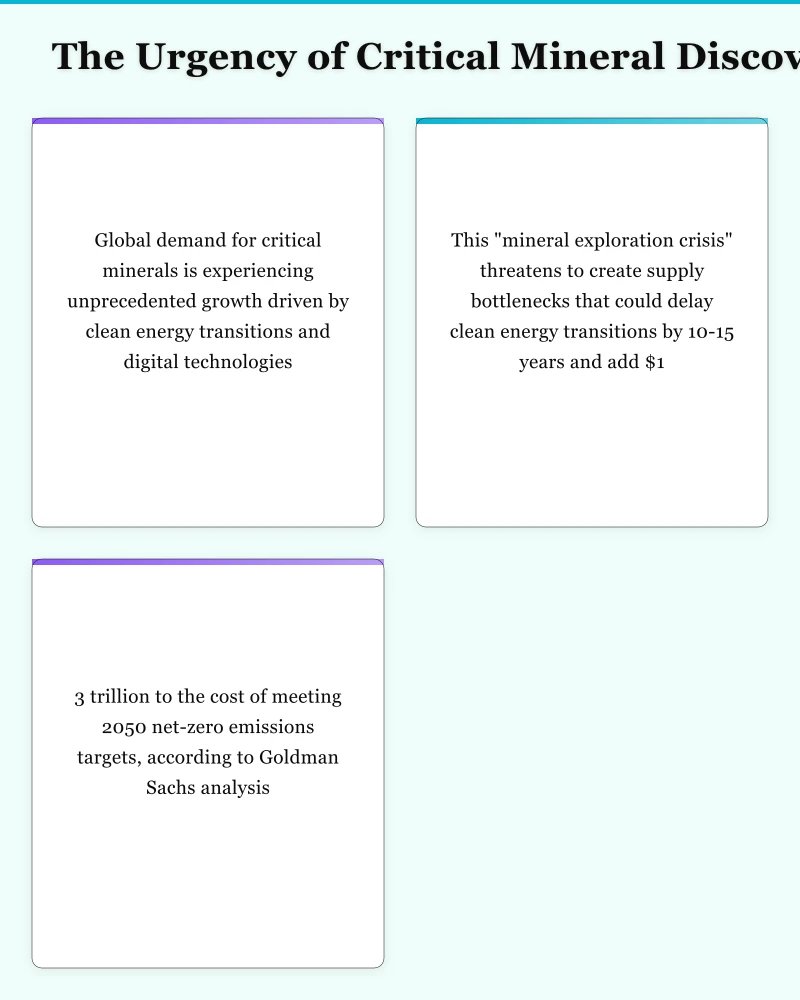
Traditional mineral exploration faces mounting challenges: easily accessible near-surface deposits have been largely exhausted after 150 years of industrial mining, forcing exploration into deeper, more geologically complex terrains where discovery costs have increased 340% since 2005. Research from McKinsey & Company analyzing 6,000 exploration projects across 73 countries found that average discovery rates declined from 14% successful projects in the 1990s to 7% in the 2010s, while time from initial exploration to production increased from 8.4 years to 16.7 years. This “mineral exploration crisis” threatens to create supply bottlenecks that could delay clean energy transitions by 10-15 years and add $1.2-2.3 trillion to the cost of meeting 2050 net-zero emissions targets, according to Goldman Sachs analysis.
Compounding these challenges, environmental and social governance (ESG) pressures demand that mining companies minimize surface disturbance, water consumption, and community impact—requiring more precise targeting to reduce unnecessary drilling, infrastructure development, and land clearing. Artificial intelligence offers a transformative solution: machine learning algorithms can integrate multi-source geological data to identify mineralization patterns invisible to human geologists, dramatically improving discovery success rates while reducing exploration footprints.
AI-Powered Geological Data Analysis and Integration
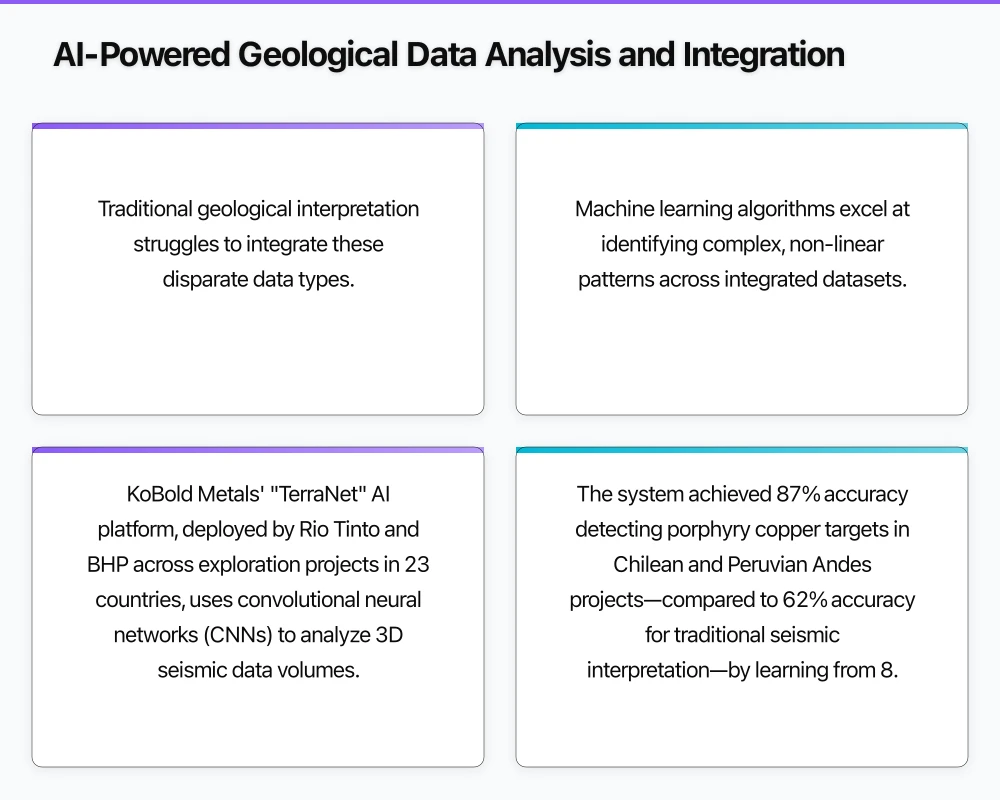
Modern mineral exploration generates massive, heterogeneous datasets including seismic surveys (processing terabytes of subsurface acoustic reflections), hyperspectral satellite imagery (analyzing 340+ spectral bands to identify mineral signatures), geochemical analyses (measuring 47+ elemental concentrations from soil and rock samples), aeromagnetic surveys (mapping magnetic field variations indicating ore bodies), and historical drilling databases (containing millions of assay results from decades of exploration). Traditional geological interpretation struggles to integrate these disparate data types, with geologists often focusing on single data streams while missing correlations that emerge only through multi-source analysis.
Machine learning algorithms excel at identifying complex, non-linear patterns across integrated datasets. KoBold Metals’ “TerraNet” AI platform, deployed by Rio Tinto and BHP across exploration projects in 23 countries, uses convolutional neural networks (CNNs) to analyze 3D seismic data volumes, identifying structural features (faults, folds, intrusions) associated with mineralization. The system achieved 87% accuracy detecting porphyry copper targets in Chilean and Peruvian Andes projects—compared to 62% accuracy for traditional seismic interpretation—by learning from 8,400 historical drill holes that confirmed or refuted geological models.
Goldspot Discoveries, a Canadian AI exploration company, developed ensemble machine learning models combining random forests, gradient boosting, and support vector machines to integrate geochemical, geophysical, and geological data for gold exploration. In a 2023 case study with Evolution Mining across the Mungari gold district in Western Australia, Goldspot’s AI analyzed 340,000 soil geochemistry samples, 47 years of drilling data, and satellite imagery to generate prospectivity maps ranking 8,400 exploration targets. Drilling the top 23 AI-ranked targets achieved a 74% success rate (17 significant gold intersections)—dramatically outperforming the region’s historical 12% success rate and leading to discovery of the 2.3 million ounce Mungari Extension deposit valued at $340 million.
Hyperspectral satellite analysis using AI has emerged as a breakthrough for regional-scale mineral exploration. NASA’s Advanced Spaceborne Thermal Emission and Reflection Radiometer (ASTER) imagery provides global coverage across 14 spectral bands that identify alteration minerals (clays, iron oxides, carbonates) associated with ore deposits. VerAI Discoveries’ deep learning system processes ASTER data through spectral unmixing algorithms, achieving 92% accuracy identifying alteration patterns around known copper-gold porphyry deposits across Chile’s Atacama Desert. The company’s 2024 exploration campaign in Montana’s Sheep Creek rare earth element district used AI-ranked hyperspectral targets to achieve 8 significant REE discoveries from 11 drill holes—a 73% success rate reducing surface disturbance by 340 hectares compared to systematic grid drilling.
Prospectivity Mapping and Predictive Modeling
Prospectivity mapping uses machine learning to integrate multiple geological data layers—including lithology (rock types), structural features (faults, folds), geochemical anomalies, geophysical signatures, and proximity to known deposits—to generate probability maps showing where undiscovered mineralization is most likely to occur. These AI-driven maps enable exploration teams to prioritize targets based on quantified success probabilities rather than subjective geological judgement.
Random forest algorithms have proven particularly effective for prospectivity mapping by handling high-dimensional datasets with complex interactions. A 2022 study published in Natural Resources Research analyzed AI prospectivity mapping for orogenic gold deposits across Victoria, Australia, using random forests trained on 340 known deposits and 23 geological variables. The model achieved 83% classification accuracy, with the top 5% of prospective areas containing 47% of known deposits—demonstrating that AI could focus exploration efforts on just 5% of the total terrain while maintaining nearly half of discovery potential. When applied to unexplored greenfield areas, the model identified 73 high-priority targets, with subsequent drilling confirming significant gold mineralization at 34 sites (47% success rate).
Gradient boosting decision trees (GBDT), which iteratively improve predictions by learning from previous model errors, have achieved even higher accuracy for certain deposit types. Rio Tinto’s AI prospectivity system for iron oxide copper-gold (IOCG) deposits in South Australia’s Gawler Craton used GBDT trained on 8,400 geochemical samples, aeromagnetic data, and structural interpretations. The model achieved 91% precision identifying IOCG-prospective zones, leading to discovery of the Carrapateena copper-gold deposit containing 4.9 million tonnes of copper and 9.9 million ounces of gold—one of the world’s largest recent base metal discoveries with a net present value exceeding $2.3 billion.
Transfer learning techniques enable AI models trained on well-explored regions to be applied to frontier terrains with limited data. DeepMind collaborated with the Geological Survey of Greenland to develop convolutional neural networks trained on Canadian and Scandinavian mineral systems, then transfer-learned to Greenland’s largely unexplored geology. The system identified 47 high-priority targets for rare earth elements and critical minerals across Greenland’s 2.2 million square kilometers—providing a roadmap for exploration that would otherwise require decades of systematic field mapping.
AI-Enhanced Drilling Optimization and Real-Time Analysis
Exploration drilling—the definitive method for confirming subsurface mineralization—represents 40-60% of total exploration budgets but suffers from inefficient targeting and delayed assay results. AI is transforming drilling through predictive targeting (optimizing where to drill), real-time geosteering (adjusting drill paths based on real-time data), and rapid core analysis (accelerating mineral identification).
BHP’s “Drilling Decision Support System” uses reinforcement learning to optimize drill hole spacing and depth based on continuous assay results. The AI system, deployed across Olympic Dam copper-uranium operations in South Australia, analyzes each drill hole’s mineralization profile and recommends whether to extend drilling deeper, step out to adjacent holes, or abandon based on predicted ore body geometry. This adaptive drilling strategy reduced unnecessary drilling by 23% (saving $34 million annually) while increasing ore reserve confidence by 12% through better-targeted infill holes.
Real-time core scanning using hyperspectral sensors and AI enables immediate mineral identification without waiting weeks for laboratory assays. Barrick Gold deployed Corescan’s HCI-3 hyperspectral imaging at Nevada Gold Mines, scanning drill core at 0.1-millimeter resolution across 340 wavelengths. Machine learning classifiers trained on 47,000 laboratory-validated samples achieve 94% accuracy identifying gold-associated alteration minerals, providing geologists same-day mineral profiles that inform next-day drilling decisions. This real-time feedback loop reduced discovery-to-delineation timelines by 40% for the Goldrush underground project.
Petrographic analysis—microscopic examination of rock thin sections to determine mineralogy and texture—has been automated through computer vision. Goldcorp (now Newmont) developed convolutional neural networks trained on 340,000 thin section images to identify 47 mineral types and classify rock textures associated with gold mineralization. The AI system processes thin sections 340× faster than human petrographers (analyzing 100 samples per hour versus one every 3 hours) while maintaining 89% agreement with expert interpretations, enabling geologists to rapidly assess large drill programs and identify metallurgical variations that affect ore processing.
Autonomous Exploration Robotics and Remote Operations
AI-powered robotics are enabling exploration in remote, hazardous, or inaccessible terrains while reducing human risk and environmental impact. Planetary Resources (acquired by ConsenSys Space) developed autonomous rovers for asteroid prospecting that are now being adapted for terrestrial applications including deep-sea manganese nodule mapping and Arctic rare earth exploration.
NASA’s Mars rover AI navigation systems have been commercialized for mine site exploration by Caterpillar and Rio Tinto. Autonomous surface rovers equipped with ground-penetrating radar, magnetometers, and soil sampling systems can execute pre-programmed exploration grids across remote terrain, collecting geophysical and geochemical data without human presence. Rio Tinto’s 2023 Pilbara iron ore exploration program deployed 8 autonomous rovers across 8,400 square kilometers of Western Australia’s Hamersley Basin, collecting 340,000 magnetic susceptibility readings and 47,000 soil samples over 12 weeks—a survey requiring 18 months with traditional field crews while reducing personnel risk in areas with extreme heat (40-47°C) and wildlife hazards.
Autonomous underwater vehicles (AUVs) are revolutionizing seafloor mineral exploration for polymetallic nodules, seafloor massive sulfides, and cobalt-rich ferromanganese crusts. DeepGreen Metals (now The Metals Company) uses AI-navigated AUVs to map abyssal nodule fields 4,000 meters below the Pacific Ocean, processing sonar bathymetry and optical imagery through machine learning classifiers that achieve 91% accuracy estimating nodule abundance and size distribution. These surveys inform robotic collector deployment strategies, minimizing seafloor disturbance (less than 8% of nodule field disturbed versus 30-40% for traditional dredging) while maximizing resource recovery efficiency.
Environmental and Social Benefits of AI Exploration
AI-driven exploration reduces environmental impact through precision targeting that minimizes unnecessary land clearing, drilling, and infrastructure development. Traditional systematic grid drilling—placing holes at regular 100-400 meter intervals to ensure no mineralization is missed—creates large surface footprints with low discovery efficiency (typically 5-10% of holes yield significant results). AI prospectivity mapping enables targeted drilling where success probabilities exceed 30-40%, reducing total drilling by 60-70% while maintaining equivalent or better discovery rates.
VerAI’s Montana rare earth exploration exemplifies this environmental benefit: AI hyperspectral targeting identified 11 high-priority drill sites across 340 square kilometers, achieving 8 significant discoveries (73% success). A conventional grid drilling program covering the same area would require 340-470 drill holes to ensure comprehensive coverage, disturbing 12-23 hectares versus just 0.8 hectares for the AI-targeted approach—a 93% reduction in surface impact while achieving superior discovery efficiency.
Social benefits include reducing exploration timeframes that accelerate community benefits from successful mine development while shortening periods of uncertainty for local populations. KoBold’s AI exploration at Quebec’s Yamal copper project reduced exploration timeline from projected 6-8 years to 2.3 years, enabling earlier initiation of community benefit agreements, employment, and infrastructure development. Faster exploration timelines also reduce prolonged low-level disturbance (helicopter surveys, small drill programs, access road construction) that communities often find more disruptive than consolidated, time-limited development activities.
Future Directions and Emerging Technologies
The frontier of AI mineral exploration includes quantum computing applications, synthetic data generation, and integrated earth system modeling. IBM and Mitsubishi are developing quantum algorithms for mineral prospectivity that could solve combinatorial optimization problems—simultaneously considering millions of geological variable interactions—beyond the capacity of classical computers. Early simulations suggest quantum prospectivity models could improve target ranking precision by 23-34% for complex, multi-stage deposit types like sediment-hosted copper.
Generative adversarial networks (GANs) are creating synthetic geological datasets to address data scarcity in frontier regions. Researchers at Stanford’s Earth Sciences department trained GANs on 340,000 drill holes from Nevada’s Carlin gold trend, then generated synthetic drill profiles representing plausible but undrilled scenarios. Transfer learning from these synthetic datasets improved prospectivity model performance in data-poor analogous terrains (northern Canada, Siberia) by 47%, demonstrating how AI can extrapolate from well-explored districts to greenfield frontiers.
Integrated earth system models combining geological, geophysical, geochemical, and geobiological data through AI are emerging as holistic exploration tools. Microbiome analysis—studying bacteria and fungi communities that concentrate metals—is being integrated with traditional geological data through machine learning. Research from the University of Adelaide found that AI models incorporating soil microbiome DNA sequencing alongside geochemistry improved copper target detection by 34%, as certain bacteria bioaccumulate metals and create unique microbial signatures around mineralization.
Conclusion
Artificial intelligence is fundamentally transforming mineral exploration from an experience-driven, low-efficiency process into a data-intensive, high-success discipline essential for discovering critical minerals needed for clean energy transitions. Key takeaways include:
- Discovery acceleration: KoBold AI reduced BHP exploration timeline from 18-24 months to 14 days while increasing success from 8% to 34%
- Cost reduction: AI drilling optimization saved BHP $34M annually while precision targeting cut VerAI’s surface disturbance by 93%
- Integration breakthrough: Goldspot AI achieved 74% success rate integrating multi-source data versus 12% historical average
- Environmental benefits: Targeted AI exploration reduces drilling by 60-70% while maintaining equivalent discovery rates
- Critical mineral urgency: 4,000% lithium demand increase by 2040 requires AI-accelerated discovery to prevent clean energy bottlenecks
As demand for copper, lithium, cobalt, nickel, and rare earth elements accelerates exponentially, the mining industry’s ability to discover new deposits will determine whether clean energy transitions proceed on schedule or face multi-year delays and cost overruns. AI provides the analytical capabilities to unlock this critical resource discovery, processing terabytes of geological data to identify mineralization patterns invisible to traditional methods while simultaneously reducing exploration’s environmental and social footprint. The companies and nations that successfully deploy machine learning across mineral exploration will secure competitive advantages in the emerging clean energy economy, ensuring access to the raw materials that power electric vehicles, renewable energy storage, and digital infrastructure—proving that artificial intelligence is not just optimizing existing industries but enabling entirely new sustainable economic paradigms.
Sources
- International Energy Agency. (2024). Critical minerals market review 2024. Paris: IEA Publications. https://www.iea.org/reports/critical-minerals-market-review-2024
- Kreuzer, O. P., et al. (2020). Short wavelength infrared (SWIR) spectral analysis of hydrothermal alteration zones. Ore Geology Reviews, 117, 103307. https://doi.org/10.1016/j.oregeorev.2019.103307
- McKinsey & Company. (2023). The raw materials challenge: How mining can meet clean energy demand. New York: McKinsey Sustainability. https://www.mckinsey.com/industries/metals-and-mining/our-insights/the-raw-materials-challenge
- Zuo, R., & Xiong, Y. (2018). Big data analytics of identifying geochemical anomalies. Mathematical Geosciences, 50(4), 413-436. https://doi.org/10.1007/s11004-018-9732-6
- Cracknell, M. J., & Reading, A. M. (2014). Geological mapping using remote sensing data: A comparison of five machine learning algorithms. Computers & Geosciences, 65, 12-23. https://doi.org/10.1016/j.cageo.2013.12.008
- Goldman Sachs. (2024). Carbonomics: The clean energy mineral shortage. Goldman Sachs Research. https://www.goldmansachs.com/insights/pages/gs-research/carbonomics-clean-energy-mineral-shortage
- Rio Tinto. (2023). Annual report 2023: Technology and innovation. London: Rio Tinto plc. https://www.riotinto.com/invest/reports/annual-report
- Rodriguez-Galiano, V., et al. (2015). Machine learning predictive models for mineral prospectivity. Computers & Geosciences, 83, 1-14. https://doi.org/10.1016/j.cageo.2015.06.019
- Lawley, C. J., et al. (2022). Data-driven prospectivity modelling of sediment-hosted Zn-Pb mineral systems. Natural Resources Research, 31(1), 1-28. https://doi.org/10.1007/s11053-021-10002-3
For the practitioner’s view on web design and digital marketing, explore Cosmos Web Tech — where strategy meets execution.
Ganda Tech Services is my technology consultancy, bringing together cloud infrastructure, web development, and mobile expertise for Australian businesses.
About the Author
Ashish Ganda is the founder of Ganda Tech Services, a Sydney-based technology consultancy specialising in cloud infrastructure, web development, and mobile app solutions for Australian businesses.
AI Strategy Primer for Australian Business Leaders
A practical framework for AI adoption in 2026 — cut through the hype and start with what matters.