Cloud Security Posture Management for Multi-Cloud Enterprises
The expansion of enterprise workloads across multiple cloud platforms has created a security challenge that traditional approaches cannot address. When infrastructure is defined by code, provisioned on demand, and distributed across AWS, Azure, and GCP, the security perimeter dissolves. Misconfigurations — not sophisticated attacks — are the primary cause of cloud security incidents, with Gartner estimating that through 2025, 99% of cloud security failures will be the customer’s fault.
Cloud Security Posture Management (CSPM) has emerged as the discipline and tooling category that addresses this challenge. CSPM continuously monitors cloud environments for misconfigurations, compliance violations, and security risks, providing the visibility and automation needed to maintain security posture across dynamic, multi-cloud infrastructure. For CTOs managing enterprise cloud portfolios, CSPM is not optional — it is a foundational security capability.
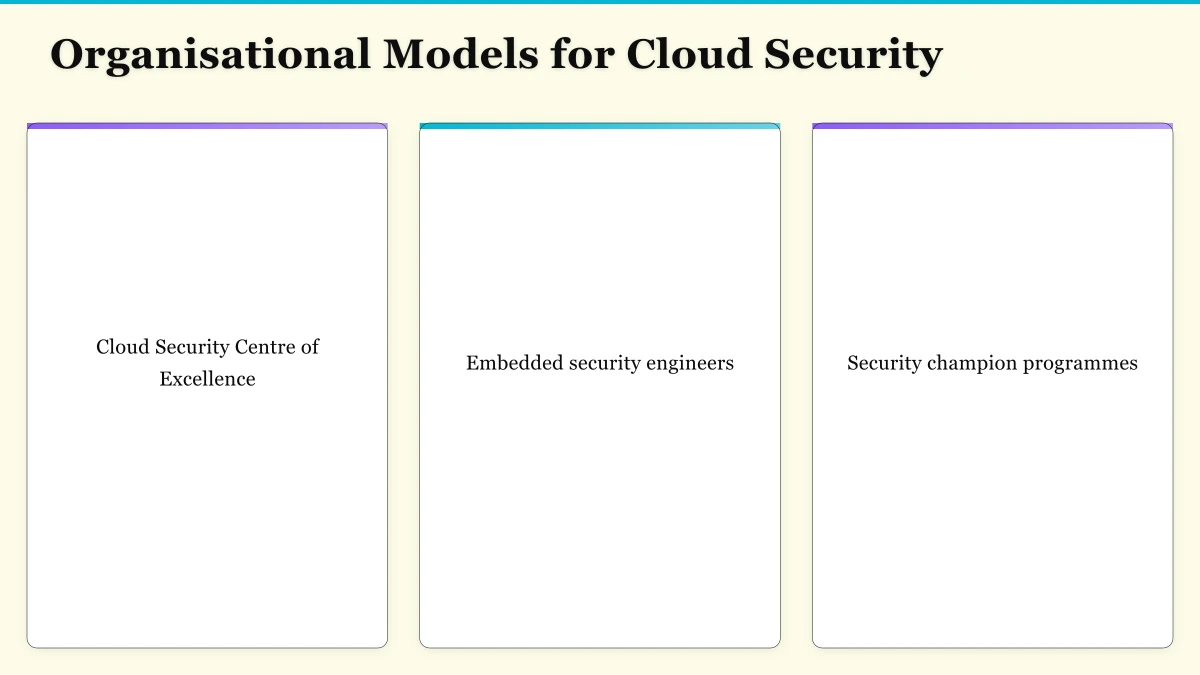
The Multi-Cloud Security Challenge
Multi-cloud environments amplify security complexity in ways that single-cloud deployments do not. Each cloud provider implements security controls differently — IAM policies, network security groups, encryption configuration, logging mechanisms, and compliance frameworks vary significantly between AWS, Azure, and GCP. Security expertise that applies to one cloud does not transfer directly to another, creating knowledge gaps that misconfigurations exploit.
The configuration surface area is enormous. A typical enterprise AWS account contains thousands of configurable resources — S3 buckets, EC2 security groups, IAM policies, RDS instances, Lambda functions — each with security-relevant configuration options. Multiply this by Azure subscriptions and GCP projects, and the number of potential misconfiguration points reaches tens of thousands. Manual security review at this scale is impossible.
The pace of change compounds the challenge. Cloud resources are provisioned and modified continuously through Infrastructure as Code, CI/CD pipelines, and console interactions. A security review that identifies zero misconfigurations today may find dozens tomorrow. Point-in-time assessments are insufficient; continuous monitoring is essential.
Common misconfigurations that CSPM identifies include: publicly accessible S3 buckets or Azure Blob containers, overly permissive IAM policies (including policies that grant administrator access to service accounts), unencrypted data stores and volumes, security groups allowing unrestricted inbound access, logging and monitoring disabled on critical services, root account usage without MFA, and exposed access keys and credentials.
These misconfigurations are not theoretical risks. The Capital One breach in 2019 exploited a misconfigured web application firewall. Numerous data exposures have resulted from publicly accessible cloud storage. Enterprise cloud security incidents overwhelmingly trace back to configuration errors, not sophisticated exploitation.
CSPM Capabilities and Tooling Landscape
CSPM platforms provide several core capabilities that together create comprehensive cloud security visibility.
Configuration Assessment continuously evaluates cloud resource configurations against security benchmarks and organisational policies. CIS Benchmarks (Center for Internet Security) provide widely accepted security baselines for AWS, Azure, and GCP, covering hundreds of configuration checks across compute, storage, networking, identity, and logging services. CSPM tools automate these assessments, identifying non-compliant resources and providing remediation guidance.
Compliance Monitoring maps cloud configurations to regulatory frameworks — SOC 2, PCI DSS, HIPAA, GDPR, ISO 27001, and industry-specific standards. For enterprises in regulated industries, continuous compliance monitoring replaces periodic manual audits with real-time visibility into compliance status. This does not eliminate the need for formal audits but dramatically reduces the preparation effort and the risk of audit findings.
Risk Prioritisation addresses the overwhelming volume of findings that CSPM tools generate. A large enterprise environment may have thousands of configuration findings, and treating them all equally is operationally impractical. Advanced CSPM platforms prioritise findings based on exposure (is the resource internet-facing?), sensitivity (does it contain or access sensitive data?), blast radius (what is the impact if compromised?), and exploitability (is there a known attack path?).
Automated Remediation moves beyond detection to resolution. Some CSPM platforms can automatically fix common misconfigurations — removing public access from S3 buckets, enforcing encryption on new resources, or rotating exposed credentials. Automated remediation requires careful implementation to avoid disrupting legitimate configurations, but for clear-cut violations (public access on a storage bucket tagged as internal-only), automation significantly reduces exposure time.
Multi-Cloud Visibility provides a unified security view across AWS, Azure, and GCP. Rather than managing separate security tools for each cloud, multi-cloud CSPM platforms normalise findings across providers, enabling consistent security policies and consolidated reporting. This is essential for enterprises operating across multiple clouds, where provider-specific tools create visibility silos.
The tooling landscape includes cloud-native services (AWS Security Hub, Azure Security Center, Google Security Command Center), dedicated CSPM platforms (Wiz, Orca Security, Lacework, Prisma Cloud), and broader cloud security platforms that include CSPM alongside other capabilities (CrowdStrike Falcon Cloud Security, Check Point CloudGuard). Cloud-native services provide good coverage for single-cloud environments; dedicated CSPM platforms provide deeper multi-cloud capabilities.
Implementing CSPM in Enterprise Environments
Successful CSPM implementation requires more than tool deployment. It demands organisational alignment, process integration, and sustained operational commitment.
Establish a security baseline before deploying CSPM by defining the security policies that CSPM will enforce. Start with CIS Benchmarks as a foundation and customise for organisational requirements — industry regulations, internal security standards, and risk tolerance. Policy definition is a collaborative exercise involving security, cloud engineering, and compliance teams.
Deploy in assessment mode first, generating findings without automated remediation. The initial assessment will likely reveal thousands of findings, many of which may represent legitimate configurations or accepted risks. The triage process — categorising findings as violations to remediate, accepted risks to document, or false positives to suppress — establishes the operational reality of CSPM management.
Integrate with existing workflows rather than creating separate security processes. CSPM findings should flow into the organisation’s existing ticketing systems (Jira, ServiceNow), alerting channels (Slack, PagerDuty), and governance processes. Critical findings should trigger immediate incident response. Medium-severity findings should create engineering tickets with defined SLA timelines. Low-severity findings should inform security posture dashboards and trend analysis.
Shift left by integrating CSPM into CI/CD pipelines. Tools like Checkov, tfsec, and Bridgecrew scan Infrastructure as Code templates before deployment, preventing misconfigurations from reaching production. This pre-deployment scanning is far more efficient than post-deployment detection and remediation, as it catches issues when they are cheapest to fix.
Establish ownership and accountability for cloud security findings. The most effective model assigns remediation responsibility to the team that owns the cloud resource, with the security team providing guidance and tracking. Centralising remediation in the security team creates a bottleneck and disconnects security from the engineering context needed for effective remediation.
Organisational Models for Cloud Security
The organisational model for cloud security in multi-cloud enterprises is as important as the tooling.
Cloud Security Centre of Excellence provides a centralised team that defines policies, manages CSPM tooling, and monitors overall security posture. This team does not remediate findings directly but ensures that resource-owning teams have the guidance, tooling, and motivation to maintain security standards. The centre of excellence model works well for organisations with strong engineering culture and distributed accountability.
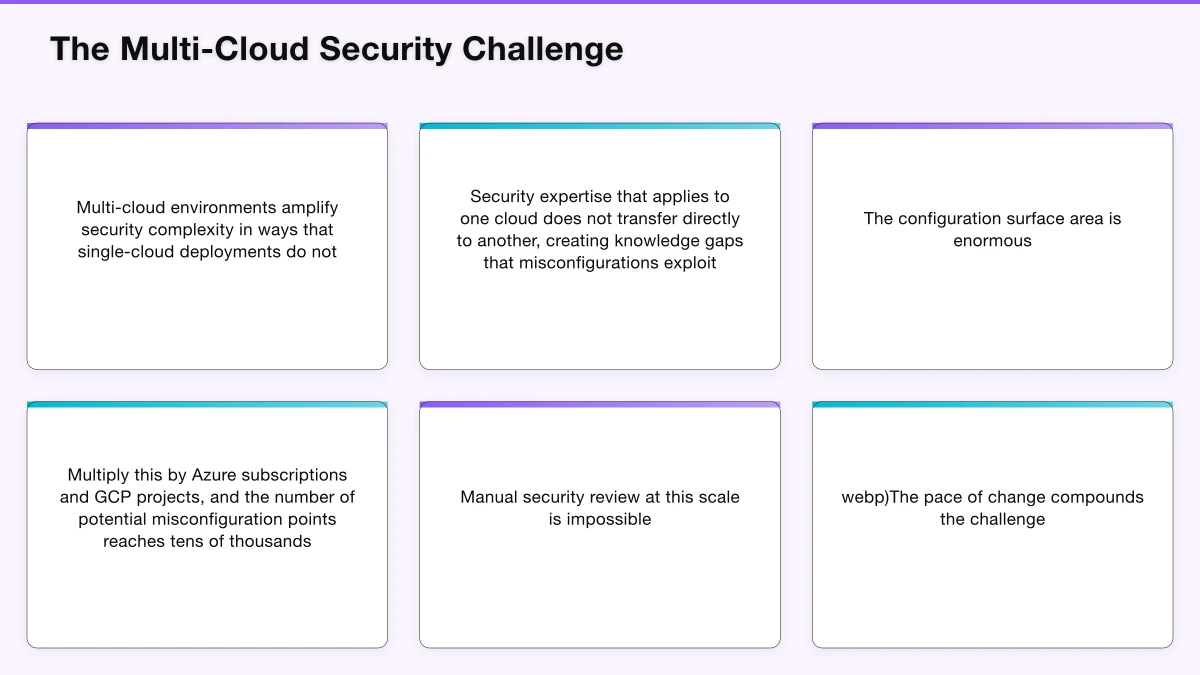
Embedded security engineers places security specialists within cloud engineering and application teams. These embedded engineers bring security expertise to day-to-day engineering decisions, conducting architecture reviews, guiding secure configuration, and ensuring that security is considered throughout the development lifecycle. This model is resource-intensive but produces the best security outcomes.
Security champion programmes train engineers within each team to serve as security advocates. Champions receive additional security training, participate in security community meetings, and serve as the first point of contact for security questions within their teams. This model scales better than embedded security engineers while maintaining distributed security awareness.
Most enterprises benefit from a combination: a central cloud security team managing CSPM tooling and policy, with security champions in engineering teams providing distributed awareness and accountability.
Conclusion
Cloud Security Posture Management is a non-negotiable capability for enterprises operating in multi-cloud environments. The configuration complexity, pace of change, and consequence of misconfigurations demand continuous, automated monitoring that manual processes cannot provide.
For CTOs investing in cloud security in 2022, CSPM should be among the highest priorities. The tooling has matured significantly, with both cloud-native and third-party options providing comprehensive coverage. The greater challenge is organisational: establishing policies, integrating with workflows, assigning accountability, and building the culture of security awareness that sustainable cloud security requires.
The enterprises that invest in CSPM now will build the security foundations that their growing cloud portfolios demand. Those that defer will accumulate security debt that becomes exponentially more expensive to address as cloud adoption expands.
The strategic frameworks I discuss here come to life through execution. Cloud Geeks covers the practical side of cloud infrastructure and IT management.
As founder of Ganda Tech Services, I work with Australian businesses to align technology investments with business growth — across cloud, web, and mobile.
About the Author
Ashish Ganda is the founder of Ganda Tech Services, a Sydney-based technology consultancy specialising in cloud infrastructure, web development, and mobile app solutions for Australian businesses.
Digital Transformation Roadmap 2026
A 12-month framework for Australian SMBs ready to modernise — phases, tools, and milestones.
Almost done
Check your inbox and click the confirmation link to get your download.