Cloud-Native Security Posture Management: A Strategic Guide for Enterprise CTOs
The cloud security landscape has fundamentally transformed. As enterprises push more workloads into multi-cloud environments, traditional perimeter-based security models have become not just inadequate but dangerously obsolete. The attack surface has expanded exponentially, with ephemeral containers, serverless functions, and infrastructure-as-code creating complexity that manual security processes cannot address. For enterprise CTOs, mastering Cloud-Native Application Protection Platforms (CNAPP) and Cloud Security Posture Management (CSPM) has become a strategic imperative that directly impacts business resilience and competitive positioning.
The stakes have never been higher. IBM’s 2016 Cost of a Data Breach Report found that cloud-based breaches now account for 45% of all incidents, with average costs exceeding $5.17 million per breach. Yet organizations with mature CSPM implementations reduce breach likelihood by 60% and detection time by 80%. This is not merely a technology decision; it is a fundamental business risk calculation that demands executive attention and strategic investment.
Understanding the Cloud Security Posture Landscape
The convergence of multiple security disciplines into unified platforms represents a significant architectural evolution. Where enterprises previously deployed separate tools for vulnerability scanning, configuration management, identity governance, and threat detection, modern CNAPP solutions integrate these capabilities into cohesive platforms that provide visibility across the entire cloud estate.
The CNAPP Evolution: Cloud-Native Application Protection Platforms emerged from the recognition that cloud security requires purpose-built approaches rather than adapted legacy tools. Gartner’s definition encompasses workload protection, configuration management, network security, and identity analytics within a unified platform. The market has consolidated rapidly, with major acquisitions bringing comprehensive capabilities under single vendors. Palo Alto’s acquisition of Orca Security, Microsoft’s Defender for Cloud expansion, and CrowdStrike’s Falcon Cloud Security represent this consolidation trend.
For CTOs evaluating these platforms, the key differentiator is integration depth rather than feature checklists. Platforms that share context across security functions—correlating configuration drift with vulnerability data and runtime behavior—provide dramatically better signal-to-noise ratios than loosely coupled point solutions. Security teams drowning in alerts cannot protect the organization effectively.
CSPM as Foundation: Cloud Security Posture Management forms the foundational layer of cloud security strategy. CSPM continuously monitors cloud configurations against security benchmarks, compliance frameworks, and organizational policies. This automated assessment identifies misconfigurations, policy violations, and drift from baseline standards before they become exploitable vulnerabilities.
The Center for Internet Security (CIS) benchmarks provide standardized configuration baselines across major cloud platforms. Organizations should implement CSPM solutions that map to these benchmarks while supporting customization for industry-specific requirements. Financial services organizations, for example, must align with PCI-DSS controls, while healthcare enterprises require HIPAA-aligned policies.
Cloud Workload Protection Platforms (CWPP): While CSPM addresses configuration and policy, CWPP protects running workloads across virtual machines, containers, and serverless functions. Runtime protection, vulnerability management, and behavioral monitoring operate at the workload level, detecting threats that configuration-based approaches cannot identify.
The integration between CSPM and CWPP creates defense-in-depth. Configuration hardening reduces attack surface while runtime protection detects exploitation attempts. Organizations lacking either capability have significant blind spots that sophisticated attackers actively exploit.
Building Enterprise CSPM Architecture
Effective CSPM implementation requires architectural decisions that balance security rigor with operational practicality. The goal is continuous security assurance without creating friction that drives shadow IT or slows business velocity.
Multi-Cloud Visibility Strategy: Most enterprises operate across multiple cloud providers, creating fragmented visibility that attackers exploit. AWS, Azure, and Google Cloud each present different security models, configuration options, and compliance requirements. Effective CSPM must normalize security posture assessment across providers while respecting platform-specific controls.
This requires a central security data lake aggregating findings across cloud environments, normalized severity scoring enabling consistent prioritization, and unified dashboards providing executive visibility into organizational security posture. Leading organizations implement cloud-agnostic CSPM platforms while maintaining provider-specific expertise within security teams.
Configuration Baseline Management: Security posture management begins with defining acceptable configurations. This involves establishing baseline policies aligned to security frameworks, implementing automated assessment against these baselines, detecting and alerting on configuration drift, and providing remediation guidance or automated correction.
Baseline policies should be version-controlled and reviewed regularly as cloud provider capabilities evolve. AWS, Azure, and Google Cloud release new services and configuration options continuously; baselines must evolve accordingly to address emerging capabilities and threats.
Infrastructure as Code Security Integration: Modern cloud deployments increasingly leverage Terraform, CloudFormation, Pulumi, and similar infrastructure-as-code tools. Shifting security left into the development pipeline prevents misconfigurations from reaching production environments.
This requires CSPM integration with CI/CD pipelines, scanning IaC templates before deployment, policy-as-code frameworks enabling developer self-service, and guardrails preventing policy-violating deployments. Organizations implementing IaC security scanning report 70% reduction in production misconfigurations compared to runtime-only detection approaches.
Compliance Automation at Scale
Regulatory compliance drives significant cloud security investment, yet manual compliance processes cannot scale to cloud velocity. Automated compliance assessment and evidence collection transform compliance from periodic projects into continuous assurance.
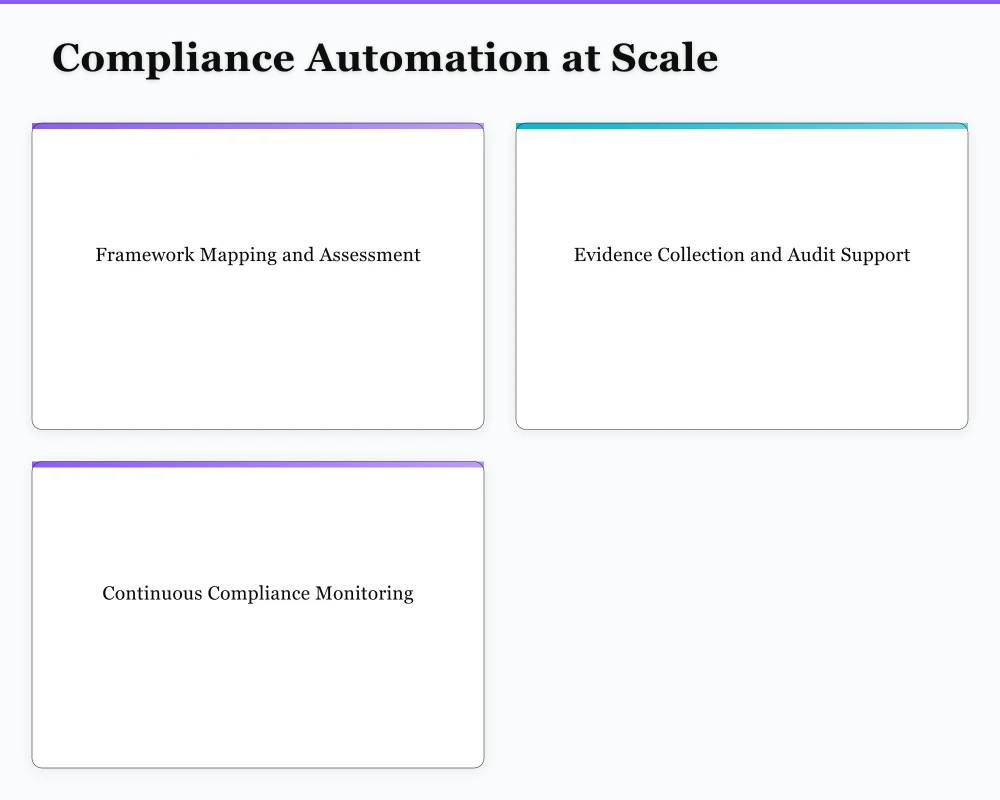
Framework Mapping and Assessment: Enterprise CSPM implementations must map security controls to relevant compliance frameworks. This typically includes industry standards like SOC 2, ISO 27001, and NIST Cybersecurity Framework, regulatory requirements including GDPR, HIPAA, PCI-DSS, and Australian Privacy Act, and internal policies and risk management frameworks.
Automated mapping enables continuous compliance assessment rather than point-in-time audits. Organizations can identify compliance gaps immediately when configurations drift, enabling rapid remediation before audit cycles.
Evidence Collection and Audit Support: Compliance audits require evidence demonstrating control effectiveness. Manual evidence collection consumes significant security team bandwidth and often produces incomplete documentation. Automated evidence collection through CSPM platforms provides continuous evidence generation, historical compliance posture tracking, audit-ready reporting and documentation, and gap analysis against compliance requirements.
This automation reduces audit preparation time by 60-80% while improving evidence quality and completeness.
Continuous Compliance Monitoring: Point-in-time compliance assessments provide false assurance. Between assessments, configurations drift, new resources deploy, and compliance posture degrades. Continuous monitoring identifies compliance issues within minutes of occurrence rather than months later during audits.
Leading organizations implement compliance dashboards visible to both security teams and business stakeholders, automated alerting on compliance violations, trend analysis showing posture improvement or degradation, and executive reporting enabling governance oversight.
Identity and Access Management Integration
Cloud security incidents frequently involve identity compromise or excessive permissions. Integrating identity analytics into CSPM provides visibility into access patterns and permission sprawl that configuration-based approaches miss.
Permission Analysis and Right-Sizing: Cloud environments accumulate excessive permissions over time. Developers request broad permissions during development, then retain them in production. Service accounts accumulate permissions across projects. The result is attack surface expansion through permission sprawl.
Effective CSPM includes permission analysis identifying unused permissions and excessive access, recommendations for permission right-sizing, detection of permission escalation paths, and service account privilege monitoring.
Google Cloud’s IAM Recommender, AWS IAM Access Analyzer, and Azure AD access reviews provide native capabilities, while CNAPP platforms offer cross-cloud permission visibility.
Identity Threat Detection: Beyond static permission analysis, behavioral analytics identify identity-based threats. Unusual access patterns, impossible travel scenarios, and privilege escalation attempts indicate potential compromise.
This requires integration between CSPM platforms and identity providers, correlation of access events with resource changes, and machine learning models establishing behavioral baselines and detecting anomalies.
Container and Kubernetes Security Posture
Container adoption continues accelerating, with Kubernetes becoming the de facto orchestration standard. Container environments introduce security challenges that traditional approaches cannot address, requiring specialized posture management capabilities.
Image Security and Registry Scanning: Container security begins before deployment through image scanning and registry management. Vulnerable base images, embedded secrets, and malicious packages must be detected before production deployment.
Effective container security includes registry scanning for vulnerabilities and misconfigurations, software bill of materials (SBOM) generation and analysis, image signing and verification ensuring deployment integrity, and base image management reducing vulnerability surface.
Kubernetes Configuration Management: Kubernetes introduces extensive configuration complexity with security implications. Network policies, RBAC configurations, pod security standards, and admission controls require continuous assessment.
The NSA/CISA Kubernetes Hardening Guide provides baseline configuration recommendations that CSPM solutions should assess against. Common misconfigurations include overly permissive network policies, excessive service account privileges, missing resource limits enabling denial-of-service, and insufficient pod security restrictions.
Runtime Container Protection: Container runtime protection detects threats during execution that static analysis cannot identify. This includes process monitoring detecting unexpected executions, file integrity monitoring identifying unauthorized changes, network behavior analysis detecting lateral movement, and cryptomining detection protecting infrastructure resources.
The ephemeral nature of containers makes traditional endpoint protection approaches ineffective. Purpose-built container security agents provide lightweight, effective protection without compromising container performance.
Threat Detection and Response Integration
Security posture management identifies vulnerabilities and misconfigurations; threat detection identifies active exploitation. Integrating these capabilities provides complete visibility from prevention through detection and response.
Cloud-Native Threat Detection: Cloud providers offer native threat detection services including AWS GuardDuty, Azure Defender, and Google Cloud Security Command Center. These services leverage provider telemetry unavailable to third-party tools, providing detection capabilities that complement CNAPP platforms.
Effective architecture integrates native detection with CNAPP platforms, correlating alerts across sources and reducing duplicate findings. This requires alert aggregation and deduplication, enrichment with CSPM context linking threats to vulnerable configurations, and automated response workflows triggered by high-confidence detections.
Security Operations Integration: CSPM findings must flow into security operations workflows. Integration with SIEM platforms, SOAR tools, and ticketing systems ensures findings drive remediation rather than accumulating in dashboards.
This integration includes automated ticket creation for high-severity findings, SIEM correlation linking posture issues with threat detections, SOAR playbooks automating common remediation actions, and metrics tracking time-to-remediation and finding recurrence.
Incident Response Preparation: Security posture management supports incident response through baseline documentation. When incidents occur, responders need rapid understanding of what changed and what the normal state should be.
CSPM provides configuration history enabling change correlation, baseline documentation for rapid anomaly identification, and compliance status affecting regulatory notification requirements.
Organizational and Governance Considerations
Technology alone cannot ensure cloud security. Organizational structures, processes, and accountability frameworks determine whether CSPM investments deliver value.
Security Team Evolution: Cloud-native security requires different skills than traditional security operations. Security teams must understand cloud architecture, infrastructure-as-code, and DevOps workflows to effectively secure modern environments.
This evolution includes training programs building cloud security expertise, embedding security engineers within cloud platform teams, collaborative relationships with development organizations, and cloud-native tooling replacing legacy security approaches.
Shared Responsibility Model Clarity: Cloud security operates under shared responsibility models where providers secure infrastructure while customers secure workloads and configurations. Confusion about responsibility boundaries creates security gaps.
CTOs must ensure organizational understanding of provider versus customer responsibilities, clear ownership of security controls within customer scope, documented processes for managing shared responsibility boundaries, and regular review as cloud adoption patterns evolve.
Security as Enabler: Security organizations that operate as barriers to cloud adoption drive shadow IT and reduce organizational security. Effective cloud security teams enable secure cloud adoption through guardrails, self-service security tools, and developer-friendly security processes.
This requires automated security gates that provide immediate feedback, self-service security scanning developers can invoke independently, clear documentation of security requirements and acceptable patterns, and exception processes for legitimate business needs.
Strategic Implementation Recommendations
Enterprise CSPM implementation should follow phased approaches that deliver incremental value while building toward comprehensive security posture management.
Phase 1: Visibility and Assessment (Months 1-3): Establish comprehensive visibility across cloud environments. Deploy CSPM tooling across all cloud accounts and subscriptions. Implement baseline assessment against CIS benchmarks and relevant compliance frameworks. Create executive dashboards showing organizational security posture.
This phase identifies the magnitude of existing security debt and establishes baselines for improvement measurement.
Phase 2: Prioritized Remediation (Months 3-6): Address critical and high-severity findings through prioritized remediation programs. Implement automated remediation for well-understood issues. Establish processes for ongoing finding triage and remediation tracking. Begin infrastructure-as-code security integration.
Focus on reducing critical findings to near-zero while building processes for sustainable posture management.
Phase 3: Shift-Left Integration (Months 6-12): Integrate security assessment into development pipelines. Implement policy-as-code frameworks enabling developer self-service. Deploy container and Kubernetes security capabilities. Establish continuous compliance monitoring and automated evidence collection.
This phase prevents new security debt accumulation while maintaining remediation progress on existing issues.
Phase 4: Advanced Detection and Response (Months 12-18): Integrate threat detection with posture management. Implement identity analytics and behavioral monitoring. Deploy advanced container runtime protection. Establish security operations integration and automated response capabilities.
This phase completes the security posture management architecture, enabling both prevention and detection.
Measuring Security Posture Effectiveness
Effective measurement demonstrates value and identifies improvement opportunities. Key metrics for CSPM programs include:
Posture Metrics: Track critical and high findings over time, mean time to remediation by severity, compliance coverage across frameworks, and configuration drift frequency and duration.
Operational Metrics: Measure false positive rates and alert fatigue indicators, time from finding to remediation, percentage of findings remediated automatically, and developer engagement with shift-left tools.
Business Metrics: Monitor security incidents correlated with posture findings, audit findings and remediation costs, and cloud security investment versus risk reduction.
Regular reporting on these metrics to executive leadership ensures continued investment and organizational commitment to security posture improvement.
Looking Forward: The Evolving Cloud Security Landscape
Cloud security continues evolving rapidly. Emerging trends that CTOs should monitor include AI-powered security operations using machine learning for threat detection and automated response, expanded CNAPP scope incorporating data security posture management (DSPM), increased regulatory requirements driving compliance automation investment, and platform consolidation reducing tool sprawl while increasing vendor dependency.
Organizations that establish robust CSPM foundations today position themselves to adopt emerging capabilities efficiently as the market evolves.
The strategic imperative is clear: cloud security posture management is no longer optional for enterprises operating at scale. The organizations that master CNAPP and CSPM capabilities will operate more securely, achieve compliance more efficiently, and enable business velocity that competitors cannot match. The time to invest is now, before security debt accumulates to unmanageable levels.
Sources
- IBM Security. (2016). Cost of a Data Breach Report 2016. IBM Corporation.
- Gartner. (2016). Market Guide for Cloud-Native Application Protection Platforms. Gartner Research.
- Center for Internet Security. (2016). CIS Benchmarks for Cloud Providers. https://www.cisecurity.org/cis-benchmarks
- National Security Agency & Cybersecurity and Infrastructure Security Agency. (2016). Kubernetes Hardening Guide. NSA/CISA.
- Cloud Security Alliance. (2016). Cloud Controls Matrix v4. https://cloudsecurityalliance.org/research/cloud-controls-matrix
Ash Ganda is a technology executive specializing in enterprise cloud architecture and security strategy. Connect on LinkedIn to discuss cloud security posture management for your organization.
Need to put cloud strategy into action? Cloud Geeks provides in-depth guides on AWS, Azure, and cybersecurity for Australian SMBs.
These insights are drawn from my work leading Ganda Tech Services — helping Australian businesses navigate digital transformation through cloud, web, and mobile.
About the Author
Ashish Ganda is the founder of Ganda Tech Services, a Sydney-based technology consultancy specialising in cloud infrastructure, web development, and mobile app solutions for Australian businesses.
Digital Transformation Roadmap 2026
A 12-month framework for Australian SMBs ready to modernise — phases, tools, and milestones.
Almost done
Check your inbox and click the confirmation link to get your download.