OWASP Top 10 for Enterprise: Security Patterns Every Cloud Architect Should Implement
Security as Architecture, Not Afterthought
Security incidents rarely surprise security teams. They surprise everyone else.
When post-mortems reveal the root cause—unvalidated input, broken access control, exposed credentials—security professionals nod knowingly. These vulnerabilities appear in every penetration test, every code review, every risk assessment. They persist because security is treated as a checklist to complete before launch rather than a design constraint to satisfy during architecture.
The OWASP Top 10 represents the most common and impactful web application vulnerabilities. For cloud architects, it’s a design specification. Every architectural decision—from API gateway configuration to database access patterns—either prevents or enables these vulnerabilities.
This post examines each OWASP Top 10 category through an enterprise cloud architecture lens. Not just what the vulnerability is, but what architectural patterns prevent it at the infrastructure level rather than relying on individual developer discipline.
A01:2018 – Broken Access Control
Access control failures now top the OWASP list, appearing in 94% of applications tested. The pattern is consistent: users accessing resources they shouldn’t, escalating privileges they weren’t granted, bypassing controls that should have stopped them.
The Architectural Problem
Traditional access control implementations suffer from three structural weaknesses:
- Distributed enforcement: Every service implements its own access checks, creating inconsistency.
- Implicit trust: Internal services trust each other without verification.
- Coarse granularity: Users get broad access when they need specific permissions.
Architectural Patterns
Centralised Policy Decision Points
Implement a centralised authorisation service that all access decisions flow through:
[Request] -> [API Gateway] -> [Policy Decision Point] -> [Resource Service]
                                      |
                                      v
                              [Policy Information Point]
                              (User attributes, roles, policies)
Open Policy Agent (OPA) or cloud-native solutions (AWS IAM, Azure RBAC, GCP IAM) provide the infrastructure. The architectural discipline is ensuring every service consults this authority.
Zero Trust Service Mesh
Within your service mesh, require mutual TLS and service identity verification for every internal call. Istio, Linkerd, and cloud-native meshes provide this capability:
- Every service has a cryptographic identity
- Every call is authenticated and authorised
- Network position doesn’t confer trust
Attribute-Based Access Control
Move beyond role-based access to attribute-based policies that consider context:
allow if:
  user.department == resource.owner_department AND
  user.clearance_level >= resource.sensitivity AND
  request.time within business_hours AND
  request.location in allowed_regions
This granularity prevents over-permissioning while maintaining operational flexibility.
Audit Everything
Access control failures you don’t detect become breaches. Log every access decision—grants and denials—with sufficient context for investigation:
- Who requested access (identity, roles, attributes)
- What resource was targeted
- What action was attempted
- Whether access was granted or denied
- Why the decision was made (policy reference)
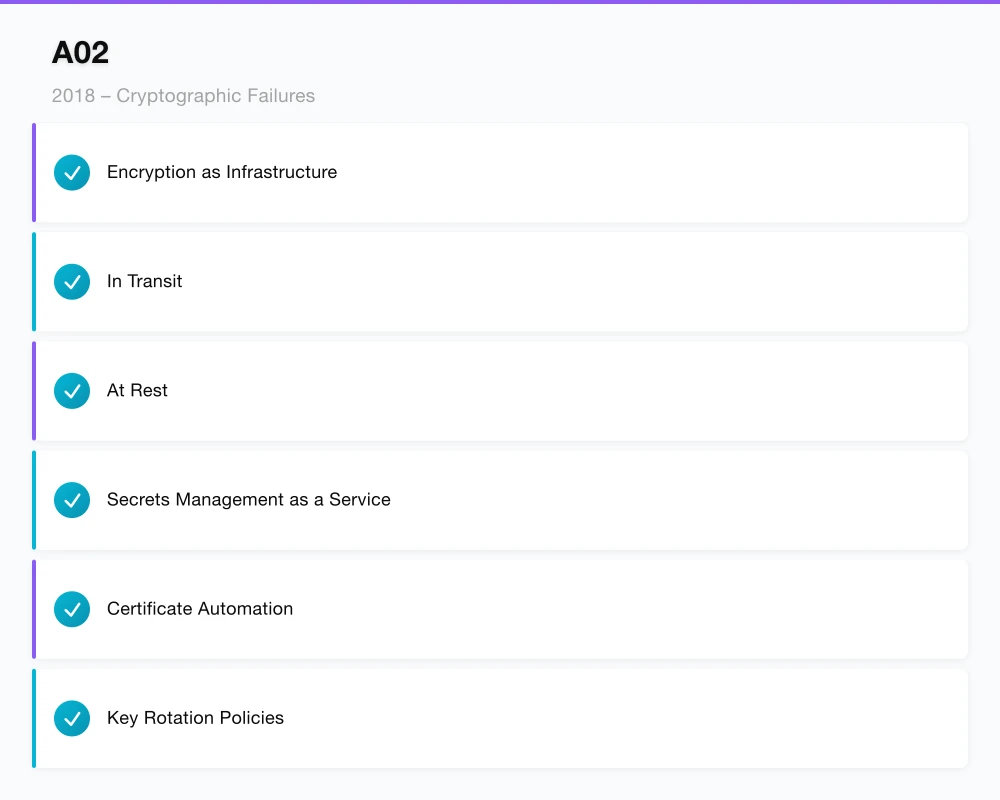
A02:2018 – Cryptographic Failures
Previously called “Sensitive Data Exposure,” this category addresses failures in cryptographic protection—data transmitted in cleartext, weak algorithms, poor key management, exposed credentials.
The Architectural Problem
Cryptography is easy to implement poorly. Developers choose deprecated algorithms, store keys alongside data, forget to enable TLS for internal traffic, and reinvent cryptographic protocols that experts have spent decades perfecting.
Architectural Patterns
Encryption as Infrastructure
Remove cryptographic decisions from application code by encrypting at the infrastructure layer:
In Transit:
- Terminate TLS at load balancers with managed certificates (ACM, GCP-managed SSL)
- Enforce minimum TLS 1.2 with strong cipher suites
- Enable mutual TLS for service-to-service communication in the mesh
At Rest:
- Use cloud-native encryption (S3 default encryption, RDS encryption, EBS encryption)
- Enable encryption by default; require explicit opt-out with justification
- Implement field-level encryption for sensitive data beyond volume encryption
Secrets Management as a Service
Centralise credential storage in dedicated secrets managers:
[Application] -> [Secrets Manager API] -> [Encrypted Secret Store]
                        |
                        v
                 [Audit Logging]
AWS Secrets Manager, HashiCorp Vault, Azure Key Vault, and GCP Secret Manager provide:
- Encryption at rest with hardware security modules
- Rotation automation without application changes
- Access auditing and alerting
- Versioning and rollback
Certificate Automation
Manual certificate management leads to expired certificates in production and expired certificates lead to outages or disabled security controls. Automate certificate lifecycle:
- Use ACME-compatible CAs (Let’s Encrypt for public, internal CA for private)
- Deploy cert-manager in Kubernetes environments
- Alert on certificates approaching expiration, not after
Key Rotation Policies
Cryptographic keys should rotate regularly:
- Encryption keys: 90-day rotation minimum
- API keys: 30-day rotation or on personnel changes
- Service account credentials: Automatic rotation through cloud IAM
Design systems to handle key rotation without downtime—typically through key versioning and graceful transition periods.
A03:2018 – Injection
Injection attacks occur when untrusted data is sent to an interpreter as part of a command or query. SQL injection gets the headlines, but command injection, LDAP injection, and template injection follow the same pattern.
The Architectural Problem
Injection vulnerabilities persist because every data boundary is a potential injection point. User input, API requests, file uploads, message queue payloads—any data that flows through interpreters can carry malicious payloads.
Architectural Patterns
Input Validation at the Edge
Validate and sanitise input before it enters your system, not at each service that consumes it:
[Internet] -> [WAF] -> [API Gateway] -> [Input Validation Service] -> [Application Services]
              |           |                      |
              v           v                      v
         Block attacks   Rate limit         Reject malformed
                         Auth verify        Sanitise content
Web Application Firewalls (AWS WAF, Cloudflare, Imperva) provide first-line defence:
- OWASP Core Rule Set blocks common attack patterns
- Custom rules address application-specific threats
- Managed rule updates adapt to emerging attacks
Parameterised Everything
At the code level, parameterised queries are non-negotiable. But architecture can enforce this:
- Database access through ORMs that mandate parameterisation
- Stored procedures for complex operations (attack surface reduction)
- Database user permissions limited to required operations (no raw DDL)
Content Type Enforcement
Reject requests that don’t match expected content types:
- API expects JSON; reject XML, form-encoded, and other formats
- Strict Content-Type validation prevents parser confusion attacks
- Binary upload validation through magic bytes, not just extensions
Sandboxed Interpretation
When user-provided code or templates must execute:
- Isolated runtime environments (containers, VMs, WebAssembly)
- Resource limits (CPU, memory, network, filesystem)
- Allowlisted operations and APIs
- Timeout enforcement
A04:2018 – Insecure Design
This new category addresses fundamental design flaws that can’t be fixed by perfect implementation. Security requirements missing from architecture, threat modelling never performed, defence-in-depth not considered.
The Architectural Problem
Insecure design manifests as “we didn’t think about that” during incident response. The system works as designed; the design just didn’t account for adversarial conditions.
Architectural Patterns
Threat Modelling as Architecture Practice
Integrate STRIDE or other threat modelling methodologies into architecture review:
For every component, ask:
- Spoofing: Can attackers impersonate legitimate entities?
- Tampering: Can data be modified inappropriately?
- Repudiation: Can users deny actions they took?
- Information disclosure: Can data leak inappropriately?
- Denial of service: Can availability be compromised?
- Elevation of privilege: Can attackers gain unauthorised access?
Document mitigations in architecture decision records.
Defence in Depth
Design multiple independent security layers. If one fails, others contain the damage:
Layer 1: Network (WAF, DDoS protection, network segmentation)
Layer 2: Identity (Authentication, MFA, identity verification)
Layer 3: Access (Authorisation, RBAC, attribute-based policies)
Layer 4: Application (Input validation, output encoding, secure coding)
Layer 5: Data (Encryption, tokenisation, data masking)
Layer 6: Detection (Logging, monitoring, anomaly detection)
No single layer provides complete protection. All layers together create attacker friction that delays, detects, or prevents compromise.
Failure Mode Analysis
For each security control, document:
- How can this control fail?
- How would we detect that failure?
- What compensating controls exist?
This analysis reveals single points of failure in security architecture.
A05:2018 – Security Misconfiguration
The most common vulnerability in real-world systems: default credentials unchanged, unnecessary features enabled, error messages revealing internals, cloud storage publicly accessible.
The Architectural Problem
Secure configuration is a continuous process, not a one-time activity. Systems drift from secure baselines. New deployments miss hardening steps. Cloud resources provision with dangerous defaults.
Architectural Patterns
Infrastructure as Code with Security Policies
Define infrastructure through code and enforce security policies in the deployment pipeline:
# Terraform with OPA policy enforcement
resource "aws_s3_bucket" "data" {
  bucket = "my-data-bucket"

  # These settings enforced by policy, not just convention
  versioning {
    enabled = true
  }

  server_side_encryption_configuration {
    rule {
      apply_server_side_encryption_by_default {
        sse_algorithm = "aws:kms"
      }
    }
  }
}

# Policy (enforced in CI/CD)
deny[msg] {
  input.resource_type == "aws_s3_bucket"
  not input.config.server_side_encryption_configuration
  msg := "S3 buckets must have encryption enabled"
}
Continuous Configuration Scanning
Cloud security posture management (CSPM) tools continuously scan for misconfigurations:
- AWS Config, Azure Policy, GCP Security Command Centre for cloud-native
- Third-party tools (Prisma Cloud, Wiz, Lacework) for multi-cloud
- CIS Benchmarks as baseline configuration standards
Alert on drift from secure baselines, not just new deployments.
Minimal Base Images
Container images should contain only required components:
- Distroless or Alpine-based images reduce attack surface
- No package managers in production images
- No shell access unless explicitly required
- Regular rebuilds incorporate security patches
Environment Parity
Configuration differences between environments create security gaps. Production hardening that doesn’t exist in staging leads to vulnerabilities that testing doesn’t catch:
- Identical security configurations across all environments
- Secrets differ; security controls don’t
- Production restrictions replicated in lower environments
A06:2018 – Vulnerable and Outdated Components
Software supply chain security: using libraries with known vulnerabilities, failing to update dependencies, running unpatched systems.
The Architectural Problem
Modern applications depend on hundreds of libraries. Tracking vulnerabilities across this dependency tree manually is impossible. Automated tooling is essential but insufficient without architectural support.
Architectural Patterns
Software Composition Analysis in CI/CD
Scan dependencies for known vulnerabilities before deployment:
[Code Commit] -> [Build] -> [SCA Scan] -> [Deploy]
                               |
                               v
                    Block if critical vulnerabilities
                    Warn if moderate vulnerabilities
                    Track all findings in security dashboard
Tools: Snyk, Dependabot, OWASP Dependency-Check, Trivy
Dependency Update Automation
Automated pull requests for dependency updates:
- Dependabot, Renovate for source dependencies
- Container image updates through base image monitoring
- Automated testing validates updates don’t break functionality
Internal Registry with Scanning
Don’t pull directly from public registries in production:
[Public Registry] -> [Scanning] -> [Internal Registry] -> [Production]
                         |
                         v
              Reject images with critical CVEs
              Tag with scan date/results
This creates an approval gate for third-party software and enables air-gapped deployments.
Runtime Vulnerability Monitoring
Dependencies that were clean at deployment time may develop vulnerabilities later:
- Container runtime scanning (Falco, Sysdig)
- Workload vulnerability correlation with deployed inventory
- Automated patching workflows for critical vulnerabilities
A07:2018 – Identification and Authentication Failures
Previously “Broken Authentication”: credential stuffing, session hijacking, weak password policies, missing multi-factor authentication.
Architectural Patterns
Centralised Identity Provider
Consolidate authentication in a dedicated identity service:
- OIDC/OAuth 2.0 for application authentication
- SAML for legacy enterprise integrations
- Social identity providers for consumer applications
One system to harden, audit, and protect rather than authentication logic scattered across services.
Multi-Factor Authentication Everywhere
MFA should be default, not optional:
- Enforce MFA for all privileged access
- Risk-based MFA for standard users (new device, unusual location)
- Phishing-resistant options (FIDO2, passkeys) preferred over SMS
Session Security
- Short-lived access tokens (15-60 minutes)
- Secure, HTTP-only session cookies
- Session binding to client fingerprint
- Immediate invalidation on logout/password change
Credential Security
- Rate limiting on authentication endpoints
- Account lockout with intelligent unlock
- Breached password checking (Have I Been Pwned API)
- Passwordless options (passkeys, magic links)
A08:2018 – Software and Data Integrity Failures
Ensuring that software and data haven’t been tampered with: unsigned updates, unverified CI/CD pipelines, deserialisation of untrusted data.
Architectural Patterns
Signed Artefacts Throughout the Pipeline
Every build artefact should be cryptographically signed:
[Source Code] -> [Build] -> [Sign] -> [Registry] -> [Verify] -> [Deploy]
                    |          |                        |
                    v          v                        v
            Attestation    Private key           Public key
            of build       in HSM/Vault          in deploy config
Sigstore/Cosign provide open-source signing infrastructure. Cloud providers offer managed equivalents.
CI/CD Pipeline Hardening
Your CI/CD pipeline is a high-value target—compromise it, compromise everything it deploys:
- Pipeline configuration as code with code review
- Ephemeral build environments (no persistent state)
- Minimal permissions (no admin access to production)
- Audit logging of all pipeline activities
- Branch protection requiring reviews for protected branches
Dependency Verification
Verify integrity of dependencies, not just vulnerability status:
- Lock file pinning to exact versions and hashes
- Checksum verification on download
- Reproducible builds where feasible
A09:2018 – Security Logging and Monitoring Failures
The inability to detect, escalate, and respond to active attacks. Insufficient logging, ineffective alerting, missing incident response capability.
Architectural Patterns
Centralised Security Logging
Aggregate security-relevant logs into a SIEM or log analysis platform:
[Application Logs]    -> [Log Aggregation] -> [SIEM] -> [Alerting]
[Infrastructure Logs] ->         |               |           |
[Cloud Audit Logs]    ->         |               v           v
[Network Logs]        ->         |          Correlation   Response
                                 v          Detection     Workflow
                          Long-term storage
                          for forensics
What to Log:
- Authentication events (success and failure)
- Authorisation decisions
- Input validation failures
- Error conditions
- Administrative actions
- Data access patterns
Detection Engineering
Logs without analysis are just storage costs. Build detection logic:
- Known attack signatures (SQL injection patterns, credential spraying)
- Behavioural anomalies (unusual access times, data volume spikes)
- Threshold alerts (failed logins, error rates)
- Correlation rules (attack patterns across multiple sources)
Incident Response Integration
Alerts should trigger response workflows:
- Automated containment for high-confidence detections
- On-call escalation for investigation
- Runbooks for common incident types
- Integration with ticketing and communication systems
A10:2018 – Server-Side Request Forgery (SSRF)
Applications that fetch resources from user-supplied URLs can be tricked into accessing internal resources, cloud metadata services, or other unintended targets.
Architectural Patterns
Network Segmentation
Limit what internal resources are reachable from applications that make external requests:
- Dedicated egress proxies for external traffic
- No direct metadata service access (IMDSv2 with hop limit)
- Internal service discovery through controlled mechanisms
URL Validation and Allowlisting
If applications must fetch user-supplied URLs:
- Allowlist of permitted domains/IPs
- Block private IP ranges (10.0.0.0/8, 172.16.0.0/12, 192.168.0.0/16)
- Block cloud metadata services (169.254.169.254)
- DNS rebinding protection (verify resolution after validation)
Instance Metadata Protection
Cloud metadata services are primary SSRF targets:
- Enforce IMDSv2 on AWS (requires session tokens)
- Block metadata access from container workloads
- Use workload identity instead of instance credentials
Building Security Culture
Architectural patterns matter, but they require organisational support:
Security Champions Program Embed security-focused engineers in each development team. They translate security requirements into team context and provide first-line security review.
Security Architecture Review Major architecture decisions require security input before implementation, not during deployment review. Bake security requirements into the design phase.
Continuous Learning The threat landscape evolves. Security architecture must evolve with it:
- Regular security training for all engineers
- Threat intelligence feeds informing architecture decisions
- Post-incident architecture reviews
The OWASP Top 10 will change. The specific vulnerabilities will shift as some are addressed and others emerge. What won’t change is the principle: security is an architectural concern, not a feature to add later.
Enterprise architects who internalise this principle—who evaluate every design decision through a security lens—build systems that resist attack by design rather than hoping individual developers never make mistakes.
That’s the difference between organisations that read about breaches and organisations that appear in breach headlines.
Ash Ganda advises enterprise technology leaders on cloud architecture, security strategy, and digital transformation. Connect on LinkedIn for ongoing insights.
If this strategic perspective has you thinking about cloud adoption, Cloud Geeks provides the implementation detail — from AWS setup to security hardening.
Ganda Tech Services is my technology consultancy, bringing together cloud infrastructure, web development, and mobile expertise for Australian businesses.
About the Author
Ashish Ganda is the founder of Ganda Tech Services, a Sydney-based technology consultancy specialising in cloud infrastructure, web development, and mobile app solutions for Australian businesses.
Digital Transformation Roadmap 2026
A 12-month framework for Australian SMBs ready to modernise — phases, tools, and milestones.
Almost done
Check your inbox and click the confirmation link to get your download.