Cloud FinOps 2.0: Unit Economics for Cloud-Native Applications
Introduction
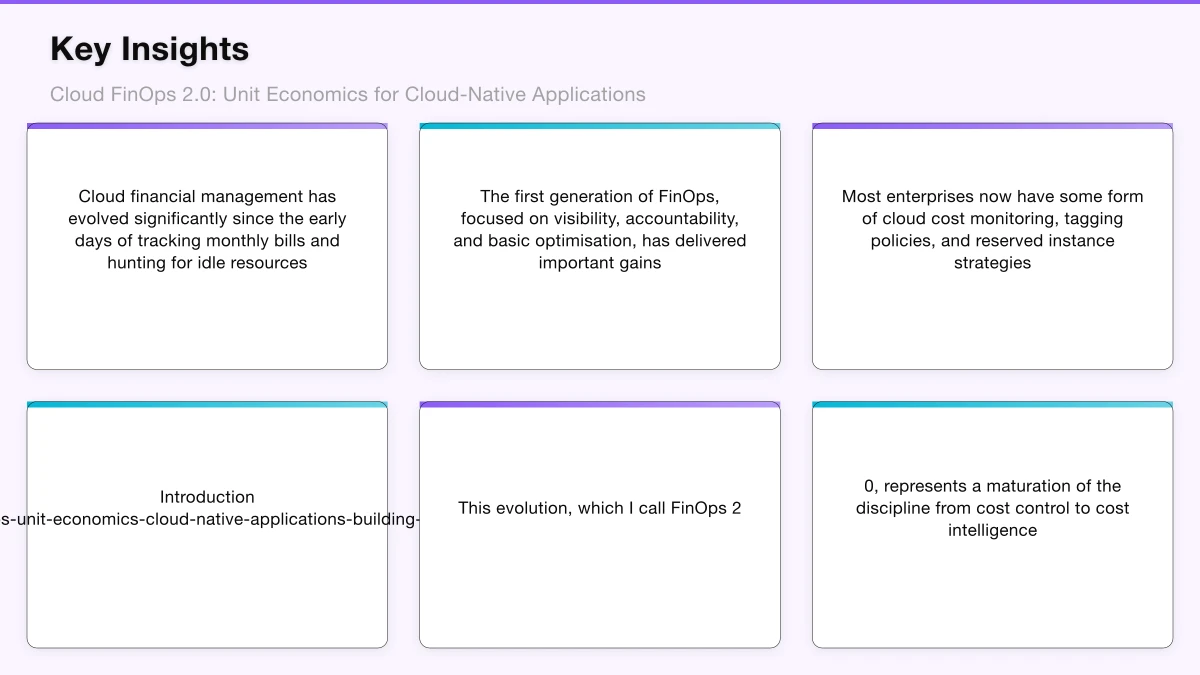
Cloud financial management has evolved significantly since the early days of tracking monthly bills and hunting for idle resources. The first generation of FinOps, focused on visibility, accountability, and basic optimisation, has delivered important gains. Most enterprises now have some form of cloud cost monitoring, tagging policies, and reserved instance strategies. Yet many CTOs find themselves in an uncomfortable position: cloud spending continues to grow faster than revenue, and it remains difficult to answer the fundamental question that the CFO keeps asking, “Are we getting value for our cloud investment?”
The answer to this question requires moving beyond cost management to cost economics, specifically, understanding the unit economics of cloud-native applications. Unit economics connects infrastructure spending to business outcomes, enabling leaders to reason about cloud investment in terms of cost per transaction, cost per customer, or cost per revenue dollar rather than raw infrastructure spending.
This evolution, which I call FinOps 2.0, represents a maturation of the discipline from cost control to cost intelligence. It requires changes in measurement, tooling, organisational structure, and mindset. For enterprise leaders managing cloud budgets that now routinely reach tens or hundreds of millions of dollars annually, this maturation is essential.
From Cost Visibility to Unit Economics
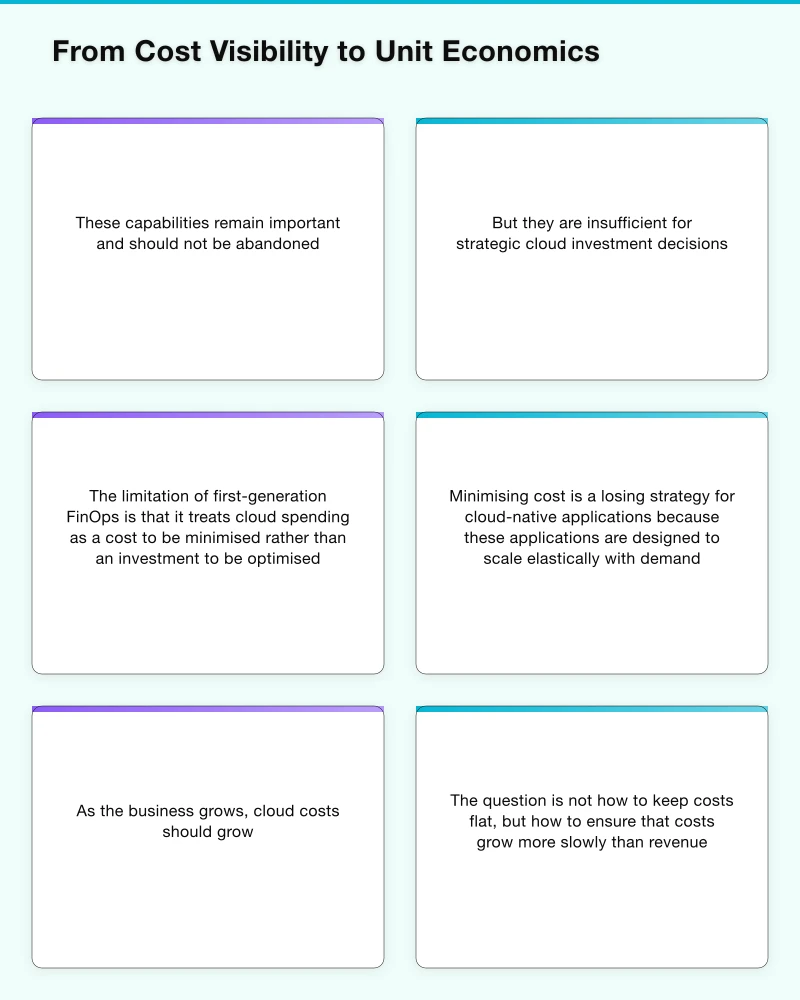
The first generation of FinOps established essential foundations: comprehensive cost visibility through tagging and allocation, accountability through chargeback or showback models, and optimisation through rightsizing, reserved instances, and waste elimination. These capabilities remain important and should not be abandoned. But they are insufficient for strategic cloud investment decisions.
The limitation of first-generation FinOps is that it treats cloud spending as a cost to be minimised rather than an investment to be optimised. Minimising cost is a losing strategy for cloud-native applications because these applications are designed to scale elastically with demand. As the business grows, cloud costs should grow. The question is not how to keep costs flat, but how to ensure that costs grow more slowly than revenue.
Unit economics provides this perspective. By dividing cloud costs by a relevant business metric, whether transactions processed, customers served, API calls handled, or revenue generated, you create a ratio that measures efficiency rather than absolute spending. This ratio can be tracked over time, benchmarked against industry peers, and used to set targets that align engineering optimisation efforts with business objectives.
Consider a practical example. A SaaS platform spends three million dollars per month on cloud infrastructure and serves one hundred thousand active customers. The unit cost is thirty dollars per customer per month. If the platform can reduce this to twenty-five dollars through architectural optimisation while maintaining service quality, the savings are five hundred thousand dollars monthly, and the improvement creates permanent margin expansion that compounds as the customer base grows. This framing makes cloud optimisation a strategic investment rather than a cost-cutting exercise.
Building the Unit Economics Framework
Implementing unit economics for cloud-native applications requires connecting three data domains that typically exist in separate systems: cloud cost data, application performance data, and business metrics data. The integration of these domains is the central technical challenge.
Cloud cost data comes from provider billing APIs and cost management tools. The key requirement is granular allocation: the ability to attribute costs to specific services, features, or customer segments rather than just organisational units or accounts. This requires disciplined tagging strategies and, increasingly, the use of tools that can allocate shared infrastructure costs like Kubernetes clusters or databases based on actual resource consumption patterns.
Application performance data provides the denominator for unit economics calculations. Transactions processed, API calls served, messages queued, bytes stored, and computation completed are all potential unit metrics depending on the application’s nature. This data typically comes from observability platforms and application-level instrumentation. The key requirement is that the performance data can be correlated with cost data at a meaningful granularity level.
Business metrics provide the strategic context. Revenue per customer, customer lifetime value, and gross margin targets transform raw unit economics into actionable business intelligence. A cost per transaction metric is useful for engineering optimisation, but a cost-as-percentage-of-revenue metric is what enables strategic conversations with the CFO and board.
The technical implementation typically involves a data pipeline that ingests cost, performance, and business data into a common analytics platform where unit economics can be calculated, visualised, and alerted on. Tools like CloudZero, Apptio Cloudability, and custom-built solutions on top of cloud provider data exports all serve this purpose. The choice depends on the scale and complexity of the environment, but the architectural pattern is consistent.
Organisational Models for FinOps 2.0
Unit economics changes the organisational model for cloud financial management. In first-generation FinOps, cost management was often centralised in a dedicated FinOps team that monitored spending and recommended optimisations to engineering teams. This model works for basic waste elimination but breaks down when optimisation requires deep understanding of application architecture and business context.
FinOps 2.0 distributes cost responsibility to the teams that make architecture and implementation decisions. Each engineering team should understand the unit economics of their services and be accountable for improving them. The central FinOps team evolves from an operational cost management function to a strategic capability that provides tooling, frameworks, and benchmarking that empower distributed teams to make good economic decisions.
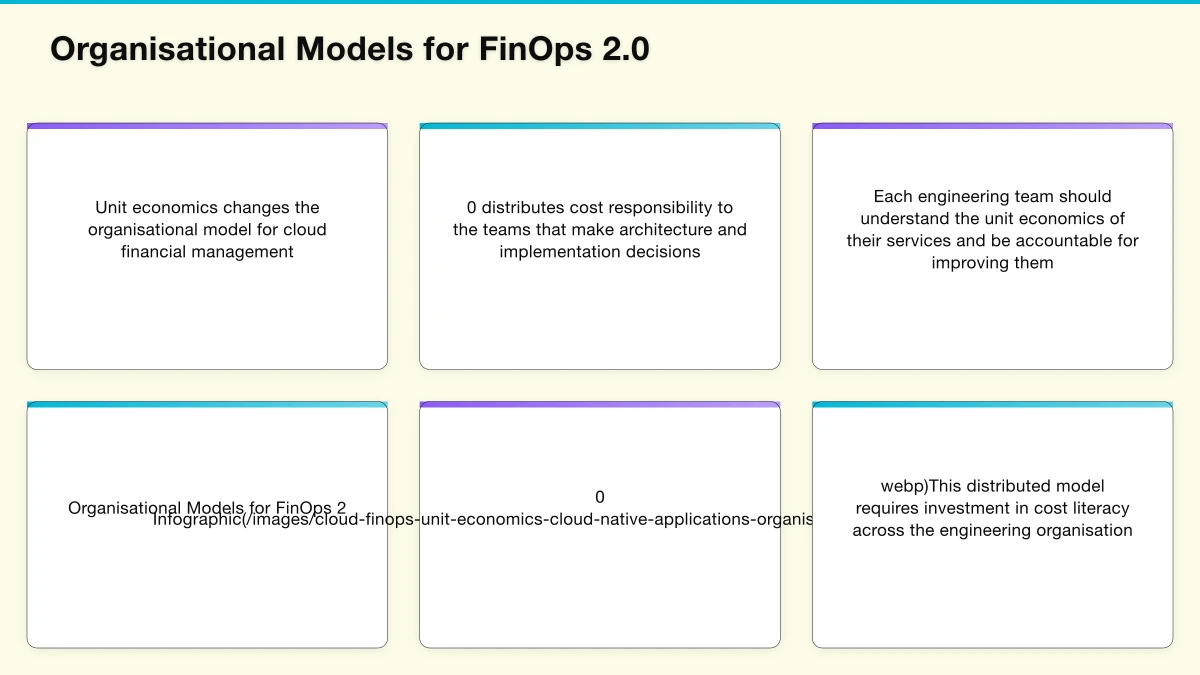
This distributed model requires investment in cost literacy across the engineering organisation. Engineers need to understand how their architectural decisions impact unit economics. Is that additional database index worth the storage cost given the query performance improvement it delivers? Should this batch job run on spot instances even though it might be interrupted? Is the convenience of a managed service worth the premium over a self-managed alternative?
These questions cannot be answered by a central FinOps team. They require engineers who understand both the technical trade-offs and the economic implications. Building this cost-aware engineering culture is the most important and most challenging aspect of FinOps 2.0.
Engineering managers play a critical role in this cultural shift. When unit economics targets are included alongside reliability and velocity metrics in team dashboards and planning processes, cost efficiency becomes a first-class engineering concern rather than an afterthought. When engineers who identify significant cost optimisations are recognised and rewarded, the organisation signals that economic thinking is valued.
Architecture-Driven Cost Optimisation
The most impactful cost optimisations come not from tweaking instance sizes or purchasing commitments, though these remain valuable, but from architectural decisions that fundamentally change the cost profile of an application.
Serverless architectures, for example, align cost directly with usage, eliminating the baseline cost of idle capacity. For workloads with variable demand patterns, the shift from provisioned infrastructure to serverless can reduce costs by fifty to seventy percent while improving scalability. However, serverless is not universally optimal. For steady-state, high-throughput workloads, provisioned infrastructure with reserved pricing often provides better unit economics.
Data tier architecture has an outsized impact on cloud costs because storage and database services frequently represent the largest portion of cloud spending. Implementing appropriate data lifecycle policies, using tiered storage strategies, and selecting the right database technology for each access pattern can dramatically improve data-related unit economics without impacting application functionality.
Caching strategies, both at the application level and the CDN level, reduce the cost of serving repeated requests. For read-heavy applications, an effective caching layer can improve unit economics by an order of magnitude by serving the vast majority of requests from low-cost cache rather than expensive compute and database resources.
Multi-tenancy architecture decisions have particularly significant implications for SaaS applications. Shared infrastructure with logical tenant isolation provides dramatically better unit economics than dedicated infrastructure per tenant, but it increases architectural complexity and may conflict with enterprise customer requirements for data isolation. The trade-off analysis should be informed by unit economics data that quantifies the cost difference between isolation models.
The Strategic Conversation
Ultimately, FinOps 2.0 is about enabling a strategic conversation between technology and business leadership about cloud investment. This conversation moves beyond “why is our cloud bill so high?” to “what is the marginal cost of serving the next ten thousand customers, and how does that compare to the marginal revenue they generate?”
This is the conversation that turns cloud spending from a CFO concern into a strategic lever. When the organisation understands its unit economics, it can model the infrastructure implications of business growth scenarios, evaluate the ROI of engineering investment in cost optimisation, and make informed build-versus-buy decisions that account for total cost of ownership.
For CTOs, the ability to conduct this conversation fluently is increasingly a requirement of the role. Cloud spending is too large a line item and too closely connected to business outcomes to manage with first-generation tools and mindsets. The evolution to unit economics is not optional; it is the path to demonstrating that cloud investment generates business value and to earning the continued confidence of the board in the technology strategy.
For the practitioner’s view on web design and digital marketing, explore Cosmos Web Tech — where strategy meets execution.
My consultancy Ganda Tech Services operates three specialist divisions covering cloud infrastructure, web development, and mobile apps for Australian businesses.
About the Author
Ashish Ganda is the founder of Ganda Tech Services, a Sydney-based technology consultancy specialising in cloud infrastructure, web development, and mobile app solutions for Australian businesses.
Digital Transformation Roadmap 2026
A 12-month framework for Australian SMBs ready to modernise — phases, tools, and milestones.