Building Scalable Enterprise Notification Systems
Introduction
Notifications are the nervous system of enterprise applications. They inform employees of pending approvals, alert operators to system anomalies, update customers on order status, and communicate time-sensitive information across every business process. Yet in most enterprises, notification capability is fragmented across dozens of applications, each implementing its own email sending, SMS gateway integration, or push notification logic with little coordination, consistency, or governance.
This fragmentation creates multiple problems. Users receive excessive, poorly prioritised notifications that train them to ignore important messages. Development teams duplicate effort building notification functionality in every application. Compliance teams cannot audit or govern notification content consistently. And the organisation lacks the ability to provide users with unified notification preferences or a consolidated notification feed.
A centralised enterprise notification platform addresses these problems by providing a shared service for notification composition, routing, delivery, and governance. For CTOs, this platform represents an investment in user experience, developer productivity, and operational governance that pays dividends across every application in the enterprise portfolio.
Architecture of an Enterprise Notification Platform
An enterprise notification platform comprises several architectural components that together provide end-to-end notification capability.
The notification API provides the interface through which applications request notifications. Applications specify the recipient, the notification type, and the contextual data (template variables) needed to compose the notification. The API abstracts away delivery channel selection, template rendering, preference enforcement, and delivery logistics, allowing application developers to trigger notifications with minimal code. The API should be both synchronous (for immediate notifications) and asynchronous (for bulk or non-urgent notifications), with the asynchronous path being the default to decouple application performance from notification delivery.
The composition engine renders notification content from templates and contextual data. Templates are maintained centrally, ensuring consistent branding, tone, and compliance with communication policies. Template management should support versioning, approval workflows, and A/B testing for customer-facing notifications. Multi-language support is essential for global enterprises, with templates maintained in each supported language and the recipient’s language preference driving template selection.
The routing engine determines how each notification should be delivered based on the notification type, the recipient’s preferences, the urgency level, and the delivery channel capabilities. A high-priority security alert might be delivered via SMS and push notification simultaneously. A routine status update might be delivered via in-app notification only. A daily digest of low-priority notifications might be aggregated and delivered via email. The routing logic should be configurable by notification type, with sensible defaults that recipients can customise through their preference settings.
The delivery layer handles the mechanics of sending notifications through each channel: email via SMTP or email service providers, SMS via telephony APIs, push notifications via platform notification services (APNs, FCM), in-app notifications via WebSocket or polling, and collaboration platform messages via Slack or Teams APIs. Each delivery channel has different reliability characteristics, cost profiles, and rate limits that the delivery layer must manage.
The preference management service allows recipients to control which notifications they receive and through which channels. Preferences should be granular (per notification type) but manageable (with category-level defaults). Mandatory notifications, such as security alerts and regulatory communications, should be exempt from preference suppression. The preference interface should be accessible from within applications and as a standalone settings page.
Handling Scale and Reliability
Enterprise notification volumes can be enormous. A large enterprise might send millions of notifications daily across channels. The platform must handle this volume reliably without introducing latency or losing notifications.
Asynchronous processing is fundamental to scalability. Notification requests should be queued immediately upon receipt, with workers consuming from the queue to perform composition, routing, and delivery. This decouples request ingestion from processing, allowing the platform to absorb traffic spikes without back-pressuring application services. Apache Kafka or cloud-native message queues (SQS, Azure Service Bus, Google Cloud Pub/Sub) provide the durability and throughput needed for this pattern.
Throttling and rate limiting protect both the notification platform and its delivery channel providers. Email service providers impose sending rate limits. SMS providers limit throughput. Push notification services throttle excessive senders. The platform must enforce per-channel rate limits, queuing notifications that exceed limits and delivering them as capacity becomes available. User-level throttling prevents notification flooding: if an application bug generates thousands of notifications for a single user, the platform should detect and suppress the excess.
Delivery tracking and retry logic ensure reliable delivery. Each notification should be tracked through its lifecycle: queued, composed, routed, sent, delivered (where delivery confirmation is available), and opened (for channels that support read receipts). Failed deliveries should be retried with exponential backoff, up to a configurable limit. Persistent delivery failures should be surfaced for investigation, as they may indicate invalid contact information or channel-specific issues.
Deduplication prevents the same notification from being delivered multiple times due to retries or application bugs. A deduplication key, typically a hash of the notification type, recipient, and key contextual data, identifies duplicate requests within a time window. This is particularly important for financial notifications, approval requests, and other notifications where duplication could cause confusion or incorrect actions.
Governance, Compliance, and Analytics
Enterprise notification platforms serve as a governance layer that ensures notification practices comply with regulatory requirements and organisational policies.
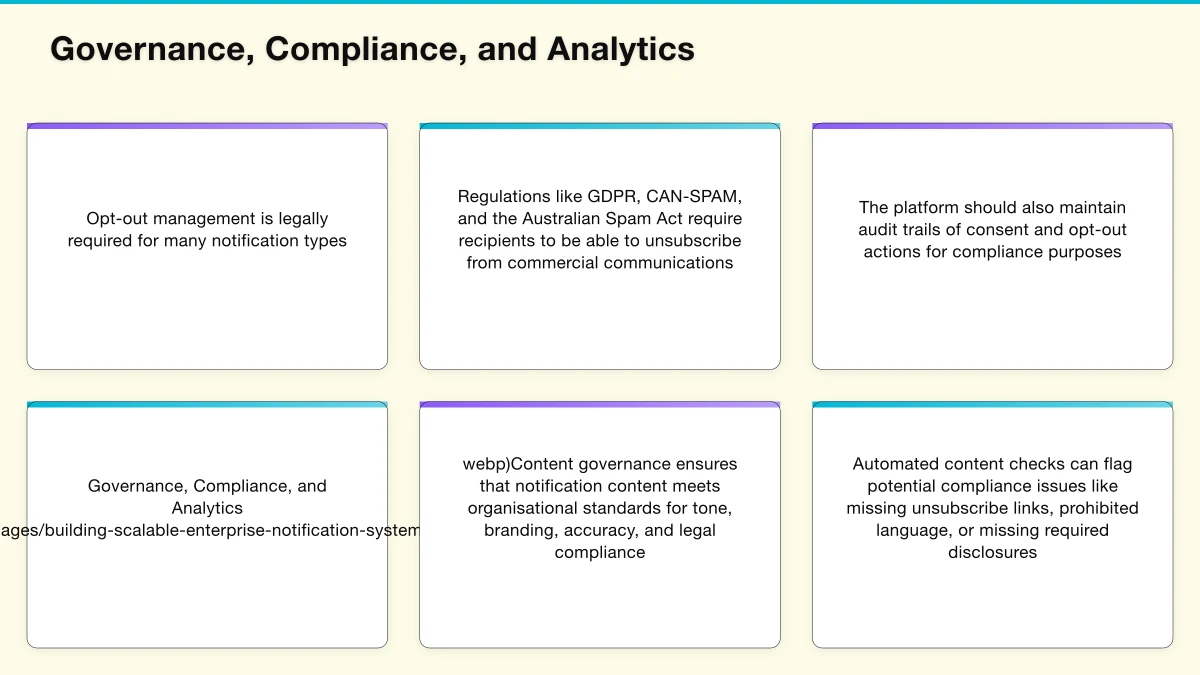
Opt-out management is legally required for many notification types. Regulations like GDPR, CAN-SPAM, and the Australian Spam Act require recipients to be able to unsubscribe from commercial communications. The notification platform should provide opt-out mechanisms for each channel and notification category, with opt-out requests processed within the legally required timeframe. The platform should also maintain audit trails of consent and opt-out actions for compliance purposes.
Content governance ensures that notification content meets organisational standards for tone, branding, accuracy, and legal compliance. Template review workflows, where new templates are approved by relevant stakeholders before activation, prevent unapproved content from reaching recipients. Automated content checks can flag potential compliance issues like missing unsubscribe links, prohibited language, or missing required disclosures.
Notification analytics provide visibility into notification effectiveness and user engagement. Metrics should include delivery rates by channel, open and click-through rates (where measurable), opt-out rates by notification type, user preference distributions, and delivery latency. These analytics enable continuous improvement of notification strategy: notifications with low engagement may need content improvement or frequency adjustment, while high opt-out rates may indicate that a notification type is providing insufficient value.
Do-not-disturb and scheduling capabilities respect recipients’ time. The platform should support quiet hours during which non-urgent notifications are held for later delivery, timezone-aware scheduling that delivers notifications during business hours in the recipient’s timezone, and batch delivery that aggregates low-priority notifications into periodic digests rather than delivering each one individually.
Organisational Model and Adoption
The notification platform should be owned by a platform engineering team and operated as an internal product. This team maintains the platform infrastructure, develops new capabilities, manages delivery channel integrations, and provides support to application teams integrating with the platform.
Application team adoption is driven by the platform’s value proposition: faster development (no need to implement notification logic), better user experience (consistent, preference-respecting notifications), and compliance built in. Adoption should be encouraged through developer-friendly documentation, SDK libraries for common programming languages, and a self-service portal for template creation and testing.
Migration from application-specific notification implementations to the centralised platform should be incremental. New applications should be required to use the platform from the start. Existing applications should migrate as they undergo development activity that touches notification functionality. This approach avoids a disruptive big-bang migration while progressively consolidating notification capability.
An enterprise notification platform is not glamorous infrastructure. But it is infrastructure that every application needs, every user interacts with, and every compliance team cares about. Building it once, building it well, and operating it as a shared capability is far more efficient and effective than the fragmented alternative that most enterprises currently endure.
Need to turn digital strategy into a web presence? Cosmos Web Tech covers website design, SEO, and e-commerce for Australian SMBs.
Ganda Tech Services is my technology consultancy, bringing together cloud infrastructure, web development, and mobile expertise for Australian businesses.
About the Author
Ashish Ganda is the founder of Ganda Tech Services, a Sydney-based technology consultancy specialising in cloud infrastructure, web development, and mobile app solutions for Australian businesses.
Tech Stack Selection Guide 2026
Choose the right tools for your Australian business — without the vendor hype or overlapping spend.
Almost done
Check your inbox and click the confirmation link to get your download.