Building Enterprise-Grade NLP Pipelines: Lessons from Production Deployments
The Production Reality Check
Natural Language Processing demonstrations are easy. You fine-tune a model, run it against a test dataset, celebrate the accuracy metrics, and present to stakeholders. Everyone nods approvingly. The project gets approved.
Then production happens.
Latency spikes during peak hours. Edge cases cascade into error storms. Models confidently produce wrong answers. Users game the system in ways no one anticipated. The elegant proof-of-concept becomes a support nightmare that consumes engineering cycles and erodes stakeholder trust.
I’ve seen this pattern repeatedly across enterprise NLP deployments—from speech-to-text systems in call centres to document processing pipelines in legal firms to RAG (Retrieval-Augmented Generation) systems in knowledge-intensive organisations. The failure mode is remarkably consistent: teams optimise for model accuracy while underinvesting in the architectural foundations that determine production success.
This post shares the lessons from those deployments—what actually matters when NLP systems need to work reliably, at scale, with real users.
Architecture Principles for Production NLP
Principle 1: Decouple Ingestion from Processing
The most common architectural mistake in NLP systems is synchronous processing—accepting input, running inference, and returning results in a single request-response cycle.
This works fine in demos. It fails in production because:
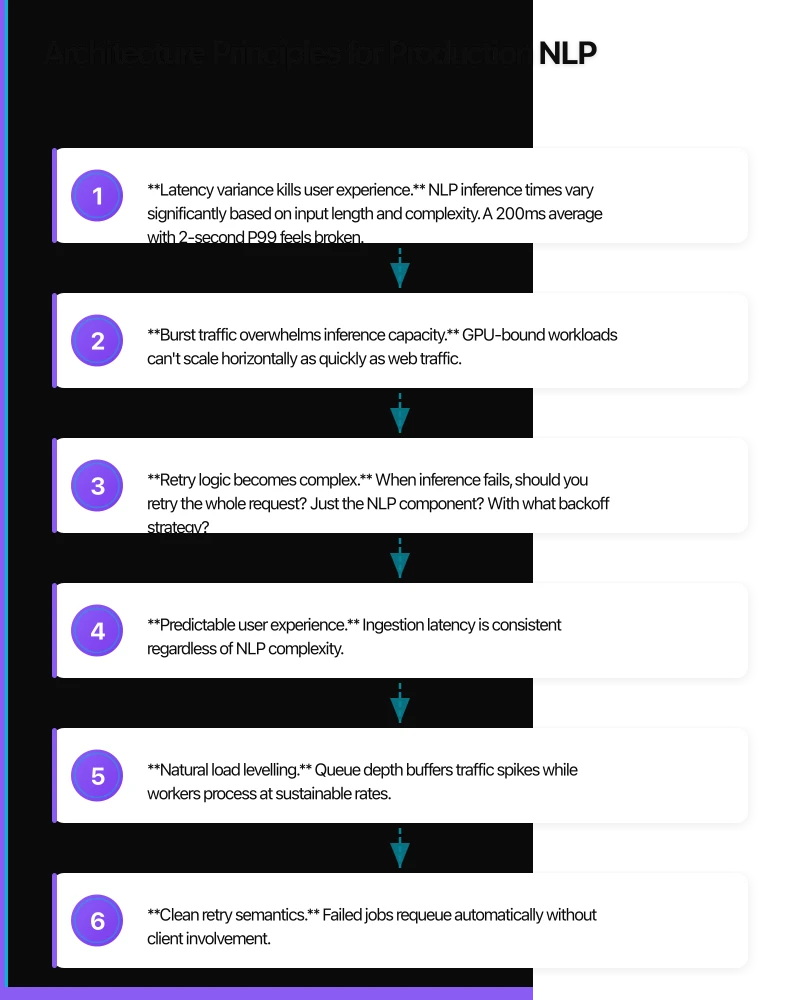
- Latency variance kills user experience. NLP inference times vary significantly based on input length and complexity. A 200ms average with 2-second P99 feels broken.
- Burst traffic overwhelms inference capacity. GPU-bound workloads can’t scale horizontally as quickly as web traffic.
- Retry logic becomes complex. When inference fails, should you retry the whole request? Just the NLP component? With what backoff strategy?
The Better Approach:
Separate ingestion from processing using a queue-based architecture:
[Client] -> [API Gateway] -> [Ingestion Service] -> [Message Queue]
                                                          |
                                                          v
                                                  [NLP Processing Workers]
                                                          |
                                                          v
                                                   [Results Store]
                                                          |
                                                          v
                                              [Notification/Polling]
The ingestion service accepts requests immediately, queues work items, and returns a job ID. Clients poll for results or receive webhooks when processing completes. This pattern provides:
- Predictable user experience. Ingestion latency is consistent regardless of NLP complexity.
- Natural load levelling. Queue depth buffers traffic spikes while workers process at sustainable rates.
- Clean retry semantics. Failed jobs requeue automatically without client involvement.
- Independent scaling. Add processing workers without touching the ingestion layer.
Principle 2: Design for Degradation
Production NLP systems will fail. Models will produce nonsense. External services will timeout. GPU instances will become unavailable. The question isn’t whether failures occur but how the system behaves when they do.
Graceful Degradation Patterns:
Fallback Hierarchies Don’t depend on a single model. Build chains of decreasing capability:
- Primary: Fine-tuned domain model (highest quality)
- Secondary: General-purpose large model (good quality, higher cost)
- Tertiary: Simple heuristic extraction (acceptable quality, always available)
- Final: Return “unable to process” with useful context
Each fallback should be independently deployable and testable. Circuit breakers should automatically route to fallbacks when primary systems degrade.
Confidence-Based Routing When models return low confidence scores, route to human review rather than returning potentially wrong results. This requires:
- Calibrated confidence scores (not just raw softmax outputs)
- Review queue infrastructure with appropriate tooling
- Feedback loops that improve model performance over time
Partial Results For complex pipelines (entity extraction + classification + summarisation), design for partial completion. If summarisation fails, return entities and classifications rather than nothing.
Principle 3: Treat Observability as a First-Class Concern
You cannot improve what you cannot measure. NLP systems present unique observability challenges because:
- Ground truth is often unavailable. Unlike web services where 500 errors are clearly failures, NLP outputs exist on a quality spectrum.
- Failure modes are subtle. A translation that’s grammatically correct but semantically wrong won’t trigger alerts.
- Bias and drift are statistical. Individual predictions don’t reveal systemic problems.
Observability Infrastructure:
Input Logging with Sampling Log representative samples of inputs and outputs for offline analysis. Full logging is often impractical (privacy, cost, storage) but sampled logging enables:
- Quality auditing by human reviewers
- Regression detection when models are updated
- Edge case identification for retraining
Latency Histograms, Not Averages Track full latency distributions. A system with 100ms average but 5-second P99 behaves very differently from one with 200ms average and 300ms P99.
Confidence Score Monitoring Track confidence score distributions over time. Sudden shifts often indicate:
- Input distribution changes (new data sources, user behaviour shifts)
- Model degradation (concept drift, data quality issues)
- Upstream system problems (encoding issues, preprocessing bugs)
Business Metric Correlation Connect NLP quality metrics to business outcomes. If your document classification system feeds a downstream workflow, track whether classification confidence correlates with workflow success rates.
Speech-to-Text: Lessons from Call Centre Deployments
Speech-to-text (STT) systems in call centre environments face challenges that academic benchmarks don’t capture.
Audio Quality Variance
Real phone calls include:
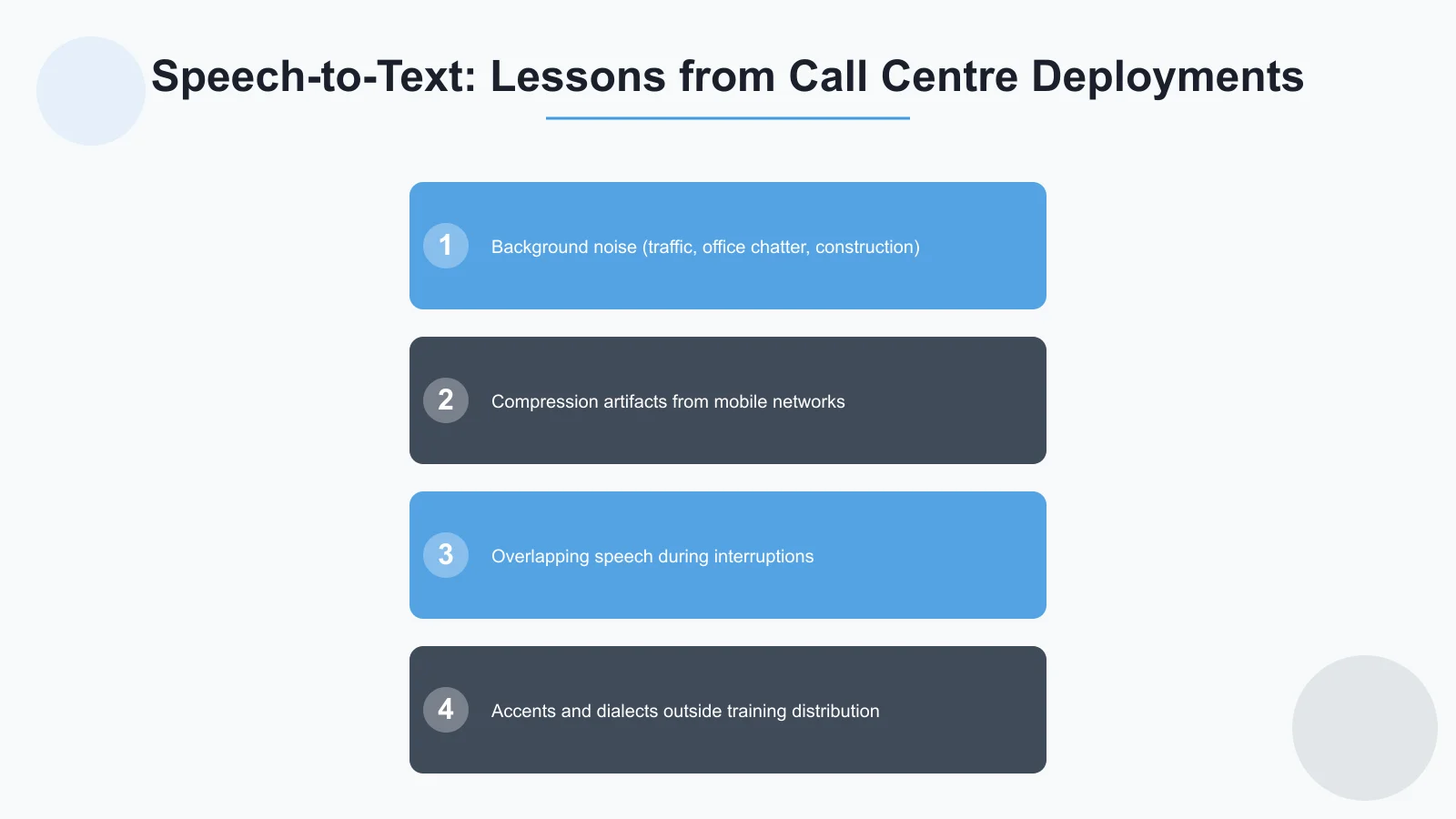
- Background noise (traffic, office chatter, construction)
- Compression artifacts from mobile networks
- Overlapping speech during interruptions
- Accents and dialects outside training distribution
- Technical terminology specific to your business
Production Strategies:
Pre-processing Pipelines Apply audio normalisation, noise reduction, and voice activity detection before transcription. These preprocessing steps often matter more than model selection:
[Raw Audio] -> [Noise Reduction] -> [Normalisation] -> [VAD Segmentation] -> [STT Model]Speaker Diarisation Separate speakers before transcription. Single-speaker models struggle with overlapping speech. Diarisation also enables speaker-specific confidence thresholds.
Domain Adaptation Fine-tune on your specific domain’s vocabulary and acoustic conditions. A model trained on podcasts will struggle with call centre audio regardless of its benchmark scores.
Real-Time vs. Batch Processing
Real-time transcription (for live agent assistance) and batch transcription (for post-call analytics) have fundamentally different requirements:
Real-Time Constraints:
- Latency under 300ms for usable live assistance
- Streaming architecture with partial results
- GPU memory management for concurrent calls
- Strict availability requirements—downtime affects live operations
Batch Advantages:
- Larger context windows improve accuracy
- Retry and failover without user-visible impact
- Cost optimisation through spot instances and off-peak processing
- Higher-quality models that would be too slow for real-time
Most production systems need both. Design them as separate subsystems sharing common components (audio preprocessing, vocabulary) but with independent deployment and scaling.
Handling Confidential Information
Call recordings contain PII, payment information, and regulated data. NLP systems must handle this appropriately:
Redaction Pipelines Apply PII detection and redaction before storing transcripts. This is typically a two-stage process:
- Entity recognition for standard PII (names, addresses, SSNs)
- Domain-specific patterns (account numbers, policy IDs, medical terms)
Retention Policies Raw audio often cannot be retained. Design systems that:
- Process audio in memory without persistent storage
- Generate transcripts with embedded quality metrics
- Support “right to be forgotten” deletion of derived data
Access Controls Implement fine-grained access to transcripts based on:
- User role (agent, supervisor, analyst)
- Data sensitivity level
- Time-based restrictions (access expires after case closure)
RAG Systems: Beyond the Demo
Retrieval-Augmented Generation has become the default architecture for enterprise knowledge systems. The basic pattern is straightforward: retrieve relevant documents, inject them into LLM context, generate responses.
Production RAG systems are considerably more complex.
Retrieval Quality is Everything
The most sophisticated language model produces garbage given irrelevant context. Retrieval quality determines RAG system quality.
Chunking Strategies How you split documents into retrievable chunks dramatically affects performance:
- Fixed-size chunks (512 tokens): Simple but breaks semantic units
- Semantic chunks (paragraph/section boundaries): Preserves meaning but creates size variance
- Hierarchical chunks (document + section + paragraph): Enables multi-level retrieval
There’s no universally correct approach. Empirical testing on your document corpus is essential.
Embedding Model Selection Embedding models have different strengths:
- General-purpose models (OpenAI, Cohere): Good baseline, may miss domain nuance
- Domain-adapted models: Better precision for specific vocabularies
- Asymmetric models: Handle query-document mismatch better
Consider hybrid approaches: dense retrieval (embeddings) for semantic similarity, sparse retrieval (BM25) for exact term matching, re-ranking for final selection.
Metadata Filtering Pure semantic similarity isn’t always appropriate. A question about 2024 policies shouldn’t retrieve 2019 documents even if they’re semantically similar. Build metadata into your retrieval pipeline:
- Temporal filters (document date, validity period)
- Access controls (department, clearance level)
- Source quality (official policy vs. informal guidance)
Context Window Management
LLM context windows are finite. Retrieving 50 relevant documents and cramming them all into context produces worse results than carefully selecting the most relevant 5.
Relevance Scoring Score retrieved documents on multiple dimensions:
- Semantic similarity to query
- Recency and timeliness
- Source authority and reliability
- Coverage of query facets (multi-part questions need multi-part context)
Context Construction Once you’ve selected documents, how you present them matters:
# Context Documents

## Document 1: [Title] (Source: [Source], Date: [Date])
[Content excerpt]

## Document 2: [Title] (Source: [Source], Date: [Date])
[Content excerpt]

# User Question
[Query]
Clear delineation helps the LLM appropriately weight and attribute information.
Handling Answer Quality
Unlike traditional search (which returns documents), RAG systems generate answers. This creates new failure modes:
Hallucination Detection LLMs confidently generate plausible-sounding but incorrect information. Mitigation strategies:
- Citation requirements: Require the model to cite specific passages supporting claims
- Retrieval verification: Check that cited passages actually contain claimed information
- Confidence thresholds: Decline to answer when supporting evidence is weak
Attribution and Transparency Users need to verify answers. Provide:
- Source document links
- Relevant excerpts with highlighting
- Confidence indicators
- “Ask a human” escalation paths
Feedback Loops User feedback on answer quality is invaluable:
- Thumbs up/down on responses
- “This didn’t answer my question” reporting
- Expert review sampling
Feed this data into retrieval tuning, embedding model selection, and prompt optimisation.
Infrastructure Considerations
GPU Management
NLP workloads are typically GPU-bound. Managing GPU infrastructure in production requires different approaches than CPU-based services.
Right-Sizing GPU Selection Match GPU capabilities to workload requirements:
- Inference-optimised GPUs (T4, A10G): Cost-effective for production serving
- Training-capable GPUs (A100, H100): Required for fine-tuning, overkill for inference
- Memory vs. compute trade-offs: Large models need memory; small models are compute-bound
Batching for Efficiency GPU efficiency improves dramatically with batched inference. Design request aggregation:
- Collect requests over short time windows (10-50ms)
- Pad inputs to consistent lengths for efficient batch processing
- Return results asynchronously as processing completes
Multi-Model Serving Switching models on GPU is expensive. Keep frequently-used models resident:
- Analyse access patterns to determine hot models
- Implement LRU eviction for model caching
- Consider dedicated instances for critical high-traffic models
Cost Management
Production NLP at scale is expensive. Managed LLM APIs charge per token. GPU instances charge per hour. Both add up quickly.
Token Optimisation For LLM-based systems:
- Aggressive prompt optimisation (shorter prompts = lower cost)
- Caching for repeated queries
- Smaller models for simpler tasks (don’t use GPT-4 for classification)
Tiered Processing Route requests to appropriate capability levels:
- Simple queries: Fast, cheap models
- Standard queries: Balanced cost/quality models
- Complex queries: Premium models with human review for edge cases
Spot Instance Strategies For batch workloads:
- Use spot/preemptible instances (70% cost reduction)
- Design for interruption (checkpointing, idempotent processing)
- Maintain on-demand capacity for baseline load
Building the Team
Production NLP systems require skills that span traditional boundaries:
- ML engineers who understand model training and inference optimisation
- Platform engineers who can build reliable distributed systems
- Domain experts who understand the business context and data nuances
- Data engineers who manage the ingestion and preprocessing pipelines
The most successful teams I’ve seen operate as integrated units rather than siloed specialisations. ML engineers understand infrastructure constraints. Platform engineers understand model behaviour. Everyone understands the business problem.
From Proof-of-Concept to Production
The gap between NLP demos and production systems isn’t primarily technical—it’s cultural and organisational.
Set Realistic Expectations Stakeholders often expect demo accuracy in production conditions. Communicate clearly:
- Production will have lower accuracy than controlled tests
- Edge cases will take months to address, not weeks
- Quality improvements require ongoing investment, not one-time development
Invest in Foundations Before Features The pressure to add capabilities before foundations are solid is constant. Resist it. An 80% accurate system with robust operations is more valuable than a 95% accurate system that goes down every other week.
Plan for Evolution NLP is advancing rapidly. Systems built today will need major updates within 18-24 months. Design for:
- Model replacement without architecture changes
- A/B testing of different approaches
- Gradual rollout of updates with monitoring
The organisations that succeed with production NLP don’t have better algorithms. They have better architecture, better operations, and better expectations management. Those are the lessons worth learning.
Ash Ganda advises enterprise technology leaders on cloud architecture, AI systems, and digital transformation strategy. Connect on LinkedIn for ongoing insights.
Turning strategy into infrastructure? Cloud Geeks covers managed cloud, DevOps, and IT security for businesses putting digital plans into action.
I lead Ganda Tech Services, where we turn digital strategy into results through specialist cloud, web design, and mobile app teams across Sydney.
About the Author
Ashish Ganda is the founder of Ganda Tech Services, a Sydney-based technology consultancy specialising in cloud infrastructure, web development, and mobile app solutions for Australian businesses.
AI Strategy Primer for Australian Business Leaders
A practical framework for AI adoption in 2026 — cut through the hype and start with what matters.