
AI Ethics in the Enterprise: Frameworks for Responsible Innovation
The Ethics Imperative
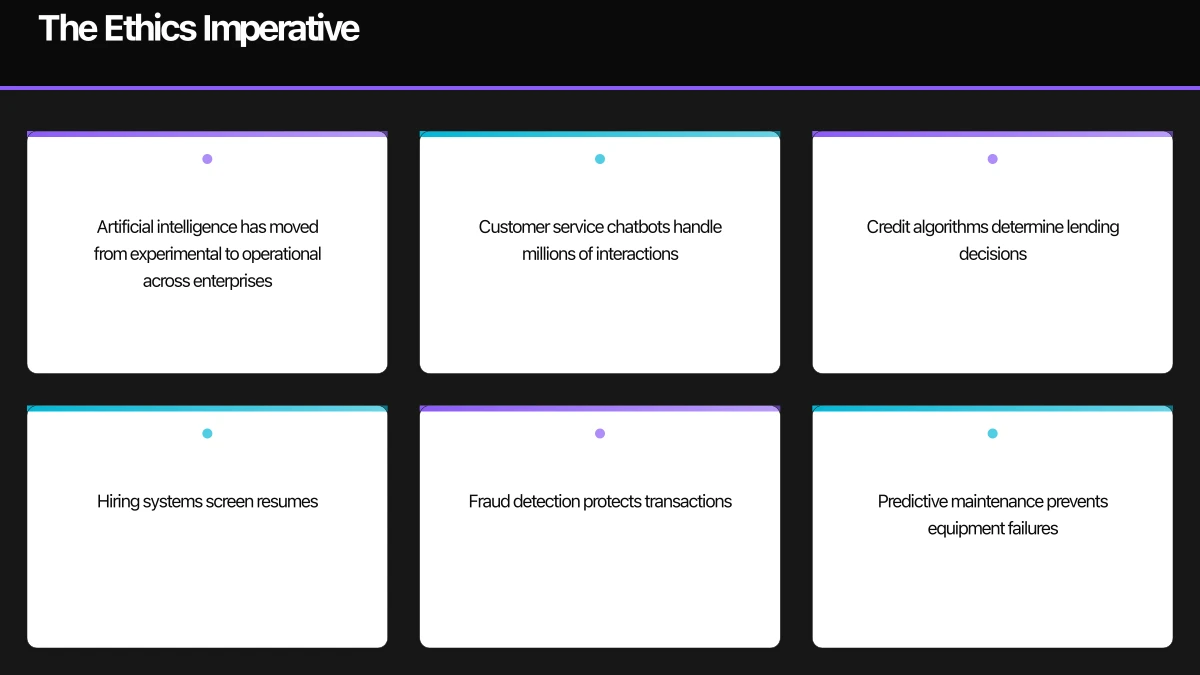
Artificial intelligence has moved from experimental to operational across enterprises. Customer service chatbots handle millions of interactions. Credit algorithms determine lending decisions. Hiring systems screen resumes. Fraud detection protects transactions. Predictive maintenance prevents equipment failures.
This operational reality creates an ethical imperative. When AI systems make or influence decisions affecting people’s lives—their employment, credit, healthcare, insurance, legal outcomes—the ethical dimensions are not optional considerations. They are core to responsible deployment.
The stakes are both moral and practical. Biased algorithms invite regulatory action, reputational damage, and customer abandonment. Unexplainable decisions undermine trust and accountability. Privacy violations create legal liability. Enterprises that treat AI ethics as an afterthought are discovering that remediation is far more costly than prevention.
According to the World Economic Forum’s 2025 AI Governance Survey, 78% of enterprises now have some form of AI ethics initiative—up from 43% in 2022. Yet only 23% describe their approach as mature. For technology leaders, building effective AI ethics frameworks is now an essential capability.
Understanding AI Ethics Dimensions
AI ethics encompasses multiple interconnected concerns:
Fairness and Non-Discrimination
AI systems can perpetuate or amplify societal biases. Training data reflecting historical discrimination produces models that discriminate. Proxy variables can reintroduce protected characteristics even when explicit attributes are excluded.
The Amazon hiring example: Amazon’s experimental hiring algorithm, trained on historical resume data, learned to downgrade resumes containing words associated with women. The company abandoned the system in 2018, but similar dynamics appear in deployed systems across industries.
The healthcare resource allocation study: Research published in Science demonstrated that a widely-used healthcare algorithm systematically underestimated the health needs of Black patients, resulting in reduced care recommendations. The algorithm used healthcare costs as a proxy for health needs, not accounting for disparate access to healthcare.
Fairness is technically challenging because multiple fairness definitions exist—demographic parity, equalized odds, calibration—and they cannot all be satisfied simultaneously. Fairness requires choice, and choice requires ethical judgment.
Transparency and Explainability
When AI systems make consequential decisions, affected individuals often have a right to understand why. Regulatory frameworks increasingly require it—the EU AI Act mandates transparency for high-risk AI systems; US regulatory guidance from the CFPB, EEOC, and other agencies emphasizes explainability in their domains.
Technical approaches to explainability:
- Intrinsically interpretable models: Linear regression, decision trees, rule-based systems—simple enough to understand directly
- Post-hoc explanations: SHAP, LIME, attention visualization—techniques that explain black-box model predictions
- Concept-based explanations: Higher-level explanations using human-understandable concepts
The appropriate level of explainability depends on context. A content recommendation doesn’t require the same transparency as a credit denial.
Privacy and Data Protection
AI systems require data, and data creates privacy risks:
Training data privacy: Models can memorize and potentially leak sensitive training data. Large language models have been shown to reproduce verbatim text from their training sets, including personal information.
Inference privacy: The mere act of querying a model can reveal sensitive information. Membership inference attacks can determine whether an individual’s data was in the training set.
Purpose limitation: Data collected for one purpose may be repurposed for AI training in ways users didn’t anticipate or consent to.
Privacy-preserving machine learning techniques—differential privacy, federated learning, secure multi-party computation—can mitigate some risks but involve tradeoffs with model performance and operational complexity.
Accountability and Liability
When AI systems cause harm, who is responsible? The developer? The deploying organization? The user who relied on the system? Current legal frameworks are still adapting to these questions.
Clear accountability requires:
- Human oversight: Appropriate human involvement in decisions, especially high-stakes ones
- Audit trails: Documentation of model development, testing, and deployment decisions
- Error correction mechanisms: Processes for affected individuals to contest decisions and seek remediation
- Ongoing monitoring: Detection of problems after deployment, not just pre-deployment testing
Safety and Reliability
AI systems should be reliable under normal conditions and fail gracefully under unexpected conditions:
Robustness: Resistance to adversarial inputs, distribution shift, and edge cases.
Reliability: Consistent performance over time and across contexts.
Fallback mechanisms: Graceful degradation when models encounter uncertainty.
Testing rigor: Comprehensive evaluation including stress testing and red-teaming.
Building an AI Ethics Framework
Governance Structure
Effective AI ethics requires governance beyond individual project decisions:
AI Ethics Board or Committee: Cross-functional body including technology, legal, compliance, business, and potentially external perspectives. Responsibilities include:
- Establishing ethical principles and policies
- Reviewing high-risk AI use cases
- Adjudicating difficult decisions
- Monitoring landscape changes
Embedded Ethics Review: Integration of ethics considerations into AI development lifecycle. Not a gate at the end but a practice throughout.
Executive Accountability: Senior leader accountable for AI ethics. Typically the CTO, CDO, or dedicated Chief AI Ethics Officer for larger organizations.
Escalation Paths: Clear processes for raising concerns. Employees should feel safe surfacing ethical issues without fear of retaliation.
Risk Assessment Framework
Not all AI applications carry equal risk. Classify applications by risk level to allocate ethics resources appropriately:
High-risk applications (require extensive review):
- Decisions affecting employment, credit, insurance, healthcare
- Criminal justice or law enforcement applications
- Applications affecting vulnerable populations
- Applications with significant safety implications
Medium-risk applications (require standard review):
- Internal process automation
- Business analytics and forecasting
- Customer segmentation
Low-risk applications (require documentation):
- Productivity tools
- Content recommendation for entertainment
- Spam filtering
The EU AI Act provides a regulatory framework for risk classification that organizations can adapt, even before formal enforcement.
Development Lifecycle Integration
Embed ethics throughout the AI development process:
Problem Definition:
- Is AI the right solution?
- What could go wrong?
- Who could be harmed?
- Are there less risky alternatives?
Data Collection and Preparation:
- Is data collection ethical and consensual?
- Does data represent the population appropriately?
- Are there biases in labeling?
- Is privacy protected?
Model Development:
- Are fairness metrics defined and measured?
- Is the model appropriately explainable?
- Has the model been tested for robustness?
- Are edge cases considered?
Deployment:
- Is there appropriate human oversight?
- Are monitoring systems in place?
- Are feedback mechanisms established?
- Is there a plan for incidents?
Ongoing Operations:
- Is the model performing as expected?
- Are fairness metrics stable?
- Are users understanding and trusting the system appropriately?
- Have conditions changed that might affect model validity?
Fairness Testing and Monitoring
Operationalize fairness through measurement:
Pre-deployment testing:
- Evaluate model performance across demographic groups
- Test for disparate impact using relevant legal thresholds
- Examine predictions for patterns of discrimination
- Document fairness testing process and results
Post-deployment monitoring:
- Track fairness metrics in production
- Monitor for distribution shifts that could affect fairness
- Analyze complaints and appeals for patterns
- Regular re-evaluation of model fairness
Tools and frameworks:
- IBM AI Fairness 360
- Google What-If Tool
- Microsoft Fairlearn
- Amazon SageMaker Clarify
Transparency Implementation
Implement transparency appropriate to application risk level:
For users/affected individuals:
- Clear disclosure that AI is involved in decisions
- Accessible explanations of decision factors
- Information about how to contest decisions
- Privacy notices covering AI data use
For regulators:
- Technical documentation of model methodology
- Testing and validation records
- Monitoring and audit results
- Incident documentation
For internal stakeholders:
- Model cards documenting model purpose, performance, and limitations
- Data sheets documenting training data characteristics
- Decision logs for ethics review outcomes
- Regular reporting to ethics board
Privacy Protection
Implement technical and organizational privacy safeguards:
Data minimization: Collect and retain only necessary data. Delete data when no longer needed.
Anonymization and pseudonymization: Remove or mask identifying information. Use techniques appropriate to re-identification risk.
Access controls: Limit data access to authorized purposes and personnel.
Privacy-preserving ML techniques: Consider differential privacy for training data protection, federated learning to avoid data centralization, or synthetic data for development.
Consent management: Ensure appropriate consent for AI data uses. Provide mechanisms to withdraw consent.
Organizational Culture and Capabilities
Building Ethical Awareness
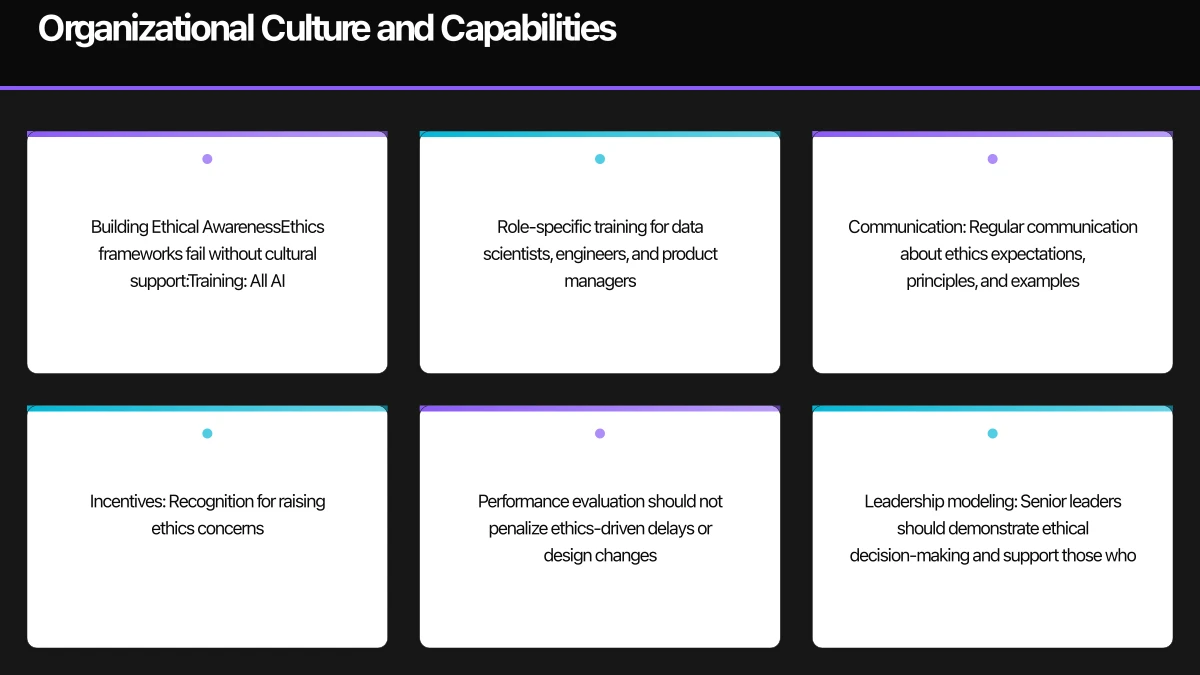
Ethics frameworks fail without cultural support:
Training: All AI practitioners should understand ethics fundamentals. Role-specific training for data scientists, engineers, and product managers.
Communication: Regular communication about ethics expectations, principles, and examples.
Incentives: Recognition for raising ethics concerns. Performance evaluation should not penalize ethics-driven delays or design changes.
Leadership modeling: Senior leaders should demonstrate ethical decision-making and support those who raise concerns.
Diverse Teams
Homogeneous teams have blind spots. Diverse perspectives help identify potential harms that others might miss:
Demographic diversity: Different backgrounds bring different awareness of potential impacts.
Disciplinary diversity: Ethicists, social scientists, and domain experts complement technical perspectives.
Inclusive processes: Create space for dissenting voices. Avoid groupthink in ethics discussions.
External Engagement
Organizations cannot develop AI ethics in isolation:
Civil society engagement: Seek input from advocacy groups, community organizations, and affected populations.
Academic partnerships: Collaborate on research into fairness, explainability, and other technical challenges.
Industry collaboration: Participate in standards development and best practice sharing.
Regulatory dialogue: Engage constructively with regulators developing AI frameworks.
The Regulatory Landscape
AI regulation is evolving rapidly. Key developments:
EU AI Act
The EU AI Act, with key provisions taking effect this year, establishes:
Prohibited practices: Manipulative or deceptive AI, social scoring, certain biometric uses.
High-risk system requirements: Risk management, data governance, technical documentation, transparency, human oversight, accuracy requirements.
General-purpose AI obligations: Transparency, copyright compliance, safety testing for systemic risk models.
Penalties: Fines up to 35 million euros or 7% of global annual turnover.
Organizations deploying AI in Europe or affecting European individuals must comply. The extraterritorial reach means global implications.
US Regulatory Approach
The US has taken a sector-specific rather than comprehensive approach:
EEOC guidance: Scrutiny of AI in employment decisions under Title VII.
CFPB oversight: Explainability requirements for AI in consumer credit.
FTC enforcement: Unfair or deceptive AI practices.
State laws: Colorado AI Act, NYC Local Law 144, and others creating patchwork requirements.
Executive orders: Presidential direction on AI safety and security, though subject to administration changes.
Other Jurisdictions
UK: Principles-based approach with sector-specific implementation.
Canada: Proposed Artificial Intelligence and Data Act (AIDA).
Australia: Voluntary AI Ethics Principles with potential future regulation.
Singapore: Model AI Governance Framework with sector-specific guidance.
Global organizations need monitoring capabilities to track evolving requirements across jurisdictions.
Case Studies in AI Ethics
Successful Implementation: Financial Services Firm
A major financial services firm implemented a comprehensive AI ethics program:
Governance: Established AI Ethics Board with cross-functional representation. Implemented tiered review process based on risk level.
Technical controls: Deployed fairness testing in model validation pipeline. Implemented explainability requirements for customer-facing decisions. Built monitoring dashboards for fairness metrics.
Culture: Trained all model developers on ethics fundamentals. Created incentives for raising ethics concerns. Documented ethics considerations in all model documentation.
Results: Identified and remediated bias in several models before deployment. Established credibility with regulators. Avoided public incidents despite extensive AI use.
Learning from Failure: Facial Recognition Vendor
A facial recognition technology company provides cautionary lessons:
Initial approach: Deployed technology to law enforcement without ethics review. Training data skewed toward lighter-skinned individuals.
Consequences: Academic research demonstrated significant accuracy disparities across demographic groups. Wrongful arrests occurred when technology misidentified individuals. Public backlash and legislative action followed.
Aftermath: Company implemented ethics review processes but after reputational damage. Some jurisdictions banned or restricted the technology.
Lessons: Proactive ethics review could have identified accuracy disparities. Engagement with affected communities might have revealed concerns. The cost of remediation far exceeded what prevention would have required.
Measuring Ethics Program Effectiveness
Ethics programs need measurement to improve:
Process metrics:
- Percentage of AI projects receiving ethics review
- Time from ethics concern to resolution
- Training completion rates
- Ethics board meeting frequency
Outcome metrics:
- Fairness metric trends across deployed models
- Complaints and appeals related to AI decisions
- Ethics-related incidents
- Regulatory findings or enforcement actions
Cultural metrics:
- Employee survey results on ethics culture
- Ethics concern reporting rates
- Retention of employees who raise concerns
Report metrics to the ethics board quarterly. Benchmark against available industry data.
The Path Forward
AI ethics is not a constraint on innovation—it is a requirement for sustainable innovation. Organizations that embed ethics into AI development:
- Avoid costly remediation and regulatory action
- Build trust with customers and stakeholders
- Attract talent who want to work on responsible technology
- Create competitive advantage through trusted AI
For CTOs, the strategic recommendations are clear:
-
Establish governance now. If you don’t have an AI ethics framework, you’re behind. The regulatory landscape is tightening and expectations are rising.
-
Make it practical. Principles without implementation are empty. Embed ethics into development processes with concrete requirements and tools.
-
Resource appropriately. Ethics review takes time. Fairness testing requires tooling. Training requires investment. Budget for it.
-
Cultivate culture. Frameworks fail without cultural support. Leaders must model ethical decision-making and support those who raise concerns.
-
Stay current. The regulatory and technical landscape is evolving rapidly. Continuous learning and adaptation are essential.
The organizations that treat AI ethics as a strategic capability rather than a compliance burden will be best positioned for the AI-intensive future that is already arriving.
For guidance on implementing AI ethics frameworks that balance innovation with responsibility, connect with me to discuss approaches tailored to your organization’s context and AI portfolio.
For hands-on guidance on cloud migration and managed IT, my team at Cloud Geeks helps Australian businesses implement these strategies.
As founder of Ganda Tech Services, I work with Australian businesses to align technology investments with business growth — across cloud, web, and mobile.
About the Author
Ashish Ganda is the founder of Ganda Tech Services, a Sydney-based technology consultancy specialising in cloud infrastructure, web development, and mobile app solutions for Australian businesses.
AI Strategy Primer for Australian Business Leaders
A practical framework for AI adoption in 2026 — cut through the hype and start with what matters.