Building Enterprise-Grade Developer Experience
Developer experience (DX) has emerged as one of the most significant differentiators between high-performing and struggling technology organisations. The concept extends beyond ergonomic tooling to encompass the entire ecosystem in which developers operate: the speed of feedback loops, the clarity of documentation, the friction in deployment processes, the quality of internal APIs, and the cognitive load imposed by organisational complexity.
The economic argument for DX investment is compelling. An enterprise with 500 engineers, each earning an average fully-loaded cost of $200,000, represents a $100 million annual investment. If poor developer experience reduces productivity by 20% — a conservative estimate for many enterprises — the organisation loses $20 million annually in unrealised productivity. A $2-3 million investment in DX improvement that recovers even half of that loss delivers extraordinary returns.
Yet many enterprises underinvest in developer experience, treating it as a quality-of-life concern rather than a strategic lever. This article makes the case for DX as a first-class strategic investment and provides a framework for systematic improvement.
The Dimensions of Developer Experience
Developer experience encompasses multiple dimensions that interact to create the overall experience of building software within an organisation.
Development Environment Quality determines how quickly developers can start working productively. The time from new employee orientation to first meaningful code contribution is a revealing metric. In organisations with poor DX, developers spend days or weeks configuring development environments, waiting for access provisioning, and navigating undocumented setup procedures. In organisations with excellent DX, standardised development environments (whether local configurations managed by tools like Homebrew and asdf, cloud-based environments like GitHub Codespaces, or containerised dev environments) enable productivity within hours.
The development environment extends beyond initial setup to the daily experience of writing, building, and testing code. Build times, test execution speeds, IDE responsiveness, and hot-reload capabilities all affect the tightness of the development feedback loop. When a developer makes a change and waits minutes for the build to complete and tests to run, the cognitive context is lost. When feedback is sub-second, developers maintain flow state and iterate rapidly.
CI/CD and Deployment Friction is often the largest source of developer frustration in enterprise environments. Pipelines that take 45 minutes to complete, require manual intervention for staging deployments, or provide cryptic error messages when they fail impose a significant tax on every code change. The gap between committing code and seeing it running in production is a direct measure of organisational agility.
The best enterprise CI/CD experiences provide fast feedback (build and unit test results within 5 minutes), clear visibility (real-time pipeline status with detailed logs), and self-service deployment (developers deploy to production through a simple, well-documented process without requiring approvals from other teams for routine changes).
Documentation and Knowledge Sharing is the dimension most enterprises acknowledge as important but fail to invest in systematically. Internal APIs without documentation, architecture decisions without rationale records, and operational procedures maintained only in the memories of senior engineers create a constant drag on developer productivity. New team members ramp slowly, developers working across team boundaries waste time discovering interfaces, and institutional knowledge is lost when engineers leave.
Effective documentation practices include API documentation generated from code (OpenAPI specifications, GraphQL schema documentation), architecture decision records (ADRs) that capture the why behind design choices, and runbooks that enable any engineer to operate a service they did not build. The key is making documentation a byproduct of development workflows rather than a separate activity that competes with feature delivery.
Internal Platform and Tool Quality shapes the daily experience of enterprise developers. When internal tools are well-designed, reliable, and well-documented, developers trust them and use them effectively. When internal tools are brittle, poorly documented, or unreliable, developers work around them, creating shadow IT practices that undermine governance and consistency.
Measuring Developer Experience
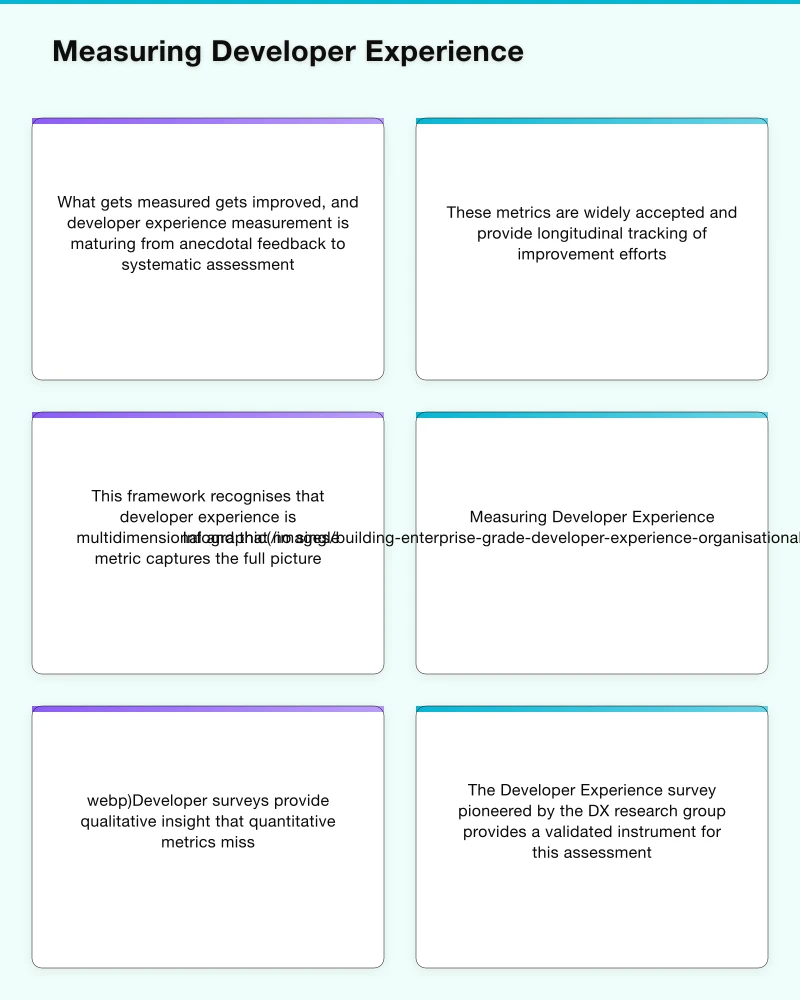
What gets measured gets improved, and developer experience measurement is maturing from anecdotal feedback to systematic assessment.
The DORA metrics — deployment frequency, lead time for changes, change failure rate, and mean time to recovery — provide outcome-level measurements that correlate with both developer experience and organisational performance. These metrics are widely accepted and provide longitudinal tracking of improvement efforts.
The SPACE framework, proposed by researchers from GitHub, University of Victoria, and Microsoft, provides a more comprehensive measurement model across five dimensions: Satisfaction and wellbeing, Performance, Activity, Communication and collaboration, and Efficiency and flow. This framework recognises that developer experience is multidimensional and that no single metric captures the full picture.
Developer surveys provide qualitative insight that quantitative metrics miss. Regular surveys (quarterly is a common cadence) asking developers about their satisfaction with tools, processes, documentation, and support identify pain points that metrics alone cannot reveal. The Developer Experience survey pioneered by the DX research group provides a validated instrument for this assessment.
Time-to-first-commit for new engineers is a powerful operational metric. It measures the end-to-end onboarding experience, from environment setup through access provisioning to productive contribution. Organisations tracking this metric often discover surprisingly long times — days or weeks — that motivate investment in onboarding automation.
Build and test cycle times should be tracked continuously and treated with the same urgency as production performance metrics. When build times increase, developer productivity decreases directly. Setting and enforcing time budgets for builds and test suites — for example, requiring that the full build and unit test suite complete within 5 minutes — prevents the gradual degradation that compounds over time.
Organisational Models for DX Investment
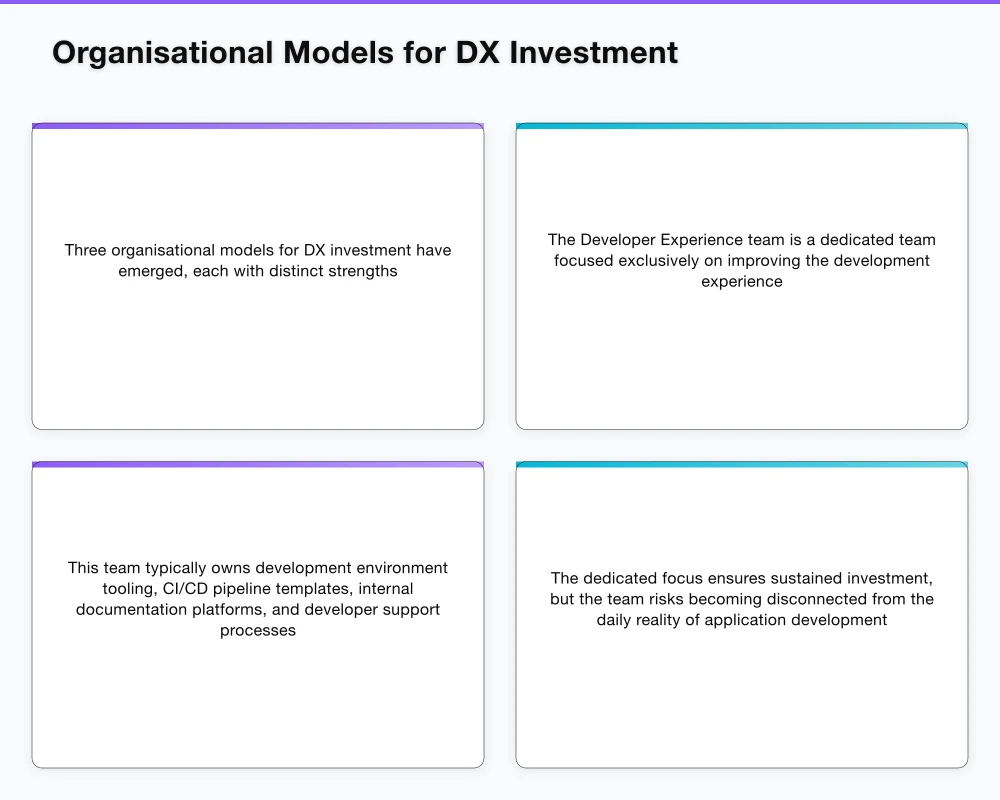
Three organisational models for DX investment have emerged, each with distinct strengths.
The Developer Experience team is a dedicated team focused exclusively on improving the development experience. This team typically owns development environment tooling, CI/CD pipeline templates, internal documentation platforms, and developer support processes. The dedicated focus ensures sustained investment, but the team risks becoming disconnected from the daily reality of application development.
The Platform Engineering team addresses DX as part of a broader internal developer platform mandate. Developer experience improvements are delivered through the platform — self-service capabilities, golden path templates, and integrated tooling. This model aligns DX investment with platform strategy, ensuring that experience improvements are systematic rather than ad hoc.
The Distributed responsibility model embeds DX accountability across all engineering teams, typically through engineering managers who are measured on team productivity and developer satisfaction. This model avoids creating a separate team but risks under-investment when DX improvements compete with feature delivery priorities.
The most effective approach combines elements: a dedicated DX or platform engineering team that drives systematic improvements, with distributed accountability ensuring that every team contributes to the overall developer experience.
Strategic Implementation Priorities
For CTOs beginning a systematic DX improvement programme, the following priorities provide the highest return on investment.
First, fix the CI/CD pipeline. Nothing frustrates developers more than slow, unreliable, or opaque build and deployment processes. Invest in parallel test execution, build caching, clear error messages, and self-service deployment. Target build-and-test completion within 10 minutes as an initial benchmark.
Second, standardise and automate development environment setup. Create scripted, reproducible development environments that work consistently across machines. Cloud-based development environments eliminate “works on my machine” problems entirely and simplify onboarding.
Third, invest in internal documentation. Start with API documentation generated from code, then build architecture decision records and operational runbooks. Make documentation contribution a recognised and valued engineering activity.
Fourth, create feedback mechanisms that surface developer pain points. Regular surveys, open office hours with the DX team, and analysis of support request patterns provide the insight needed to prioritise improvements.
Conclusion
Developer experience is not a luxury — it is a strategic capability that directly impacts engineering productivity, talent retention, and organisational agility. The enterprises that invest systematically in developer experience will compound their engineering effectiveness over time, building software faster and more reliably than competitors who treat DX as an afterthought.
For CTOs in 2022, the opportunity is clear. The tooling and practices for excellent developer experience are well-understood and accessible. The measurement frameworks exist. The economic case is straightforward. What remains is the strategic commitment to treat developer experience with the same rigour and investment that the organisation applies to customer experience.
Mobile execution is where many digital strategies come to life. Awesome Apps publishes practical guides on app development and mobile UX.
As founder of Ganda Tech Services, I work with Australian businesses to align technology investments with business growth — across cloud, web, and mobile.
About the Author
Ashish Ganda is the founder of Ganda Tech Services, a Sydney-based technology consultancy specialising in cloud infrastructure, web development, and mobile app solutions for Australian businesses.
Tech Stack Selection Guide 2026
Choose the right tools for your Australian business — without the vendor hype or overlapping spend.
Almost done
Check your inbox and click the confirmation link to get your download.