Building Internal Developer Platforms: Strategy and Architecture
The emergence of internal developer platforms (IDPs) as a strategic investment for enterprise technology organisations reflects a fundamental shift in how we think about engineering productivity. Rather than expecting every development team to independently master the full stack of infrastructure, deployment, observability, and security tooling, organisations are consolidating these capabilities into curated platforms that abstract complexity and accelerate delivery.
This is not a new idea in principle — platform teams have existed for decades. What has changed is the sophistication of the tooling, the maturity of cloud-native infrastructure, and the economic argument. When a typical enterprise supports dozens or hundreds of development teams, the cost of each team independently solving the same infrastructure and deployment challenges dwarfs the investment in a well-designed platform.
The challenge is execution. Internal platforms that succeed deliver remarkable productivity gains. Those that fail become expensive, underutilised mandates that frustrate developers and waste organisational resources. Understanding the strategic principles that separate success from failure is essential for CTOs committing to this investment.
The Strategic Rationale for Platform Investment
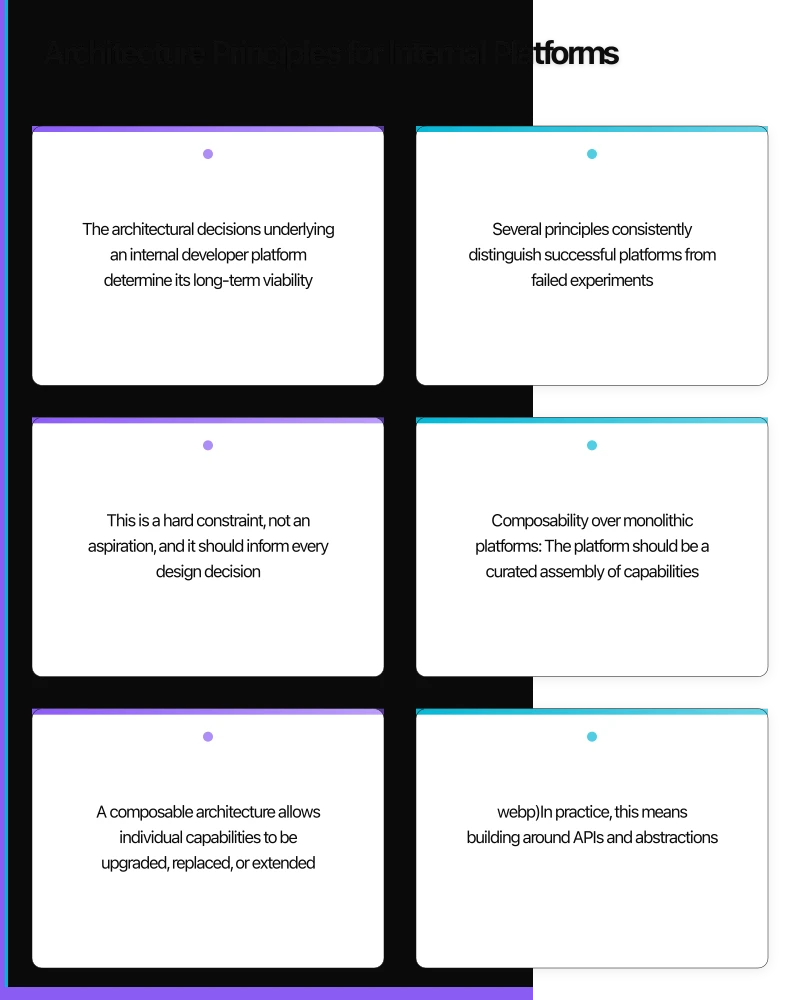
The business case for internal developer platforms rests on three pillars: engineering velocity, operational consistency, and talent leverage.
Engineering velocity is the most immediately measurable benefit. When developers can provision infrastructure, deploy applications, configure monitoring, and manage secrets through a self-service platform, the time from code commit to production deployment compresses dramatically. Organisations with mature platforms report deployment lead times of minutes rather than days or weeks, with correspondingly faster feature delivery and shorter feedback loops.
The velocity improvement is not just about individual deployments. It is about removing the friction that discourages experimentation. When spinning up a new service requires filing tickets, waiting for infrastructure provisioning, and configuring deployment pipelines from scratch, teams naturally resist creating new services and instead bolt functionality onto existing monoliths. When the platform makes service creation trivial, teams adopt architectures that best fit the problem domain rather than architectures that minimise operational overhead.
Operational consistency is the second pillar. Without a platform, each team makes independent decisions about deployment strategies, observability tooling, security configurations, and operational procedures. The resulting heterogeneity creates scaling problems: incident response requires understanding each team’s unique setup, security audits must examine each team’s individual configurations, and operational expertise cannot transfer between teams.
A well-designed platform establishes golden paths — opinionated, well-supported approaches for common tasks — that embed organisational standards into the developer experience. Security policies, compliance requirements, and operational best practices are baked into the platform rather than documented in wikis that developers may or may not read. This does not eliminate teams’ ability to deviate when necessary, but it makes the right thing the easy thing.
Talent leverage is the third and often underappreciated pillar. Deep expertise in Kubernetes, service mesh configuration, CI/CD pipeline architecture, and production observability is scarce and expensive. Without a platform, every team needs some level of this expertise, creating a hiring bottleneck that constrains organisational growth. A platform concentrates this expertise in a dedicated team that serves the entire organisation, allowing application developers to focus on business logic rather than infrastructure.
Architecture Principles for Internal Platforms
The architectural decisions underlying an internal developer platform determine its long-term viability. Several principles consistently distinguish successful platforms from failed experiments.
Self-service as a design constraint: Every capability the platform provides must be accessible through self-service interfaces — whether CLI tools, web portals, APIs, or declarative configuration files. Any workflow that requires filing a ticket or waiting for a platform team member creates a bottleneck that undermines the platform’s core value proposition. This is a hard constraint, not an aspiration, and it should inform every design decision.
Composability over monolithic platforms: The platform should be a curated assembly of capabilities rather than a single monolithic system. Infrastructure provisioning, deployment pipelines, observability, and security scanning are distinct concerns that evolve at different rates and may leverage different underlying technologies. A composable architecture allows individual capabilities to be upgraded, replaced, or extended without disrupting the entire platform.
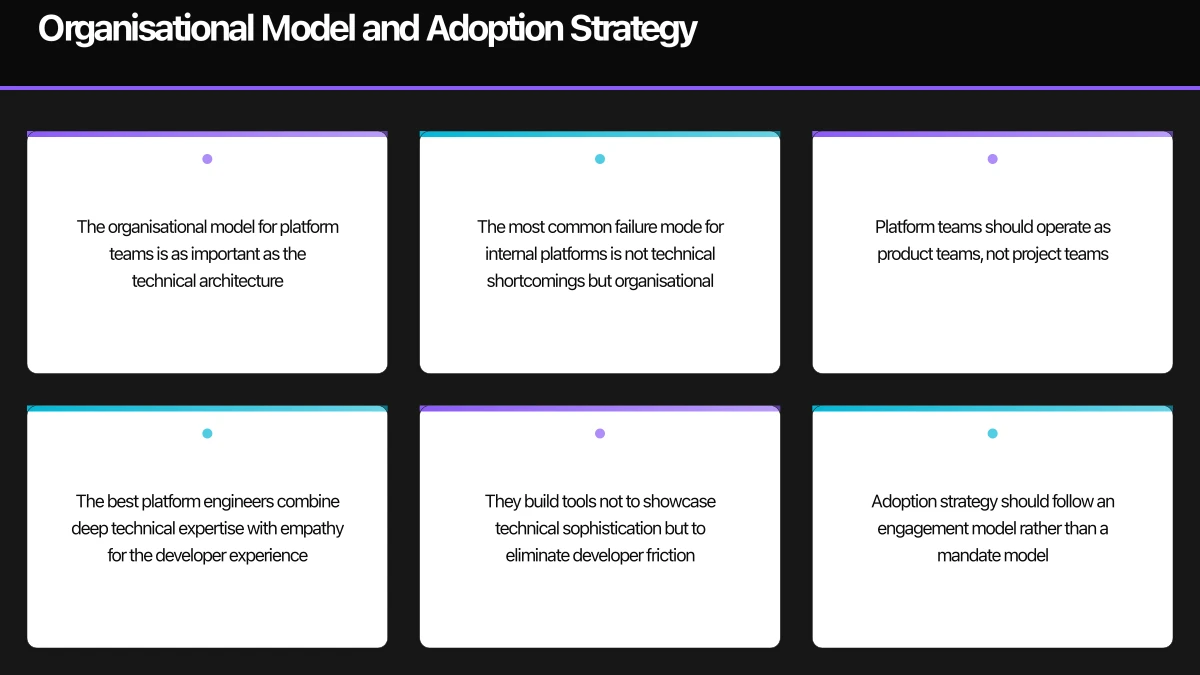
In practice, this means building around APIs and abstractions. The deployment capability should define a clear interface that can be implemented by different CI/CD engines. The infrastructure provisioning capability should abstract over different cloud providers. The observability capability should support pluggable backends. This composability is what prevents the platform from becoming a monolith that is as difficult to change as the legacy systems it was meant to replace.
Opinionated but not constraining: The platform should provide golden paths that make the most common workflows effortless, while allowing teams to deviate when they have legitimate reasons. A platform that only supports one deployment model or one programming language will face resistance from teams with valid requirements that do not fit the mould. The art is making the golden path so attractive that most teams choose it voluntarily, while ensuring that deviation is possible and supported.
Developer experience as a first-class concern: The platform’s success is ultimately measured by developer adoption, and adoption is driven by experience. Platform interfaces should be intuitive, documentation should be excellent, error messages should be helpful, and feedback loops should be fast. Treating platform development with the same UX rigour that product teams apply to customer-facing products is not a luxury — it is a success criterion.
Technology Foundations and Implementation
The technology landscape for internal developer platforms has matured significantly, and several foundational components have emerged as common building blocks.
Kubernetes has become the dominant compute substrate for internal platforms. Its declarative resource model, extensibility through custom resources, and ecosystem of operators and controllers make it a natural foundation. However, raw Kubernetes is too complex for most application developers. The platform’s role is to abstract Kubernetes complexity behind higher-level abstractions — application definitions, environment specifications, and deployment policies — that map to developer mental models rather than infrastructure primitives.
Backstage, the developer portal framework open-sourced by Spotify, has gained significant traction as the user interface layer for internal platforms. It provides a plugin-based architecture for aggregating service catalogues, documentation, CI/CD pipeline status, infrastructure information, and other developer-facing capabilities into a single portal. While Backstage requires significant customisation to fit individual organisations, it provides a more mature starting point than building a developer portal from scratch.
Infrastructure as Code (IaC) tools — Terraform, Pulumi, and cloud-native alternatives like AWS CDK — provide the provisioning layer. The platform typically wraps these tools in higher-level abstractions (often implemented as Terraform modules or Crossplane compositions) that expose organisational-approved configurations while hiding the underlying complexity. Developers request “a PostgreSQL database for production” and the platform provisions it with appropriate sizing, backup policies, security groups, and monitoring.
GitOps practices, often implemented through tools like ArgoCD or Flux, provide the deployment and configuration management layer. Application and infrastructure configurations are stored in Git repositories, and automated reconciliation ensures that running systems match the declared state. This provides auditability (every change is a git commit), rollback capability (revert the commit), and a familiar developer workflow (pull requests for changes).
The observability layer typically integrates open-source tools like Prometheus, Grafana, and Jaeger, or commercial platforms like Datadog or New Relic. The platform’s contribution is pre-configured dashboards, standard alerting rules, and automated instrumentation that gives teams operational visibility without requiring each team to configure observability from scratch.
Organisational Model and Adoption Strategy
The organisational model for platform teams is as important as the technical architecture. The most common failure mode for internal platforms is not technical shortcomings but organisational misalignment.
Platform teams should operate as product teams, not project teams. They need a product manager (or a technically oriented product owner) who understands developer needs, prioritises features based on organisational impact, and measures success through adoption metrics. The platform’s customers are internal developers, and the platform team should engage with them through the same mechanisms that product teams use with external customers: user research, feedback channels, usage analytics, and iterative improvement.
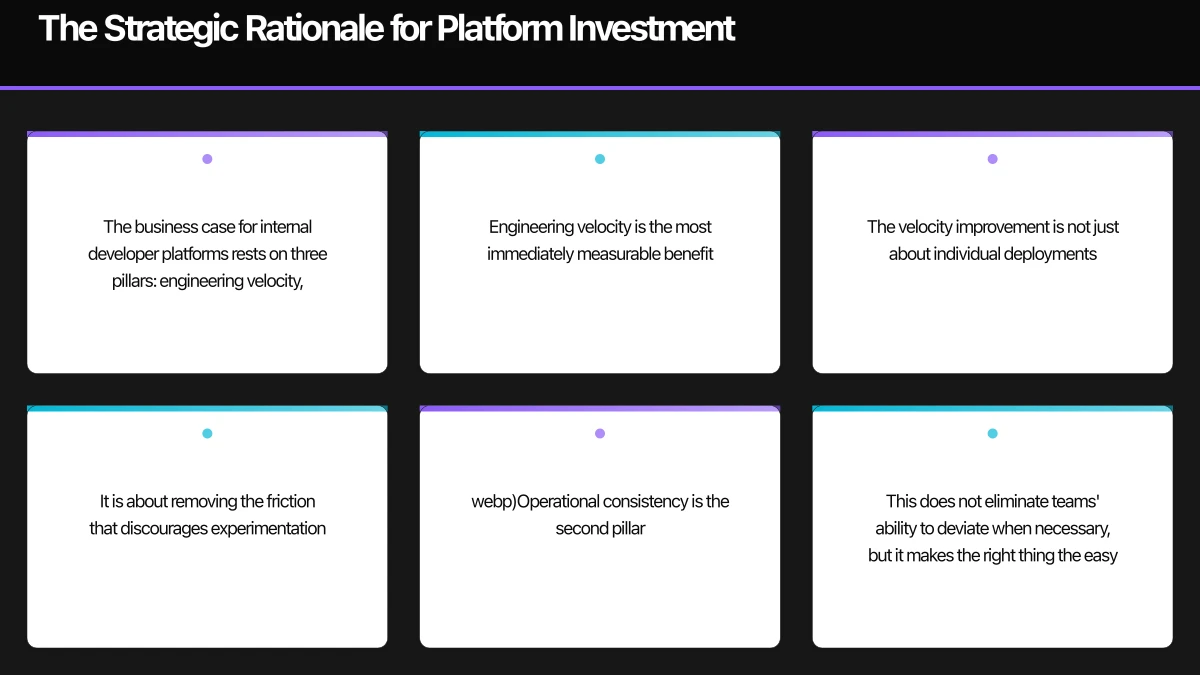
Staffing the platform team requires a blend of skills: infrastructure engineering, software development, developer experience design, and technical communication. The best platform engineers combine deep technical expertise with empathy for the developer experience. They build tools not to showcase technical sophistication but to eliminate developer friction.
Adoption strategy should follow an engagement model rather than a mandate model. Mandating platform usage creates resentment and incentivises workarounds. Instead, identify early adopter teams who are enthusiastic about improving their developer experience, co-develop initial platform capabilities with them, and use their success stories to drive organic adoption. When the platform genuinely improves developer productivity, adoption follows naturally.
The platform should be funded centrally rather than charged back to individual teams, at least during the initial adoption phase. Chargeback models create perverse incentives: teams avoid using platform capabilities to manage costs, even when those capabilities would accelerate their delivery. Central funding treats the platform as shared infrastructure, like electricity or internet connectivity, that enables the entire organisation.
Conclusion
Internal developer platforms represent one of the highest-leverage investments available to enterprise technology organisations. By consolidating infrastructure expertise, establishing operational consistency, and accelerating developer workflows, a well-designed platform multiplies the productivity of every development team it serves.
The investment is substantial — a dedicated platform team of 5-10 engineers for a medium-sized organisation, more for large enterprises — but the returns compound as adoption grows. Each new team that adopts the platform benefits from the accumulated capabilities and best practices embedded within it, and each team’s feedback improves the platform for everyone.
For CTOs considering this investment in 2022, the technology landscape has matured to the point where building an internal developer platform is no longer a pioneering experiment. It is an established practice with proven patterns, mature tooling, and a growing community of practitioners sharing lessons learned. The question is not whether to build a platform but how to build one that developers actually want to use.
Your digital strategy starts with being found online. Cosmos Web Tech covers SEO, WordPress, and web performance for Australian businesses.
Ash Ganda is the founder of Ganda Tech Services, a Sydney-based technology consultancy delivering cloud, web, and mobile solutions for Australian businesses.
About the Author
Ashish Ganda is the founder of Ganda Tech Services, a Sydney-based technology consultancy specialising in cloud infrastructure, web development, and mobile app solutions for Australian businesses.
Tech Stack Selection Guide 2026
Choose the right tools for your Australian business — without the vendor hype or overlapping spend.
Almost done
Check your inbox and click the confirmation link to get your download.