Azure OpenAI Service: Enterprise Deployment Considerations for CTOs
Introduction
Microsoft’s Azure OpenAI Service represents the most significant intersection of enterprise cloud infrastructure and frontier AI capabilities available today. For organisations already invested in the Microsoft ecosystem—Azure, Microsoft 365, Dynamics 365—the service offers a compelling path to AI adoption that leverages existing security frameworks, compliance certifications, and operational expertise.
But compelling doesn’t mean simple. Enterprise deployment of Azure OpenAI requires careful navigation of capacity constraints, cost structures, and architectural decisions that will shape AI capabilities for years to come.
The Microsoft AI Value Proposition
Enterprise Compliance Out of the Box
Azure OpenAI inherits Azure’s comprehensive compliance portfolio: SOC 2, ISO 27001, HIPAA, FedRAMP, and dozens of regional certifications. For enterprises in regulated industries, this compliance inheritance can reduce AI adoption timelines by months compared to building equivalent controls around other AI services.
The compliance story extends beyond certifications. Azure OpenAI:
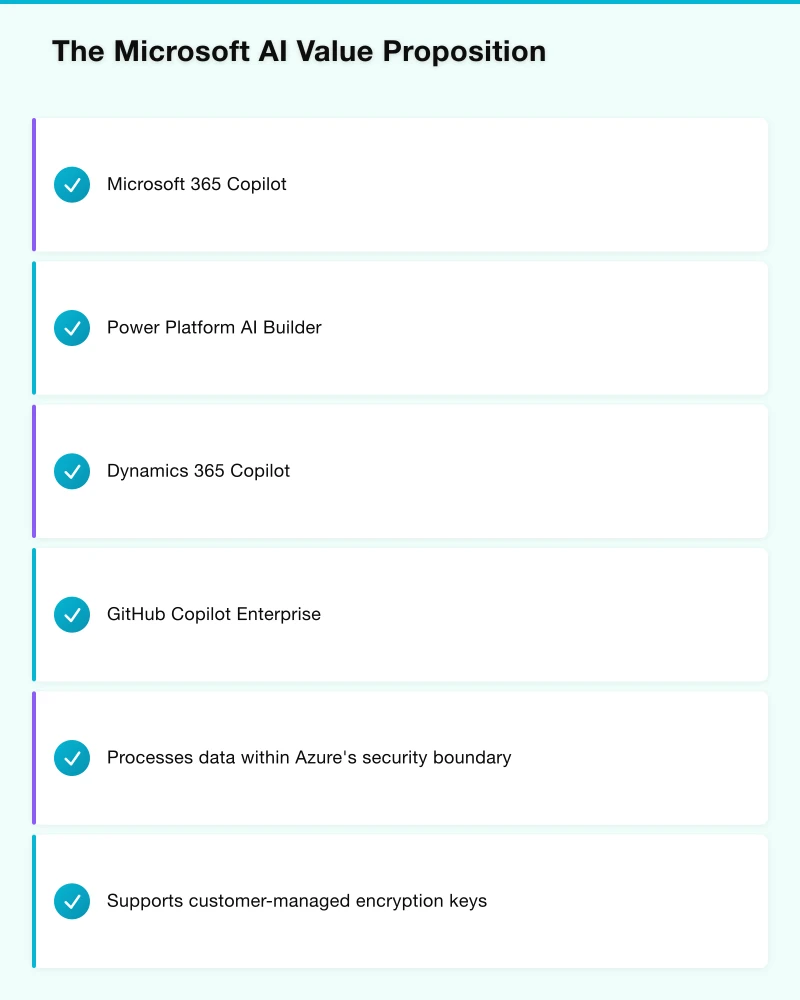
- Processes data within Azure’s security boundary
- Supports customer-managed encryption keys
- Integrates with Azure Active Directory for identity management
- Provides detailed audit logging through Azure Monitor
- Offers data residency guarantees for supported regions
For Australian enterprises specifically, Azure’s Australian datacentre regions mean data sovereignty requirements can be met without complex architectural workarounds.
Microsoft 365 Integration Synergies
The long-term strategic value of Azure OpenAI extends beyond standalone API access. Microsoft is systematically embedding OpenAI capabilities across its productivity suite:
Microsoft 365 Copilot: GPT-4 integration across Word, Excel, PowerPoint, Outlook, and Teams. Organisations using Azure OpenAI build familiarity with models that will power their productivity tools.
Power Platform AI Builder: Low-code AI capabilities built on the same foundation, enabling citizen developers to leverage enterprise AI investments.
Dynamics 365 Copilot: AI-assisted CRM and ERP functionality sharing common infrastructure.
GitHub Copilot Enterprise: Developer productivity tools that can be connected to organisational context through Azure OpenAI.
This integration density creates an ecosystem where Azure OpenAI investments compound across multiple business functions.
Deployment Architecture Decisions
Model Selection and Capacity
Azure OpenAI offers access to GPT-4, GPT-4 Turbo, GPT-3.5 Turbo, and DALL-E models. However, model availability varies by region, and capacity is constrained.
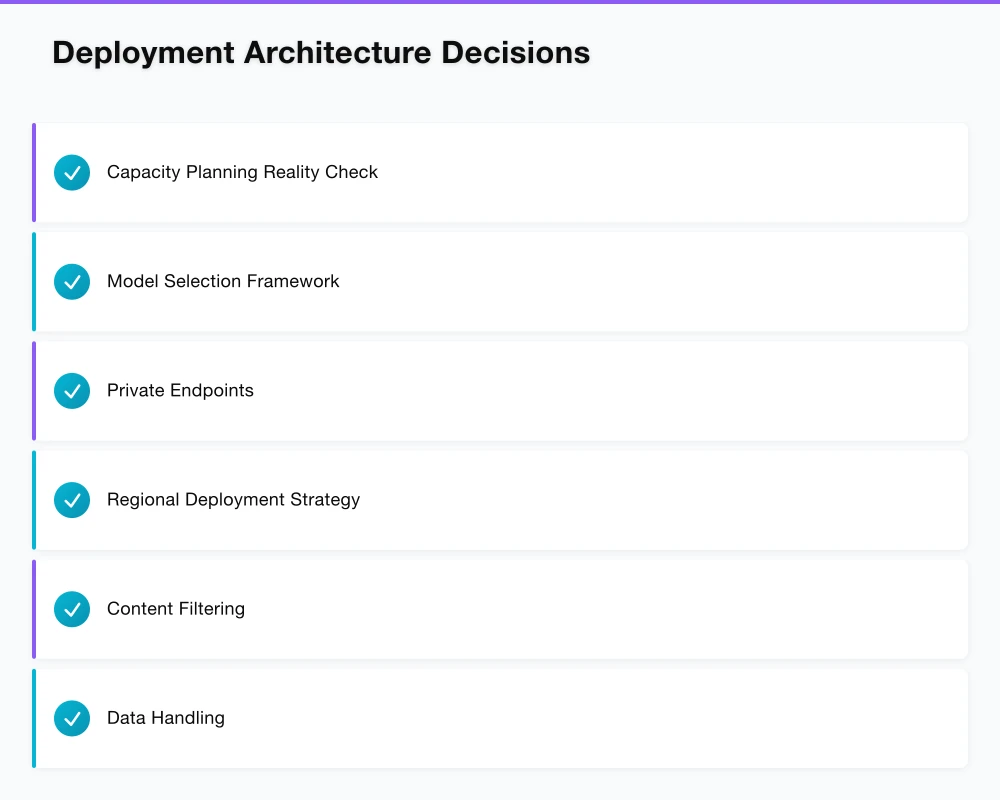
Capacity Planning Reality Check
Azure OpenAI operates under a quota system. Default quotas are often insufficient for production workloads. Enterprises must:
- Request quota increases well before production deployments
- Plan for regional failover if primary region quotas are exhausted
- Monitor token consumption against allocated quotas
- Build queuing mechanisms for quota-constrained scenarios
The quota approval process can take days or weeks. Factor this into deployment timelines.
Model Selection Framework
| Use Case | Recommended Model | Rationale |
|---|---|---|
| Complex reasoning, analysis | GPT-4 | Highest capability, highest cost |
| High-volume, simpler tasks | GPT-3.5 Turbo | Cost-effective for many applications |
| Long context requirements | GPT-4 Turbo (128K) | Extended context window |
| Real-time chat applications | GPT-3.5 Turbo | Lower latency |
| Image generation | DALL-E 3 | Best quality for enterprise use |
Build applications that can route requests to appropriate models based on task complexity.
Network Architecture
Private Endpoints
For enterprise deployment, configure Azure OpenAI with private endpoints:
- Traffic flows through Azure backbone, not public internet
- Integration with existing Azure virtual network architecture
- Consistent with enterprise network security policies
- Enables on-premises access through ExpressRoute or VPN
Regional Deployment Strategy
Azure OpenAI availability varies by region. As of mid-2024:
- US regions: Broadest model availability
- European regions: Growing availability with data residency
- Asia-Pacific: Limited but expanding
- Australia: Available in Australia East
For global enterprises, architect for multi-region deployment with intelligent routing based on:
- User location for latency optimisation
- Data residency requirements for compliance
- Capacity availability for reliability
Security Controls
Content Filtering
Azure OpenAI includes mandatory content filtering for harmful content categories. This filtering:
- Cannot be completely disabled for most deployments
- May affect some legitimate use cases
- Can be customised through Azure’s responsible AI features
- Should be tested thoroughly with representative workloads
Some enterprise applications—medical, legal, security research—may require modified filtering configurations. This requires Microsoft approval and additional review processes.
Data Handling
Azure OpenAI provides clear data handling commitments:
- Prompts and completions are not used to train models
- Data is not shared with OpenAI for model improvement
- Abuse monitoring data is retained for 30 days (can be reduced with approved use cases)
- Customer data is processed only in the deployed Azure region
These commitments address the primary enterprise concern about AI services: competitive or sensitive information leaking into shared model training.
Cost Management Strategies
Pricing Structure
Azure OpenAI uses token-based pricing that varies by model:
- GPT-4: ~$0.03/1K prompt tokens, ~$0.06/1K completion tokens
- GPT-3.5 Turbo: ~$0.0005/1K prompt tokens, ~$0.0015/1K completion tokens
- Prices subject to change; verify current pricing
The 60x cost differential between GPT-4 and GPT-3.5 Turbo makes model selection the primary cost lever.
Optimisation Techniques
Intelligent Model Routing
Build classification logic that routes requests to the minimum viable model:
- Simple queries → GPT-3.5 Turbo
- Complex analysis → GPT-4
- Unknown complexity → Start with GPT-3.5 Turbo, escalate if needed
This routing can reduce costs by 40-60% for mixed workloads.
Prompt Optimisation
Token costs accumulate in prompts, not just completions. Optimise prompts by:
- Using concise, specific instructions
- Avoiding repetitive context in conversation history
- Implementing conversation summarisation for long interactions
- Caching and reusing common prompt components
Response Caching
Many enterprise applications generate repeated similar queries. Implement caching:
- Semantic similarity matching for cache hits
- Time-based cache invalidation for dynamic content
- User-specific vs. shared cache strategies
- Cache warm-up for predictable query patterns
Caching strategies commonly reduce inference costs by 20-40%.
Provisioned Throughput
For predictable, high-volume workloads, Azure offers Provisioned Throughput Units (PTUs):
- Reserved capacity at predictable cost
- Guaranteed availability without quota concerns
- Cost-effective above certain volume thresholds
Model PTU economics carefully. Unused provisioned capacity is more expensive than on-demand.
Budget Controls
Implement multiple layers of cost control:
Azure Cost Management
- Set budgets with alerts at multiple thresholds
- Configure action groups for automatic notifications
- Implement spending caps where supported
Application-Level Controls
- Per-user or per-department quotas
- Rate limiting to prevent runaway costs
- Approval workflows for high-cost operations
Monitoring and Attribution
- Tag all resources for cost allocation
- Build dashboards showing cost by application, team, use case
- Implement chargeback or showback models
Integration Patterns
API Management Layer
Don’t expose Azure OpenAI endpoints directly to applications. Implement an API management layer that:
Azure API Management Integration
- Centralised authentication and authorisation
- Rate limiting and throttling
- Request/response transformation
- Caching at the gateway level
- Analytics and monitoring
Custom Abstraction Services
- Business logic integration
- Prompt template management
- Response validation and filtering
- Fallback and retry logic
- Multi-model orchestration
This abstraction layer becomes critical for governance, optimisation, and future flexibility.
Enterprise Application Integration
SharePoint and Microsoft 365
- Semantic search across document libraries
- Automated content summarisation
- Intelligent document processing
- Meeting transcription and insights
Dynamics 365
- Customer interaction analysis
- Automated response drafting
- Predictive lead scoring
- Contract analysis and extraction
Power Platform
- AI-powered workflows in Power Automate
- Natural language interfaces in Power Apps
- Intelligent data analysis in Power BI
Custom Applications
- Customer-facing chatbots with enterprise knowledge
- Internal knowledge assistants
- Code generation and review tools
- Document analysis and extraction pipelines
Organisational Readiness
Skills Development
Successful Azure OpenAI deployment requires skills across multiple domains:
Prompt Engineering
- Understanding model capabilities and limitations
- Crafting effective instructions
- Testing and iterating on prompts
- Building prompt libraries and templates
AI Application Architecture
- Designing for AI uncertainty
- Building human-in-the-loop workflows
- Implementing appropriate guardrails
- Managing conversation state
Responsible AI
- Understanding bias and fairness considerations
- Implementing content moderation
- Designing for transparency
- Building feedback and improvement loops
Azure Platform
- Azure networking and security
- Cost management and optimisation
- Monitoring and operations
- DevOps for AI workloads
Change Management
AI adoption creates organisational change that extends beyond technology:
Workforce Implications
- Roles will evolve as AI handles routine tasks
- New skills become valuable (prompt engineering, AI oversight)
- Resistance often comes from uncertainty, not technology
- Clear communication about AI’s role reduces anxiety
Process Redesign
- Existing processes may not benefit from AI without modification
- Human-AI collaboration patterns require new workflows
- Quality assurance needs adaptation for AI-generated content
- Feedback loops are essential for continuous improvement
Governance Evolution
- AI introduces new risk categories
- Existing policies may not address AI-specific concerns
- Cross-functional governance bodies may be needed
- Regular policy review as capabilities evolve
Conclusion
Azure OpenAI Service provides a robust foundation for enterprise AI adoption, particularly for organisations already invested in Microsoft’s ecosystem. The combination of compliance inheritance, productivity suite integration, and enterprise security controls addresses many barriers that slow AI adoption.
Success requires:
- Realistic capacity planning and quota management
- Thoughtful architecture that enables governance and optimisation
- Active cost management with multiple control layers
- Organisational investment in skills and change management
The enterprises that move thoughtfully now—building foundations rather than racing to deploy—will be positioned to scale AI capabilities as the technology matures and new use cases emerge.
Sources
- Microsoft. (2024). Azure OpenAI Service Documentation. Microsoft Learn. https://learn.microsoft.com/en-us/azure/ai-services/openai/
- Microsoft. (2024). Azure OpenAI Service Pricing. Microsoft Azure. https://azure.microsoft.com/en-au/pricing/details/cognitive-services/openai-service/
- Microsoft. (2024). Responsible AI Practices for Azure OpenAI. Microsoft Learn. https://learn.microsoft.com/en-us/azure/ai-services/openai/concepts/responsible-ai
- Gartner. (2024). Magic Quadrant for Cloud AI Developer Services. Gartner Research. https://www.gartner.com/en/documents/cloud-ai-developer-services
- Forrester. (2024). The Forrester Wave: AI Foundation Models. Forrester Research. https://www.forrester.com/report/ai-foundation-models/
Strategic technology guidance for enterprise leaders building AI capabilities.
For hands-on guidance on cloud migration and managed IT, my team at Cloud Geeks helps Australian businesses implement these strategies.
I lead Ganda Tech Services, where we turn digital strategy into results through specialist cloud, web design, and mobile app teams across Sydney.
About the Author
Ashish Ganda is the founder of Ganda Tech Services, a Sydney-based technology consultancy specialising in cloud infrastructure, web development, and mobile app solutions for Australian businesses.
AI Strategy Primer for Australian Business Leaders
A practical framework for AI adoption in 2026 — cut through the hype and start with what matters.