AWS Bedrock and the Enterprise AI Strategy: Moving Beyond Experimentation
Introduction
The generative AI landscape shifted dramatically when AWS launched Bedrock in general availability. For the first time, enterprises have access to multiple foundation models—Claude, Llama 3, Stable Diffusion, and Amazon’s own Titan—through a single managed service with enterprise-grade security controls.
But access to models is only the beginning. The real challenge facing CTOs is moving from scattered AI experiments to coordinated, governed, production-grade implementations. After working with multiple enterprise clients on their Bedrock deployments, patterns have emerged that separate successful implementations from expensive false starts.
The Current State of Enterprise AI Adoption
Most enterprises find themselves in one of three positions:
Stage 1: Shadow AI — Individual teams using ChatGPT, Claude, or other consumer AI tools without IT oversight. Data governance is nonexistent. Costs are hidden in expense reports. Security teams are unaware of what data is being shared with external services.
Stage 2: Pilot Purgatory — IT has approved one or two AI pilot projects, typically in low-risk areas like internal documentation or customer service automation. These pilots succeed in isolation but lack clear paths to production or scaling frameworks.
Stage 3: Strategic Integration — AI initiatives are governed centrally, costs are tracked and optimised, security controls are enforced, and successful pilots have clear graduation paths to production systems.
AWS Bedrock provides the infrastructure to jump from Stage 1 or 2 directly to Stage 3—but only with proper planning.
Why Bedrock Changes the Enterprise AI Equation
Model Flexibility Without Vendor Lock-In
The foundation model landscape is evolving rapidly. Anthropic’s Claude models excel at nuanced reasoning and safety. Meta’s Llama 3 offers strong performance for many use cases with more permissive licensing. Stability AI’s models handle image generation. Amazon’s Titan provides a cost-effective option for simpler tasks.
Bedrock’s unified API means enterprises can:
- Run the same application against different models for comparison
- Switch models as capabilities improve or costs change
- Use different models for different tasks within the same application
- Avoid rewriting applications when better models emerge
This flexibility is critical when the model landscape changes quarterly.
Enterprise Security by Default
Bedrock addresses the security concerns that kept many enterprises from adopting AI:
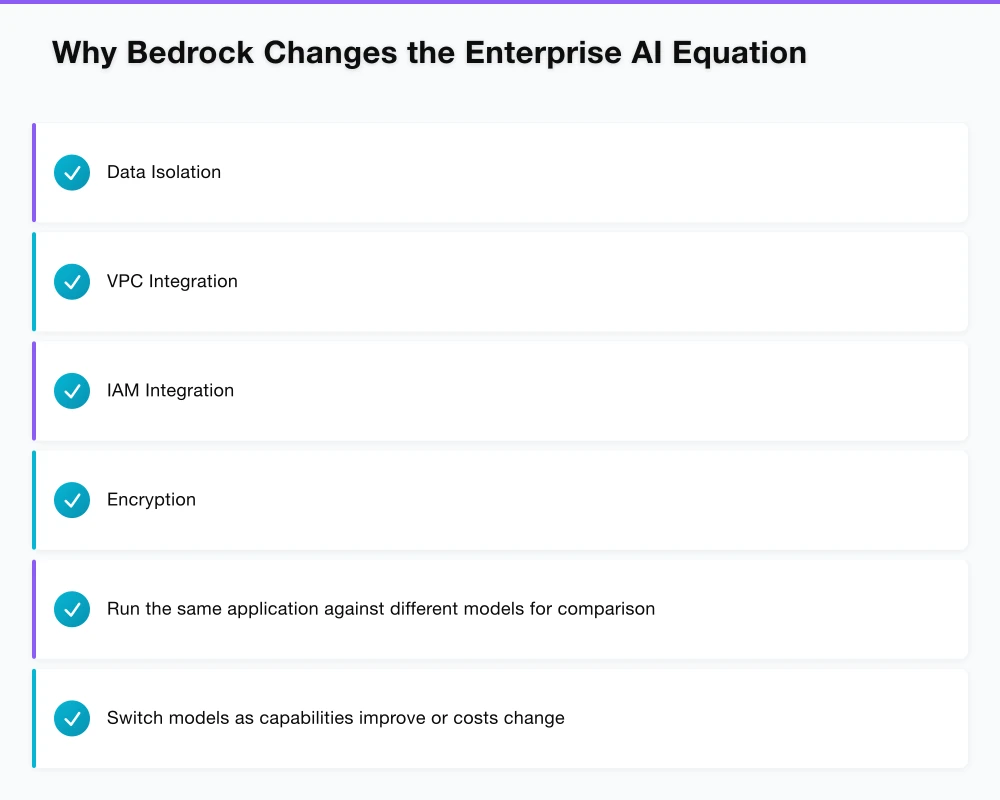
Data Isolation: Customer data used for inference is not used to train models. This addresses the primary concern about competitive intelligence leaking into shared model training.
VPC Integration: Bedrock endpoints can be deployed within your VPC using PrivateLink, ensuring inference traffic never traverses the public internet.
IAM Integration: Granular access controls determine which teams can access which models, with full CloudTrail logging for audit compliance.
Encryption: Data is encrypted in transit and at rest using customer-managed keys.
These aren’t afterthought security features—they’re fundamental to Bedrock’s architecture.
Operational Simplicity
Managing foundation models requires significant infrastructure expertise:
- GPU cluster management
- Model serving optimisation
- Scaling for variable workloads
- High availability and failover
Bedrock abstracts all of this. Teams focus on building applications, not managing infrastructure. This operational simplicity translates directly to faster time-to-production.
Building an Enterprise Bedrock Strategy
Governance First
Before provisioning any Bedrock resources, establish governance frameworks:
Model Selection Criteria: Define which models are approved for which use cases. Claude might be approved for customer-facing applications requiring nuanced responses, while Titan handles internal document processing at lower cost.
Data Classification Integration: Connect your existing data classification system to Bedrock access controls. Sensitive data categories might only flow through certain models with enhanced logging.
Cost Allocation: Implement tagging strategies that allocate Bedrock costs to specific projects, departments, or cost centres. Bedrock’s per-token pricing makes cost attribution straightforward.
Prompt Governance: Establish standards for prompt engineering, including required safety guidelines, brand voice requirements, and prohibited content policies.
Architecture Patterns That Scale
Successful enterprise Bedrock deployments follow common architectural patterns:
Abstraction Layer Pattern
Never call Bedrock APIs directly from application code. Build an internal abstraction layer that:
- Enforces governance policies
- Handles model selection logic
- Manages prompt templates
- Provides consistent error handling
- Enables model switching without application changes
This abstraction becomes your organisation’s AI platform, even if Bedrock is the underlying infrastructure.
Prompt Registry Pattern
Maintain a central registry of approved prompts for common use cases. This ensures:
- Consistency across applications
- Easier prompt optimisation
- Compliance with brand and legal requirements
- Knowledge sharing across teams
Version prompts like code. Track performance metrics for each version.
Guardrails Pattern
Implement input and output guardrails that:
- Filter inappropriate input before it reaches models
- Validate output against business rules before returning to users
- Log edge cases for human review
- Provide fallback responses when guardrails trigger
Bedrock’s native guardrails feature simplifies this, but most enterprises need additional custom validation.
Cost Optimisation Strategies
Bedrock’s per-token pricing creates both opportunity and risk. Without active management, costs can spiral unexpectedly.
Right-Size Model Selection: Not every task needs the most capable model. Internal document summarisation might work fine with Titan, saving significant cost over Claude. Build model selection logic that chooses the minimum viable model for each request type.
Prompt Optimisation: Shorter prompts cost less. Invest in prompt engineering that achieves required quality with minimal tokens. This often means more specific instructions rather than lengthy context.
Caching and Deduplication: Implement caching for common requests. If multiple users ask similar questions, serve cached responses rather than repeated inference calls.
Provisioned Throughput: For predictable, high-volume workloads, provisioned throughput provides cost savings over on-demand pricing. Model this carefully—provisioned capacity that goes unused costs more than on-demand.
Budget Alerts: Configure CloudWatch alarms for Bedrock spending. Set alerts at multiple thresholds (50%, 75%, 90% of budget) to catch runaway costs early.
Implementation Roadmap
Phase 1: Foundation (Weeks 1-4)
Week 1-2: Governance Setup
- Document model selection criteria
- Define data classification policies for AI
- Establish cost allocation tagging
- Create prompt governance guidelines
Week 3-4: Infrastructure
- Configure Bedrock access with appropriate IAM policies
- Set up VPC endpoints and PrivateLink
- Implement logging and monitoring
- Build initial abstraction layer
Phase 2: Controlled Pilots (Weeks 5-12)
Select 2-3 Pilot Use Cases
Good initial use cases share characteristics:
- Clear success metrics
- Limited blast radius if problems occur
- Engaged business stakeholders
- Existing data and processes to enhance
Common starting points:
- Internal knowledge base Q&A
- Document summarisation for specific workflows
- First-draft content generation for review
Build, Measure, Iterate
For each pilot:
- Define success metrics before building
- Instrument comprehensively for learning
- Schedule weekly reviews with stakeholders
- Document learnings in accessible format
Phase 3: Production Graduation (Weeks 13-20)
Successful pilots graduate to production with:
- Formal architecture review
- Load testing and capacity planning
- Incident response procedures
- User training and documentation
- Cost forecasting and budget approval
Phase 4: Scale and Optimise (Ongoing)
With production systems running:
- Continuously optimise costs
- Expand to additional use cases
- Build internal expertise and centres of excellence
- Evaluate new models as they become available
Common Pitfalls and How to Avoid Them
Pitfall: Treating AI as a Feature, Not a Capability
Teams often approach AI as adding a feature to existing applications. This leads to scattered implementations, duplicated effort, and inconsistent governance.
Solution: Build AI as an organisational capability with shared infrastructure, common patterns, and centralised expertise. Individual teams consume the capability; they don’t build it from scratch.
Pitfall: Underestimating Prompt Engineering
Effective prompts require significant iteration. Teams often expect models to understand requirements with minimal guidance, leading to poor results and skepticism about AI capabilities.
Solution: Invest in prompt engineering as a discipline. Train team members. Build libraries of effective prompts. Share learnings across teams.
Pitfall: Ignoring the Human Element
AI implementations that remove humans from processes often fail. Users don’t trust fully automated outputs. Edge cases fall through cracks. Quality degrades without human feedback loops.
Solution: Design human-in-the-loop workflows. Use AI to augment human capabilities, not replace human judgment. Build feedback mechanisms that improve systems over time.
Pitfall: Launching Without Guardrails
The pressure to ship quickly leads teams to skip input validation and output filtering. This creates reputation risk when models produce inappropriate content.
Solution: Guardrails are not optional. Build them before launch. Test adversarial inputs. Plan for edge cases.
Measuring Success
Define metrics across multiple dimensions:
Business Impact
- Time saved on specific workflows
- Quality improvements in outputs
- New capabilities enabled
- Revenue impact where applicable
Technical Performance
- Latency percentiles
- Error rates
- Model accuracy for specific tasks
- System availability
Operational Efficiency
- Cost per transaction
- Infrastructure utilisation
- Time to deploy new use cases
- Incident frequency and resolution time
Governance Compliance
- Policy adherence rates
- Audit findings
- Security incidents
- Data handling compliance
The Path Forward
AWS Bedrock provides the infrastructure enterprises need to move AI from experimentation to production. But infrastructure alone doesn’t create value—strategy, governance, and execution determine success.
The enterprises that will lead in the AI era are building foundations now: governance frameworks, architectural patterns, and organisational capabilities that will scale as AI technology advances.
The models will improve. The costs will decrease. The capabilities will expand. What won’t change is the need for thoughtful strategy connecting AI capabilities to business outcomes.
Start building that foundation today.
Sources
- AWS. (2024). Amazon Bedrock Documentation. Amazon Web Services. https://docs.aws.amazon.com/bedrock/
- Anthropic. (2024). Claude Model Card. Anthropic. https://www.anthropic.com/claude
- McKinsey & Company. (2024). The State of AI in 2024. McKinsey Global Institute. https://www.mckinsey.com/capabilities/quantumblack/our-insights/the-state-of-ai
- Gartner. (2024). Emerging Technology Roadmap for Generative AI. Gartner Research. https://www.gartner.com/en/articles/emerging-tech-generative-ai
- AWS. (2024). Well-Architected Framework: Machine Learning Lens. Amazon Web Services. https://docs.aws.amazon.com/wellarchitected/latest/machine-learning-lens/
Strategic guidance for enterprise technology leaders navigating the AI transformation.
The strategic frameworks I discuss here come to life through execution. Cloud Geeks covers the practical side of cloud infrastructure and IT management.
I lead Ganda Tech Services, where we turn digital strategy into results through specialist cloud, web design, and mobile app teams across Sydney.
About the Author
Ashish Ganda is the founder of Ganda Tech Services, a Sydney-based technology consultancy specialising in cloud infrastructure, web development, and mobile app solutions for Australian businesses.
AI Strategy Primer for Australian Business Leaders
A practical framework for AI adoption in 2026 — cut through the hype and start with what matters.