Application Modernisation: Choosing the Right Approach
Introduction
Legacy applications are simultaneously the backbone and the burden of enterprise IT. They run critical business processes but resist change, consume disproportionate resources, and limit business agility. Modernisation is essential—but how to modernise is far from obvious.
The wrong approach wastes resources, introduces risk, and delivers disappointing results. The right approach transforms constraints into capabilities. This guide helps CTOs navigate these decisions.
Why Modernise
Business Drivers
Agility
- Faster response to market changes
- Quicker feature delivery
- Reduced change lead times
- Business experimentation enablement
Cost
- Infrastructure efficiency
- Operational cost reduction
- Reduced maintenance burden
- Better resource utilisation
Capability
- New functionality enablement
- Integration with modern services
- Mobile and digital channel support
- Analytics and AI readiness
Risk
- Technology obsolescence
- Security vulnerability exposure
- Talent scarcity for legacy skills
- Vendor and support risk
When Not to Modernise
Not every application needs modernisation:
- Stable, low-change applications
- Near end-of-life systems
- Applications being replaced
- Adequate current performance
- Excessive modernisation risk
Sometimes maintaining the status quo is the right decision.
Modernisation Spectrum
The 7 Rs Framework
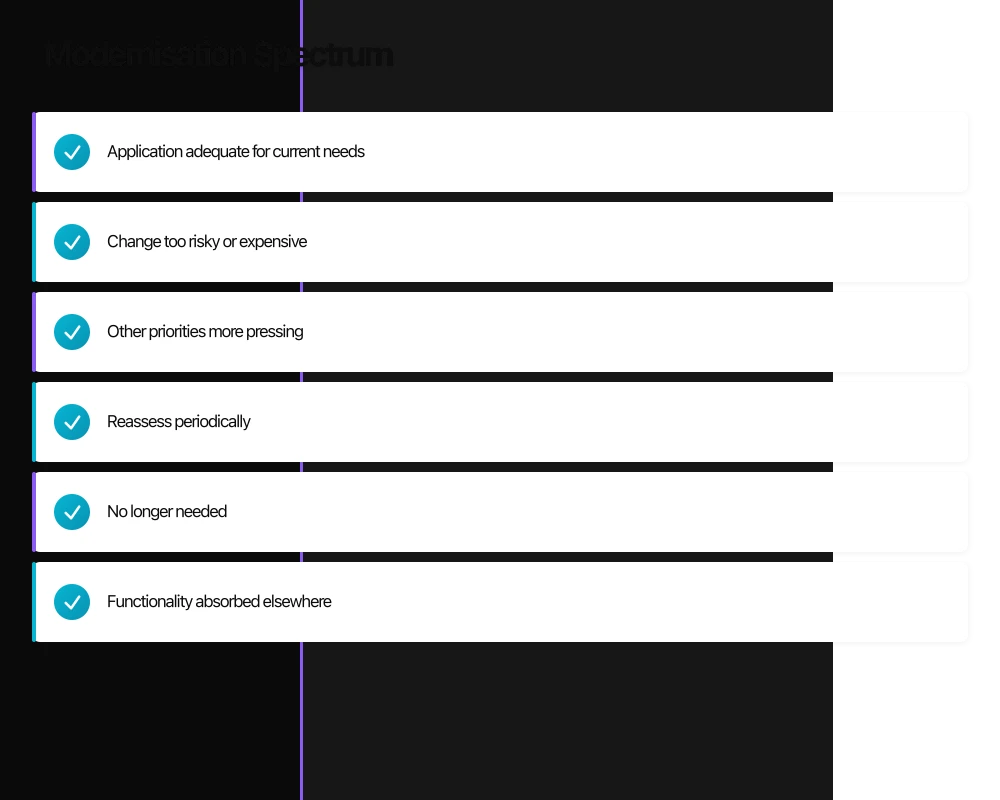
Retain
Keep as-is, possibly with minor improvements:
- Application adequate for current needs
- Change too risky or expensive
- Other priorities more pressing
- Reassess periodically
Retire
Decommission the application:
- No longer needed
- Functionality absorbed elsewhere
- Cost of maintenance exceeds value
- Compliance or risk requirement
Rehost (Lift and Shift)
Move to new infrastructure without code changes:
- Quickest migration path
- Minimal risk
- Limited benefit beyond infrastructure
- Often first step toward further modernisation
Relocate
Move to new platform with minimal changes:
- Database platform migration
- Container without refactoring
- Different cloud provider
- Managed service adoption
Repurchase
Replace with SaaS or commercial product:
- Commodity functionality
- Better solution available
- Build vs buy decision
- Transition complexity consideration
Replatform (Lift, Tinker, and Shift)
Partial modernisation for cloud optimisation:
- Database to managed service
- Containerisation without redesign
- Minimal code changes
- Cloud service adoption
Refactor/Rearchitect
Substantial redesign for modern architecture:
- Microservices decomposition
- Cloud-native patterns
- Significant code changes
- Maximum benefit, maximum effort
Rebuild
Complete rewrite:
- Ground-up development
- Modern technology stack
- Requirements preserved or evolved
- Highest effort and risk
Choosing the Right Approach
Factors to Consider
- Business criticality
- Change velocity needs
- Technical debt level
- Available skills
- Time constraints
- Budget limitations
- Risk tolerance
Decision Matrix Approach
Evaluate each application on:
- Business value (high/medium/low)
- Technical health (good/fair/poor)
- Strategic alignment (core/important/commodity)
Map to appropriate modernisation approach.
Assessment Process
Application Portfolio Analysis
Inventory
- Complete application catalogue
- Business owner identification
- Technical stack documentation
- Integration mapping
- Cost allocation
Classification
- Business criticality tiers
- Strategic importance
- Change frequency
- User impact
- Revenue relationship
Technical Assessment
Architecture Review
- Current state documentation
- Scalability limitations
- Security posture
- Performance characteristics
- Integration patterns
Code Analysis
- Code quality metrics
- Technical debt quantification
- Test coverage
- Documentation state
- Dependency analysis
Infrastructure Review
- Hosting environment
- Resource utilisation
- Monitoring and operations
- Disaster recovery
- Security controls
Business Assessment
Stakeholder Input
- Pain points and limitations
- Future requirements
- Change frequency expectations
- Risk tolerance
- Timeline pressures
Value Analysis
- Current business value
- Potential improved value
- Cost of status quo
- Modernisation investment required
- Expected return
Execution Approaches
Strangler Fig Pattern
Gradually replace legacy system:
- Build new functionality alongside legacy
- Route new requests to new system
- Incrementally migrate existing features
- Eventually retire legacy
Benefits
- Reduced risk
- Continuous delivery
- Easier course correction
- Maintained business continuity
Challenges
- Coexistence complexity
- Extended transition period
- Integration overhead
- Potential scope creep
Big Bang Replacement
Complete cutover at defined point:
When Appropriate
- Small, bounded applications
- Clean replacement available
- Coexistence impractical
- Timeline pressure
Risks
- All-or-nothing pressure
- Limited rollback options
- Integration complexity at cutover
- Extended validation period
Parallel Running
Operate old and new simultaneously:
How It Works
- Run both systems in production
- Compare outputs and behaviour
- Build confidence in new system
- Cut over when validated
Benefits
- Validation of new system
- Risk mitigation
- User confidence building
- Rollback option maintained
Challenges
- Duplicate operational cost
- Data synchronisation
- Extended timeline
- Resource intensive
Technology Considerations
Containerisation
Benefits
- Deployment consistency
- Infrastructure abstraction
- Scaling capabilities
- Operational efficiency
Approach
- Assess containerisation feasibility
- Address dependencies
- Modernise deployment pipelines
- Implement orchestration
Microservices
When to Decompose
- Independent scaling needs
- Different change velocities
- Team autonomy requirements
- Technology diversity needs
When to Avoid
- Small applications
- Limited team experience
- Insufficient operational maturity
- Unnecessary complexity
Serverless
Good Fit
- Event-driven workloads
- Variable demand patterns
- Simple, stateless functions
- Rapid development needs
Poor Fit
- Long-running processes
- Complex state management
- High-frequency transactions
- Cost-sensitive high-volume
API-First
Benefits
- Integration flexibility
- Channel independence
- Partner enablement
- Future adaptability
Implementation
- API design standards
- Gateway implementation
- Security patterns
- Documentation and discovery
Organisational Considerations
Skills and Teams
Assessment
- Current skill inventory
- Gap analysis
- Training needs
- Hiring requirements
Options
- Internal skill development
- Strategic hiring
- Partner augmentation
- Managed services
Change Management
Stakeholder Engagement
- Business sponsor alignment
- User involvement
- Technical team buy-in
- Executive communication
Risk Management
- Risk identification
- Mitigation planning
- Contingency preparation
- Monitoring and response
Governance
Decision Rights
- Modernisation approach selection
- Technology choices
- Resource allocation
- Timeline and scope changes
Oversight
- Progress tracking
- Benefit realisation
- Risk monitoring
- Course correction triggers
Common Pitfalls
Underestimating Complexity
The Problem
Legacy systems hide complexity:
- Undocumented business rules
- Hidden integrations
- Data quality issues
- Edge cases in production
Mitigation
- Thorough assessment
- Conservative estimates
- Incremental approach
- Discovery buffer
Scope Creep
The Problem
Modernisation becomes vehicle for every enhancement:
- Timeline extends
- Budget overruns
- Focus dilutes
- Completion delays
Mitigation
- Clear scope boundaries
- Change control
- Phased delivery
- Separate enhancement from modernisation
Ignoring Data
The Problem
Focus on application code, neglect data migration:
- Data quality issues surface late
- Migration complexity underestimated
- Historical data handling unclear
- Testing insufficient
Mitigation
- Data assessment early
- Migration planning and testing
- Quality remediation
- Validation processes
Skills Gaps
The Problem
New technologies require new skills:
- Learning curve delays
- Quality issues from inexperience
- Operational challenges
- Retention risk
Mitigation
- Skill assessment upfront
- Training investment
- Expert support
- Realistic timeline adjustment
Measuring Success
During Modernisation
Progress Metrics
- Migration completion percentage
- Feature parity achievement
- Performance benchmarks
- Issue resolution rates
Health Metrics
- Team velocity
- Defect rates
- Stakeholder satisfaction
- Risk register status
Post-Modernisation
Technical Metrics
- System performance
- Reliability improvements
- Deployment frequency
- Incident reduction
Business Metrics
- Delivery speed improvement
- Cost reduction achieved
- User satisfaction
- Business capability enablement
Conclusion
Application modernisation is strategic investment. The right approach—matched to business context, technical reality, and organisational capability—transforms legacy constraints into modern capabilities.
Start with clear understanding of why modernisation matters for each application. Assess honestly. Choose approaches appropriate to context. Execute incrementally where possible. Measure outcomes.
The goal isn’t modernisation for its own sake—it’s business value that modernisation enables.
Strategy without a web presence is invisible. Cosmos Web Tech publishes practical guides on building websites that attract and convert Australian customers.
As founder of Ganda Tech Services, I work with Australian businesses to align technology investments with business growth — across cloud, web, and mobile.
About the Author
Ashish Ganda is the founder of Ganda Tech Services, a Sydney-based technology consultancy specialising in cloud infrastructure, web development, and mobile app solutions for Australian businesses.
Digital Transformation Roadmap 2026
A 12-month framework for Australian SMBs ready to modernise — phases, tools, and milestones.
Almost done
Check your inbox and click the confirmation link to get your download.