AI-Powered Documentation: Transforming Enterprise Knowledge Management
Introduction
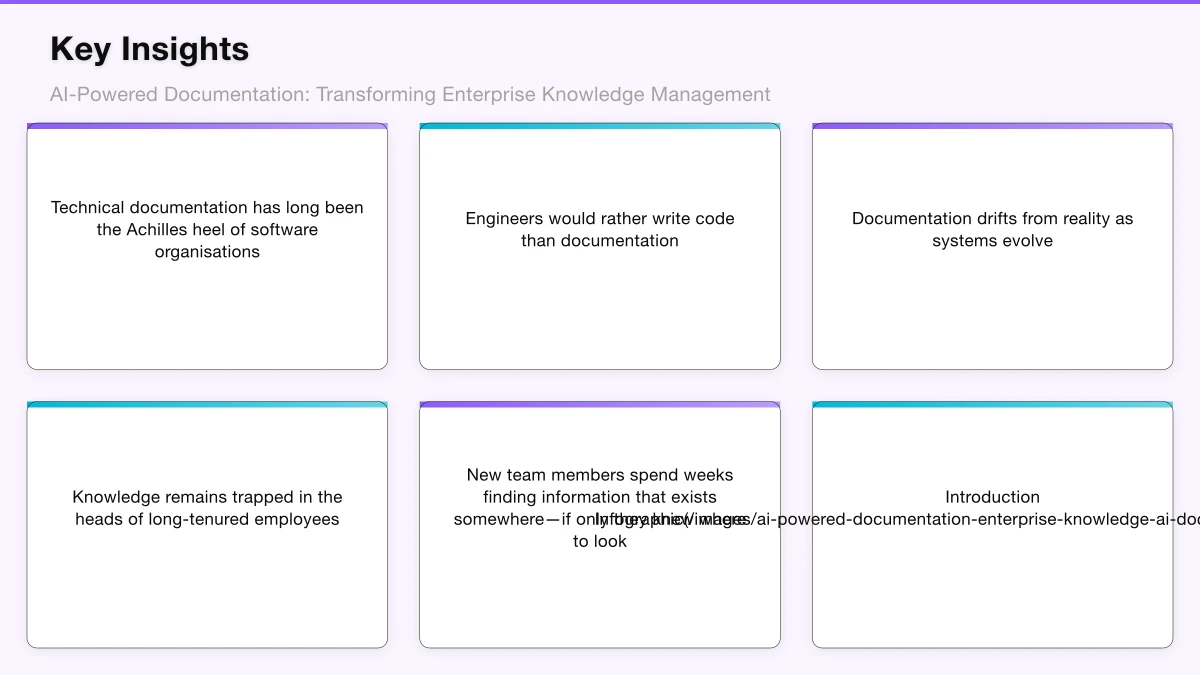
Technical documentation has long been the Achilles heel of software organisations. Engineers would rather write code than documentation. Documentation drifts from reality as systems evolve. Knowledge remains trapped in the heads of long-tenured employees. New team members spend weeks finding information that exists somewhere—if only they knew where to look.
The emergence of large language models presents a genuine opportunity to address these persistent challenges. AI can now generate documentation from code, answer questions about existing documentation, identify gaps in coverage, and help maintain accuracy over time. The question for enterprise technology leaders is no longer whether AI will transform documentation practices, but how to implement these capabilities effectively.
This guide examines how CTOs are deploying AI-powered documentation systems, the architectural patterns that enable success, and the organisational considerations that determine whether these initiatives deliver lasting value.
The Documentation Problem at Scale
Why Traditional Approaches Fail
Enterprise documentation challenges compound as organisations grow:
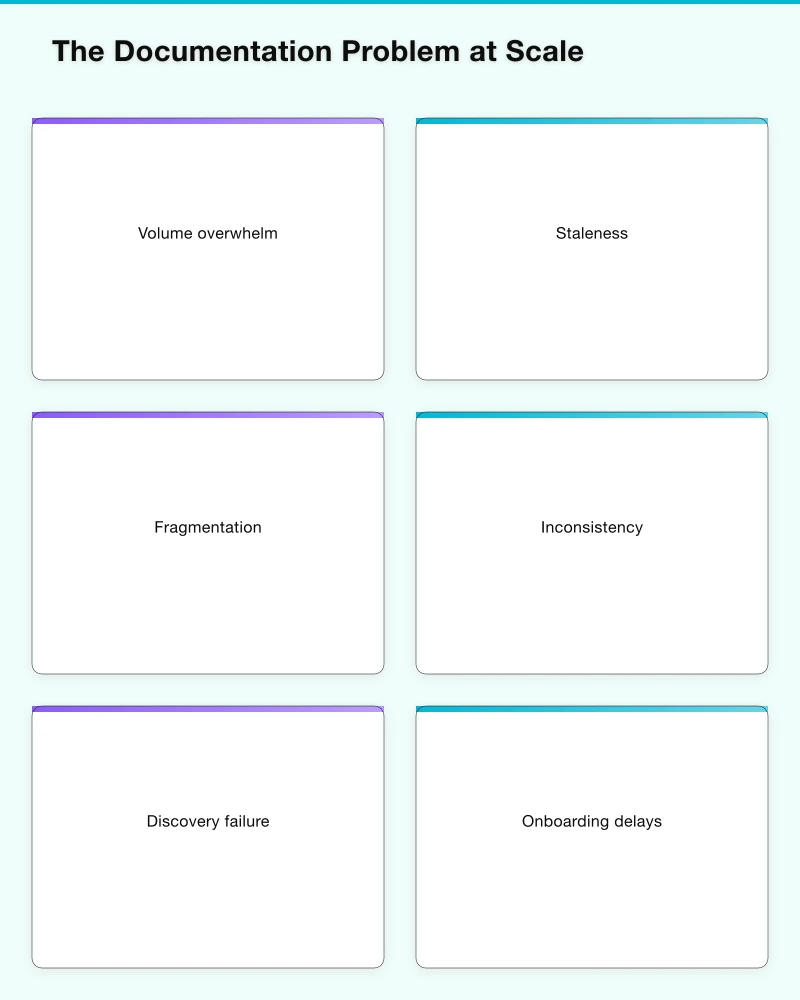
Volume overwhelm: Large organisations generate thousands of documents across multiple systems—Confluence, SharePoint, wikis, README files, code comments, runbooks. Finding relevant information becomes a search problem no one has time to solve.
Staleness: Documentation written during initial development rarely updates as systems evolve. Engineers learn not to trust docs, defeating their purpose.
Fragmentation: Different teams use different tools and conventions. Knowledge splits across silos that don’t connect.
Inconsistency: Without style standards or editorial review, documentation quality varies wildly. Some systems have excellent docs; others have barely comprehensible notes.
Discovery failure: Even when good documentation exists, people can’t find it. Search returns too many results or none at all.
The Hidden Costs
Documentation problems manifest as visible costs:
Onboarding delays: New engineers take months to become productive, repeatedly asking questions that documentation should answer.
Duplicated effort: Teams rebuild solutions that exist elsewhere because they couldn’t find prior work.
Support burden: Internal support teams answer questions that self-service documentation should handle.
Incident response delays: During outages, responders waste critical minutes finding runbooks and system information.
Knowledge loss: When experienced employees leave, undocumented knowledge goes with them.
McKinsey research suggests knowledge workers spend nearly 20% of their time searching for information. In engineering organisations, the figure may be higher.
What AI Changes
Large language models introduce capabilities that address these challenges directly:
Generation: Create initial documentation from code, APIs, and system configurations Summarisation: Condense lengthy documents into actionable summaries Question answering: Enable natural language queries across documentation corpuses Gap identification: Detect missing or outdated documentation Translation: Convert between technical depth levels for different audiences Consistency enforcement: Apply style and terminology standards at scale
These capabilities don’t replace human judgment but augment it dramatically—transforming documentation from a manual burden to an assisted workflow.
AI Documentation Capabilities
Automated Documentation Generation
AI can generate substantial documentation automatically:
API documentation: Given an API definition (OpenAPI, GraphQL schema), generate comprehensive reference documentation including examples, error codes, and usage patterns.
Code documentation: Analyse codebases to generate function-level documentation, architecture overviews, and dependency explanations.
Runbooks: Extract operational knowledge from code, configuration, and monitoring systems to create draft runbooks.
Changelog generation: Summarise code changes into human-readable release notes.
Example generation: Create realistic usage examples for APIs and libraries.
The quality of AI-generated documentation has improved dramatically with GPT-4 and Claude. Generated content requires human review but provides a strong starting point that dramatically reduces time-to-documentation.
Intelligent Search and Discovery
Traditional keyword search fails for documentation:
- Users don’t know the right terms
- Relevant documents use different terminology
- Context matters more than keywords
AI-powered search transforms discovery:
Semantic search: Find documents by meaning rather than exact keyword match. “How do we handle authentication?” finds relevant content whether it uses “auth,” “login,” “identity,” or “SSO.”
Conversational interfaces: Natural language questions return direct answers synthesised from multiple sources. “What’s our process for database failover?” provides a direct response rather than a list of links.
Context-aware recommendations: Based on what users are working on, proactively surface relevant documentation.
Multi-source federation: Query across multiple documentation systems from a single interface, breaking down tool silos.
Documentation Maintenance
AI addresses the staleness problem:
Drift detection: Compare documentation against current code and configuration. Flag discrepancies for review.
Update suggestions: When code changes, suggest documentation updates based on the nature of the change.
Link validation: Identify broken links and references to deprecated systems.
Coverage analysis: Identify areas with insufficient documentation based on code complexity, usage patterns, or support tickets.
Knowledge Synthesis
AI excels at combining information from multiple sources:
Incident post-mortems: Analyse incident data to generate draft post-mortem documents.
Onboarding guides: Synthesise information across systems into role-specific onboarding materials.
Decision records: Extract architectural decisions from meeting notes, Slack discussions, and commit messages.
FAQ generation: Analyse support tickets and Slack questions to identify common issues and generate FAQ content.
Architecture Patterns
Retrieval-Augmented Generation (RAG)
The most common pattern for enterprise AI documentation combines retrieval with generation:
Document ingestion: Index documents from various sources into a vector database Query processing: Convert user questions into vector embeddings Retrieval: Find relevant document chunks based on semantic similarity Generation: Use an LLM to synthesise an answer from retrieved context
RAG provides several advantages:
- Answers grounded in actual documentation (reducing hallucination)
- Sources can be cited for verification
- Content updates without model retraining
- Works with existing documentation
Implementation considerations:
- Chunking strategy affects retrieval quality
- Embedding model selection impacts semantic accuracy
- Hybrid search (vector + keyword) often outperforms pure vector
- Reranking improves relevance in top results
Document Processing Pipeline
Effective RAG requires robust document processing:
Ingestion: Connect to document sources (Confluence, GitHub, SharePoint, S3) Parsing: Extract text from various formats (Markdown, PDF, HTML, DOCX) Chunking: Split documents into retrievable segments Enrichment: Add metadata (source, author, date, category) Embedding: Generate vector embeddings for semantic search Indexing: Store in vector database for retrieval Synchronisation: Keep index current as documents change
Vector Database Selection
Vector databases enable semantic search at scale:
Pinecone: Managed service, enterprise features, strong performance Weaviate: Open source, hybrid search, good community Qdrant: Open source, Rust-based, efficient Milvus: Open source, CNCF project, scalable pgvector: PostgreSQL extension, familiar tooling
Cloud providers also offer vector capabilities:
- Amazon OpenSearch with vector engine
- Azure Cognitive Search with vector search
- Google Vertex AI Matching Engine
Selection criteria include scale requirements, deployment preferences (managed vs self-hosted), and existing infrastructure.
LLM Integration
Large language models power generation and understanding:
Enterprise LLM options:
- OpenAI GPT-4 (API)
- Anthropic Claude (API)
- Azure OpenAI Service (managed GPT-4)
- Amazon Bedrock (multiple models)
- Google Vertex AI (PaLM, Gemini)
- Self-hosted open models (Llama 2, Mixtral)
Considerations:
- Data privacy and residency requirements
- Latency for interactive use cases
- Cost at scale
- Model capability for technical content
- API reliability and support
Many enterprises use Azure OpenAI or Amazon Bedrock to benefit from cloud provider enterprise agreements and compliance postures.
Implementation Strategy
Start with High-Value Use Cases
Don’t try to solve all documentation problems simultaneously. Identify use cases with clear ROI:
Developer onboarding: New engineers finding answers to common questions API discovery: Teams finding and understanding available services Incident response: Operators locating runbooks and system information Internal support: Self-service answers to IT and platform questions
Each use case has measurable outcomes: time to first commit, support ticket volume, mean time to resolution.
Pilot Before Scaling
Run focused pilots before enterprise-wide deployment:
Scope: Single team or department Duration: 8-12 weeks for meaningful data Metrics: Define success criteria upfront Iteration: Refine based on feedback
Pilots reveal integration challenges, quality issues, and adoption barriers before they affect the entire organisation.
Data Quality Foundation
AI amplifies data quality—both good and bad:
Audit existing documentation: Before enabling AI search, assess what exists. AI surfacing outdated or incorrect information erodes trust.
Establish ownership: Every document should have an owner responsible for accuracy.
Create feedback loops: Users should be able to flag incorrect AI responses, triggering review.
Prioritise coverage: Focus documentation effort on high-value, high-traffic areas.
Integration with Existing Tools
AI documentation systems should meet developers where they work:
IDE integration: Answer questions without leaving the editor Slack/Teams bots: Natural language queries in communication tools CLI tools: Documentation access from terminal Browser extensions: Contextual help in web applications API access: Embed capabilities in internal tools
Friction kills adoption. Seamless integration enables habit formation.
Organisational Considerations
Ownership and Governance
Clarify responsibilities for AI documentation systems:
Platform ownership: Which team maintains the AI infrastructure? Content ownership: Who ensures documentation accuracy? Quality standards: What review processes apply to AI-generated content? Security review: How is sensitive information protected?
Without clear ownership, systems drift toward neglect.
Change Management
AI documentation changes how people work:
Training: Users need to understand how to query effectively and when to trust results.
Expectation setting: AI provides assistance, not perfection. Human verification remains essential for critical information.
Feedback culture: Encourage reporting of incorrect or unhelpful responses. This data improves the system.
Workflow integration: Update processes to incorporate AI documentation at appropriate points.
Quality Assurance
AI-generated content requires oversight:
Human review: Generated documentation should be reviewed before publication.
Confidence indicators: Display confidence levels so users know when to verify.
Source citation: Always provide source documents so users can check context.
Feedback mechanisms: Easy ways to report problems drive continuous improvement.
Regular audits: Periodically evaluate AI response quality across use cases.
Security and Privacy
Enterprise AI documentation raises security considerations:
Data classification: Ensure AI doesn’t expose information to unauthorised users.
Access control: Respect existing document permissions in AI responses.
Sensitive content: Identify and handle PII, credentials, and other sensitive data appropriately.
Audit logging: Track AI queries for security and compliance.
Vendor data handling: Understand how LLM providers handle your data.
Measuring Success
Productivity Metrics
Track efficiency improvements:
Time to find information: Survey or observe how long it takes to find answers
Support ticket deflection: Reduction in internal support requests
Onboarding velocity: Time for new engineers to become productive
Documentation coverage: Percentage of systems with adequate documentation
Quality Metrics
Assess AI response quality:
Accuracy rate: Percentage of responses that are correct (sampled and verified)
Relevance scores: User ratings of response helpfulness
Hallucination rate: Frequency of responses not grounded in source documents
Source quality: Proportion of responses citing current, authoritative sources
Adoption Metrics
Monitor usage and engagement:
Active users: How many people use the system regularly?
Query volume: How many questions are being asked?
Return usage: Do users come back after initial experience?
Integration adoption: Which integrations see most use?
Business Impact
Connect to business outcomes:
Developer productivity: Output metrics before and after implementation
Incident resolution time: Faster access to runbooks and system information
Knowledge retention: Impact when key employees leave
Onboarding costs: Reduction in time spent by senior engineers mentoring
Common Challenges and Solutions
Hallucination Management
LLMs sometimes generate plausible but incorrect information.
Mitigations:
- RAG grounds responses in actual documents
- Confidence thresholds filter uncertain responses
- Source citation enables verification
- User feedback identifies problems
- Domain-specific fine-tuning improves accuracy
Stale Content Amplification
AI can surface outdated information convincingly.
Solutions:
- Date-aware retrieval prioritises recent content
- Staleness warnings on older documents
- Automated drift detection flags discrepancies
- Regular content review cycles
Adoption Resistance
Some users prefer traditional methods or distrust AI.
Approaches:
- Demonstrate value with specific use cases
- Provide easy fallback to traditional search
- Address accuracy concerns with transparency
- Gather and act on user feedback
- Celebrate early adopter successes
Integration Complexity
Connecting to diverse document sources is challenging.
Strategies:
- Prioritise high-value sources first
- Use standard APIs where available
- Build modular connector architecture
- Accept that some sources may not be worth integrating
The Future of AI Documentation
Emerging Capabilities
The field evolves rapidly:
Code-aware documentation: AI that understands codebase context deeply, generating and updating documentation as code changes.
Interactive documentation: Conversational interfaces that guide users through complex procedures.
Multilingual support: Automatic translation and localisation of documentation.
Video documentation: AI-generated video explanations from written content.
Predictive documentation: Systems that identify documentation needs before users ask.
Continuous Evolution
AI documentation is not a one-time implementation:
- Models improve—new capabilities become available
- User expectations rise—what delighted last year becomes baseline
- Document corpus grows—systems must scale
- Security requirements evolve—controls must keep pace
Build systems with evolution in mind. Modular architectures adapt more easily than monolithic ones.
Conclusion
AI-powered documentation represents one of the clearest enterprise AI opportunities available today. The problems are well-understood, the technology is mature enough for production use, and the ROI is measurable in developer time saved and knowledge preserved.
Success requires more than technology deployment. Data quality foundations must be established. Organisational ownership must be clear. Change management must address how people work. Quality assurance must ensure AI assistance doesn’t introduce new problems.
For CTOs, the strategic question is not whether to invest in AI documentation but how quickly and comprehensively to move. Organisations that build robust knowledge management with AI assistance will accelerate developer productivity, reduce dependency on individual experts, and create lasting institutional memory.
The documentation problem has persisted for decades because traditional approaches don’t scale. AI changes that equation—not by eliminating the need for human curation, but by making curation practical at enterprise scale.
Sources
- McKinsey Global Institute. (2023). The State of AI in 2023: Generative AI’s Breakout Year. McKinsey & Company.
- Gartner. (2025). Market Guide for AI-Powered Knowledge Management. Gartner Research.
- Stack Overflow. (2024). Developer Survey 2024: AI Tools and Documentation. Stack Overflow.
- OpenAI. (2025). GPT-4 Technical Report and Enterprise Applications. OpenAI.
- LangChain. (2025). Building RAG Applications. https://python.langchain.com/docs/
Strategic guidance for technology leaders implementing AI-powered knowledge management systems.
If this strategic perspective has you considering a mobile channel, Awesome Apps provides actionable app development and ASO guidance.
Ganda Tech Services is my technology consultancy, bringing together cloud infrastructure, web development, and mobile expertise for Australian businesses.
About the Author
Ashish Ganda is the founder of Ganda Tech Services, a Sydney-based technology consultancy specialising in cloud infrastructure, web development, and mobile app solutions for Australian businesses.
Digital Transformation Roadmap 2026
A 12-month framework for Australian SMBs ready to modernise — phases, tools, and milestones.
Almost done
Check your inbox and click the confirmation link to get your download.