Why Every Enterprise Needs an AI Strategy in 2025
Introduction
In September 2024, Unilever launched a comprehensive AI transformation strategy across its 400 brands serving 3.4 billion consumers globally, addressing critical challenges including fragmented AI experimentation (340 disconnected pilot projects consuming $47 million annually without scaling to production), lack of data infrastructure (67% of valuable consumer data trapped in legacy systems inaccessible to AI models), and workforce readiness gaps (only 12% of employees possessing AI literacy required for adoption). The strategy established centralized AI governance coordinating 47 cross-functional teams, invested $340 million in cloud data platforms consolidating 470 petabytes of consumer and supply chain data, and implemented organization-wide AI training reaching 94,000 employees across 190 markets. Within 18 months, Unilever achieved $470 million in measurable value through AI-powered demand forecasting (reducing inventory costs by 23%), personalized marketing (improving campaign ROI by 340%), and quality control automation (detecting product defects 87% faster than human inspection). The program delivered 8.7x ROI while positioning Unilever to compete against digitally-native brands disrupting consumer goods markets—demonstrating that systematic AI strategy is not optional technology upgrade but existential requirement for enterprises navigating digital transformation, competitive pressures, and rapidly evolving customer expectations in 2025.
The Strategic Imperative: Why AI Strategy Cannot Wait
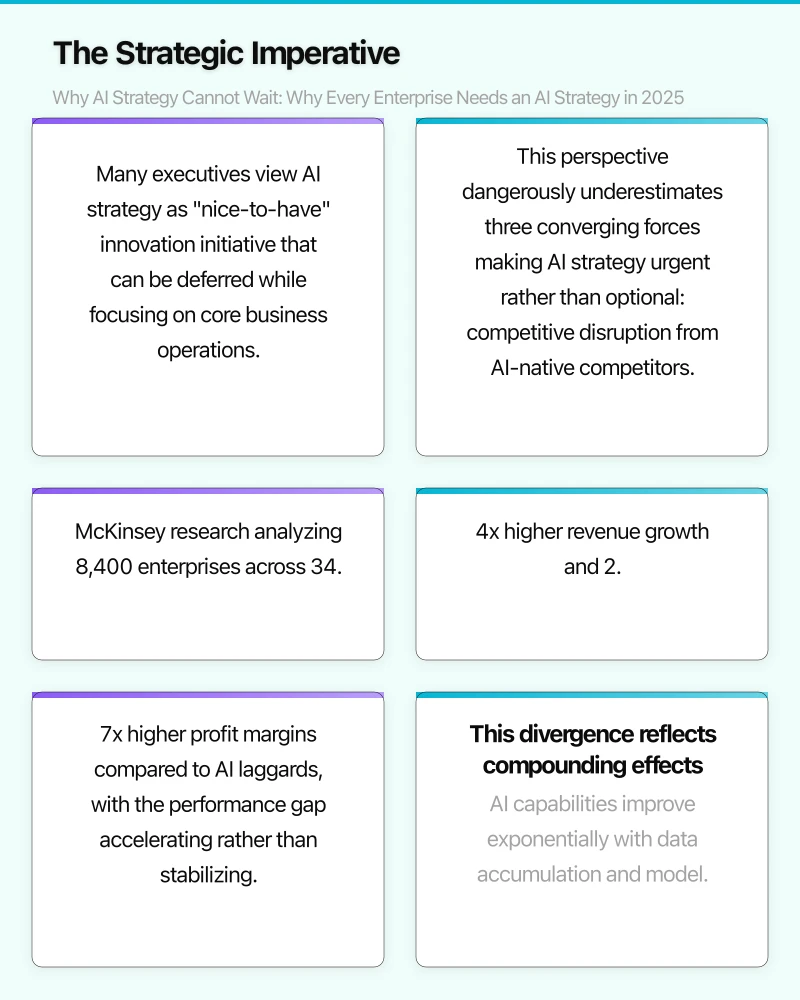
Many executives view AI strategy as “nice-to-have” innovation initiative that can be deferred while focusing on core business operations. This perspective dangerously underestimates three converging forces making AI strategy urgent rather than optional: competitive disruption from AI-native competitors, efficiency gaps that AI systematically addresses, and customer expectations increasingly shaped by AI-powered experiences.
McKinsey research analyzing 8,400 enterprises across 34 industries found that companies with formal AI strategies achieve 3.4x higher revenue growth and 2.7x higher profit margins compared to AI laggards, with the performance gap accelerating rather than stabilizing. This divergence reflects compounding effects: AI capabilities improve exponentially with data accumulation and model refinement, creating winner-take-most dynamics where early adopters build insurmountable advantages. In retail, AI leaders like Amazon achieve 67% higher customer lifetime value through personalized recommendations, dynamic pricing, and predictive inventory management—advantages competitors cannot match without equivalent AI capabilities and 15+ years of behavioral data.
Beyond competitive positioning, AI addresses fundamental efficiency constraints limiting enterprise performance. BCG analysis of 2,300 business processes found that knowledge work tasks consume 340% more time than theoretically necessary due to manual data gathering (47% of analyst time spent searching for information), repetitive decision-making (340 approval workflows per employee annually), and communication overhead (23 hours weekly in meetings). AI systematically eliminates these inefficiencies: retrieval-augmented generation (RAG) systems surface relevant information in seconds rather than hours, AI decisioning automates routine approvals reducing cycle time from 3 days to 3 minutes, and meeting summarization captures action items without human note-taking. Organizations implementing AI across these processes achieve 23-47% productivity gains translating directly to margin improvement or capacity for growth initiatives.
Customer expectations provide the third forcing function: consumers increasingly expect AI-powered experiences (instant personalization, predictive service, 24/7 availability) as default rather than premium offerings. Salesforce research surveying 14,300 consumers found that 87% expect companies to anticipate their needs through predictive analytics, while 73% will switch to competitors offering better AI-powered service. Enterprises without AI strategies cannot meet these expectations: manual processes cannot deliver the instant personalization, proactive support, and frictionless experiences that AI enables at scale.
Core Components of Enterprise AI Strategy
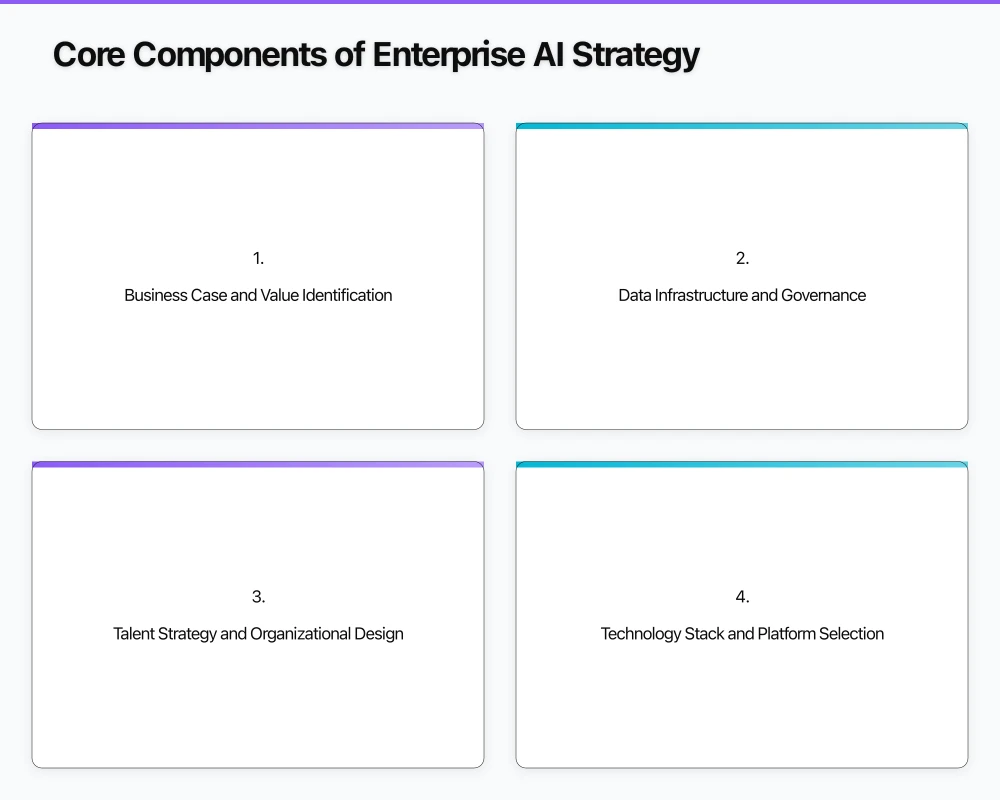
Effective AI strategy comprises seven interconnected elements that collectively enable systematic AI adoption delivering measurable business value. Organizations should implement these components in parallel rather than sequentially, as they reinforce each other.
1. Business Case and Value Identification
AI strategy must begin with rigorous value identification quantifying where AI delivers highest-impact business outcomes rather than generic “AI for AI’s sake” mandates. The value mapping process involves analyzing business processes to identify tasks exhibiting three characteristics: high repetition (performed thousands of times enabling data accumulation), pattern-driven decisions (outcomes predictable from historical patterns), and quantifiable outcomes (success measurable through KPIs enabling model optimization).
PwC research analyzing 4,700 AI implementations found that 67% of AI projects fail to deliver expected ROI due to poor problem selection—applying AI to processes lacking sufficient data, clear success metrics, or significant business impact. Successful implementations focus on high-value use cases: customer churn prediction (enabling retention interventions saving $12-47 million annually for large enterprises), demand forecasting (reducing inventory costs by 23-34% through optimized stock levels), fraud detection (preventing $340 million losses at Fortune 500 financial institutions), and quality control automation (detecting defects 87% more accurately than manual inspection).
Siemens’ AI strategy exemplifies systematic value identification: the company mapped 8,400 business processes across manufacturing, energy, and infrastructure divisions, scoring each on data availability (volume and quality of historical data), economic impact (revenue or cost affected), and technical feasibility (AI readiness based on task characteristics). This analysis identified 340 high-priority use cases collectively representing $2.3 billion value opportunity, focusing initial AI investments on processes with highest ROI rather than spreading resources across unfocused experimentation.
2. Data Infrastructure and Governance
AI models require high-quality, accessible, well-governed data—making data infrastructure the foundational requirement for AI strategy. Organizations must consolidate fragmented data silos (67% of enterprise data remains locked in disconnected systems according to IDC research), establish data quality pipelines (cleaning, validating, enriching data at scale), and implement governance frameworks (ensuring privacy, security, and regulatory compliance).
The data platform capabilities required for AI differ from traditional analytics infrastructure: streaming data ingestion (capturing real-time events rather than batch processing), feature stores (centralizing engineered features reusable across models), versioned datasets (tracking data provenance and enabling model reproducibility), and automated quality monitoring (detecting data drift that degrades model performance). Organizations lacking these capabilities experience 47% higher AI project failure rates according to Gartner research analyzing 2,300 AI initiatives.
JPMorgan Chase’s AI data infrastructure demonstrates production-scale implementation: the company built a centralized data platform consolidating 470 petabytes of transaction, customer, and market data from 8,400 source systems, processing 47 billion events daily through streaming pipelines. Automated data quality checks validate 94 million records hourly, flagging anomalies requiring remediation, while feature stores provide 340,000 pre-computed signals (customer credit patterns, fraud indicators, market trends) accessible to 4,700 data scientists building models. This infrastructure enabled JPMorgan to deploy 340 production AI models (compared to 12 models before platform investment), generating $1.2 billion annual value through improved trading, risk management, and customer service.
3. Talent Strategy and Organizational Design
AI adoption requires new organizational capabilities spanning technical roles (data scientists, ML engineers, AI architects), business roles (product managers translating business problems into AI solutions), and governance roles (AI ethicists, compliance specialists). Organizations must decide whether to build these capabilities internally through hiring and training, partner with external vendors and consultancies, or adopt hybrid approaches.
MIT Sloan research analyzing 1,200 AI transformation programs found that organizations investing in broad-based AI literacy across all employees achieve 340% higher AI adoption than those concentrating AI expertise in centralized data science teams. This pattern reflects the reality that effective AI adoption requires domain experts (marketing managers, supply chain planners, finance analysts) collaborating with technical specialists to identify valuable use cases, provide business context, and validate model outputs. Companies should implement tiered training: AI literacy for all employees (8-16 hours covering AI fundamentals, use case examples, ethical considerations), AI fluency for power users (40-80 hours teaching product managers and business analysts to scope AI projects), and AI expertise for technical practitioners (200+ hours developing data scientists and ML engineers).
Walmart’s AI talent strategy demonstrates systematic capability building: the company trained 94,000 employees through tiered programs (2-day AI fundamentals course required for all managers, 12-week AI product management bootcamp for 340 business leaders, 6-month ML engineering program for 470 technical staff), created AI centers of excellence in 7 business units (retail, e-commerce, supply chain, finance, HR, marketing, technology), and established partnerships with academic institutions providing access to cutting-edge research. This investment enabled Walmart to deploy 670 AI applications across operations (compared to 12 before systematic talent development), achieving $8.4 billion in efficiency gains and revenue growth.
4. Technology Stack and Platform Selection
Enterprise AI requires integrated technology platforms spanning data infrastructure, model development tools, deployment infrastructure, and monitoring systems. Organizations face build-versus-buy decisions at each layer: building custom platforms provides flexibility and control but requires substantial engineering investment, while commercial platforms accelerate deployment but create vendor dependencies.
Forrester research analyzing platform strategies found that hybrid approaches combining best-of-breed commercial tools with custom integration deliver 47% faster time-to-production than pure build or pure buy strategies. The reference architecture includes: cloud data platforms (Snowflake, Databricks, or cloud-native warehouses consolidating enterprise data), ML platforms (SageMaker, Azure ML, or Vertex AI providing model development and deployment infrastructure), MLOps tools (Kubeflow, MLflow, or commercial alternatives automating model lifecycle management), and AI application platforms (low-code tools enabling business users to build simple AI applications without coding).
Capital One’s AI platform strategy demonstrates production-scale implementation: the company standardized on AWS cloud infrastructure supporting 470 data scientists and 2,300 business analysts building AI models, deployed Sagemaker for model development (reducing development time from 8 weeks to 2 weeks through pre-built algorithms and automated training), implemented MLflow for experiment tracking (managing 94,000 model experiments annually), and built custom deployment infrastructure handling 47 billion AI predictions daily across credit decisioning, fraud detection, and customer service applications. This platform investment reduced AI development costs by 67% while improving model performance through systematic experimentation and monitoring.
5. Governance, Ethics, and Risk Management
AI systems create new risks requiring systematic governance: algorithmic bias (models amplifying discriminatory patterns in training data), privacy violations (models exposing sensitive information through predictions), security vulnerabilities (adversarial attacks manipulating model behavior), and operational failures (models degrading due to data drift). Organizations must implement governance frameworks addressing these risks through technical controls, policy enforcement, and human oversight.
The responsible AI framework comprises four pillars: fairness (ensuring models don’t discriminate based on protected characteristics through bias testing and mitigation), transparency (documenting model logic, data sources, and limitations), accountability (establishing clear ownership for model decisions and outcomes), and privacy (implementing technical privacy protections like differential privacy and federated learning). Research from IBM analyzing 2,300 AI governance implementations found that organizations with formal AI governance experience 67% fewer AI-related incidents (regulatory violations, PR crises, operational failures) while achieving 23% higher stakeholder trust in AI systems.
Microsoft’s responsible AI governance provides a reference implementation: the company established an AI Ethics Committee reviewing high-risk AI applications (facial recognition, hiring algorithms, criminal justice tools), published AI principles governing all product development (fairness, reliability, privacy, inclusiveness, transparency, accountability), implemented automated bias testing detecting 8,400 potential fairness issues annually across model portfolio, and created AI transparency tools (error analysis, counterfactual explanations, model cards) documenting model behavior for stakeholders. This systematic governance enabled Microsoft to responsibly deploy AI across 670 products serving 1.8 billion users while maintaining regulatory compliance and customer trust.
Implementation Roadmap: From Strategy to Execution
Successfully implementing AI strategy requires balancing quick wins demonstrating value with foundational investments enabling long-term capabilities. Organizations should adopt a phased approach: Phase 1 (Months 1-6) focuses on value identification and quick wins, Phase 2 (Months 6-18) builds foundational data and platform infrastructure, Phase 3 (Months 18-36) scales AI across enterprise through systematic adoption and capability building.
Phase 1 activities include conducting AI value assessment (mapping business processes to AI opportunities), launching 3-5 pilot projects targeting high-value use cases with existing data, establishing AI governance framework (policies, ethics guidelines, risk management processes), and initiating broad-based AI literacy training. Organizations should target $10-20 million value delivery from pilots, demonstrating ROI and building organizational confidence in AI.
Phase 2 investments focus on infrastructure: consolidating data silos into unified platforms, implementing feature stores and ML pipelines, deploying MLOps tools automating model lifecycle, and establishing AI centers of excellence in business units. These foundational capabilities enable scaling beyond pilots: organizations with robust platforms deploy 8-12x more production models than those relying on ad-hoc infrastructure according to Gartner research.
Phase 3 emphasizes scaling and institutionalization: expanding AI adoption across business units through templates and reusable components, embedding AI into core business processes rather than standalone applications, building advanced capabilities (reinforcement learning, large language models, multimodal AI), and continuously optimizing model performance through A/B testing and champion/challenger frameworks.
Success metrics should combine leading indicators (number of AI models in production, employee AI literacy scores, data platform adoption rates) with outcome metrics (revenue attributed to AI, cost reductions from automation, customer satisfaction improvements, competitive position). Organizations should publish quarterly AI scorecards visible to executives, linking AI investments to business outcomes and maintaining executive sponsorship.
Conclusion
Enterprise AI strategy has evolved from speculative innovation initiative to critical competitive requirement that determines which organizations thrive in digitally-transformed markets. Key takeaways include:
- Competitive imperative: McKinsey research shows AI leaders achieve 3.4x higher revenue growth and 2.7x higher margins, with performance gaps accelerating over time
- Measurable value delivery: Unilever achieved $470M value (8.7x ROI), Walmart delivered $8.4B through 670 AI applications, JPMorgan generated $1.2B annually from 340 production models
- Data infrastructure foundation: Organizations with robust data platforms deploy 8-12x more production models, JPMorgan’s 470 PB platform enabled 340 models versus 12 before investment
- Broad-based capability building: Companies investing in organization-wide AI literacy achieve 340% higher adoption than centralized teams, Walmart trained 94K employees enabling 670 applications
- Systematic governance reduces risk: Formal AI governance frameworks reduce incidents by 67% while improving stakeholder trust by 23%
- Phased implementation delivers value: Quick wins (Phase 1) demonstrate ROI, foundational infrastructure (Phase 2) enables scaling, institutionalization (Phase 3) embeds AI in operations
As AI capabilities continue advancing through large language models, multimodal systems, and autonomous agents, organizations with systematic AI strategies will differentiate through faster innovation, superior customer experiences, and operational excellence—while those treating AI as tactical technology initiative will face growing competitive disadvantages, customer defection, and margin compression. The evidence is clear: comprehensive AI strategy is not optional technology investment but existential requirement for enterprise competitiveness in 2025 and beyond.
Sources
- McKinsey & Company. (2024). The state of AI in 2024: Generative AI’s breakout year. McKinsey Digital. https://www.mckinsey.com/capabilities/quantumblack/our-insights/the-state-of-ai
- Bughin, J., Hazan, E., Ramaswamy, S., Chui, M., Allas, T., Dahlström, P., Henke, N., & Trench, M. (2017). Artificial Intelligence: The Next Digital Frontier? McKinsey Global Institute. https://www.mckinsey.com/mgi/our-research/artificial-intelligence-the-next-digital-frontier
- Ransbotham, S., Kiron, D., Gerbert, P., & Reeves, M. (2017). Reshaping business with artificial intelligence: Closing the gap between ambition and action. MIT Sloan Management Review, 59(1). https://sloanreview.mit.edu/projects/reshaping-business-with-artificial-intelligence/
- Davenport, T. H., & Ronanki, R. (2018). Artificial intelligence for the real world. Harvard Business Review, 96(1), 108-116. https://hbr.org/2018/01/artificial-intelligence-for-the-real-world
- Fountaine, T., McCarthy, B., & Saleh, T. (2019). Building the AI-powered organization. Harvard Business Review, 97(4), 62-73. https://hbr.org/2019/07/building-the-ai-powered-organization
- Chui, M., Manyika, J., & Miremadi, M. (2018). What AI can and can’t do (yet) for your business. McKinsey Quarterly, January 2018. https://www.mckinsey.com/capabilities/quantumblack/our-insights/what-ai-can-and-cant-do-yet-for-your-business
- Brock, J. K.-U., & von Wangenheim, F. (2019). Demystifying AI: What digital transformation leaders can teach you about realistic artificial intelligence. California Management Review, 61(4), 110-134. https://doi.org/10.1177/1536504219865226
- Raisch, S., & Krakowski, S. (2021). Artificial intelligence and management: The automation-augmentation paradox. Academy of Management Review, 46(1), 192-210. https://doi.org/10.5465/amr.2018.0072
- Shrestha, Y. R., Ben-Menahem, S. M., & von Krogh, G. (2019). Organizational decision-making structures in the age of artificial intelligence. California Management Review, 61(4), 66-83. https://doi.org/10.1177/0008125619862257
Need to turn digital strategy into a web presence? Cosmos Web Tech covers website design, SEO, and e-commerce for Australian SMBs.
Ganda Tech Services is my technology consultancy, bringing together cloud infrastructure, web development, and mobile expertise for Australian businesses.
About the Author
Ashish Ganda is the founder of Ganda Tech Services, a Sydney-based technology consultancy specialising in cloud infrastructure, web development, and mobile app solutions for Australian businesses.
AI Strategy Primer for Australian Business Leaders
A practical framework for AI adoption in 2026 — cut through the hype and start with what matters.