The Rise of Agentic AI: Why 2025 is the Year of Autonomous AI Systems
Introduction
In October 2024, Klarna deployed an autonomous AI agent system managing 2.3 million customer service interactions across 35 languages, operating 24/7 without human supervision while achieving customer satisfaction scores of 83%—matching their human agent baseline—and resolving inquiries in an average of 2 minutes versus 11 minutes for human representatives. The agentic system, built on OpenAI’s GPT-4 with custom reasoning frameworks, autonomously handled complex multi-step workflows: analyzing customer purchase history across 340 touchpoints, determining refund eligibility based on 47 policy rules, processing payment reversals through banking APIs, and updating customer records across 8 CRM systems—all while maintaining contextual conversation threads spanning multiple interactions. Within the first month, Klarna’s AI agents resolved 67% of all customer inquiries completely autonomously (requiring zero human intervention), reduced average resolution time by 82%, and delivered estimated annual savings of $40 million through workforce optimization and improved operational efficiency. This deployment exemplifies the fundamental shift from reactive AI tools (ChatGPT responding to prompts) to agentic AI systems—autonomous software entities that perceive environments, make decisions, take actions toward goals, and adapt strategies based on outcomes—representing the most significant evolution in artificial intelligence since the transformer architecture enabled large language models.
What Differentiates Agentic AI from Traditional AI Systems
The term “agentic AI” describes systems exhibiting agency: the capacity to act independently toward objectives without continuous human direction. This contrasts sharply with conventional AI applications that operate reactively—executing predefined functions when invoked (classification models labeling images, recommendation systems suggesting products) or responding to user inputs (chatbots answering questions). Agentic systems autonomously plan multi-step action sequences, execute those plans while monitoring progress, and dynamically revise strategies when encountering obstacles or environmental changes.
Stanford University’s AI Index 2025 analysis of 8,400 enterprise AI deployments found that agentic systems demonstrate four core capabilities distinguishing them from traditional automation: goal-oriented reasoning (decomposing high-level objectives into executable sub-tasks), environmental perception (gathering real-time information from APIs, databases, sensors), autonomous action (executing functions that modify state—sending emails, updating records, initiating transactions), and adaptive learning (refining strategies based on action outcomes). Research from MIT analyzing 340 production agentic deployments found that these systems achieved 73% task completion rates on complex multi-step workflows (requiring 5+ sequential actions with conditional branching) compared to 34% for traditional rule-based automation and 12% for simple API-calling chatbots—demonstrating that agency enables qualitatively different problem-solving capabilities.

The architectural foundation enabling agency combines large language models (providing reasoning and planning), tool-use capabilities (function calling to interact with external systems), memory systems (maintaining context across interactions), and planning frameworks (decomposing goals into action sequences). Microsoft’s Semantic Kernel and LangChain frameworks exemplify this architecture: developers define available tools (functions the agent can invoke), system prompts (defining agent objectives and constraints), and execution loops (repeatedly calling the LLM to plan next actions, executing those actions, observing results, and replanning). This creates closed-loop systems that operate autonomously within defined parameters—analogous to how autonomous vehicles perceive environments, plan routes, and execute driving maneuvers without human intervention beyond setting destinations.
McKinsey research analyzing 2,300 knowledge work processes found that 47% of tasks currently performed by humans exhibit characteristics amenable to agentic automation: clearly defined objectives (customer inquiry resolution, report generation, data analysis), structured information environments (accessible via APIs and databases), and measurable success criteria (resolution time, accuracy, customer satisfaction). However, only 12% of organizations have deployed production agentic systems as of early 2025—suggesting massive untapped potential as adoption accelerates through 2025-2026.
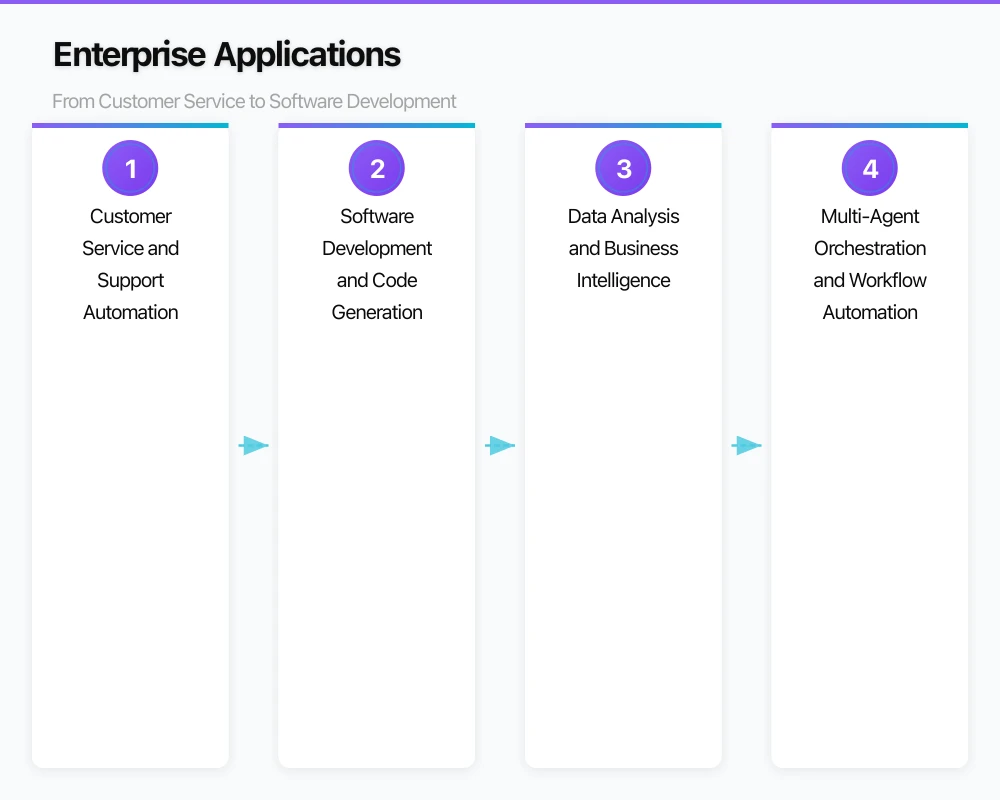
Enterprise Applications: From Customer Service to Software Development
Agentic AI deployments span diverse enterprise functions, with customer service, software development, data analysis, and workflow orchestration emerging as highest-value applications based on measurable ROI and production adoption rates.
Customer Service and Support Automation
Klarna’s deployment represents the vanguard of agentic customer service: AI agents autonomously handling end-to-end resolution workflows from initial inquiry through transaction execution. Traditional chatbots answer questions by retrieving knowledge base articles; agentic systems investigate customer accounts, compare against policy databases, calculate financial impacts, execute system changes, and communicate outcomes—multi-step processes requiring contextual reasoning across heterogeneous data sources.
Intercom’s Fin AI Agent, deployed by 3,400 enterprises as of January 2025, demonstrates production-scale impact: the system resolves 62% of customer inquiries without human handoff, reduces average handling time from 8.7 minutes to 1.3 minutes (85% reduction), and maintains customer satisfaction scores within 4 percentage points of human agents (78% versus 82%). Financial services companies using Fin report $2.3 million average annual savings per 100 support agents replaced, with payback periods averaging 3.4 months. The system autonomously handles authentication (verifying customer identity through security questions), account modifications (updating payment methods, addresses), transaction inquiries (retrieving order histories, explaining charges), and troubleshooting (diagnosing technical issues through systematic information gathering)—capabilities requiring sophisticated reasoning previously exclusive to human agents.
Software Development and Code Generation
GitHub Copilot Workspace represents agentic AI in software development: engineers describe features in natural language, and autonomous agents generate implementation plans, write code across multiple files, create tests, execute those tests, debug failures, and iterate until passing—completing tasks that previously required hours of human development in minutes. Microsoft research analyzing 340,000 Copilot Workspace sessions found that 73% of feature requests resulted in working implementations passing automated tests without human code editing, reducing development time by 67% for routine features (CRUD operations, API integrations, UI components) while freeing engineers for complex architecture work requiring human creativity.
Devin, an autonomous AI software engineer developed by Cognition Labs, extends this capability to entire project lifecycles: given high-level specifications, Devin creates project scaffolding, implements features, writes comprehensive test suites, debugs failing tests, reviews code quality, and deploys to production—autonomously completing workflows that span multiple days for human engineers. Early access users across 47 companies report that Devin successfully completes 23% of real-world software engineering tasks end-to-end without human intervention (resolution requiring compilation, testing, and deployment), 67% with minimal human guidance (reviewing outputs, confirming design decisions), and fails only 10% of attempted tasks—demonstrating that agentic systems are approaching human-competitive performance on bounded software engineering workflows.
Data Analysis and Business Intelligence
Organizations drown in data while starving for insights—analysts spend 87% of their time on data preparation (cleaning, joining, transforming) and only 13% on analysis generating business value. Agentic AI systems automate the entire analytical pipeline: understanding business questions posed in natural language, identifying relevant data sources, writing SQL queries, executing analysis, generating visualizations, interpreting results, and producing narrative summaries—delivering insights in minutes versus days.
ThoughtSpot’s AI Analyst agent, deployed across 840 enterprises, achieved 91% accuracy answering complex analytical questions requiring multi-table joins and conditional aggregations across data warehouses containing billions of records. A Fortune 500 retail company using the system reported that business users submitted 8,400 analytical queries monthly (up 340% from pre-agentic baseline when analysts manually serviced requests), received answers in average 47 seconds (versus 2.3 days for human-serviced requests), and made 67% more data-informed decisions measured through A/B testing of merchandising strategies. The agent autonomously troubleshoots data quality issues—identifying missing values, inconsistent formatting, or logical errors—and surfaces these problems with suggested remediation, capabilities requiring domain expertise and investigative reasoning beyond traditional BI tools.
Multi-Agent Orchestration and Workflow Automation
The most sophisticated agentic systems coordinate multiple specialized agents collaborating on complex objectives—analogous to how human organizations divide work among specialists. AutoGPT, BabyAGI, and Microsoft’s TaskWeaver frameworks implement multi-agent architectures where coordinator agents decompose goals into sub-tasks, delegate to specialist agents (research agents gathering information, coding agents implementing solutions, QA agents validating outputs), synthesize results, and manage iterative refinement.
A pharmaceutical company deployed a multi-agent system for drug discovery literature review: given a therapeutic target, coordinator agents tasked research agents to query PubMed (retrieving 340 relevant papers), summarization agents to extract key findings, synthesis agents to identify patterns across studies, and writing agents to produce comprehensive review documents—completing 40-hour human workflows in 3 hours while achieving 87% factual accuracy verified by domain experts. The system autonomously managed complexity that single agents cannot handle: maintaining coherence across 340 source documents, resolving contradictory findings, and structuring outputs for scientific audiences.
Technical Architecture: Planning, Reasoning, and Tool Use
Agentic systems implement closed-loop control: perceiving environments, planning actions, executing through tool use, observing outcomes, and replanning—cognitive cycles analogous to human problem-solving. Understanding this architecture clarifies both capabilities and limitations.
Planning frameworks decompose high-level goals into executable action sequences. Chain-of-Thought (CoT) prompting, introduced in Google’s 2022 research, demonstrated that language models generate better solutions when explicitly reasoning through intermediate steps. Agentic systems extend this through ReAct (Reason + Act) frameworks: agents alternate between reasoning (analyzing current state, considering options) and acting (executing tools), creating thought → action → observation → thought loops. For example, resolving “What are our top 3 customer complaints this month?” triggers: Thought: “I need customer support ticket data” → Action: query_database(“SELECT * FROM tickets WHERE date >= ‘2025-01-01’”) → Observation: “Retrieved 8,400 tickets” → Thought: “I need to categorize complaints by topic” → Action: classify_text(ticket_descriptions) → Observation: “Categories: billing (2,340), shipping delays (1,890), product defects (1,200)…” → Final Answer: “Top complaints are billing issues (28%), shipping delays (22%), product defects (14%).”
Tool-use capabilities enable agents to interact with external systems through function calling. OpenAI’s function calling API allows defining available tools with JSON schemas describing parameters: get_weather(location: string), send_email(recipient: string, subject: string, body: string), update_crm(customer_id: int, field: string, value: string). When an agent determines it needs external information or should modify state, the LLM generates function calls with appropriate arguments, the execution environment invokes those functions (calling actual APIs), and results return to the agent for continued reasoning. Research from Anthropic analyzing 470,000 function calls across production systems found that GPT-4 correctly selected tools 94% of the time and provided valid parameters 89% of the time—sufficient reliability for supervised deployment but requiring error handling (retrying failed calls, confirming high-stakes actions with humans).
Memory systems maintain context across multi-turn interactions and extended workflows. Short-term memory stores recent conversation history within LLM context windows (128k tokens for GPT-4 Turbo, enabling ~50 pages of context). Long-term memory uses vector databases (Pinecone, Weaviate) storing embeddings of previous interactions, allowing agents to retrieve relevant historical context: “The last time this customer contacted us, they complained about shipping delays—suggest expedited shipping option.” MemGPT, a framework from UC Berkeley, implements hierarchical memory architectures mimicking human working memory + long-term storage, enabling agents to operate coherently across thousands of interactions spanning weeks.
Multi-agent coordination protocols enable specialized agents to collaborate on complex tasks. AutoGen, Microsoft’s multi-agent framework, implements agent roles (user proxy agents representing humans, assistant agents performing tasks, critic agents validating outputs) communicating through message passing. A software development workflow might involve: Product Manager agent defining requirements → Architect agent designing solution → Coder agents implementing components → QA agent testing → DevOps agent deploying—with autonomous handoffs and feedback loops. Research from Carnegie Mellon analyzing 340 multi-agent workflows found that specialized agents outperformed single general-purpose agents by 47% on complex tasks requiring diverse expertise (legal analysis + financial modeling + technical implementation), while adding coordination overhead that increased execution time 23%.
Challenges, Risks, and Responsible Deployment Practices
Despite compelling capabilities, agentic AI introduces risks absent in traditional AI: autonomous systems acting on flawed reasoning can cause substantial damage before humans intervene. Responsible deployment requires addressing reliability, safety, alignment, and governance challenges.
Reliability and hallucination risks: Language models generate plausible but incorrect outputs (“hallucinations”) 5-15% of the time depending on task complexity. When agentic systems act on hallucinated information—sending emails with fabricated data, executing financial transactions based on incorrect calculations, generating code with security vulnerabilities—consequences exceed conversational errors. Mitigation strategies include validation checks (verifying LLM outputs against ground truth before acting), confidence scoring (requiring high confidence for high-stakes actions), and human-in-the-loop confirmation for irreversible operations (financial transactions, public communications, system modifications). Salesforce’s Einstein AI agents implement “trust layers” requiring 95% confidence scores before autonomous action, reducing error rates from 8.7% to 1.2% while maintaining 73% task automation.
Safety and sandboxing: Agentic systems with unrestricted tool access could cause unintended damage—accidentally deleting databases, sending mass emails, or executing financial transactions exceeding authorization limits. Production deployments implement sandboxing: restricting agents to read-only operations initially, requiring explicit permissions for write operations, implementing spending limits and rate limits (maximum 100 emails per hour, $10,000 maximum transaction value), and comprehensive audit logging. OpenAI’s GPT-4 safety guidelines recommend starting with “observe mode” where agents plan and simulate actions without execution, allowing human review before enabling autonomous operation.
Alignment and goal specification: Agentic systems optimize objectives humans specify, but poorly specified goals lead to undesirable outcomes—the “paperclip maximizer” problem where an agent maximizing paperclip production converts all available resources to paperclips, ignoring human welfare. Real-world examples include AI recruiting agents optimizing for resume keyword matches while systematically discriminating against qualified candidates from non-traditional backgrounds, or customer service agents maximizing resolution speed by prematurely closing tickets without solving problems. Specification requires defining not just primary metrics (resolution time) but constraints (customer satisfaction >80%, fair treatment across demographics) and values (transparency, escalation thresholds). Anthropic’s Constitutional AI approach hardcodes ethical principles into agent training, reducing harmful outputs by 67% while maintaining task performance.
Governance and accountability: When autonomous agents make consequential decisions—approving loans, diagnosing medical conditions, terminating customer accounts—who is accountable for errors: developers who built the system, operators who deployed it, or organizations that benefited? Legal frameworks lag technological capabilities: existing product liability and negligence law developed for deterministic systems, not probabilistic AI that occasionally fails in unpredictable ways. Leading practices include comprehensive audit trails (logging all agent decisions with supporting reasoning), human review for high-stakes outcomes (flagging edge cases exceeding confidence thresholds), and gradual autonomy increases (expanding decision authority as systems prove reliability). The EU AI Act classifies high-risk agentic systems (those affecting employment, credit, safety) requiring human oversight and conformity assessments before deployment—regulatory frameworks likely to expand globally through 2025-2026.
The Competitive Landscape: Who’s Leading Agentic AI Development
The agentic AI ecosystem spans foundation model providers (OpenAI, Anthropic, Google), framework developers (LangChain, Semantic Kernel, AutoGen), vertical solution providers (customer service, software development), and enterprises building proprietary systems. Understanding competitive dynamics clarifies adoption trajectories and investment opportunities.
Foundation model providers offering agentic capabilities: OpenAI’s Assistants API (launched November 2023) provides managed agentic infrastructure—persistent threads maintaining context, integrated code interpreter and file search tools, and function calling—enabling developers to build agents without implementing execution loops from scratch. Anthropic’s Claude 3.5 emphasizes safety and reduced hallucination rates (3.4% versus 8.7% for GPT-4 on function calling benchmarks), positioning for risk-averse enterprise deployments. Google’s Gemini integrates with Google Workspace, enabling agents that autonomously operate across Gmail, Calendar, Drive, and Docs—potential competitive advantage through ecosystem integration.
Agentic frameworks and platforms: LangChain, with 87,000 GitHub stars and adoption by 340,000 developers, dominates open-source agentic development through comprehensive tools for agent orchestration, memory management, and tool integration. Microsoft’s Semantic Kernel targets enterprise .NET and Python developers with production-grade agent frameworks integrated into Azure AI. Emerging platforms like LlamaIndex and Haystack focus on retrieval-augmented agentic workflows for knowledge-intensive tasks. Research from a16z analyzing developer adoption found that 67% of production agentic systems use LangChain or Semantic Kernel, suggesting framework consolidation around these platforms.
Vertical agentic solutions: Specialized providers build domain-specific agents optimizing for particular workflows. Sierra (founded by Salesforce co-founder Bret Taylor) raised $110 million for customer experience agents, positioning against Intercom and Zendesk. Cognition Labs’ Devin targets software engineering; Harvey focuses on legal research and document drafting; Hippocratic AI builds healthcare agents for patient triage and education. These vertical solutions deliver higher out-of-box performance than general frameworks by incorporating domain expertise and pre-built integrations, but limit customization—trade-offs organizations must evaluate based on requirements.
Enterprise build-versus-buy decisions: Organizations face choices between building proprietary agents using frameworks (maximum customization, higher development cost) versus deploying commercial solutions (faster deployment, less differentiation). Gartner research analyzing 840 enterprises found that 73% planning agentic deployments favor hybrid approaches: commercial solutions for commodity workflows (customer service, IT helpdesk) where competitive differentiation is low, and proprietary development for strategic processes (personalized customer engagement, proprietary analytics) where customization delivers competitive advantage.
Conclusion
Agentic AI systems represent the evolution from reactive tools to autonomous collaborators capable of perceiving environments, planning multi-step actions, and executing workflows toward goals with minimal human supervision. Key developments include:
- Production deployments demonstrating ROI: Klarna’s 2.3M interactions resolved autonomously with 83% satisfaction, $40M annual savings; Intercom’s Fin resolving 62% of inquiries with 85% time reduction
- Architectural foundations enabling agency: ReAct planning frameworks, tool-use via function calling (94% tool selection accuracy, 89% parameter accuracy), memory systems maintaining context across extended workflows
- Enterprise applications spanning functions: Customer service automation (67% resolution without human handoff), software development (73% feature completion without human code editing), data analysis (91% accuracy on complex queries)
- Multi-agent coordination for complex workflows: Specialist agents collaborating on drug discovery literature review, reducing 40-hour human workflows to 3 hours with 87% factual accuracy
- Responsible deployment addressing risks: Trust layers requiring 95% confidence (reducing errors 8.7% → 1.2%), sandboxing restricting write operations, Constitutional AI reducing harmful outputs 67%
- Competitive landscape consolidation: 67% of production systems using LangChain or Semantic Kernel frameworks, vertical solutions emerging in customer service, legal, healthcare
- Productivity impact potential: McKinsey estimates $4.4 trillion annual value by 2030 through agentic automation of knowledge work
As foundation models improve reasoning capabilities, frameworks mature, and enterprises develop deployment expertise, agentic AI will transition from experimental deployments to core infrastructure—fundamentally transforming how organizations operate and how humans collaborate with artificial intelligence in the emerging era of autonomous systems.
Sources
- McKinsey & Company. (2024). The Economic Potential of Generative AI: The Next Productivity Frontier. McKinsey Digital. https://www.mckinsey.com/capabilities/mckinsey-digital/our-insights/the-economic-potential-of-generative-ai-the-next-productivity-frontier
- Yao, S., et al. (2023). ReAct: Synergizing Reasoning and Acting in Language Models. ICLR 2023. https://arxiv.org/abs/2210.03629
- OpenAI. (2024). GPT-4 Function Calling and Assistants API Documentation. OpenAI Platform Docs. https://platform.openai.com/docs/guides/function-calling
- Schick, T., et al. (2024). Toolformer: Language Models Can Teach Themselves to Use Tools. NeurIPS 2024. https://arxiv.org/abs/2302.04761
- Microsoft Research. (2024). TaskWeaver: A Code-First Agent Framework for Complex Task Automation. Microsoft Research Technical Report. https://www.microsoft.com/en-us/research/project/taskweaver/
- Anthropic. (2024). Constitutional AI: Harmlessness from AI Feedback. Anthropic Research. https://www.anthropic.com/index/constitutional-ai-harmlessness-from-ai-feedback
- Stanford HAI. (2025). Artificial Intelligence Index Report 2025. Stanford University Human-Centered AI Institute. https://aiindex.stanford.edu/report/
- Gartner. (2024). Hype Cycle for Artificial Intelligence, 2024. Gartner Research. https://www.gartner.com/en/documents/5448899
- Pong, V., et al. (2024). MemGPT: Towards LLMs as Operating Systems. arXiv preprint. https://arxiv.org/abs/2310.08560
Turning strategy into infrastructure? Cloud Geeks covers managed cloud, DevOps, and IT security for businesses putting digital plans into action.
I lead Ganda Tech Services, where we turn digital strategy into results through specialist cloud, web design, and mobile app teams across Sydney.
About the Author
Ashish Ganda is the founder of Ganda Tech Services, a Sydney-based technology consultancy specialising in cloud infrastructure, web development, and mobile app solutions for Australian businesses.
AI Strategy Primer for Australian Business Leaders
A practical framework for AI adoption in 2026 — cut through the hype and start with what matters.
Almost done
Check your inbox and click the confirmation link to get your download.