The CTO's Guide to Responsible AI Adoption
The pace of AI adoption is accelerating dramatically. The release of ChatGPT in November 2022 catalysed an enterprise-wide conversation about AI capabilities that extends far beyond the technology team. Boards of directors, business unit leaders, and frontline employees are simultaneously asking the same question: how should our organisation use AI?
For CTOs, this creates both urgency and responsibility. The urgency comes from competitive pressure — organisations that effectively deploy AI will gain advantages in efficiency, customer experience, and decision-making. The responsibility comes from the significant risks that irresponsible AI deployment creates: biased decisions that harm customers and employees, privacy violations, regulatory non-compliance, and reputational damage.
Responsible AI is not a constraint on AI adoption. It is the foundation that makes sustainable AI adoption possible. Organisations that deploy AI without governance will eventually face incidents that erode trust, trigger regulatory scrutiny, and set back their AI programmes by years. Organisations that build governance from the beginning create the conditions for confident, accelerating adoption.
The AI Risk Landscape
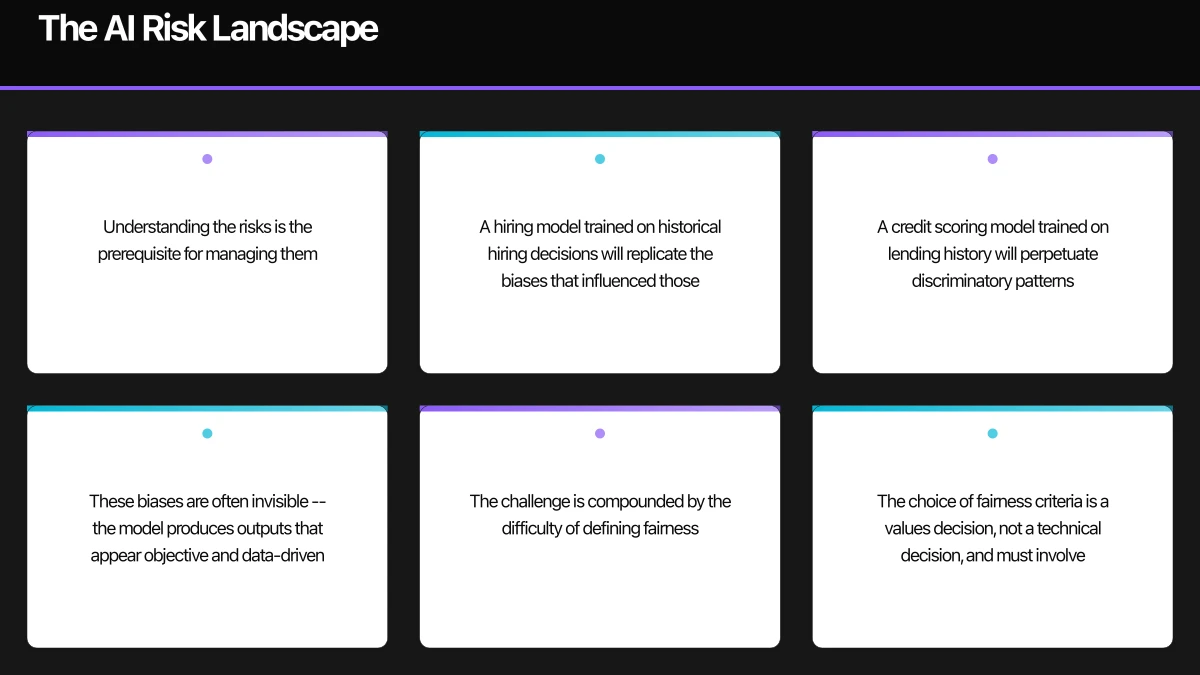
Understanding the risks is the prerequisite for managing them. Enterprise AI deployments face several categories of risk:
Bias and Fairness: AI models trained on historical data inherit the biases present in that data. A hiring model trained on historical hiring decisions will replicate the biases that influenced those decisions. A credit scoring model trained on lending history will perpetuate discriminatory patterns. These biases are often invisible — the model produces outputs that appear objective and data-driven while encoding systemic inequities.
The challenge is compounded by the difficulty of defining fairness. Different fairness criteria — demographic parity, equalised odds, predictive parity — can conflict, meaning that satisfying one definition of fairness may violate another. The choice of fairness criteria is a values decision, not a technical decision, and must involve stakeholders beyond the engineering team.
Transparency and Explainability: Many AI models, particularly deep learning models, operate as opaque systems that produce outputs without explaining their reasoning. For enterprise decisions that affect individuals — loan approvals, insurance pricing, employment decisions, medical diagnoses — the inability to explain why a decision was made creates legal, ethical, and practical problems.
The EU AI Act, currently progressing through the legislative process, will require transparency and explainability for high-risk AI applications. Even outside the EU, enterprises operating in regulated industries face increasing scrutiny of AI-driven decisions from regulators who expect the ability to audit and explain.
Data Privacy: AI models consume data, and that data often includes personal information. Training models on customer data raises consent questions. Deploying models that process personal data in real time raises data protection questions. The intersection of AI and privacy law is complex and evolving, with regulators increasingly scrutinising how AI systems use personal data.
Robustness and Reliability: AI models can fail in ways that traditional software does not. Adversarial inputs — data carefully crafted to mislead the model — can produce incorrect outputs with high confidence. Distribution shift — when production data differs from training data — degrades model accuracy silently. These failure modes require monitoring and safeguards that go beyond traditional software testing.
Societal Impact: Some AI applications raise broader societal questions that go beyond legal compliance. Facial recognition technology, autonomous decision-making in criminal justice, and AI-generated content all have implications that extend beyond the deploying organisation.
The Governance Framework
Responsible AI requires a governance framework that addresses risk assessment, development practices, deployment controls, and ongoing monitoring.
AI Ethics Board or Committee: A cross-functional body that includes technology, legal, ethics, business, and diversity perspectives provides oversight for AI initiatives. The board’s role is not to review every model but to establish policies, review high-risk applications, and provide guidance on ethical questions that arise during development.
The composition matters. A board dominated by technologists will underweight societal impacts. A board without technical members will lack the understanding to make informed decisions. The board should include senior leaders with the authority to stop projects that pose unacceptable risks.
Risk-Based Classification: Not all AI applications carry the same risk. A model that recommends products carries lower risk than a model that determines creditworthiness. The governance framework should classify AI applications by risk level and apply proportionate oversight:
Low risk: Product recommendations, content personalisation, internal process automation. Standard development practices with basic monitoring.
Medium risk: Customer service automation, fraud detection, pricing optimisation. Enhanced testing, bias evaluation, and human oversight requirements.
High risk: Credit decisions, hiring assistance, medical diagnosis support, insurance underwriting. Full impact assessment, independent review, explainability requirements, and ongoing monitoring.
Development Standards: Engineering practices that embed responsibility into the AI development lifecycle:
Data documentation: Record the provenance, characteristics, biases, and limitations of training data. Data cards or datasheets provide a structured format for this documentation.
Model documentation: Record the model’s intended use, performance characteristics, known limitations, and evaluation results. Model cards provide a structured format.
Bias testing: Evaluate model performance across demographic groups, geographic regions, and other relevant dimensions. Identify and document disparities. Determine whether disparities are acceptable given the use case and applicable fairness criteria.
Deployment Controls: Gates that must be passed before AI models reach production:
Review and approval: High-risk models require review by the AI ethics board or designated reviewers before deployment.
Human oversight: Define the appropriate level of human involvement — human-in-the-loop (human approves every decision), human-on-the-loop (human monitors and can intervene), or human-in-command (human defines parameters and reviews outcomes).
Monitoring requirements: Define what metrics will be monitored, what thresholds trigger alerts, and what response procedures apply when models behave unexpectedly.
Building Organisational Readiness
Governance frameworks are necessary but not sufficient. Organisational readiness determines whether responsible AI principles translate into practice.
AI Literacy: Decision-makers who commission AI applications need sufficient understanding of AI capabilities and limitations to set realistic expectations and ask the right questions. This does not mean every executive needs to understand gradient descent, but they need to understand that AI models are probabilistic, that they can be biased, and that they require ongoing monitoring.
Cross-Functional Collaboration: Responsible AI requires collaboration between data scientists, engineers, product managers, legal counsel, ethicists, and domain experts. Organisational structures that silo these functions impede responsible development. Cross-functional AI teams or working groups that bring diverse perspectives to AI development produce better outcomes.
Feedback Mechanisms: Users affected by AI decisions need channels to provide feedback, challenge decisions, and request human review. These feedback mechanisms serve both ethical and practical purposes: they protect individuals’ rights and they provide signals that improve model quality over time.
Incident Response: Despite best efforts, AI systems will sometimes produce harmful or inappropriate outputs. An incident response process specific to AI — including investigation procedures, impact assessment, remediation steps, and communication protocols — enables rapid, effective response.
Responsible AI adoption is not a constraint on innovation. It is the governance infrastructure that enables organisations to deploy AI confidently, at scale, with the trust of customers, regulators, and employees. The CTO who invests in responsible AI governance creates the foundation for sustainable AI adoption that delivers business value without creating the incidents that set programmes back. In a landscape where AI capabilities are expanding faster than governance practices, this investment is both strategically sound and ethically necessary.
Need to turn digital strategy into a web presence? Cosmos Web Tech covers website design, SEO, and e-commerce for Australian SMBs.
My consultancy Ganda Tech Services operates three specialist divisions covering cloud infrastructure, web development, and mobile apps for Australian businesses.
About the Author
Ashish Ganda is the founder of Ganda Tech Services, a Sydney-based technology consultancy specialising in cloud infrastructure, web development, and mobile app solutions for Australian businesses.
AI Strategy Primer for Australian Business Leaders
A practical framework for AI adoption in 2026 — cut through the hype and start with what matters.