Supply Chain Security in Enterprise Software Development
The software supply chain has become the most consequential attack surface in enterprise technology. The SolarWinds attack, discovered in December 2020, demonstrated that compromising a single software vendor could provide access to thousands of enterprise and government networks. The Log4Shell vulnerability, disclosed in December 2021, revealed that a critical vulnerability in a single open source library could affect virtually every Java application on the planet. The Codecov breach in April 2021 showed that compromised developer tools could exfiltrate secrets from thousands of CI/CD pipelines.
These are not isolated incidents — they represent a structural vulnerability in how modern software is built. Enterprise applications are assembled from thousands of components: open source libraries, commercial SDKs, container base images, build tools, and infrastructure templates. Each component is a link in the supply chain, and each link is a potential point of compromise. For CTOs, securing the software supply chain is no longer an optional security enhancement — it is a fundamental business risk management imperative.
Understanding the Software Supply Chain Attack Surface
The software supply chain encompasses everything involved in building, packaging, and distributing software. Understanding the attack surface requires examining each phase.
Dependency acquisition is the first point of vulnerability. When developers add a dependency — running npm install, pip install, or maven resolve — they trust that the package registry returns authentic, uncompromised code. Package registries like npm, PyPI, and Maven Central are public infrastructure with varying levels of security. Typosquatting attacks (publishing malicious packages with names similar to popular packages), dependency confusion attacks (publishing malicious packages to public registries with the same name as internal packages), and account takeover attacks (compromising maintainer accounts to publish malicious versions) all exploit this trust.
The transitive dependency problem amplifies the risk. A typical Node.js application has hundreds or thousands of transitive dependencies — libraries depended on by libraries depended on by the application’s direct dependencies. Each transitive dependency is a supply chain link that the development team has not explicitly evaluated. A vulnerability or compromise in any transitive dependency affects the application.
Build process integrity is the second attack surface. The build environment — CI/CD servers, build agents, and the tools they execute — has access to source code, secrets, and deployment credentials. A compromised build environment can inject malicious code during compilation, exfiltrate secrets, or modify deployment artifacts. The Codecov breach demonstrated this attack vector: a compromised code coverage tool extracted environment variables (including secrets) from CI/CD environments.
Distribution and deployment is the third attack surface. Container images pulled from public registries, Helm charts from community repositories, and Terraform modules from public registries all introduce supply chain risk at the deployment phase. A compromised base image in Docker Hub could affect thousands of applications that depend on it.
Enterprise Supply Chain Security Framework
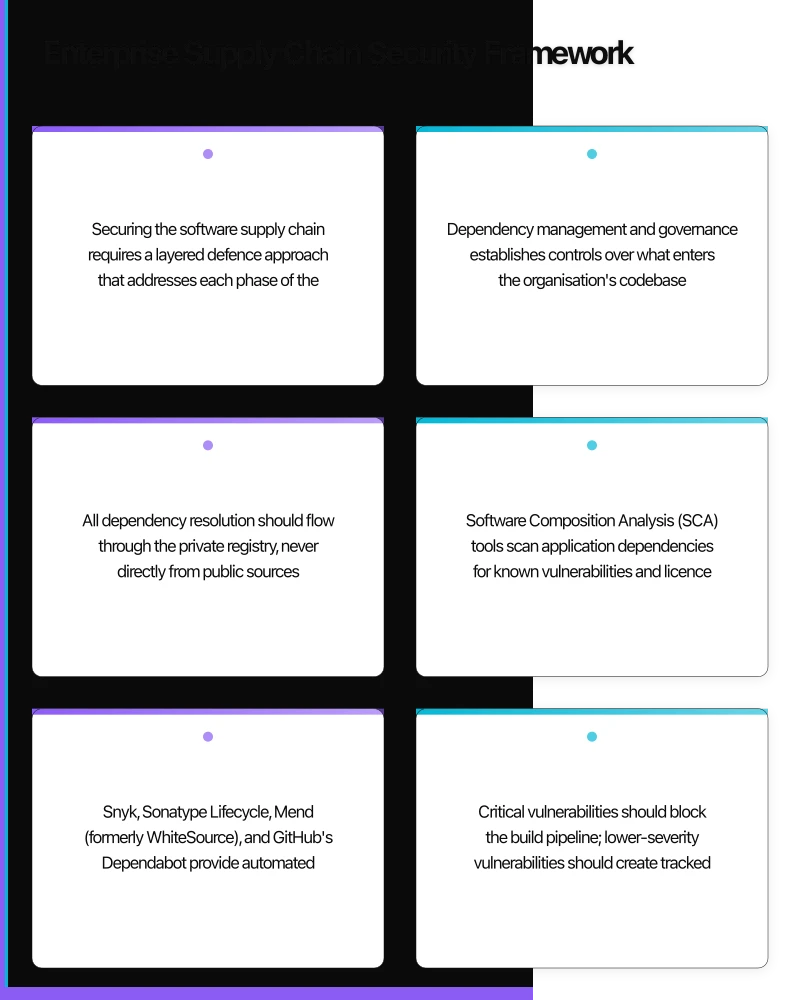
Securing the software supply chain requires a layered defence approach that addresses each phase of the supply chain.
Dependency management and governance establishes controls over what enters the organisation’s codebase. Private artifact registries (JFrog Artifactory, Sonatype Nexus, AWS CodeArtifact) proxy public package registries, caching approved packages and providing a control point for scanning and policy enforcement. All dependency resolution should flow through the private registry, never directly from public sources.
Software Composition Analysis (SCA) tools scan application dependencies for known vulnerabilities and licence compliance issues. Snyk, Sonatype Lifecycle, Mend (formerly WhiteSource), and GitHub’s Dependabot provide automated vulnerability scanning with CI/CD integration. Critical vulnerabilities should block the build pipeline; lower-severity vulnerabilities should create tracked remediation tickets.
Dependency pinning — specifying exact versions rather than version ranges — prevents unexpected updates that could introduce compromised code. Lock files (package-lock.json, Pipfile.lock, go.sum) capture the exact dependency tree at a point in time, ensuring reproducible builds. These lock files should be committed to version control and reviewed in pull requests when they change.
Build integrity and provenance ensures that build outputs are authentic and unmodified. Supply-chain Levels for Software Artifacts (SLSA, pronounced “salsa”) provides a framework for progressively improving build integrity, from basic source and build hygiene (Level 1) to hermetic, reproducible builds with verified provenance (Level 4).
Practical build integrity measures include: isolated build environments (each build runs in a clean, ephemeral container with only declared dependencies), signed build artifacts (container images signed with tools like cosign or Notary, enabling consumers to verify authenticity), and build provenance attestations (cryptographic records of what was built, from what source, in what environment).
Sigstore, a project launched by Google, Red Hat, and Purdue University, provides free, open source infrastructure for software signing, verification, and provenance. Its cosign tool enables container image signing without managing private keys, using identity-based (keyless) signing through OIDC authentication. For enterprises adopting container-based deployment, Sigstore provides a practical path to verified supply chain provenance.
Software Bill of Materials (SBOM) provides a comprehensive inventory of all components in a software product. Executive Order 14028 (May 2021) mandated SBOM requirements for software sold to the US federal government, and the practice is becoming expected across enterprise software. SPDX and CycloneDX are the dominant SBOM formats, and tools like Syft, Trivy, and FOSSA generate SBOMs from container images and source repositories.
SBOMs serve multiple purposes: vulnerability management (when a new vulnerability is disclosed, the SBOM immediately identifies affected products), licence compliance (the SBOM lists all component licences for review), and incident response (during a supply chain incident, the SBOM enables rapid assessment of exposure).
Organisational Practices and Culture
Technical controls are necessary but insufficient without organisational practices that embed supply chain security into development culture.
Dependency review processes should evaluate new dependencies before they are added to the codebase. The evaluation should consider: is the dependency actively maintained? Does it have a history of security vulnerabilities? Is the maintainer ecosystem diverse and stable? Are there alternative packages with better security profiles? Is the dependency’s licence compatible with organisational requirements?
This does not mean that every dependency addition requires a formal review board. For well-known, actively maintained packages with strong security records, the review can be lightweight. For less familiar packages, particularly those with broad permissions (filesystem access, network access, native code execution), more thorough evaluation is warranted.
Developer education on supply chain risks transforms developers from potential vulnerability vectors into active defenders. Training should cover common supply chain attack patterns (typosquatting, dependency confusion), secure dependency management practices (pinning, lock files, private registries), and the organisation’s supply chain security policies and tools.
Incident response planning for supply chain events should be established before incidents occur. When a critical vulnerability is disclosed in a widely-used library (as with Log4Shell), the organisation needs to: identify affected applications (using SBOMs or SCA tools), assess exposure and risk, prioritise and execute remediation, and communicate status to stakeholders. The speed of this response — hours versus weeks — significantly impacts the organisation’s risk exposure.
Vendor security assessment extends supply chain thinking to commercial software. When the organisation depends on third-party SaaS services, commercial SDKs, or managed platforms, those vendors’ security practices become part of the organisation’s supply chain risk. Vendor security questionnaires, SOC 2 reports, and security certifications provide assurance, but continuous monitoring of vendor security incidents and practices is also warranted.
Strategic Recommendations
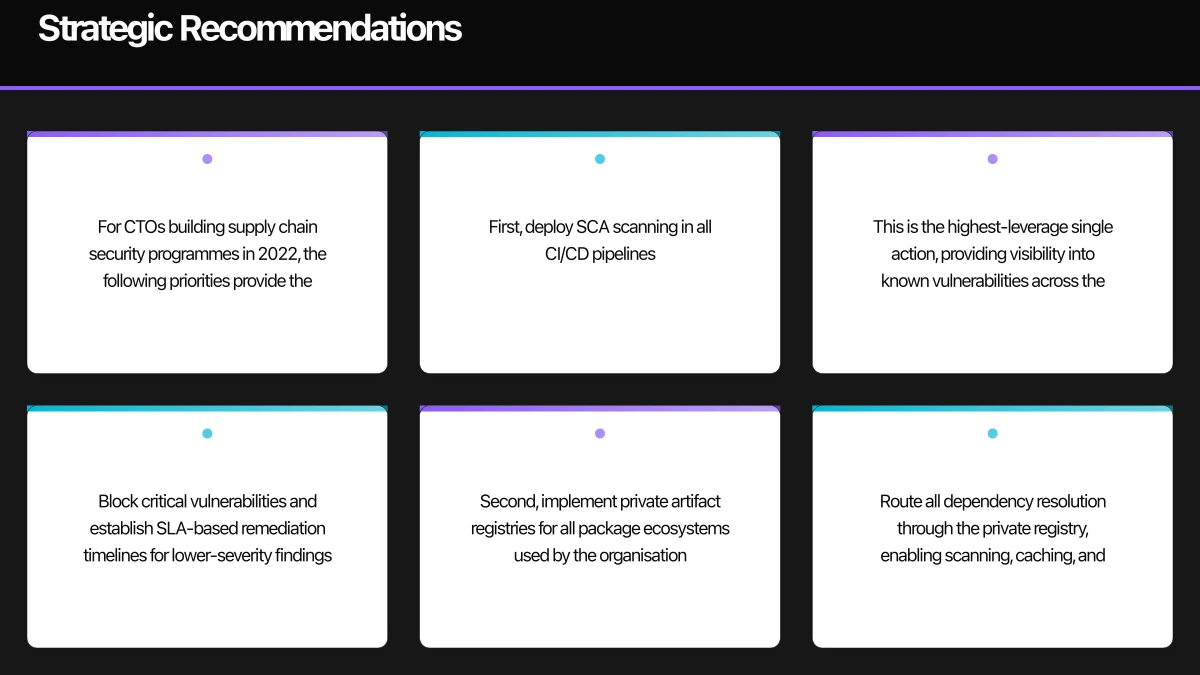
For CTOs building supply chain security programmes in 2022, the following priorities provide the strongest risk reduction.
First, deploy SCA scanning in all CI/CD pipelines. This is the highest-leverage single action, providing visibility into known vulnerabilities across the entire application portfolio. Block critical vulnerabilities and establish SLA-based remediation timelines for lower-severity findings.
Second, implement private artifact registries for all package ecosystems used by the organisation. Route all dependency resolution through the private registry, enabling scanning, caching, and policy enforcement.
Third, generate and maintain SBOMs for all production applications. When the next Log4Shell-class vulnerability is disclosed, the SBOM enables rapid identification of affected systems.
Fourth, adopt signed container images and begin establishing build provenance practices. Start with critical applications and expand coverage as processes and tooling mature.
Fifth, educate engineering teams on supply chain risks and secure development practices. The most effective technical controls can be undermined by developers who do not understand why they exist.
Conclusion
Software supply chain security has moved from a niche concern to a board-level risk. The attacks of 2020 and 2021 demonstrated that supply chain compromise can affect any organisation, regardless of the strength of its perimeter defences. For CTOs, securing the supply chain is a strategic imperative that requires investment in tooling, processes, and organisational practices.
The good news is that the tooling and frameworks for supply chain security are maturing rapidly. SLSA, Sigstore, SBOM standards, and SCA tools provide practical capabilities that did not exist even two years ago. The organisations that adopt these capabilities now will be significantly better positioned to detect and respond to supply chain threats. Those that defer will face increasing risk as attackers continue to exploit the trust relationships that define modern software supply chains.
Your digital strategy starts with being found online. Cosmos Web Tech covers SEO, WordPress, and web performance for Australian businesses.
As founder of Ganda Tech Services, I work with Australian businesses to align technology investments with business growth — across cloud, web, and mobile.
About the Author
Ashish Ganda is the founder of Ganda Tech Services, a Sydney-based technology consultancy specialising in cloud infrastructure, web development, and mobile app solutions for Australian businesses.
AI Strategy Primer for Australian Business Leaders
A practical framework for AI adoption in 2026 — cut through the hype and start with what matters.
Almost done
Check your inbox and click the confirmation link to get your download.