
The CTO's Guide to Software Supply Chain Security
Introduction
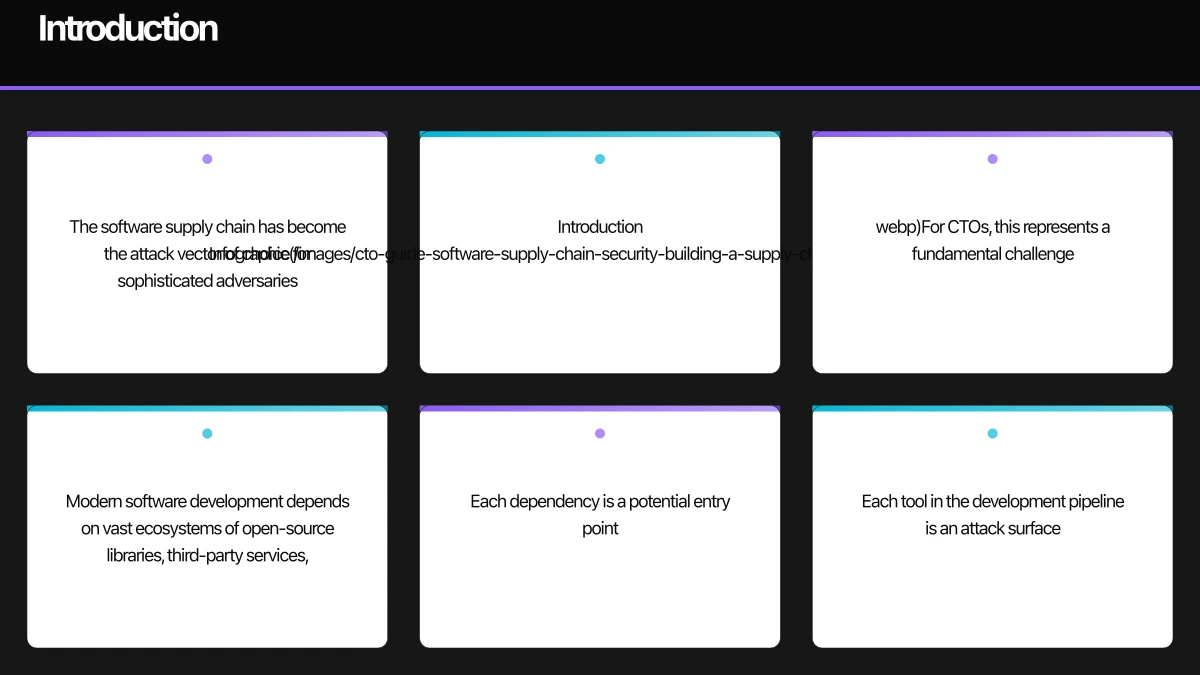
The software supply chain has become the attack vector of choice for sophisticated adversaries. From SolarWinds to Log4Shell to the steady stream of compromised npm packages, the pattern is clear: attackers target the software development and distribution infrastructure rather than attacking applications directly.
For CTOs, this represents a fundamental challenge. Modern software development depends on vast ecosystems of open-source libraries, third-party services, build tools, and distribution infrastructure. Each dependency is a potential entry point. Each tool in the development pipeline is an attack surface.
This guide examines how enterprise technology leaders should approach software supply chain security, from understanding the threat landscape to implementing practical controls that reduce risk without paralysing development velocity.
The Threat Landscape
Anatomy of Supply Chain Attacks
Supply chain attacks exploit trust relationships in software development:
Dependency Attacks
Compromising libraries that applications depend upon:
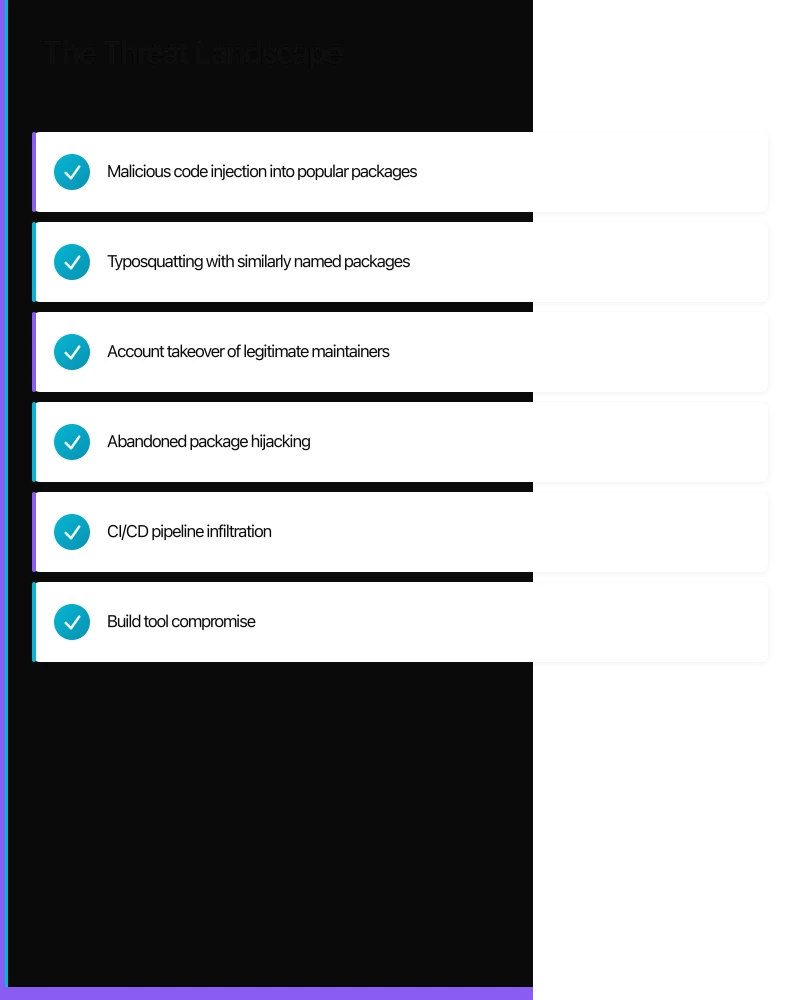
- Malicious code injection into popular packages
- Typosquatting with similarly named packages
- Account takeover of legitimate maintainers
- Abandoned package hijacking
Build System Attacks
Compromising the systems that compile and package software:
- CI/CD pipeline infiltration
- Build tool compromise
- Artifact tampering during build
- Credential theft from build systems
Distribution Attacks
Compromising how software reaches users:
- Package registry compromise
- CDN or mirror manipulation
- Update mechanism hijacking
- Code signing key theft
Development Tool Attacks
Compromising the tools developers use:
- IDE extension compromise
- Developer workstation targeting
- Source control manipulation
- Code review tool exploitation
Notable Incidents and Lessons
SolarWinds (2020)
Nation-state actors compromised the build system:
- Malicious code inserted during build process
- Signed and distributed through legitimate channels
- Affected 18,000+ organisations including government agencies
- Lesson: Build systems are high-value targets requiring protection equivalent to production systems
Log4Shell (2021)
Critical vulnerability in ubiquitous logging library:
- Present in countless applications through transitive dependencies
- Many organisations unaware of exposure
- Patching complicated by dependency complexity
- Lesson: Visibility into dependencies is essential for incident response
Codecov (2021)
Bash uploader script compromise:
- Attackers modified CI script to exfiltrate secrets
- Thousands of repositories potentially affected
- Credentials exposed from CI environments
- Lesson: Third-party CI integrations require security scrutiny
Event-Stream (2018)
Social engineering attack on npm package:
- Attacker gained maintainer access through helpful contributions
- Injected cryptocurrency-stealing code
- 8 million weekly downloads affected
- Lesson: Open-source maintainer trust cannot be assumed
Why Traditional Security Falls Short
Perimeter-focused security misses supply chain risks:
Trusted by Default
Dependencies execute with application privileges:
- No sandbox between library code and application
- Implicit trust in thousands of transitive dependencies
- Difficult to audit all dependency code
Velocity Pressure
Development speed conflicts with security review:
- Hundreds of dependency updates monthly
- New packages adopted rapidly
- Security review creates friction
Visibility Gaps
Traditional tools lack supply chain insight:
- Inventory of dependencies often unknown
- Build systems not monitored like production
- Third-party risk assessment incomplete
Building a Supply Chain Security Programme
Framework Components
A comprehensive programme addresses multiple domains:
Dependency Security
Managing risk from third-party code:
- Inventory and visibility
- Vulnerability management
- License compliance
- Quality and maintenance assessment
Build Security
Protecting the software construction process:
- Build environment hardening
- Pipeline integrity verification
- Artifact signing and verification
- Secrets management
Distribution Security
Ensuring software reaches users safely:
- Artifact integrity verification
- Secure distribution channels
- Update mechanism security
- Client-side verification
Vendor Security
Managing third-party service risk:
- Vendor security assessment
- Contractual requirements
- Continuous monitoring
- Incident response coordination
Governance Structure
Establish clear accountability:
Roles and Responsibilities
Define ownership across teams:
- Security team: Policy, tooling, monitoring
- Platform engineering: Build system security
- Development teams: Dependency decisions, updates
- Procurement: Vendor assessment
Policy Framework
Codify security requirements:
- Approved dependency sources
- Vulnerability response timelines
- Build security standards
- Vendor security requirements
Risk Acceptance Process
Handle exceptions appropriately:
- Clear escalation criteria
- Documented risk acceptance
- Time-bounded exceptions
- Regular review cadence
Dependency Security
Visibility and Inventory
You cannot secure what you cannot see:
Software Bill of Materials (SBOM)
Comprehensive dependency inventory:
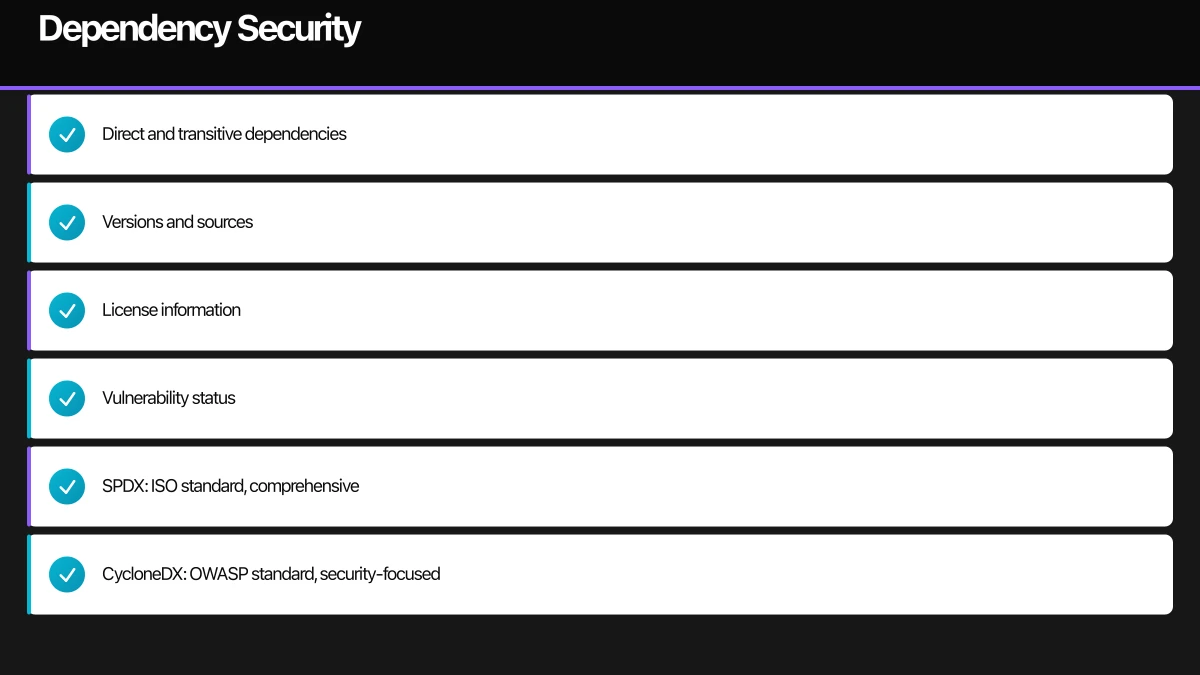
- Direct and transitive dependencies
- Versions and sources
- License information
- Vulnerability status
SBOM Formats
Industry standards for interoperability:
- SPDX: ISO standard, comprehensive
- CycloneDX: OWASP standard, security-focused
- SWID: Software identification tags
Generation Approaches
Creating accurate SBOMs:
- Build-time generation (most accurate)
- Source analysis (pre-build)
- Binary analysis (deployed artifacts)
- Registry queries (package managers)
SBOM Management
Operationalising SBOM data:
- Central repository for SBOMs
- Automated generation in CI/CD
- Customer provision requirements
- Incident response integration
Vulnerability Management
Address known vulnerabilities systematically:
Scanning Integration
Automated vulnerability detection:
- CI/CD pipeline scanning
- IDE integration for early detection
- Registry scanning for images
- Runtime detection for deployed applications
Scanning Tools
Options across the ecosystem:
- Snyk: Comprehensive with remediation guidance
- Dependabot: GitHub-native, automated PRs
- Trivy: Open-source, broad coverage
- Grype: Open-source container scanning
- OWASP Dependency-Check: Java-focused, free
Prioritisation Framework
Not all vulnerabilities are equal:
- CVSS score as baseline
- Exploitability assessment (EPSS)
- Reachability analysis
- Business context weighting
Response Timelines
Define SLAs based on risk:
| Severity | Timeline | Criteria |
|---|---|---|
| Critical | 24-72 hours | CVSS 9.0+, actively exploited |
| High | 1-2 weeks | CVSS 7.0-8.9, exploit available |
| Medium | 30 days | CVSS 4.0-6.9 |
| Low | 90 days | CVSS < 4.0 |
Dependency Selection
Prevent problems through careful selection:
Evaluation Criteria
Assess before adoption:
- Maintenance activity and responsiveness
- Security track record
- Community size and health
- License compatibility
- Transitive dependency burden
Governance Controls
Implement guardrails:
- Approved package registries
- New dependency review process
- Prohibited package lists
- Automatic policy enforcement
Ongoing Assessment
Dependencies change over time:
- Maintenance status monitoring
- Security advisory tracking
- Deprecation notification
- Regular dependency review
Update Management
Keep dependencies current:
Update Strategy
Balance currency with stability:
- Automated minor and patch updates
- Scheduled major version evaluation
- Security updates prioritised
- Testing requirements by risk level
Automation Tools
Reduce manual effort:
- Dependabot (GitHub)
- Renovate (flexible, multi-platform)
- Snyk (integrated with security)
- Custom automation for enterprise needs
Testing Requirements
Validate updates before deployment:
- Automated test suite execution
- Security scanning
- Performance regression testing
- Staged rollout for critical dependencies
Build Security
Secure Build Environments
Protect where software is constructed:
Environment Hardening
Minimise attack surface:
- Ephemeral build environments
- Minimal tooling installation
- Network isolation where possible
- Regular environment refresh
Access Control
Limit who can modify builds:
- Principle of least privilege
- MFA for build system access
- Audit logging for all actions
- Separation of duties
Secrets Management
Protect credentials in CI/CD:
- Secrets managers (HashiCorp Vault, cloud-native)
- No secrets in code or environment variables
- Short-lived credentials
- Regular rotation
Build Integrity
Ensure builds produce expected outputs:
Reproducible Builds
Same inputs produce same outputs:
- Pinned dependency versions
- Deterministic build processes
- Build environment specification
- Verification capability
Build Provenance
Document how software was built:
- SLSA framework adoption
- Signed build attestations
- Build parameter recording
- Source-to-artifact linkage
SLSA Framework
Supply-chain Levels for Software Artifacts:
| Level | Requirements | Protection |
|---|---|---|
| 1 | Build process documented | Basic provenance |
| 2 | Hosted build service, signed provenance | Build service compromise |
| 3 | Hardened build platform, non-falsifiable provenance | Build process tampering |
| 4 | Two-party review, hermetic builds | Insider threats |
Most enterprises should target SLSA Level 2-3 for critical applications.
Artifact Security
Protect build outputs:
Code Signing
Cryptographic verification of artifacts:
- Sign all release artifacts
- Hardware security modules for keys
- Signature verification in deployment
- Key rotation procedures
Artifact Repository Security
Secure internal registries:
- Access control by role
- Vulnerability scanning
- Promotion workflows
- Retention and cleanup policies
Verification Pipeline
Validate artifacts before deployment:
- Signature verification
- Policy compliance checking
- Vulnerability scanning
- Provenance validation
Third-Party Risk Management
Vendor Security Assessment
Evaluate service provider security:
Assessment Scope
What to evaluate:
- Security certifications (SOC 2, ISO 27001)
- Security practices and controls
- Incident response capabilities
- Data handling and privacy
- Business continuity planning
Assessment Methods
How to evaluate:
- Security questionnaires (SIG, CAIQ)
- Certification and audit report review
- Technical security testing
- Ongoing monitoring services
Risk-Based Approach
Scale assessment to risk:
| Vendor Type | Access Level | Assessment Depth |
|---|---|---|
| Build tools | Code, credentials | Comprehensive |
| SaaS platforms | Business data | Standard |
| Infrastructure | High privilege | Comprehensive |
| Libraries | Code execution | Automated + selective deep dive |
Contractual Protections
Codify security requirements:
Security Requirements
- Minimum security standards
- Vulnerability disclosure timelines
- Breach notification requirements
- Right to audit
Incident Response
- Notification timelines
- Cooperation requirements
- Remediation expectations
- Communication protocols
Liability and Insurance
- Cyber insurance requirements
- Liability limitations
- Indemnification provisions
Continuous Monitoring
Ongoing vendor risk visibility:
Monitoring Approaches
- Security rating services (BitSight, SecurityScorecard)
- Breach notification services
- Vendor security updates
- Certification renewal tracking
Response Triggers
- Rating score changes
- Breach disclosures
- Certification lapses
- Security incident reports
Implementation Roadmap
Phase 1: Foundation (Months 1-3)
Visibility
- Implement SBOM generation
- Deploy dependency scanning
- Inventory third-party services
- Document build processes
Quick Wins
- Enable Dependabot or Renovate
- Block critical vulnerabilities in CI
- Implement basic secrets scanning
- Establish update cadence
Governance
- Define policies and standards
- Assign roles and responsibilities
- Create exception process
Phase 2: Hardening (Months 4-8)
Build Security
- Harden CI/CD environments
- Implement artifact signing
- Deploy secrets management
- Enable build provenance
Process Maturity
- Automated policy enforcement
- Vendor assessment programme
- Dependency review process
- Incident response procedures
Measurement
- Vulnerability metrics
- Update latency tracking
- Coverage reporting
- Compliance measurement
Phase 3: Advanced (Months 9-12)
Advanced Controls
- SLSA Level 2-3 compliance
- Reproducible builds
- Runtime protection
- Advanced threat detection
Optimisation
- False positive reduction
- Process efficiency
- Developer experience
- Cost optimisation
Continuous Improvement
- Regular programme review
- Threat landscape monitoring
- Capability evolution
- Industry engagement
Tooling Ecosystem
Scanning and Analysis
Software Composition Analysis (SCA)
- Snyk: Comprehensive platform with remediation
- Mend (WhiteSource): Enterprise-focused
- Checkmarx SCA: Part of broader security platform
- Black Duck: Deep analysis capabilities
Container Scanning
- Trivy: Open-source, broad coverage
- Grype: Anchore’s open-source scanner
- Prisma Cloud: Enterprise platform
- Cloud-native options (ECR, ACR, GCR scanning)
Build and Provenance
Sigstore
Open-source signing infrastructure:
- Cosign: Container signing
- Fulcio: Certificate authority
- Rekor: Transparency log
- Growing ecosystem adoption
SLSA Tools
- slsa-github-generator: GitHub Actions provenance
- SLSA Verifier: Provenance verification
- in-toto: Supply chain layout and verification
Policy Enforcement
Open Policy Agent (OPA)
- Policy as code for supply chain rules
- Gatekeeper for Kubernetes admission
- Conftest for CI/CD policy testing
Platform-Native
- GitHub Advanced Security
- GitLab Ultimate security features
- Azure DevOps security policies
Measuring Programme Effectiveness
Key Metrics
Vulnerability Management
- Mean time to remediate by severity
- Percentage of dependencies with known vulnerabilities
- Vulnerability backlog trends
- Coverage of scanning
Dependency Health
- Percentage of dependencies current
- Average age of dependencies
- Dependencies with known maintainer issues
- License compliance rate
Build Security
- SLSA level achieved
- Percentage of artifacts signed
- Build environment refresh frequency
- Secrets scanning coverage
Programme Maturity
- Policy compliance rate
- Exception count and aging
- Training completion
- Incident response effectiveness
Reporting
Operational Dashboards
- Real-time vulnerability status
- Dependency update status
- Build security posture
- Alert and exception tracking
Executive Reporting
- Risk posture summary
- Trend analysis
- Benchmark comparison
- Investment effectiveness
Conclusion
Software supply chain security has moved from emerging concern to existential requirement. The attacks are real, the consequences severe, and the attack surface expanding with every dependency and tool integration.
The good news: practical controls exist, tooling is maturing, and industry standards are emerging. The framework outlined in this guide—spanning dependency security, build integrity, and vendor risk management—provides a roadmap for meaningful risk reduction.
Success requires sustained investment across technology, process, and people. Tools provide capability, but policies provide governance, and culture provides adoption. The organisations that treat supply chain security as a programme rather than a project will be best positioned as the threat landscape continues evolving.
Start with visibility, build toward integrity, and continuously improve. Your software supply chain is only as secure as its weakest link—and you likely have more links than you realise.
Sources
- NIST. (2024). Secure Software Development Framework (SSDF). National Institute of Standards and Technology.
- CISA. (2025). Software Supply Chain Security Guidance. Cybersecurity and Infrastructure Security Agency.
- SLSA. (2025). Supply-chain Levels for Software Artifacts Specification. https://slsa.dev/
- Sonatype. (2025). State of the Software Supply Chain Report. Sonatype Research.
Strategic guidance for technology leaders protecting the software development pipeline.
A digital strategy without mobile is incomplete. Awesome Apps publishes practical guides on building apps that Australian users love.
As founder of Ganda Tech Services, I work with Australian businesses to align technology investments with business growth — across cloud, web, and mobile.
About the Author
Ashish Ganda is the founder of Ganda Tech Services, a Sydney-based technology consultancy specialising in cloud infrastructure, web development, and mobile app solutions for Australian businesses.
AI Strategy Primer for Australian Business Leaders
A practical framework for AI adoption in 2026 — cut through the hype and start with what matters.
Almost done
Check your inbox and click the confirmation link to get your download.