The Strategic Value of Developer Productivity Engineering
Introduction
In a technology landscape where every organisation is competing for scarce engineering talent, the efficiency with which that talent is deployed is a strategic differentiator. Yet most enterprises tolerate extraordinary waste in their engineering processes: developers waiting minutes or hours for builds to complete, spending days navigating byzantine CI/CD pipelines, or losing productive hours to flaky tests and unreliable development environments.
Developer Productivity Engineering (DPE) has emerged as a discipline dedicated to systematically identifying and eliminating these productivity drains. Companies like Google, Netflix, and Spotify have long invested in dedicated productivity teams, but the practice is now spreading rapidly across the enterprise landscape as organisations recognise that a ten percent improvement in developer productivity across a thousand-person engineering organisation is the equivalent of hiring a hundred additional engineers, at a fraction of the cost.
For CTOs building the business case for DPE investment, this analysis provides a strategic framework: what developer productivity engineering encompasses, how to measure its impact, and why it deserves a permanent place in the enterprise engineering budget.
The Developer Productivity Problem
The scale of the developer productivity problem is staggering, though often invisible because it is distributed across hundreds of small frictions rather than concentrated in a single bottleneck. Research consistently finds that developers spend only thirty to forty percent of their time writing code. The remainder is consumed by a combination of waiting (for builds, tests, deployments, code reviews, and approvals), context-switching (between tools, tickets, communication channels, and tasks), searching (for documentation, code examples, configuration details, and the right person to ask), and managing toil (manually updating configurations, resolving dependency conflicts, and debugging infrastructure issues).
Each of these frictions individually seems minor, a five-minute build wait here, a ten-minute search there. But they compound across the engineering organisation to represent an enormous aggregate cost. More importantly, the cognitive cost exceeds the time cost. Every interruption and context switch carries a recovery penalty as developers reload their mental model of the problem they were working on. Research on developer flow suggests that even brief interruptions can require fifteen to twenty minutes to fully recover from.
The organisational response to this problem has historically been piecemeal: individual teams optimise their own workflows, occasionally a motivated engineer automates a particularly painful process, and periodic “developer experience” surveys identify obvious pain points without systematic follow-through. DPE takes a fundamentally different approach by treating developer productivity as a product, with dedicated teams, clear metrics, and continuous improvement.
The DPE Discipline: Scope and Structure
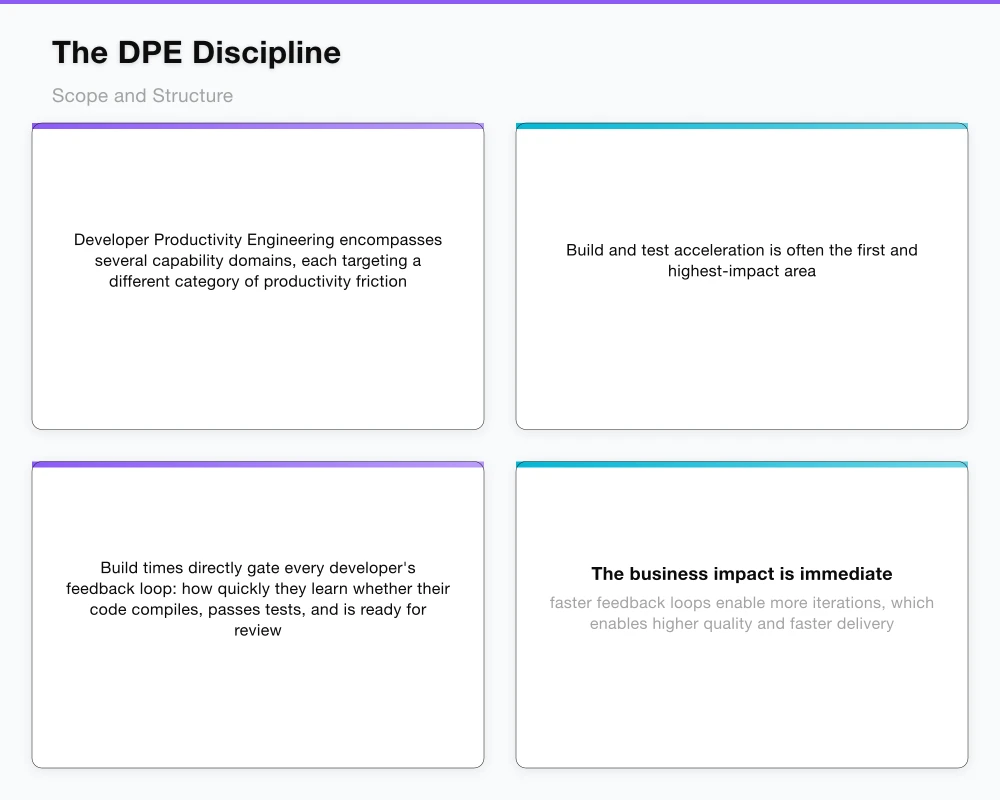
Developer Productivity Engineering encompasses several capability domains, each targeting a different category of productivity friction.
Build and test acceleration is often the first and highest-impact area. Build times directly gate every developer’s feedback loop: how quickly they learn whether their code compiles, passes tests, and is ready for review. Techniques like build caching (reusing outputs from previous builds rather than rebuilding unchanged components), test selection (running only the tests affected by a change rather than the entire suite), and remote execution (distributing build and test work across a shared compute cluster) can reduce build times from minutes to seconds. The business impact is immediate: faster feedback loops enable more iterations, which enables higher quality and faster delivery.
CI/CD pipeline optimisation extends build acceleration to the broader delivery pipeline. Pipeline efficiency depends not just on build speed but on pipeline design, parallelisation of independent stages, intelligent caching, and the elimination of unnecessary gates. DPE teams analyse pipeline data to identify bottlenecks, optimise stage sequencing, and ensure that the pipeline provides fast, reliable feedback to developers.
Development environment management addresses the significant time developers spend setting up, configuring, and troubleshooting their local development environments. Cloud development environments, pre-configured development containers, and infrastructure-as-code for development tooling can reduce onboarding time from days to hours and eliminate the “works on my machine” class of problems. Solutions like GitHub Codespaces, Gitpod, and custom internal platforms are gaining traction in this space.
Testing infrastructure encompasses the reliability and speed of the test suite itself. Flaky tests, those that pass or fail non-deterministically, are one of the most insidious productivity drains because they erode trust in the test suite, force manual investigation, and create noise that masks genuine failures. DPE teams invest in identifying and quarantining flaky tests, improving test isolation, and providing tools for developers to write more reliable tests.
Developer tooling and automation addresses the long tail of small frictions that individually seem trivial but collectively consume significant time. Custom CLI tools, automated code generation, intelligent code search, and workflow automation all fall into this category. The key is systematic identification of high-frequency manual tasks and targeted automation.
Measuring Developer Productivity
Measurement is both essential and treacherous in the DPE domain. Essential because without metrics, productivity investments cannot be justified, prioritised, or evaluated. Treacherous because simplistic metrics like lines of code, commits per day, or pull requests merged incentivise exactly the wrong behaviours and erode trust when developers perceive them as surveillance rather than improvement tools.
The SPACE framework, developed by researchers at Microsoft and the University of Victoria, provides a comprehensive model for developer productivity measurement across five dimensions: Satisfaction and well-being, Performance, Activity, Communication and collaboration, and Efficiency and flow. No single metric captures productivity; the framework recommends measuring across multiple dimensions to build a balanced picture.
For DPE-specific metrics, several categories are particularly valuable. Build and CI metrics include median build time, P95 build time, build cache hit rate, and CI pipeline success rate. These metrics directly measure the performance of the build and delivery infrastructure that DPE teams optimise. Developer feedback loop time measures the end-to-end time from code change to feedback, encompassing build, test, code review, and deployment. Developer environment setup time measures how quickly new developers or new projects can reach a productive state.
Satisfaction-based metrics, typically gathered through regular developer surveys, capture the subjective experience of using internal tools and processes. These metrics are important because they capture frictions that automated metrics miss and because developer satisfaction correlates with retention, which is a key business outcome.
The cardinal rule of DPE measurement is that metrics should be used to improve systems, not evaluate individuals. When developers trust that productivity metrics are used to identify and eliminate systemic friction rather than to rank or punish individuals, they become enthusiastic participants in the measurement programme and valuable sources of improvement ideas.
Building the Business Case
The business case for DPE investment is compelling when framed correctly. The key insight is that developer productivity improvements are multiplicative: they benefit every developer in the organisation, and their impact compounds over time as the engineering organisation grows.
Consider a concrete example. An engineering organisation of five hundred developers has a median build time of eight minutes. Each developer builds an average of ten times per day. That is forty thousand minutes, or approximately six hundred sixty-seven hours, of developer time spent waiting for builds every day. If a DPE investment reduces build time by fifty percent, the organisation recovers over three hundred hours of developer time daily. At fully loaded engineering compensation rates, this represents millions of dollars in annual value, and the build optimisation investment typically costs a fraction of that.
The same arithmetic applies across other DPE domains: CI pipeline optimisation, environment setup time reduction, and flaky test elimination each multiplied across the entire engineering organisation.
Beyond direct productivity gains, DPE investment strengthens retention by improving the daily developer experience, reduces onboarding cost and time-to-productivity for new hires, and creates capacity for innovation by freeing developers from toil. These benefits are harder to quantify but strategically significant in a talent-constrained market.
The recommended starting investment is a dedicated DPE team of three to five engineers for a medium-sized engineering organisation, growing proportionally with the engineering organisation. This team should report to engineering leadership and operate as a product team with clear metrics, a prioritised backlog, and regular engagement with their developer customers.
Developer Productivity Engineering is the highest-leverage investment most engineering organisations can make. The returns are immediate, measurable, and multiplicative. For CTOs looking to maximise the output of their engineering investment, DPE should be near the top of the priority list.
A digital strategy without mobile is incomplete. Awesome Apps publishes practical guides on building apps that Australian users love.
Ash Ganda is the founder of Ganda Tech Services, a Sydney-based technology consultancy delivering cloud, web, and mobile solutions for Australian businesses.
About the Author
Ashish Ganda is the founder of Ganda Tech Services, a Sydney-based technology consultancy specialising in cloud infrastructure, web development, and mobile app solutions for Australian businesses.
Digital Transformation Roadmap 2026
A 12-month framework for Australian SMBs ready to modernise — phases, tools, and milestones.
Almost done
Check your inbox and click the confirmation link to get your download.