Implementing GitOps in Enterprise Environments
GitOps has evolved from a Weaveworks-coined term into a broadly adopted operational model for managing Kubernetes infrastructure and application deployments. The principle is elegant: Git repositories serve as the single source of truth for the desired state of infrastructure and applications, and automated reconciliation ensures that the running state matches the declared state. Changes are made through Git commits, reviewed through pull requests, and deployed through automated synchronisation.
For enterprises managing large Kubernetes deployments, GitOps addresses fundamental operational challenges: how to maintain consistency across clusters and environments, how to audit who changed what and when, how to enable developer self-service without sacrificing governance, and how to recover quickly from configuration drift or failures. The appeal is strong, but enterprise adoption requires careful architecture decisions and organisational alignment that go beyond deploying a GitOps tool.
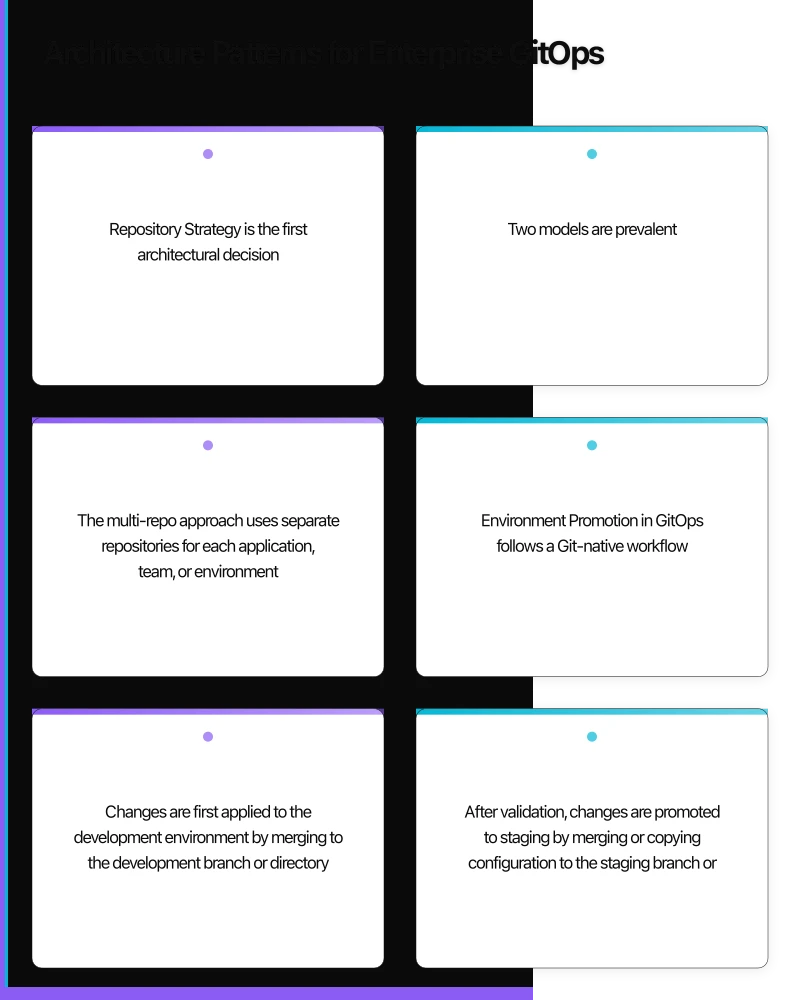
The GitOps Operating Model
GitOps establishes an operating model that fundamentally changes how infrastructure and application changes flow through the organisation.
In the traditional model, changes are pushed from CI/CD pipelines to target environments. The pipeline builds the application, authenticates to the target cluster, and applies the changes. The pipeline has credentials to modify production infrastructure, the deployment logic is embedded in pipeline scripts, and the state of the deployment is whatever the last pipeline execution produced.
In the GitOps model, the desired state is declared in Git, and a GitOps operator running inside the cluster continuously reconciles the running state to match. The operator pulls the desired state from Git (pull-based deployment), compares it to the running state, and applies any differences. Credentials for the target environment remain inside the cluster — external systems never need direct cluster access. The deployment state is the content of the Git repository, providing complete auditability and a natural rollback mechanism (revert the commit).
This pull-based model offers several enterprise-relevant advantages. Security posture improves because CI/CD pipelines no longer need production cluster credentials. The attack surface of a compromised pipeline is reduced from “can modify production infrastructure” to “can push commits to a Git repository” (which is already governed by branch protection rules and review requirements).
Drift detection and remediation is automatic. When someone makes a manual change to the cluster (a kubectl apply during incident response, a console change during debugging), the GitOps operator detects the drift and either alerts or automatically corrects it, depending on configuration. This ensures that the Git repository remains an accurate representation of the running state, not just a historical record of intended changes.
Disaster recovery is simplified because the entire cluster state is declared in Git. Recovering from a cluster failure involves provisioning a new cluster and pointing the GitOps operator at the same Git repository. The operator reconciles the new cluster to the desired state, recreating all applications and configurations.
Architecture Patterns for Enterprise GitOps
Enterprise GitOps architecture must address multi-cluster management, multi-environment promotion, and the separation of application and infrastructure concerns.
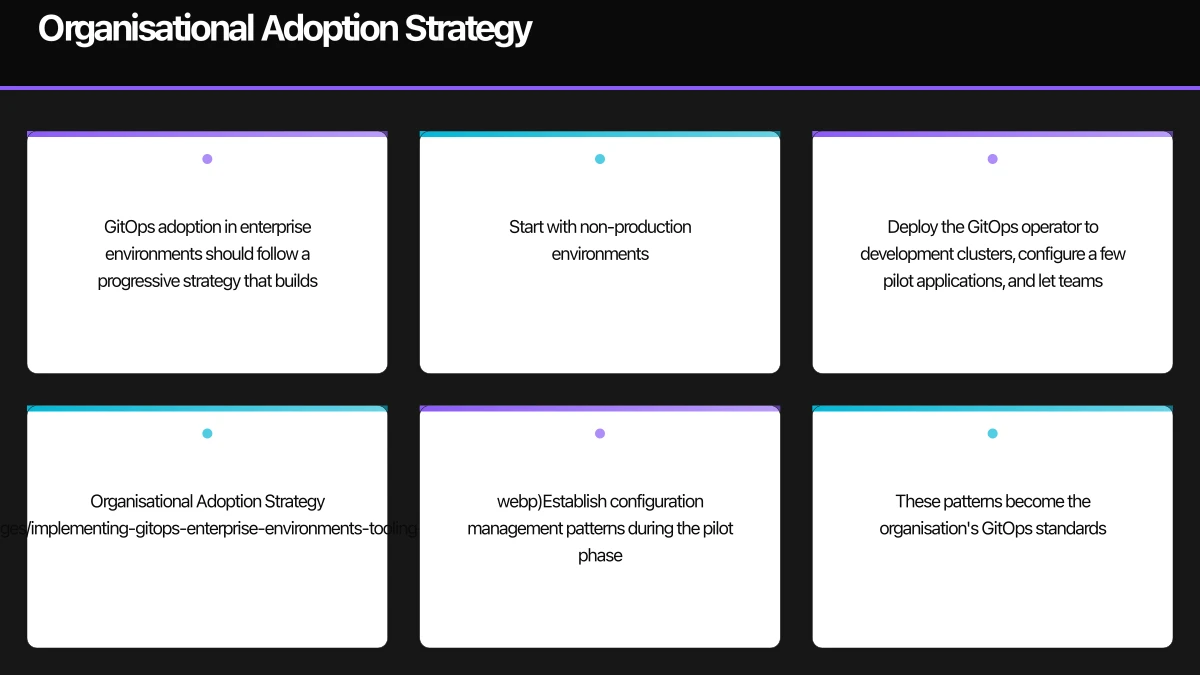
Repository Strategy is the first architectural decision. Two models are prevalent. The monorepo approach stores all environment configurations in a single repository, with directories for each environment (dev, staging, production) and each cluster. The multi-repo approach uses separate repositories for each application, team, or environment. Most enterprises adopt a hybrid: application teams maintain per-application repositories, and a platform team maintains cluster-level and infrastructure configuration repositories.
Environment Promotion in GitOps follows a Git-native workflow. Changes are first applied to the development environment by merging to the development branch or directory. After validation, changes are promoted to staging by merging or copying configuration to the staging branch or directory. Production promotion follows the same pattern. This promotion workflow can be automated (auto-promote on successful staging validation) or gated (require manual approval for production promotion).
The challenge is maintaining consistency between environments while allowing environment-specific configuration. Tools like Kustomize and Helm address this through overlays and values files that specialise a base configuration for each environment. Kustomize patches are particularly well-suited to GitOps because they are declarative and easily diffed in pull reviews.
Multi-Cluster Management is a common enterprise requirement. Organisations operating multiple Kubernetes clusters (for different environments, regions, or tenants) need a scalable approach to managing GitOps across clusters. ArgoCD’s ApplicationSet controller generates ArgoCD Applications dynamically based on Git repository structure, cluster labels, or pull request events, enabling management of hundreds of applications across dozens of clusters without manual application creation.
Secret Management is the most challenging aspect of GitOps, because secrets should not be stored in plain text in Git repositories. Several approaches address this: Sealed Secrets (encrypting secrets with a cluster-specific key, storing the encrypted form in Git), External Secrets Operator (synchronising secrets from external stores like HashiCorp Vault, AWS Secrets Manager, or Azure Key Vault), and SOPS (encrypting secret values within YAML files using cloud KMS keys). Each approach trades off complexity, security, and operational overhead.
Tooling: ArgoCD vs Flux
The enterprise GitOps tooling landscape is dominated by two CNCF projects: ArgoCD and Flux. Both implement the GitOps reconciliation model, but they differ in architecture, user experience, and enterprise feature sets.
ArgoCD provides a rich web interface that visualises application state, deployment history, and synchronisation status. This visibility is particularly valuable in enterprise environments where multiple teams and stakeholders need to understand deployment status. ArgoCD’s Application and ApplicationSet custom resources provide a declarative model for managing GitOps applications, and its RBAC system supports fine-grained access control aligned with enterprise governance requirements.
ArgoCD’s multi-tenancy support enables a single ArgoCD installation to serve multiple teams, with project-level isolation controlling which Git repositories, clusters, and namespaces each team can access. For enterprises operating shared platform infrastructure, this multi-tenancy model reduces operational overhead compared to per-team GitOps installations.
Flux takes a more composable, toolkit-oriented approach. Rather than a monolithic application, Flux comprises several controllers (Source Controller, Kustomize Controller, Helm Controller, Notification Controller) that can be deployed independently. This composability enables organisations to adopt GitOps incrementally, starting with basic manifest reconciliation and adding capabilities over time.
Flux integrates more naturally with existing CI/CD pipelines and can be used alongside other tools without requiring full adoption. Its image automation controllers can automatically update Git repositories when new container images are built, fully automating the deployment pipeline from code commit to production deployment.
For most enterprises, ArgoCD’s user interface, multi-tenancy support, and enterprise feature set make it the preferred choice. Flux is well-suited for organisations that prefer a lightweight, composable approach or have existing automation that Flux can complement.
Organisational Adoption Strategy
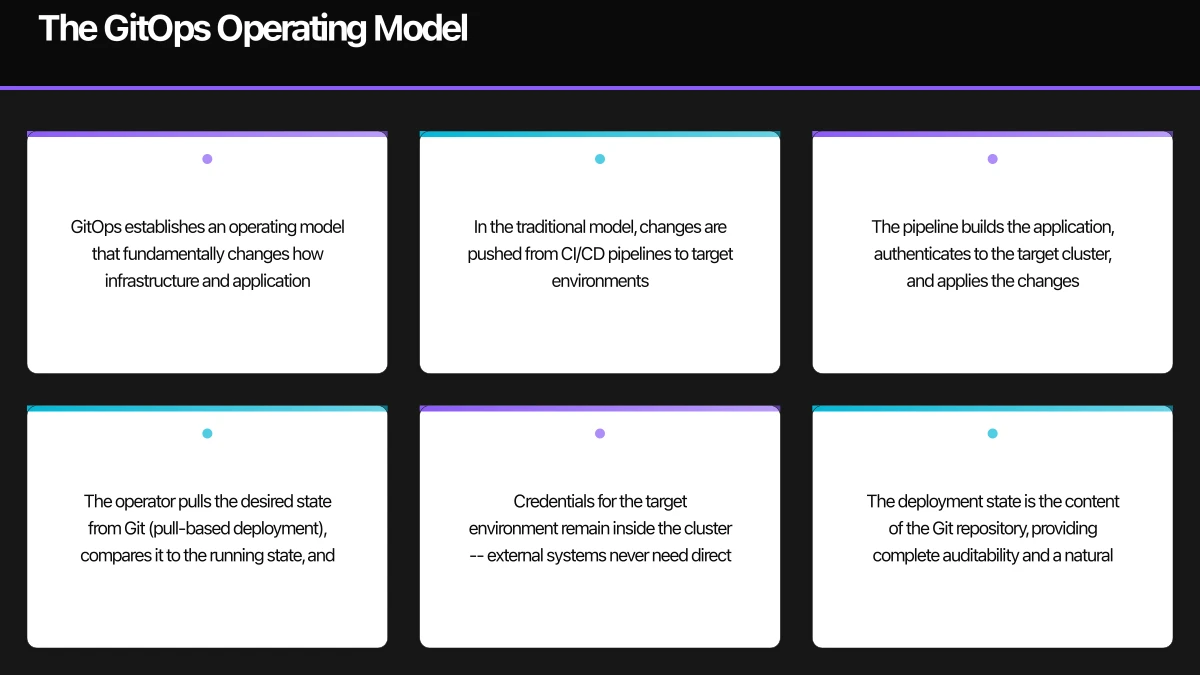
GitOps adoption in enterprise environments should follow a progressive strategy that builds confidence and capability incrementally.
Start with non-production environments. Deploy the GitOps operator to development clusters, configure a few pilot applications, and let teams experience the workflow without production risk. This phase builds familiarity with the Git-centric workflow, reveals configuration patterns that need refinement, and identifies organisational processes that need adaptation.
Establish configuration management patterns during the pilot phase. Define how applications declare their desired state (Kustomize, Helm, raw manifests), how environment-specific configuration is managed (overlays, values files), and how secrets are handled. These patterns become the organisation’s GitOps standards.
Extend to production with governance. Production GitOps deployments require branch protection rules, mandatory pull request reviews, automated validation (linting, policy checks, dry-run deployment), and approval workflows. Tools like Open Policy Agent (OPA) and Kyverno provide policy enforcement within the GitOps workflow, ensuring that configurations meet security and compliance requirements before they are synchronised.
Train and support teams through the transition. GitOps changes the developer workflow — instead of triggering deployments from CI/CD pipelines, developers update configuration in Git repositories. This shift requires training, documentation, and support during the transition period.
Conclusion
GitOps provides an operational model for Kubernetes environments that delivers the auditability, consistency, and recovery capabilities that enterprise environments demand. The Git-centric workflow aligns naturally with existing development practices, and the pull-based deployment model improves security posture compared to push-based CI/CD approaches.
For CTOs evaluating GitOps adoption in 2022, the technology and practices have reached enterprise maturity. ArgoCD and Flux are both production-proven at significant scale, and the patterns for multi-cluster management, environment promotion, and secret management are well-established. The primary investment is organisational — adapting workflows, training teams, and establishing governance — and this investment delivers lasting operational benefits.
For technical deep-dives on the cloud and IT topics I cover strategically, visit Cloud Geeks — our specialist IT infrastructure blog.
Ganda Tech Services is my technology consultancy, bringing together cloud infrastructure, web development, and mobile expertise for Australian businesses.
About the Author
Ashish Ganda is the founder of Ganda Tech Services, a Sydney-based technology consultancy specialising in cloud infrastructure, web development, and mobile app solutions for Australian businesses.
Digital Transformation Roadmap 2026
A 12-month framework for Australian SMBs ready to modernise — phases, tools, and milestones.
Almost done
Check your inbox and click the confirmation link to get your download.