Building Enterprise-Grade CI/CD with ArgoCD and GitOps
GitOps has emerged as the dominant deployment paradigm for Kubernetes-based enterprise environments. The core principle is simple: Git is the single source of truth for the desired state of all environments. Changes to infrastructure and application configurations are made through Git commits, reviewed through pull requests, and automatically reconciled by a GitOps operator that ensures the actual state of the cluster matches the declared state in Git.
ArgoCD, a CNCF graduated project, has become the leading GitOps continuous delivery tool for Kubernetes. Its declarative approach, multi-cluster support, and rich ecosystem make it well-suited for enterprise environments where hundreds of services deploy across multiple clusters and environments.
But adopting ArgoCD and GitOps at enterprise scale involves architectural decisions and organisational patterns that go well beyond installing a tool. This article addresses the patterns that differentiate a successful enterprise GitOps implementation from a tool deployment that fails to deliver its promise.
GitOps Architecture Foundations
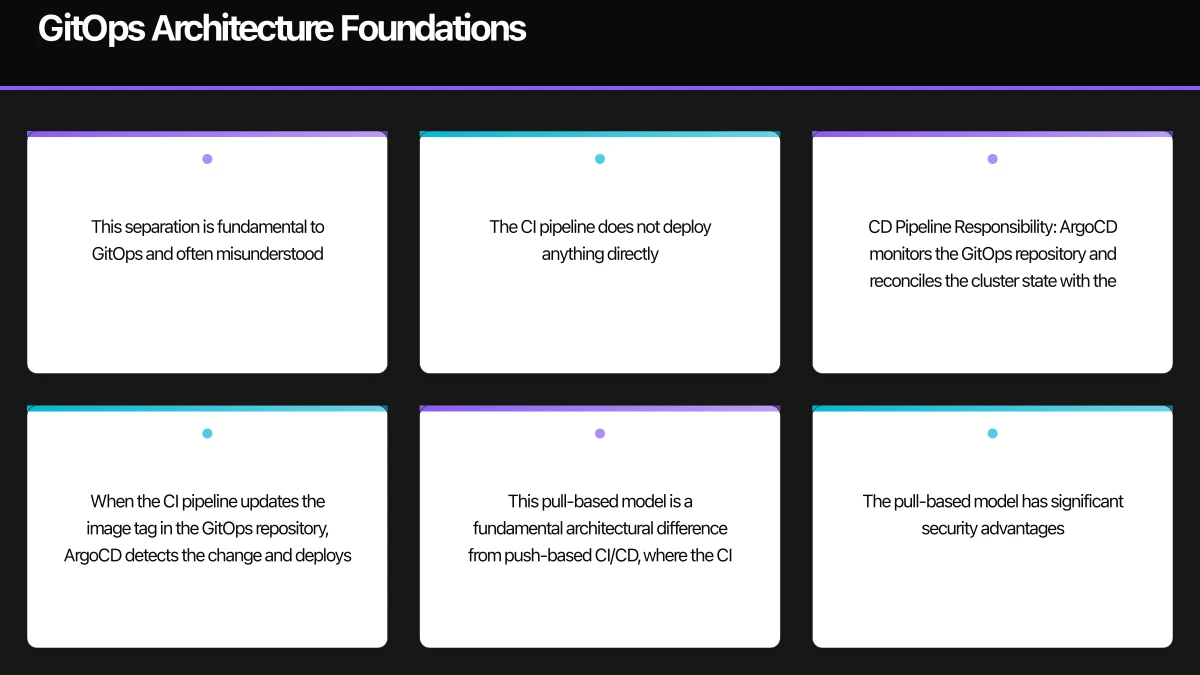
The GitOps model requires a clear separation between the CI (Continuous Integration) pipeline, which builds and tests code, and the CD (Continuous Delivery) pipeline, which deploys it. This separation is fundamental to GitOps and often misunderstood.
CI Pipeline Responsibility: The CI pipeline (Jenkins, GitHub Actions, GitLab CI, CircleCI) is responsible for compiling code, running tests, building container images, pushing images to the container registry, and updating the deployment manifests in the GitOps repository with the new image tag. The CI pipeline does not deploy anything directly.
CD Pipeline Responsibility: ArgoCD monitors the GitOps repository and reconciles the cluster state with the desired state defined in that repository. When the CI pipeline updates the image tag in the GitOps repository, ArgoCD detects the change and deploys the new version. This pull-based model is a fundamental architectural difference from push-based CI/CD, where the CI pipeline directly applies changes to the cluster.
The pull-based model has significant security advantages. The CI pipeline does not need cluster credentials, because it never directly accesses the cluster. ArgoCD, running inside the cluster, pulls configuration from Git. This reduces the attack surface: a compromise of the CI pipeline does not automatically grant access to production clusters.
Repository Structure: The structure of the GitOps repository (or repositories) is one of the most consequential design decisions. Two patterns dominate:
Monorepo: All deployment manifests for all services and all environments live in a single repository. This simplifies ArgoCD configuration and enables cross-service changes in a single commit. It becomes unwieldy at scale when hundreds of services generate frequent commits.
Repo-per-service or repo-per-team: Each service or team has its own GitOps repository. This provides autonomy and reduces commit noise but complicates cross-service changes and increases the number of repositories ArgoCD must manage.
A common enterprise pattern uses a hybrid approach: a central infrastructure repository for shared components (namespaces, RBAC, network policies) and per-team repositories for application deployments. ArgoCD’s ApplicationSet controller can dynamically generate ArgoCD Applications from templates, managing hundreds of repositories without manual configuration.
Multi-Cluster Deployment
Enterprise Kubernetes environments typically span multiple clusters: development, staging, production, and potentially multiple production clusters across regions. ArgoCD supports multi-cluster deployment through its cluster management capabilities, but the architecture requires careful design.
Hub-and-Spoke Model: A central ArgoCD instance manages deployments across all clusters. This centralises visibility and control but creates a single point of failure — if the central ArgoCD instance is unavailable, no cluster receives updates.
Distributed ArgoCD: Each cluster runs its own ArgoCD instance, managing only the deployments in that cluster. This provides resilience (failure of one ArgoCD instance affects only one cluster) but fragments visibility and management.
Hybrid Model: A central ArgoCD instance manages cross-cutting infrastructure and provides centralised visibility, while cluster-local ArgoCD instances handle application deployments. This balances centralised governance with operational resilience.
The promotion of changes between environments — from development to staging to production — is a critical workflow. In GitOps, promotion is a Git operation: merging or copying configuration from one environment’s directory or branch to another. Tools like ArgoCD Image Updater automate image tag promotion, while custom automation can handle more complex promotion workflows that include approval gates, test execution, and rollback triggers.
Security and Access Control
Enterprise GitOps implementations must address security at multiple layers:
Git Repository Access: The GitOps repository is the de facto control plane for all deployments. Write access to this repository is equivalent to deployment authority. Repository access controls must be as rigorous as production access controls. Branch protection rules that require pull request reviews for production environment changes provide an audit trail and peer review for all deployments.
ArgoCD RBAC: ArgoCD provides role-based access control that can be integrated with enterprise identity providers (LDAP, OIDC, SAML). Roles can be scoped to specific projects, applications, or clusters, enabling least-privilege access where teams can manage their own applications but cannot modify other teams’ deployments or shared infrastructure.
Secret Management: Storing secrets in Git repositories is unacceptable, even in encrypted form for most enterprise security standards. ArgoCD integrates with external secret management tools through projects like External Secrets Operator, which synchronises secrets from HashiCorp Vault, AWS Secrets Manager, or Azure Key Vault into Kubernetes secrets. Sealed Secrets, which encrypts secrets with a cluster-specific key, provides an alternative that stores encrypted secrets in Git.
Drift Detection and Remediation: ArgoCD continuously compares the actual cluster state with the desired state in Git. Any drift — whether from manual kubectl commands, automated processes, or security incidents — is detected and can be automatically remediated. This self-healing capability is one of GitOps’ strongest security properties: unauthorised changes are automatically reverted to the declared state.
Organisational Adoption
The technical implementation of ArgoCD and GitOps is only half the challenge. Organisational adoption requires addressing cultural and process changes.
Developer Experience: If GitOps makes deployment harder or slower for developers, adoption will fail regardless of its architectural benefits. The deployment workflow should be as simple as pushing code and approving a pull request. Automation that handles image building, manifest updating, and pull request creation shields developers from the GitOps machinery.
Observability and Troubleshooting: When a deployment fails in a GitOps model, the troubleshooting path follows Git history: what changed, who changed it, and when. ArgoCD’s UI provides deployment status, synchronisation state, and health checks. Integration with Slack or Teams for deployment notifications keeps teams informed. But the organisation must develop the habit of checking ArgoCD and Git history rather than resorting to direct cluster access for troubleshooting.
Governance and Compliance: GitOps provides an inherent audit trail: every deployment is a Git commit with an author, timestamp, and description. For regulated industries, this audit trail satisfies change management and deployment documentation requirements with zero additional overhead. Pull request reviews serve as the change approval mechanism, replacing heavyweight change advisory board processes.
Progressive Adoption: Rather than mandating GitOps organisation-wide, start with willing early adopters who can validate the approach and develop expertise. Their success creates the evidence and the champions needed for broader adoption. Forcing GitOps on teams that are not ready creates resistance and produces poor implementations that discredit the approach.
ArgoCD and GitOps represent a maturation of continuous delivery that aligns deployment practices with the declarative, version-controlled approach that has proven successful for infrastructure and configuration management. For CTOs, the strategic value is not just operational efficiency but also the security, auditability, and reliability properties that GitOps provides by design. The investment in getting the architecture and adoption right pays dividends across every subsequent deployment.
For practical web design and SEO guidance, my team at Cosmos Web Tech helps Australian businesses build high-performing websites.
I lead Ganda Tech Services, where we turn digital strategy into results through specialist cloud, web design, and mobile app teams across Sydney.
About the Author
Ashish Ganda is the founder of Ganda Tech Services, a Sydney-based technology consultancy specialising in cloud infrastructure, web development, and mobile app solutions for Australian businesses.
Digital Transformation Roadmap 2026
A 12-month framework for Australian SMBs ready to modernise — phases, tools, and milestones.