
Enterprise Testing Strategy: Shift Left Without Breaking Teams
The “shift left” movement — moving testing activities earlier in the software development lifecycle — has become orthodoxy in modern software engineering. The principle is sound: defects caught during development cost orders of magnitude less to fix than defects caught in production. But the enterprise implementation of shift left frequently falls short of its promise, either because it overloads development teams with testing responsibilities they are unprepared for, or because it eliminates later-stage testing that still provides value.
The challenge for enterprise CTOs is implementing shift-left testing in a way that genuinely improves quality and delivery speed without creating developer burnout, slowing delivery pipelines, or introducing false confidence that masks real quality problems. This requires a strategic approach that considers the full testing portfolio, the organisational capacity for testing, and the economics of quality at each stage of the lifecycle.
Rethinking the Testing Pyramid for Enterprise
The testing pyramid — many unit tests, fewer integration tests, fewest end-to-end tests — has been the dominant testing heuristic for over a decade. It provides useful directional guidance but oversimplifies the testing decisions that enterprise systems require.
Unit tests form the pyramid’s base and the foundation of shift-left testing. They are fast, deterministic, and specific — when a unit test fails, the cause is immediately identifiable. High unit test coverage gives developers confidence to refactor, enables rapid feedback during development, and catches logic errors before they propagate.
However, unit tests have a fundamental limitation: they validate that individual components work in isolation but say nothing about whether components work together. An enterprise system where every component has 100% unit test coverage can still fail spectacularly when those components interact with each other, with external systems, or with real data.
Integration tests validate that components work together correctly. In enterprise environments, integration testing encompasses API contract verification, database interaction testing, message queue processing, and external service integration. These tests are more expensive to run (they require infrastructure dependencies) and slower to execute, but they catch a class of defects that unit tests cannot.
The enterprise challenge with integration tests is infrastructure. Tests that depend on databases, message queues, and external services require those dependencies to be available, configured, and in a known state. Technologies like Testcontainers (which spin up dependent services as Docker containers) and service virtualisation (which simulate external service behaviour) have significantly improved the practicality of integration testing, but the investment in test infrastructure is real.
Contract tests have emerged as a critical addition to the enterprise testing portfolio. Rather than testing integration between services directly, contract tests verify that each service honours its commitments to its consumers. The Pact framework popularised consumer-driven contract testing, where each consumer defines the contract it depends on, and the provider verifies that it meets all consumer contracts.
For enterprise microservice architectures with dozens or hundreds of services, contract testing provides integration confidence without the combinatorial complexity of testing all service combinations directly. Each service can be tested independently against its contracts, enabling autonomous deployment while maintaining integration integrity.
End-to-end tests simulate complete user journeys through the system, validating that the entire stack works correctly from user interface to database and back. They provide the highest confidence that the system works as users expect, but they are slow, flaky (due to their dependency on many components), and expensive to maintain.
The enterprise anti-pattern is investing heavily in end-to-end tests as the primary quality gate. Large end-to-end test suites become bottlenecks — taking hours to run, failing unpredictably, and requiring dedicated teams to maintain. The shift-left principle argues for replacing much of this end-to-end coverage with faster, more reliable tests at lower levels of the pyramid.
Implementing Shift Left Without Breaking Teams
Shifting testing left means that developers take greater responsibility for quality, writing and maintaining tests as part of the development process rather than handing code to a separate QA team for validation. This shift, when executed well, improves quality and speed. When executed poorly, it overwhelms developers and reduces both productivity and morale.
Invest in test infrastructure before expecting test coverage. Developers will not write integration tests if standing up test dependencies requires hours of manual configuration. Provide Docker Compose configurations, Testcontainers libraries, mock service registries, and pre-configured test databases that make writing integration tests as frictionless as writing unit tests. The platform engineering team should treat test infrastructure as a first-class product.
Establish testing standards that are realistic and graduated. Not every application requires the same testing rigour. Critical payment processing services may warrant 90% unit test coverage, comprehensive contract tests, and performance benchmarks. Internal administrative tools may warrant 70% unit test coverage and basic smoke tests. A one-size-fits-all testing mandate creates friction without proportionate quality benefit.
Automate quality gates in CI/CD pipelines. Test execution should be automatic, triggered by code changes, with clear pass/fail criteria. Coverage thresholds, contract test verification, security scanning, and performance benchmarks should be enforced by the pipeline, not by manual review. Developers should receive fast feedback — test results within minutes of pushing code.
Evolve the QA role, do not eliminate it. Shift left does not mean that dedicated quality professionals become unnecessary. It means their role evolves from manual test execution to test strategy, test automation architecture, exploratory testing, and quality coaching. Quality engineers who help development teams design test strategies, build test frameworks, and improve testing practices multiply quality more effectively than those who manually execute test scripts.
Test Data Management at Enterprise Scale
Test data is the perennial challenge of enterprise testing. Applications that process complex business data — financial transactions, healthcare records, supply chain logistics — require realistic test data to validate business logic effectively. Generating, managing, and refreshing test data is one of the highest-friction testing activities in enterprise environments.
Synthetic data generation creates realistic but artificial test data that mimics production data patterns without containing real customer information. Tools like Faker libraries, custom data generators, and commercial synthetic data platforms produce data that exercises business logic paths without the privacy and compliance risks of using production data copies.
Data masking and anonymisation enables the use of production data structures and distributions with sensitive fields replaced by fictitious values. This provides the most realistic test data but requires robust masking procedures that prevent re-identification and comply with data protection regulations.
Test data as code treats test datasets as versioned artifacts, checked into source control alongside the tests that use them. This ensures test data is reproducible, reviewable, and consistent across test executions. For databases, tools like Flyway and Liquibase manage schema migrations, and fixture files manage data state.
Environment management for testing requires isolated environments where teams can test without interfering with each other. Shared test environments create contention — one team’s test data corrupts another team’s test results. Ephemeral environments, spun up for each test run and destroyed afterward, provide isolation at the cost of provisioning time and infrastructure cost.
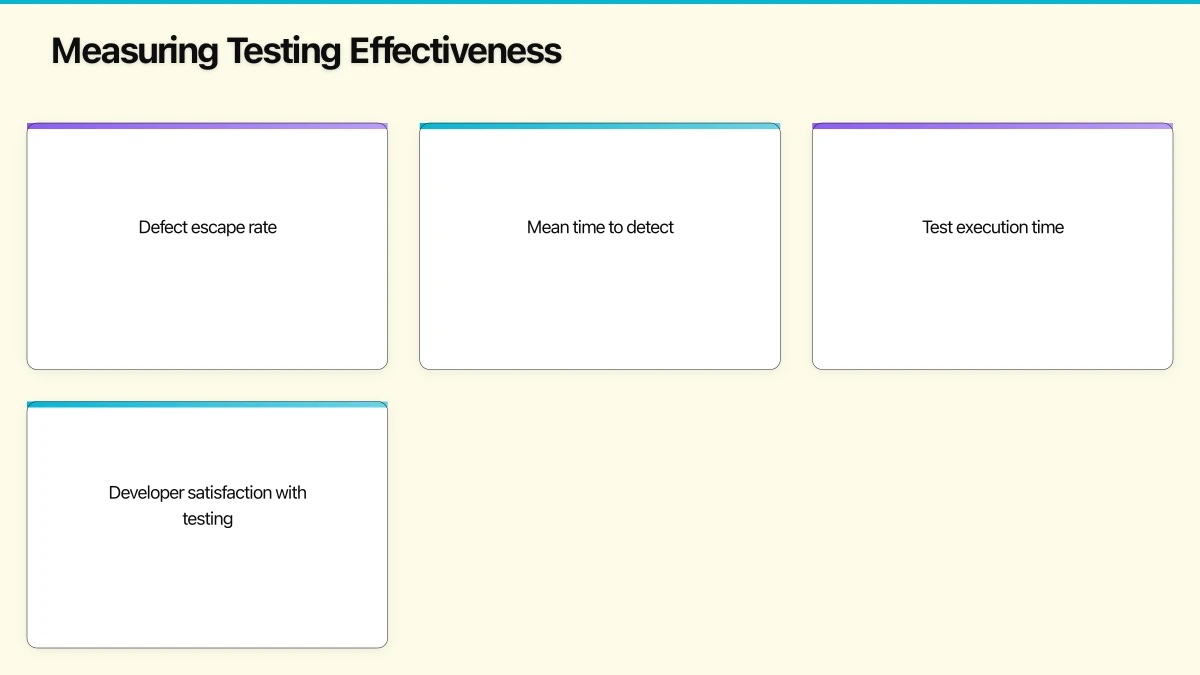
Measuring Testing Effectiveness
Testing investment should be measured by outcomes, not activity. Tracking the number of tests or test coverage percentage without connecting to quality outcomes creates perverse incentives — teams write trivial tests to meet coverage targets rather than meaningful tests that catch defects.
Defect escape rate measures the percentage of defects that reach production despite the testing process. A declining escape rate indicates improving test effectiveness. Categorising escaped defects by type (logic errors, integration failures, data issues, performance problems) identifies which testing levels need investment.
Mean time to detect measures how quickly defects are found after introduction. Shift-left initiatives should reduce this metric, catching defects in development rather than in production.
Test execution time as a proportion of the delivery pipeline determines whether testing accelerates or constrains delivery. If tests take longer than the deployment process, testing is the bottleneck. Parallelisation, selective test execution (running only tests affected by the change), and faster test infrastructure address this.
Developer satisfaction with testing assessed through surveys reveals whether the testing strategy is sustainable. Developers who find testing burdensome and unrewarding will reduce their investment over time, regardless of mandates. Testing that feels valuable — catching real bugs, providing confidence, enabling safe refactoring — sustains itself.
Conclusion
Enterprise testing strategy is about finding the right balance of testing activities across the development lifecycle, investing in the infrastructure that makes testing productive, and evolving the quality organisation to support a shift-left model without abandoning the later-stage activities that still provide value.
For CTOs implementing shift-left testing in 2022, the priorities are pragmatic: invest in test infrastructure that reduces friction, establish graduated testing standards, automate quality gates, evolve the QA role, and measure outcomes rather than activity. The goal is not maximum testing but effective testing — the minimum investment in testing activities that achieves the organisation’s quality objectives with acceptable delivery speed.
If this strategic perspective has you thinking about your online presence, Cosmos Web Tech provides actionable web design and SEO guidance.
My consultancy Ganda Tech Services operates three specialist divisions covering cloud infrastructure, web development, and mobile apps for Australian businesses.
About the Author
Ashish Ganda is the founder of Ganda Tech Services, a Sydney-based technology consultancy specialising in cloud infrastructure, web development, and mobile app solutions for Australian businesses.
Digital Transformation Roadmap 2026
A 12-month framework for Australian SMBs ready to modernise — phases, tools, and milestones.