Enterprise SaaS Evaluation: A Framework for Strategic Software Selection
Introduction
SaaS has fundamentally changed enterprise software economics. Lower upfront costs, faster deployment, and continuous updates make SaaS attractive for nearly every software category. The market has responded—thousands of SaaS products compete for enterprise attention across every functional domain.
This abundance creates its own challenge. How do you evaluate SaaS solutions systematically? Feature comparison spreadsheets don’t capture what matters. Demos show best-case scenarios. References are cherry-picked. Analyst quadrants don’t reflect your specific context.
CTOs need a framework that evaluates SaaS solutions against strategic requirements, not just functional specifications.
The SaaS Evaluation Challenge
Why Traditional Evaluation Falls Short
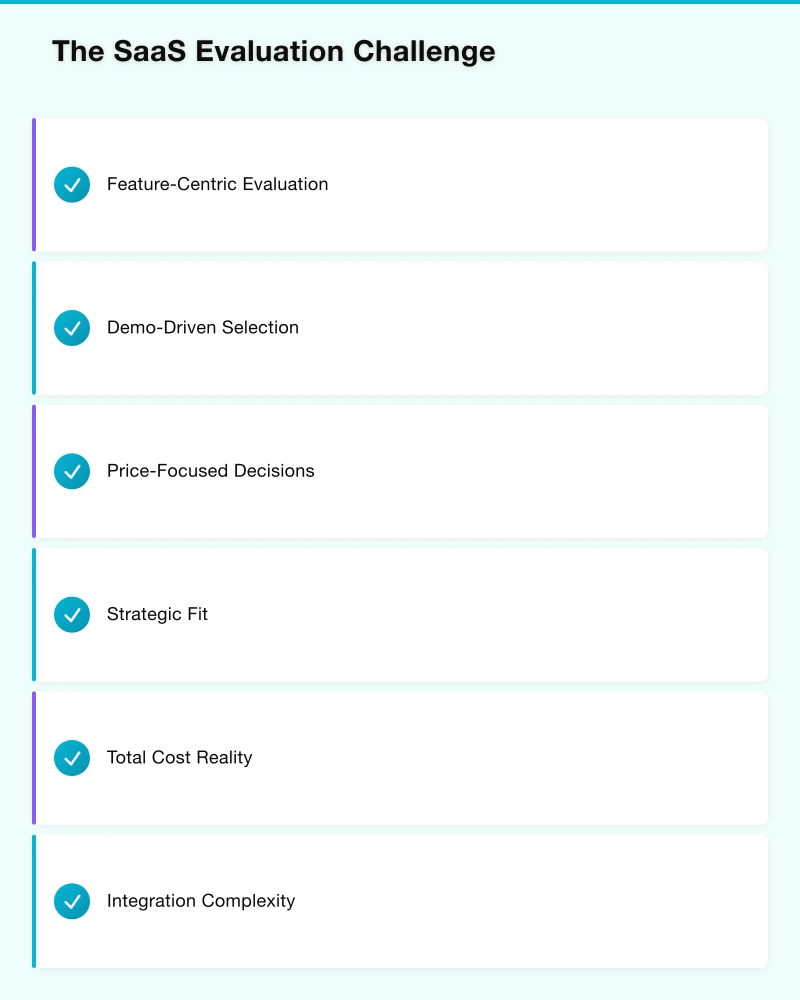
Feature-Centric Evaluation
Typical evaluation process:
- Gather requirements from stakeholders
- Create feature comparison matrix
- Score vendors against requirements
- Select highest-scoring option
Problems with this approach:
- Features are table stakes—most vendors tick most boxes
- Requirements often don’t reflect actual needs
- Weighting is arbitrary
- Misses strategic considerations
Demo-Driven Selection
Polished demos mislead:
- Show ideal scenarios, not edge cases
- Presented by experts, used by beginners
- Hidden complexity and limitations
- Configuration vs out-of-box reality
Price-Focused Decisions
Lowest price rarely means best value:
- Implementation costs vary dramatically
- Integration complexity differs
- Ongoing operational overhead
- Total cost of ownership misunderstood
What Actually Matters
Beyond features, evaluate:
Strategic Fit
- Does this solution align with technology direction?
- Will it enable or constrain future options?
- Does the vendor’s roadmap match our needs?
Total Cost Reality
- What will this actually cost over 5 years?
- What’s hidden in implementation and integration?
- How do costs scale with growth?
Integration Complexity
- How will this connect to existing systems?
- What data flows are required?
- What’s the API quality and completeness?
Operational Sustainability
- Can our team support this?
- What skills do we need?
- What’s the vendor’s support quality?
Risk Profile
- Is the vendor stable?
- What’s our exposure if things go wrong?
- How difficult is exit?
The Evaluation Framework
Phase 1: Requirements Definition
Before evaluating vendors, clarify needs:
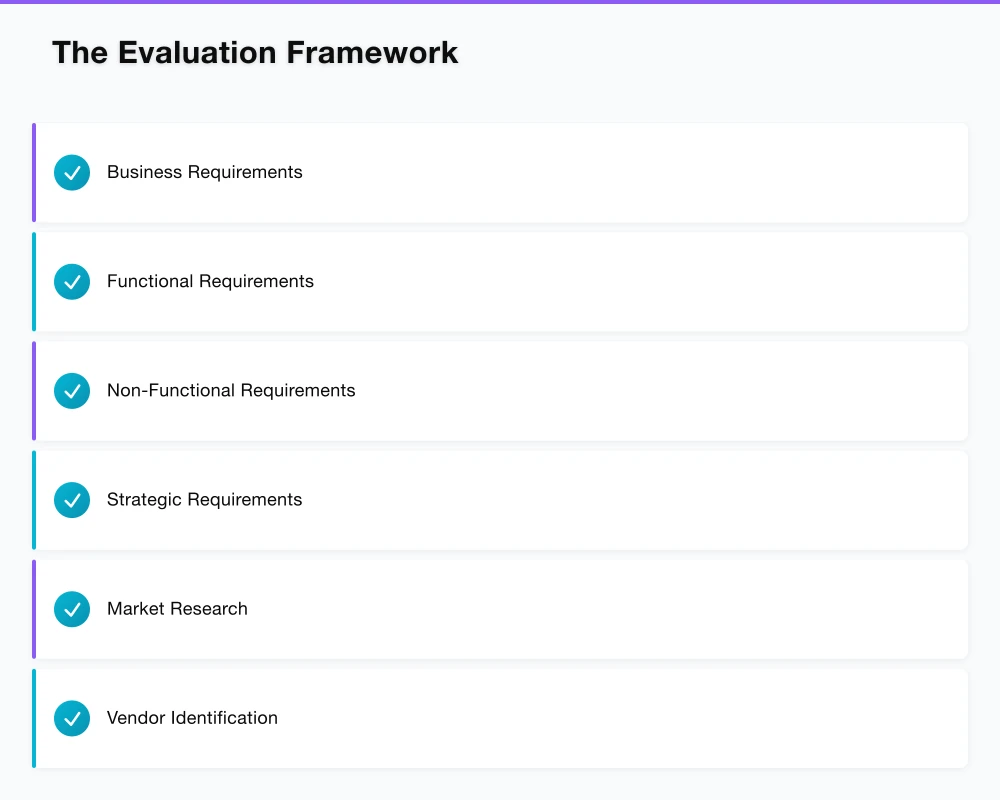
Business Requirements
Start with business outcomes:
- What problem are we solving?
- What does success look like?
- Who are the users and stakeholders?
- What processes will change?
Functional Requirements
Translate to capabilities:
- Must-have functionality (deal breakers)
- Should-have features (important)
- Nice-to-have capabilities (differentiators)
- Future requirements (roadmap alignment)
Non-Functional Requirements
Define constraints:
- Performance expectations
- Security requirements
- Compliance needs
- Integration requirements
- Scalability needs
Strategic Requirements
Consider broader context:
- Technology strategy alignment
- Vendor relationship considerations
- Build vs buy philosophy
- Platform consolidation goals
Phase 2: Market Assessment
Understand the landscape:
Market Research
Survey the market:
- Analyst reports (Gartner, Forrester)
- Peer references and communities
- Industry publications
- Vendor marketing (filtered appropriately)
Vendor Identification
Create initial list:
- Market leaders
- Specialist solutions
- Emerging options
- Incumbent or related vendors
Initial Screening
Reduce to manageable shortlist:
- Clear misfits eliminated
- Basic requirement alignment
- Budget range compatibility
- Strategic fit potential
Target 3-5 vendors for detailed evaluation.
Phase 3: Deep Evaluation
Structured assessment of shortlisted vendors:
Functional Evaluation
Beyond feature checklists:
- Hands-on evaluation environments
- Real scenario testing
- User experience assessment
- Configuration vs customisation reality
Technical Evaluation
Architecture and integration:
- API completeness and quality
- Integration patterns supported
- Data model and accessibility
- Security architecture
- Performance characteristics
Vendor Assessment
Organisation and capability:
- Financial stability
- Market position and trajectory
- Customer base and references
- Support model and quality
- Product investment and roadmap
Total Cost Analysis
Comprehensive cost modeling:
- Licensing costs (all tiers and modules)
- Implementation costs (realistic)
- Integration development
- Training and change management
- Ongoing operations and support
- Cost evolution over time
Risk Evaluation
Identify and assess risks:
- Vendor viability
- Technology obsolescence
- Integration complexity
- Lock-in and exit difficulty
- Security and compliance exposure
Phase 4: Validation
Verify findings before decision:
Reference Checks
Talk to real customers:
- Similar industry and scale
- Implementation experience
- Ongoing operations reality
- Support quality
- Gotchas and lessons learned
Ask vendors for references but also find your own.
Proof of Concept
For critical solutions:
- Limited scope implementation
- Real integration testing
- Actual user involvement
- Realistic data and scenarios
Time and cost investment, but reduces risk for major decisions.
Negotiation Testing
Understand commercial flexibility:
- Pricing negotiability
- Term flexibility
- Contract willingness
- Partnership orientation
Phase 5: Decision and Planning
Bring evaluation to conclusion:
Decision Framework
Structure the decision:
- Weighted scoring across dimensions
- Clear articulation of trade-offs
- Stakeholder alignment
- Executive approval
Implementation Planning
Plan for success:
- Realistic timeline
- Resource requirements
- Risk mitigation
- Success criteria
Contract Negotiation
Secure appropriate terms:
- Service levels
- Exit provisions
- Pricing protection
- Flexibility clauses
Evaluation Dimensions in Detail
Integration Assessment
Integration often determines success or failure:
API Quality
Evaluate thoroughly:
- API completeness (what’s exposed)
- API stability (versioning, deprecation)
- Documentation quality
- Authentication and security
- Rate limits and performance
Integration Patterns
Understand supported approaches:
- Real-time vs batch
- Push vs pull
- Event-driven capabilities
- Pre-built connectors
- Custom integration requirements
Data Accessibility
Can you get your data?
- Bulk export capabilities
- Reporting and analytics access
- Data portability
- Real-time access needs
Security Evaluation
Non-negotiable for enterprise:
Security Certifications
Baseline expectations:
- SOC 2 Type II
- ISO 27001
- Industry-specific (HIPAA, PCI, etc.)
- Regional requirements
Security Architecture
Understand implementation:
- Data encryption (transit and rest)
- Access control model
- Multi-tenancy isolation
- Penetration testing practices
- Incident response
Security Operations
Ongoing security:
- Vulnerability management
- Patch cadence
- Security monitoring
- Breach notification
Vendor Viability
Vendor stability matters:
Financial Health
For public companies:
- Revenue trends
- Profitability trajectory
- Cash position
- Market capitalisation
For private companies:
- Funding history and runway
- Customer growth
- Revenue indicators
- Investor quality
Market Position
Competitive standing:
- Market share and trajectory
- Analyst positioning
- Customer momentum
- Competitive differentiation
Product Investment
Commitment to evolution:
- R&D investment
- Release cadence
- Roadmap execution history
- Innovation track record
Total Cost of Ownership
Calculate realistically:
Year 1 Costs
Implementation year:
- License fees
- Implementation services
- Integration development
- Data migration
- Training
- Change management
- Internal resources
Ongoing Annual Costs
Steady state:
- License fees (at scale)
- Support fees
- Integration maintenance
- Operational overhead
- Training (ongoing)
- Potential professional services
Growth Scenarios
Cost evolution:
- Pricing at different scales
- Module addition costs
- User tier transitions
- Overage charges
Exit Costs
Eventually relevant:
- Data extraction effort
- Replacement implementation
- Parallel running period
- Contract obligations
Common Pitfalls
Requirements Inflation
Too many “must-haves”:
- Everything becomes critical
- No differentiation between vendors
- Important requirements buried
Solution: Ruthless prioritisation. True must-haves should be few.
Demo Seduction
Falling for impressive presentations:
- Demos show ideal scenarios
- Expert presenters vs normal users
- Hidden complexity
Solution: Hands-on evaluation with real scenarios and actual users.
Reference Bias
Only talking to selected references:
- Vendors choose their best customers
- References have incentives
- Missing challenging perspectives
Solution: Find independent references through networks.
TCO Underestimation
Focusing on license cost:
- Implementation always costs more
- Integration is complex
- Change management neglected
- Operational overhead ignored
Solution: Comprehensive cost modeling with realistic assumptions.
Feature Obsession
Chasing features over fundamentals:
- Features are easy to compare
- Fundamentals harder to evaluate
- Differentiating features rarely used
Solution: Focus on core value delivery, not feature counts.
Conclusion
Enterprise SaaS evaluation requires moving beyond feature comparison to strategic assessment. The solution that best serves your organisation may not tick the most boxes—it’s the one that delivers business value, integrates effectively, scales appropriately, and comes from a vendor you can partner with.
Invest time proportionate to decision impact. For strategic platforms, thorough evaluation pays dividends over years of use. For tactical tools, lighter-weight assessment makes sense.
Most importantly, remember that evaluation is means to an end. The goal isn’t selecting software—it’s enabling business outcomes. Keep that focus throughout the process.
Sources
- Gartner. (2023). Magic Quadrant Methodology. Gartner Research.
- Forrester. (2023). The Forrester Wave Methodology Guide. Forrester Research.
- McKinsey. (2022). SaaS and the Enterprise: Implementation Lessons. McKinsey Digital.
- IACCM. (2022). Technology Contract Benchmarking Report. International Association for Contract & Commercial Management.
Strategic guidance for technology leaders making software decisions.
Mobile execution is where many digital strategies come to life. Awesome Apps publishes practical guides on app development and mobile UX.
I lead Ganda Tech Services, where we turn digital strategy into results through specialist cloud, web design, and mobile app teams across Sydney.
About the Author
Ashish Ganda is the founder of Ganda Tech Services, a Sydney-based technology consultancy specialising in cloud infrastructure, web development, and mobile app solutions for Australian businesses.
Tech Stack Selection Guide 2026
Choose the right tools for your Australian business — without the vendor hype or overlapping spend.
Almost done
Check your inbox and click the confirmation link to get your download.