Enterprise NoSQL Strategy: MongoDB vs DynamoDB vs Cassandra
The enterprise database landscape has diversified dramatically over the past decade. Where relational databases once served as the universal data store, modern enterprises routinely operate multiple database technologies, each optimised for specific workload characteristics. NoSQL databases have moved from experimental to essential, powering use cases where relational databases face fundamental limitations: high-velocity data ingestion, flexible schema requirements, horizontal scaling beyond single-node capacity, and sub-millisecond read latency at massive scale.
Among the NoSQL options, three technologies dominate enterprise adoption: MongoDB (document database), Amazon DynamoDB (managed key-value and document database), and Apache Cassandra (wide-column store). Each represents a fundamentally different approach to data management, with distinct consistency models, scaling characteristics, and operational profiles. Choosing between them is not a matter of which is “best” but which is most strategically aligned with specific workload requirements, organisational capabilities, and infrastructure strategy.
MongoDB: The Flexible Document Database
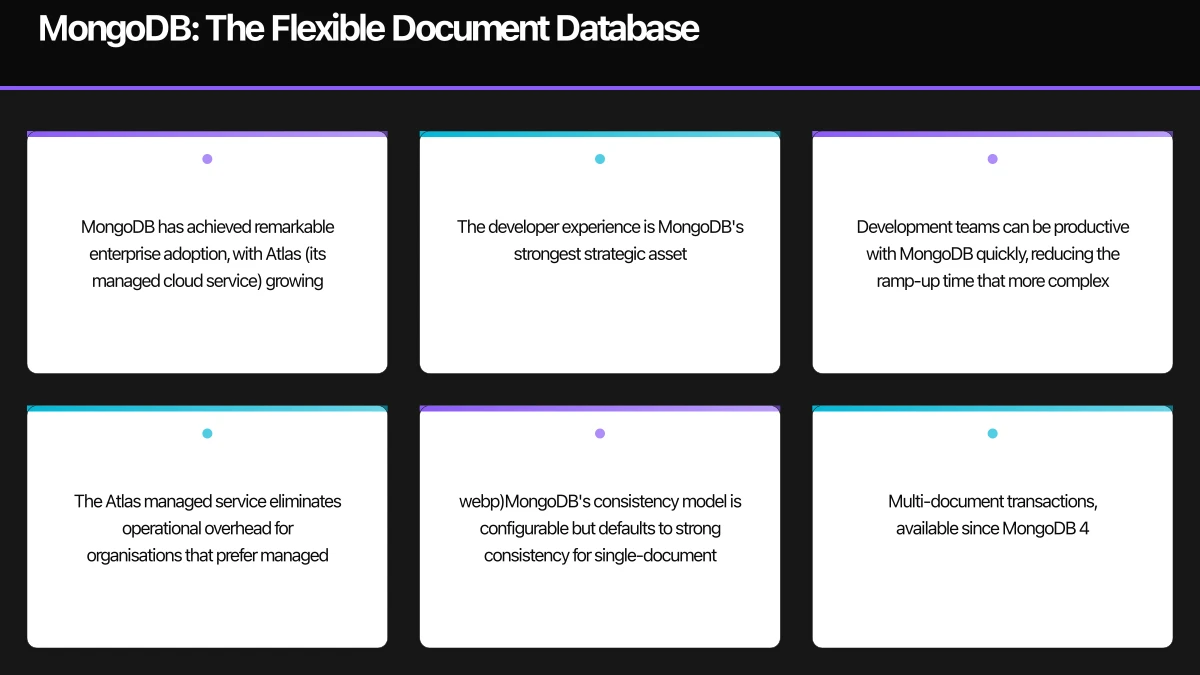
MongoDB has achieved remarkable enterprise adoption, with Atlas (its managed cloud service) growing rapidly. Its document model stores data as JSON-like documents (BSON), providing schema flexibility that aligns naturally with object-oriented programming and agile development practices. Documents can contain nested structures, arrays, and varying fields, which eliminates the impedance mismatch between application objects and database records that characterises relational databases.
The developer experience is MongoDB’s strongest strategic asset. Its query language is expressive and intuitive, its aggregation pipeline provides powerful analytical capabilities, and its drivers are available for every major programming language. Development teams can be productive with MongoDB quickly, reducing the ramp-up time that more complex databases require. The Atlas managed service eliminates operational overhead for organisations that prefer managed infrastructure.
MongoDB’s consistency model is configurable but defaults to strong consistency for single-document operations. Multi-document transactions, available since MongoDB 4.0, provide ACID guarantees across multiple documents, addressing a historical limitation that prevented adoption for transactional workloads. However, the performance characteristics of multi-document transactions differ from single-document operations, and architects should design data models to minimise multi-document transaction requirements.
Scaling in MongoDB operates through sharding — distributing data across multiple nodes based on a shard key. The choice of shard key is the most consequential data modelling decision in MongoDB, as it determines data distribution, query routing, and write scaling. Poor shard key selection leads to hot spots (uneven data distribution), scatter-gather queries (requiring all shards for a single query), and migration challenges. Enterprises adopting MongoDB at scale need deep expertise in shard key design and capacity planning.
MongoDB’s strategic limitations include higher operational complexity than DynamoDB for organisations seeking fully managed simplicity, and lower write throughput than Cassandra for extreme-scale time-series or IoT workloads. Its sweet spot is applications requiring flexible data models, rich query capabilities, and moderate to high scale — content management, product catalogues, user profiles, and real-time analytics.
Amazon DynamoDB: The Managed Scale Machine
DynamoDB represents a fundamentally different philosophy: a fully managed, serverless database that abstracts away all operational concerns in exchange for constraining the data model and access patterns. There are no servers to provision, no clusters to manage, no replication to configure, and no patching to perform. AWS handles everything, and the database scales transparently from single-digit requests per second to millions.
The pricing model is DynamoDB’s most distinctive characteristic. On-demand pricing charges per read and write request, scaling automatically with no capacity planning required. Provisioned capacity pricing offers lower per-request costs for predictable workloads with auto-scaling adjusting capacity based on utilisation. This economic model aligns infrastructure costs precisely with business demand, eliminating the overprovisioning that characterises traditional database deployments.
DynamoDB’s consistency model offers both eventually consistent reads (default, higher throughput) and strongly consistent reads (guaranteed to reflect all writes that received a successful response). Global tables provide multi-region replication with conflict resolution for globally distributed applications. DynamoDB Streams provides change data capture, enabling event-driven architectures that react to database changes.
The constraint is the data model. DynamoDB is fundamentally a key-value store with secondary index support. All queries must use the partition key (and optionally the sort key), and secondary indexes provide limited additional access patterns. This means that data models must be designed around access patterns, not entity relationships. The single-table design pattern, where multiple entity types coexist in a single table with carefully designed partition and sort keys, is the advanced modelling technique required for complex DynamoDB applications.
This access pattern constraint is DynamoDB’s greatest strategic trade-off. Applications with well-defined, stable access patterns benefit enormously from DynamoDB’s operational simplicity and scaling capability. Applications requiring ad hoc queries, complex joins, or frequently changing access patterns are poorly served. The upfront investment in access pattern analysis and data model design is essential — retrofitting a DynamoDB data model after deployment is expensive and disruptive.
DynamoDB’s strategic fit is strongest for AWS-native organisations running applications with high scale, low latency requirements, well-defined access patterns, and a preference for fully managed operations. Gaming leaderboards, session stores, IoT data ingestion, and high-traffic web applications are classic DynamoDB use cases.
Apache Cassandra: The Write-Optimised Distributed Database
Cassandra, originally developed at Facebook and now an Apache project, is designed for one specific scenario: massive write throughput across geographically distributed clusters with no single point of failure. Its architecture — inspired by Amazon’s Dynamo paper and Google’s Bigtable — uses a masterless ring topology where every node can accept reads and writes, providing linear scaling by adding nodes.
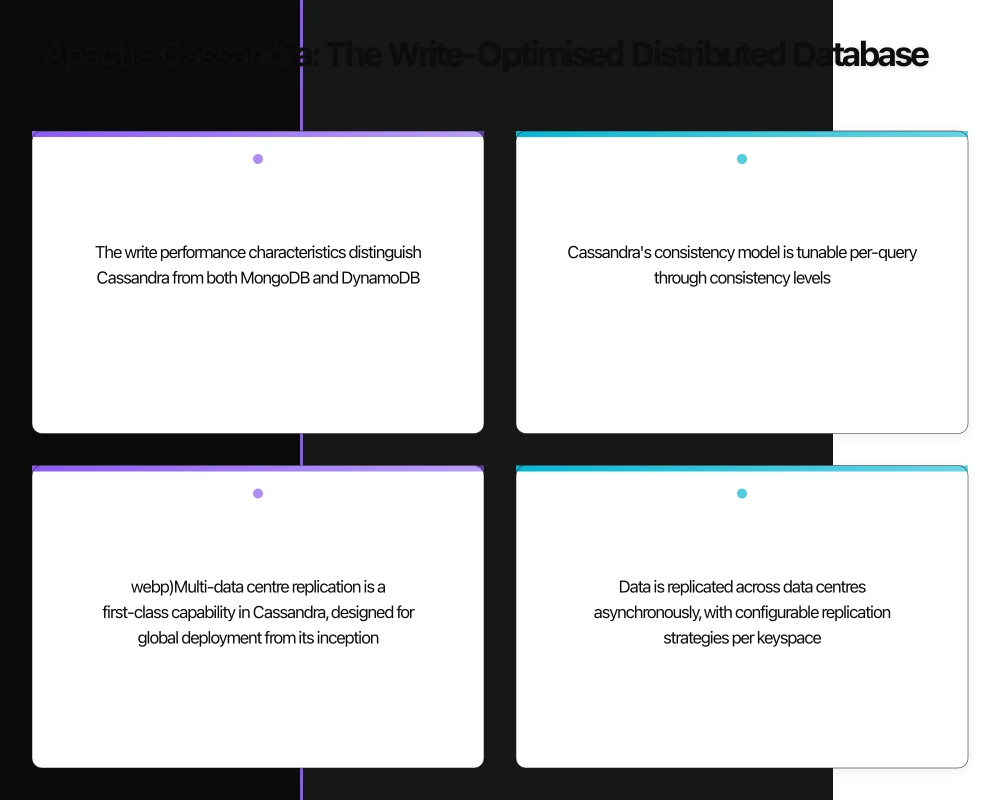
The write performance characteristics distinguish Cassandra from both MongoDB and DynamoDB. Cassandra’s log-structured merge tree (LSM tree) storage engine optimises for sequential writes, achieving write throughput that scales linearly with cluster size. Organisations processing millions of writes per second — IoT telemetry, application logging, time-series metrics, messaging systems — find Cassandra’s write performance unmatched.
Cassandra’s consistency model is tunable per-query through consistency levels. Applications can choose between eventual consistency (fastest, highest availability) and strong consistency (slower, requires quorum of replicas to agree) on a per-operation basis. This flexibility allows the same cluster to serve different consistency requirements for different operations, optimising the availability-consistency trade-off for each use case.
Multi-data centre replication is a first-class capability in Cassandra, designed for global deployment from its inception. Data is replicated across data centres asynchronously, with configurable replication strategies per keyspace. This makes Cassandra the natural choice for applications requiring active-active deployment across multiple geographic regions with local read and write performance.
The operational complexity of Cassandra is its primary strategic limitation. Managing a Cassandra cluster requires specialised expertise in capacity planning, compaction tuning, garbage collection optimisation, repair operations, and topology management. The operational burden is significantly higher than MongoDB Atlas or DynamoDB. DataStax offers a commercial distribution with enhanced management tools and the Astra managed service, which reduces operational complexity at the cost of additional licensing.
Cassandra’s data modelling is query-driven, requiring denormalisation and the creation of multiple tables to serve different query patterns. This is philosophically similar to DynamoDB’s access pattern approach but with more flexibility in query capabilities. The CQL (Cassandra Query Language) provides SQL-like syntax that eases the learning curve for relational database practitioners, though the underlying data model semantics differ substantially.
Decision Framework for Enterprise Adoption
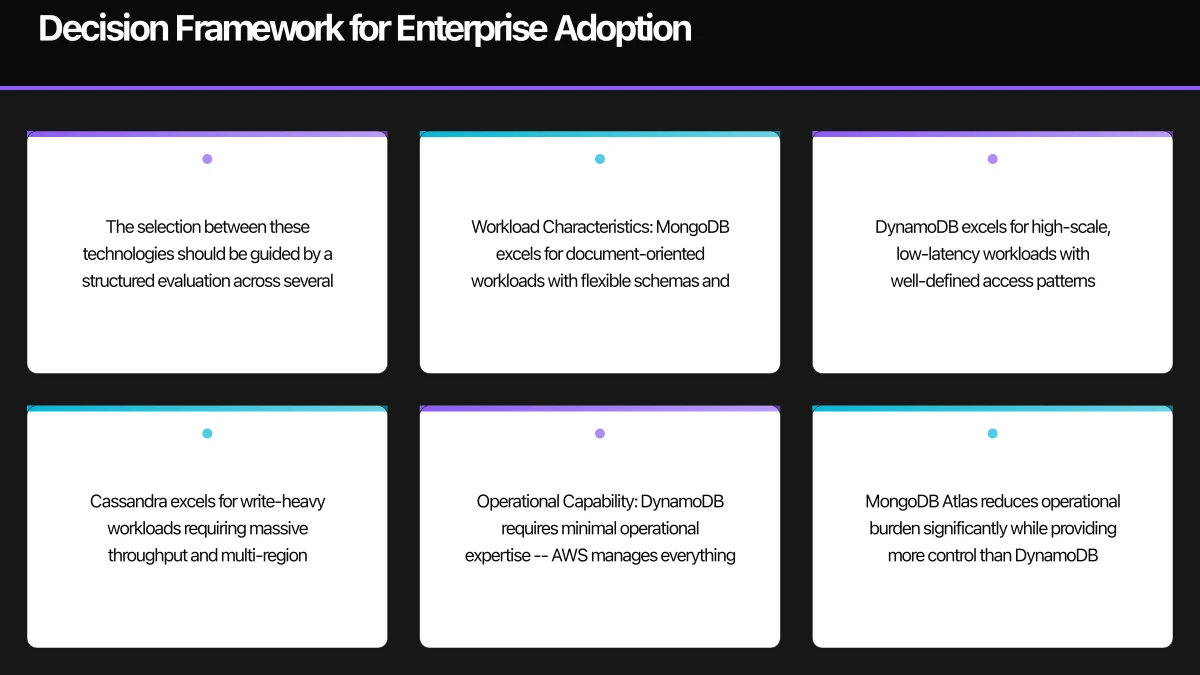
The selection between these technologies should be guided by a structured evaluation across several dimensions.
Workload Characteristics: MongoDB excels for document-oriented workloads with flexible schemas and rich query requirements. DynamoDB excels for high-scale, low-latency workloads with well-defined access patterns. Cassandra excels for write-heavy workloads requiring massive throughput and multi-region deployment.
Operational Capability: DynamoDB requires minimal operational expertise — AWS manages everything. MongoDB Atlas reduces operational burden significantly while providing more control than DynamoDB. Self-managed Cassandra requires deep distributed systems expertise. Organisations should honestly assess their operational capabilities and appetite for database operations.
Cloud Strategy: DynamoDB is available only on AWS, creating strong vendor coupling. MongoDB Atlas runs on AWS, Azure, and GCP, providing cloud portability. Cassandra runs anywhere, including on-premises, providing maximum deployment flexibility. The cloud strategy implications of each choice should weigh heavily in the decision.
Data Model Complexity: MongoDB provides the richest query capabilities and most flexible data modelling. DynamoDB and Cassandra both require careful upfront data modelling designed around access patterns. For applications where query requirements are evolving or complex, MongoDB provides the most adaptable foundation.
Cost at Scale: DynamoDB’s pay-per-request pricing is attractive for variable workloads but can become expensive at sustained high throughput. Cassandra on self-managed infrastructure provides the lowest per-operation cost at massive scale but requires operational investment. MongoDB Atlas pricing sits between these extremes.
Conclusion
Enterprise NoSQL strategy is not about selecting a single “best” database — it is about matching database characteristics to workload requirements and organisational capabilities. Many enterprises operate all three of these technologies, each serving the use cases for which it is best suited.
For CTOs making NoSQL decisions in 2022, the recommendation is to invest in understanding workload characteristics deeply before selecting technology. Prototype with realistic data volumes and access patterns. Honestly assess operational capabilities. And design for the long term — database migrations are among the most expensive and risky undertakings in enterprise technology, making the initial selection consequential for years to come.
Strategy needs execution. Cloud Geeks publishes practical cloud computing and cybersecurity guides for Australian businesses ready to act.
I lead Ganda Tech Services, where we turn digital strategy into results through specialist cloud, web design, and mobile app teams across Sydney.
About the Author
Ashish Ganda is the founder of Ganda Tech Services, a Sydney-based technology consultancy specialising in cloud infrastructure, web development, and mobile app solutions for Australian businesses.
Digital Transformation Roadmap 2026
A 12-month framework for Australian SMBs ready to modernise — phases, tools, and milestones.