Enterprise ChatGPT Adoption: Building a Governance Framework
Introduction
ChatGPT crossed 100 million users faster than any technology in history. Within months of its November 2022 launch, it became impossible to ignore. Your employees are using it—whether you’ve sanctioned it or not.
The question facing enterprise technology leaders isn’t whether to adopt generative AI, but how to enable its benefits while managing very real risks. This requires governance frameworks that balance innovation with responsibility.
The Current Reality
Shadow AI Is Already Here
Survey after survey confirms it: employees are using ChatGPT and similar tools without IT approval. A recent Gartner survey found over 70% of knowledge workers have experimented with generative AI tools, most without explicit workplace guidance.
This shadow AI usage creates risks:
- Confidential data entered into public AI services
- Inaccurate AI outputs used in business decisions
- Compliance violations from unvetted AI-generated content
- Inconsistent quality and standards
Prohibition doesn’t work. Employees who find value in these tools will continue using them—just more covertly.
The Opportunity Cost of Inaction
While risks demand attention, the opportunity cost of blocking generative AI is substantial:
- Competitors gaining productivity advantages
- Employee frustration with outdated policies
- Missed efficiency gains across knowledge work
- Innovation happening elsewhere
The organisations that figure out responsible adoption first gain sustainable competitive advantage.
Understanding the Risks
Data Security and Privacy
The Core Problem
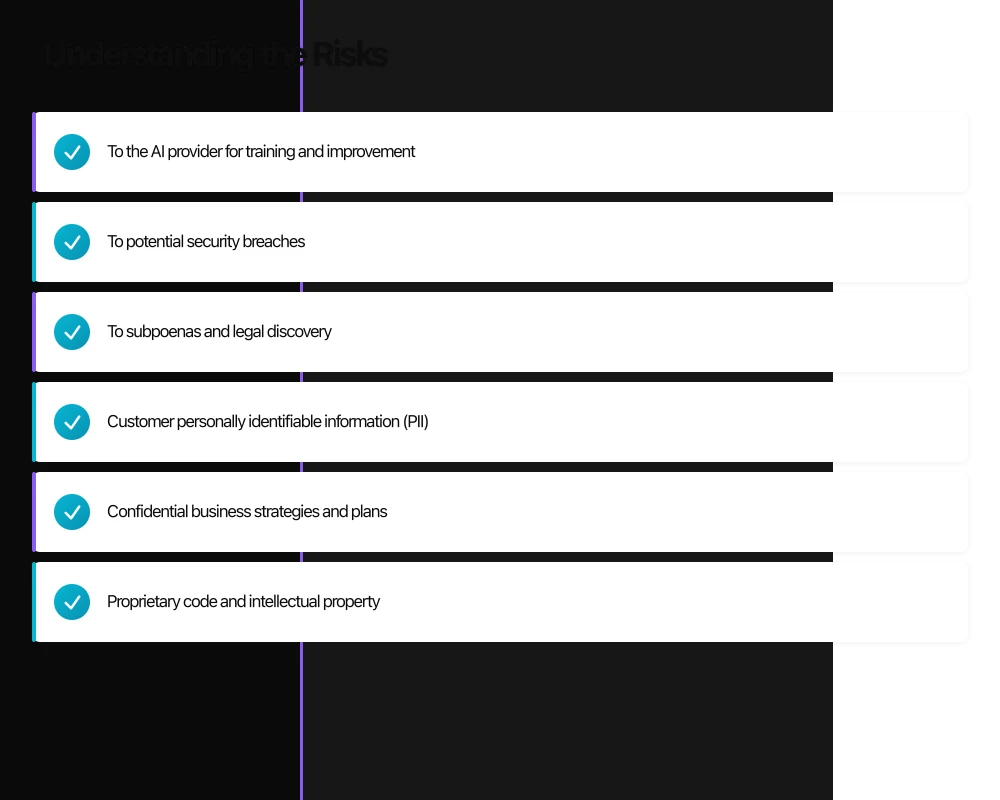
Public AI services like ChatGPT process user inputs on external servers. Anything entered becomes potentially accessible:
- To the AI provider for training and improvement
- To potential security breaches
- To subpoenas and legal discovery
What’s at Risk
- Customer personally identifiable information (PII)
- Confidential business strategies and plans
- Proprietary code and intellectual property
- Financial data and projections
- Employee personal information
- Legal and contractual documents
Real Consequences
Samsung banned ChatGPT after engineers uploaded proprietary source code. Law firms have faced sanctions for AI-generated citations that didn’t exist. These aren’t hypothetical risks—they’re happening now.
Output Quality and Accuracy
Hallucination Risk
Large language models confidently generate plausible-sounding content that is factually incorrect. They don’t “know” anything—they predict likely word sequences. This leads to:
- Fabricated citations and references
- Incorrect technical specifications
- Invented statistics and data points
- Plausible but wrong analysis
Verification Burden
Every AI output requires human verification. If employees don’t verify—or lack expertise to verify—errors propagate into business decisions, customer communications, and public content.
Compliance and Regulatory
Emerging Regulatory Landscape
AI regulation is developing rapidly:
- EU AI Act establishing risk-based requirements
- Industry-specific guidance emerging (financial services, healthcare)
- Existing regulations applying to AI outputs (advertising standards, professional liability)
Audit and Explainability
Decisions influenced by AI may require explanation:
- How was this recommendation generated?
- What data informed this analysis?
- Can we reproduce this output?
Black-box AI usage creates compliance exposure.
Intellectual Property
Input Concerns
Using copyrighted material in prompts may create liability. Using confidential third-party information violates agreements.
Output Concerns
Who owns AI-generated content? Current legal frameworks are unclear. Building business assets on uncertain IP foundations creates risk.
Building a Governance Framework
Principle 1: Enable Rather Than Block
Effective governance enables responsible use rather than attempting prohibition:
- Provide sanctioned alternatives to shadow AI
- Create clear guidelines for acceptable use
- Offer training on effective and safe usage
- Recognise that blocking drives underground usage
Principle 2: Risk-Based Approach
Not all AI use cases carry equal risk:
Lower Risk
- Drafting internal documents (with review)
- Brainstorming and ideation
- Learning and research
- Personal productivity assistance
Higher Risk
- Customer-facing content
- Code going to production
- Financial analysis and reporting
- Legal and compliance documents
- Anything involving personal data
Apply controls proportionate to risk level.
Principle 3: Human Accountability
AI doesn’t make decisions—humans do. Establish clear accountability:
- Humans review all AI outputs before use
- Humans are responsible for decisions, regardless of AI input
- Verification requirements match risk level
- No delegation of professional judgment to AI
Principle 4: Transparency
Be clear about AI usage:
- Internal awareness of AI-assisted work
- External disclosure where appropriate
- Audit trails for significant decisions
- Honest acknowledgment of capabilities and limitations
Practical Implementation
Acceptable Use Policy
Create a clear, practical policy covering:
What’s Permitted
- Sanctioned tools and platforms
- Approved use cases by category
- Data types that can be used with AI
- Verification requirements
What’s Prohibited
- Confidential data in public AI services
- Customer PII in any AI tool
- Unverified AI outputs in external communications
- Specific high-risk use cases
Grey Areas and Escalation
- How to get approval for unclear cases
- Who makes decisions on edge cases
- How policy evolves with learning
Example Policy Structure
| Data Type | Public AI (ChatGPT) | Enterprise AI (Azure OpenAI) |
|---|---|---|
| Public information | Permitted | Permitted |
| Internal documents | Prohibited | With approval |
| Customer data | Prohibited | Prohibited without controls |
| Source code | Prohibited | With security review |
Technology Controls
Enterprise AI Platforms
Consider enterprise-grade AI services that address security concerns:
- Azure OpenAI Service: Data isolation, compliance certifications
- AWS Bedrock: Recently launched, enterprise security features
- Google Cloud Vertex AI: Enterprise controls and compliance
These platforms offer:
- Data not used for model training
- Enterprise authentication and access control
- Audit logging and compliance features
- Data residency options
Access Management
- Provision AI access through existing identity systems
- Role-based access to different AI capabilities
- Logging of AI interactions for audit
- Integration with DLP and security tools
Training and Enablement
Technology controls alone are insufficient. Invest in training:
Awareness Training
- What generative AI is and isn’t
- Risks of inappropriate use
- Policy requirements and rationale
- How to report concerns
Effective Use Training
- Prompt engineering basics
- Getting better results from AI
- When AI helps vs. when it doesn’t
- Verification and quality practices
Role-Specific Training
- Developers: AI-assisted coding practices
- Marketing: Content generation guidelines
- Legal: Document drafting considerations
- Customer service: Appropriate AI assistance
Monitoring and Feedback
Usage Monitoring
Track AI adoption and usage patterns:
- Which tools are being used
- What use cases are emerging
- Where are policy questions arising
- What productivity gains are being realised
Incident Response
Plan for when things go wrong:
- Data exposure incidents
- Quality failures from AI outputs
- Compliance concerns
- Employee policy violations
Continuous Improvement
Governance should evolve:
- Regular policy review (quarterly at minimum)
- Incorporation of lessons learned
- Adjustment for new capabilities and risks
- Feedback loops from users
Organisational Considerations
Governance Structure
Who Owns AI Governance?
Cross-functional ownership works best:
- Technology: Platform and security
- Legal: Compliance and IP
- HR: Policy and training
- Business units: Use case ownership
Steering Committee
Establish a cross-functional body to:
- Set policy direction
- Review emerging use cases
- Resolve grey-area decisions
- Coordinate organisational response
Change Management
Communication
- Explain the “why” behind policies
- Acknowledge the value AI provides
- Be transparent about concerns
- Invite feedback and questions
Champions and Advocates
- Identify enthusiastic early adopters
- Enable them to share best practices
- Use them as feedback channels
- Build internal community of practice
Cultural Considerations
Innovation vs. Control Balance
Overly restrictive policies kill innovation and drive shadow IT. Overly permissive policies create unacceptable risk. Find the balance for your organisation’s risk tolerance and culture.
Learning Organisation
Treat early adoption as learning:
- Expect some missteps
- Create safe spaces to experiment
- Share learnings across the organisation
- Iterate policies based on experience
Vendor and Partner Considerations
Evaluating AI Vendors
When considering enterprise AI platforms:
Security and Compliance
- Where is data processed and stored?
- What compliance certifications exist?
- How is data isolated between customers?
- What audit capabilities are available?
Data Handling
- Is data used for model training?
- What retention policies apply?
- How is data encrypted?
- What happens upon contract termination?
Operational Reliability
- What availability SLAs are offered?
- What support is available?
- How are model updates handled?
- What change notification is provided?
Managing AI in Supply Chain
Your vendors are adopting AI too. Consider:
- How are vendors using AI in services to you?
- What data are they exposing to AI?
- What controls do they have?
- What liability exists for AI-generated errors?
Update vendor assessments and contracts to address AI usage.
Measuring Success
Adoption Metrics
- Percentage of employees using sanctioned AI tools
- Reduction in shadow AI usage
- Use cases enabled across business functions
- Training completion rates
Risk Metrics
- Policy violations identified
- Security incidents related to AI
- Quality issues from AI-generated content
- Compliance concerns raised
Value Metrics
- Productivity improvements measured
- Time saved on specific tasks
- Quality improvements where applicable
- Employee satisfaction with AI tools
Governance Health
- Policy awareness levels
- Questions and escalations (indicates engagement)
- Time to resolve grey-area decisions
- Policy evolution frequency
Looking Ahead
Near-Term Developments
The generative AI landscape is evolving rapidly:
- New capabilities emerging continuously
- Enterprise offerings maturing
- Regulatory clarity developing
- Best practices solidifying
Governance frameworks must be adaptive, not static.
Strategic Positioning
Organisations that develop strong AI governance now will be positioned to:
- Adopt new capabilities faster and safer
- Build institutional expertise
- Establish competitive advantages
- Navigate regulatory requirements
Conclusion
Generative AI adoption is not optional—it’s happening regardless of policy. The choice is whether adoption is chaotic and risky or governed and valuable.
Effective governance enables rather than blocks:
- Clear policies that employees can follow
- Technology platforms that address security concerns
- Training that builds capability and awareness
- Monitoring that catches problems early
The organisations that figure this out gain sustainable advantages. Those that don’t face either the risks of ungoverned adoption or the opportunity cost of blocked innovation.
Start building your governance framework now. The technology isn’t waiting.
Sources
- Gartner. (2023). Gartner Survey Reveals 70% of Workers Have Experimented with Generative AI. Gartner Research. https://www.gartner.com/en/newsroom/press-releases/generative-ai-survey
- OpenAI. (2023). Enterprise Privacy at OpenAI. OpenAI. https://openai.com/enterprise-privacy
- Microsoft. (2023). Data, Privacy, and Security for Azure OpenAI Service. Microsoft Learn. https://learn.microsoft.com/en-us/legal/cognitive-services/openai/data-privacy
- World Economic Forum. (2023). Responsible AI: A Global Policy Framework. WEF. https://www.weforum.org/publications/responsible-ai-global-policy-framework
- NIST. (2023). AI Risk Management Framework. National Institute of Standards and Technology. https://www.nist.gov/itl/ai-risk-management-framework
Strategic guidance for enterprise technology leaders navigating the AI transformation.
Turning mobile strategy into a shipped app? Awesome Apps covers Flutter, React Native, and native development for Australian businesses.
Ash Ganda is the founder of Ganda Tech Services, a Sydney-based technology consultancy delivering cloud, web, and mobile solutions for Australian businesses.
About the Author
Ashish Ganda is the founder of Ganda Tech Services, a Sydney-based technology consultancy specialising in cloud infrastructure, web development, and mobile app solutions for Australian businesses.
AI Strategy Primer for Australian Business Leaders
A practical framework for AI adoption in 2026 — cut through the hype and start with what matters.