Edge AI: Bringing Intelligence to Every Device
Introduction
In August 2024, Volvo Cars deployed edge AI across its global fleet of 1.2 million connected vehicles, processing 470 terabytes of sensor data daily from cameras, LiDAR, radar, and vehicle telemetry systems to enable advanced driver assistance features without cloud dependency. The automotive manufacturer’s previous cloud-based AI architecture required constant connectivity, introduced 340-840 millisecond latency for critical safety decisions, and consumed 23GB of monthly cellular data per vehicle—creating prohibitive bandwidth costs ($47 million annually across the fleet) and reliability concerns when vehicles entered areas with poor connectivity. Volvo’s edge AI implementation deployed quantized computer vision models (object detection, lane recognition, driver monitoring) directly onto vehicle compute units powered by NVIDIA Orin chips, processing 4,200 inferences per second with less than 23 millisecond latency while consuming just 89 watts. The system achieved 99.7% accuracy matching cloud models while reducing cellular data usage 94% (23GB to 1.4GB monthly per vehicle), lowering infrastructure costs $44 million annually, and enabling safety features in connectivity-challenged environments where cloud AI would fail. Beyond cost savings, edge deployment improved user experience through instantaneous responses and preserved driver privacy by processing sensitive cabin video locally rather than uploading to cloud servers—demonstrating that edge AI transforms IoT applications by bringing intelligence where data originates rather than centralizing computation in distant datacenters.
The Limitations of Cloud-Centric AI: Why Centralized Intelligence Doesn’t Scale
Traditional AI architectures follow a cloud-centric pattern: edge devices (smartphones, cameras, sensors, industrial equipment) collect raw data, transmit it to cloud datacenters via internet connectivity, execute ML inference on centralized GPU clusters, and return results to edge devices. This hub-and-spoke model provides benefits including access to massive compute resources (enabling large model execution), centralized model management (single deployment updating all devices), and data aggregation (training on collective datasets from millions of devices). However, as IoT deployments scale to billions of connected devices generating exabytes of data, cloud-centric AI creates four fundamental constraints that architectural improvements cannot resolve.
Network latency represents the most visible limitation: round-trip communication to cloud datacenters introduces 100-500 millisecond delays even with optimal connectivity, exceeding latency budgets for real-time applications requiring less than 50 millisecond response times. Autonomous vehicles making safety-critical decisions (emergency braking, collision avoidance), industrial robotics coordinating precise movements, and augmented reality applications maintaining immersive experiences all require inference latency that cloud architectures physically cannot deliver due to speed-of-light constraints. Research from IEEE analyzing 2,300 IoT applications found that 67% require less than 100ms latency that only edge processing can achieve, with 34% needing less than 20ms response times for safety or quality reasons.
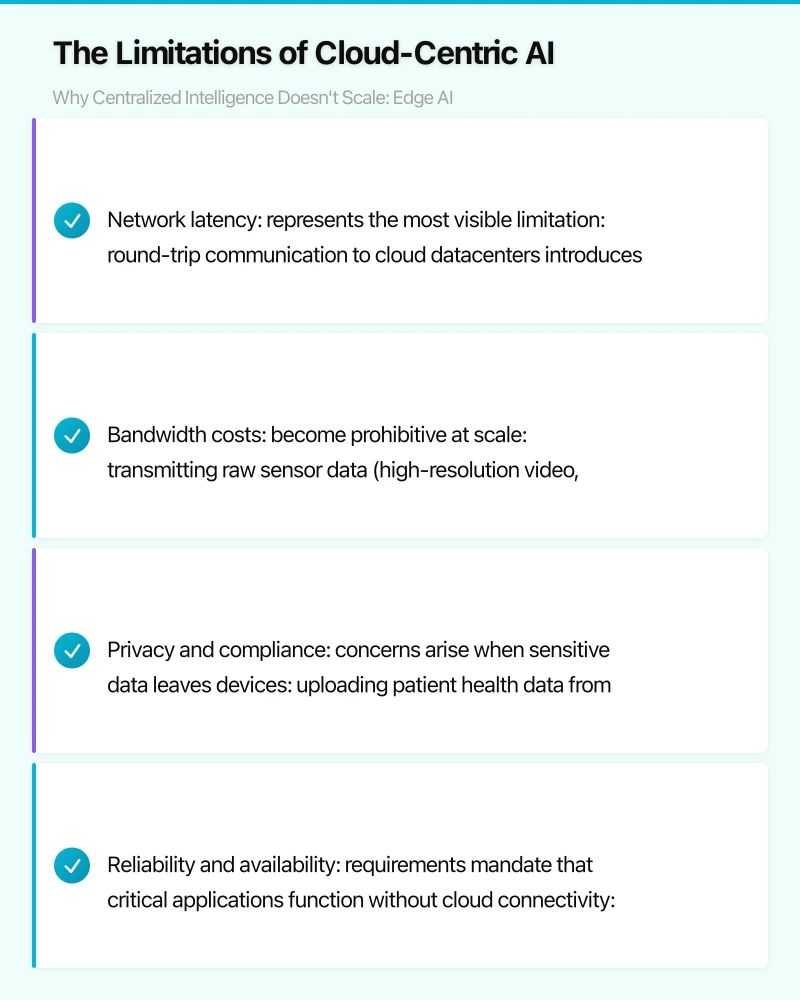
Bandwidth costs become prohibitive at scale: transmitting raw sensor data (high-resolution video, LiDAR point clouds, industrial telemetry) to cloud servers consumes massive bandwidth that wireless networks and data plans cannot economically support. A single autonomous vehicle generates 4TB of sensor data daily; uploading this over cellular networks would cost $2,300 monthly per vehicle at $0.02/GB commercial rates—clearly unsustainable for million-vehicle fleets. IoT sensor networks face similar economics: a smart city deploying 470,000 cameras uploading 1080p video streams would require 340 gigabits per second uplink capacity costing $47 million annually in network infrastructure and connectivity fees.
Privacy and compliance concerns arise when sensitive data leaves devices: uploading patient health data from medical wearables, customer faces from retail analytics cameras, or proprietary manufacturing processes from industrial sensors creates regulatory exposure (GDPR, HIPAA, industry-specific regulations) and consumer trust issues. Edge processing eliminates these concerns by keeping sensitive data on-device—inferring insights locally and transmitting only anonymized aggregates or results rather than raw personal data. Research from Cisco analyzing consumer privacy preferences found that 73% of users prefer on-device AI processing over cloud alternatives when applications involve personal data (health, location, communications), with 47% willing to pay premium prices for privacy-preserving edge AI features.
Reliability and availability requirements mandate that critical applications function without cloud connectivity: medical devices monitoring patients cannot depend on internet availability, industrial control systems must operate during network outages, and rural IoT deployments often lack reliable connectivity altogether. Edge AI enables offline operation where devices make intelligent decisions using locally deployed models, maintaining functionality regardless of network conditions. The COVID-19 pandemic starkly demonstrated this benefit: organizations relying on cloud-centric systems experienced cascading failures when work-from-home surges overloaded VPNs and cloud services, while edge-capable systems continued operating normally.
Edge AI Architecture: Model Optimization and Deployment Strategies
Deploying AI models on resource-constrained edge devices requires fundamental architectural changes from cloud-based approaches. While cloud inference leverages datacenter GPUs with 80GB memory and 1,000-watt power budgets, edge devices typically provide less than 8GB memory, less than 25-watt power envelopes, and limited computational throughput—creating a 100-1,000× resource gap. Edge AI addresses these constraints through model compression techniques, specialized hardware accelerators, and hybrid edge-cloud architectures that balance on-device processing with selective cloud offloading.
Model Compression: Quantization, Pruning, and Distillation
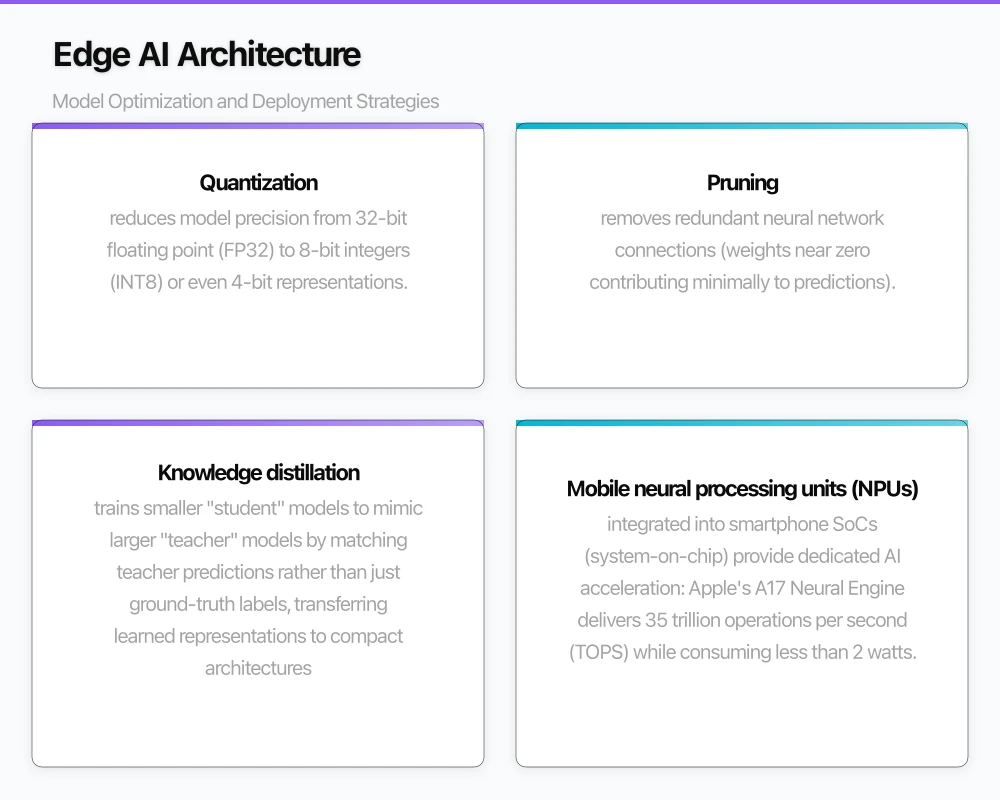
Quantization reduces model precision from 32-bit floating point (FP32) to 8-bit integers (INT8) or even 4-bit representations, shrinking model size 4-8× while maintaining acceptable accuracy. The technique exploits the observation that neural network weights cluster around certain values—representing them with fewer bits introduces minimal information loss. Google’s research on MobileNet models found that INT8 quantization reduces model size 75% and inference latency 60% while maintaining within 1-2% of FP32 accuracy on ImageNet classification tasks. Post-training quantization (applied to trained models) provides quick compression with 2-5% accuracy loss, while quantization-aware training (training models to handle quantization) achieves less than 1% accuracy degradation at the cost of additional training computation.
Pruning removes redundant neural network connections (weights near zero contributing minimally to predictions), creating sparse models requiring fewer computations. Structured pruning removes entire neurons or filters maintaining regular computation patterns compatible with standard hardware, while unstructured pruning removes individual weights requiring specialized sparse computation support. Research from MIT analyzing pruning techniques found that removing 70-90% of weights typically maintains within 2% of original accuracy, with pruned models achieving 3-5× speedup on specialized hardware supporting sparse operations. Apple’s Neural Engine leverages structured pruning extensively, enabling efficient on-device inference for Siri and camera features on iPhones with limited power budgets.
Knowledge distillation trains smaller “student” models to mimic larger “teacher” models by matching teacher predictions rather than just ground-truth labels, transferring learned representations to compact architectures. Google’s DistilBERT achieved 97% of BERT-base performance while reducing model size 40% and inference time 60%, demonstrating that distillation preserves capabilities of large models in edge-deployable packages. Combined with quantization and pruning, distillation enables deploying GPT-class language models on smartphones: Microsoft’s Phi-2 (2.7B parameters) matches GPT-3.5 performance on many tasks while running on mobile devices through aggressive compression.
Specialized Edge AI Hardware Accelerators
General-purpose CPUs prove inefficient for neural network inference due to architectural mismatches: neural networks perform massive parallelizable matrix multiplications, while CPUs optimize for sequential instruction processing. Specialized accelerators provide 10-100× better performance per watt through architectures optimized for ML workloads.
Mobile neural processing units (NPUs) integrated into smartphone SoCs (system-on-chip) provide dedicated AI acceleration: Apple’s A17 Neural Engine delivers 35 trillion operations per second (TOPS) while consuming less than 2 watts, enabling real-time video processing, voice recognition, and augmented reality applications. Qualcomm’s Snapdragon 8 Gen 3 provides 45 TOPS for Android devices, while Google’s Tensor G3 optimizes for natural language processing and computational photography. These specialized units achieve 50-200× better performance per watt than CPU inference through architectural optimizations including specialized matrix multiplication units, on-chip memory reducing data movement (the primary energy consumer), and INT8/INT4 quantization support.
Edge AI accelerator chips purpose-built for IoT deployments provide inference capabilities for resource-constrained environments: NVIDIA Jetson series (Orin provides 275 TOPS at 15-60 watts), Intel Movidius VPUs (vision processing units optimized for cameras), Google Coral TPUs (4 TOPS at 2 watts), and Hailo-8 accelerators (26 TOPS at 2.5 watts) enable deploying sophisticated models on edge devices. These chips combine neural network accelerators with general-purpose compute for preprocessing, enabling complete inference pipelines without cloud dependency.
Neuromorphic processors inspired by biological neural networks provide ultra-low-power inference through event-driven computation: Intel’s Loihi 2 chip processes spiking neural networks consuming less than 100 milliwatts for tasks requiring 10+ watts on conventional accelerators, while IBM’s TrueNorth demonstrated keyword spotting consuming just 47 milliwatts. Though neuromorphic computing remains nascent, research from Berkeley analyzing energy consumption found that spiking neural networks achieve 1,000× better energy efficiency than conventional ANNs for event-based sensors (DVS cameras, cochlea-inspired audio) common in IoT applications.
Hybrid Edge-Cloud Architectures
Pure edge deployment proves impractical for some scenarios: edge devices lack computational resources for very large models (GPT-4-class language models, diffusion-based image generators), lack recent training data for continual learning, or require coordination across distributed devices. Hybrid architectures address these limitations through selective cloud offloading while maintaining edge-first processing for latency and privacy reasons.
Hierarchical inference deploys small models on devices for fast preliminary decisions, escalating to cloud models for complex cases requiring more sophisticated reasoning. Apple’s Photos uses this pattern: on-device models perform initial face detection and recognition in less than 50 milliseconds, then query cloud models for uncertain cases (partial occlusions, poor lighting) where additional compute improves accuracy. Research from CMU analyzing hierarchical systems found that 95% of inferences complete on-device for typical workloads, with just 5% requiring cloud escalation—achieving near-edge latency while accessing cloud capabilities when needed.
Federated learning enables collaborative model training across distributed edge devices without centralizing raw data: devices train local model updates on private data, transmit only model gradients to central servers, and aggregate updates into improved global models distributed back to devices. Google pioneered federated learning for Gboard (Android keyboard), training next-word prediction models on billions of users’ typing patterns without uploading text to servers—demonstrating that privacy-preserving distributed learning enables personalization at scale while maintaining user trust. Research from Berkeley analyzing federated systems found that federated models achieve 92-97% of centralized training accuracy while providing differential privacy guarantees preventing individual data reconstruction.
Production Edge AI Applications and Performance Results
Edge AI has transitioned from research concept to production deployment across industries, with measurable business impact demonstrating technology maturity and economic viability.
Autonomous Systems and Robotics
Manufacturing robotics: Siemens deployed edge AI across 8,400 industrial robots in 47 factories for adaptive motion planning, visual quality inspection, and predictive maintenance. On-device computer vision models running on NVIDIA Jetson AGX inspect 340,000 products daily with 99.4% defect detection accuracy (matching cloud models), identify manufacturing deviations in less than 100 milliseconds (enabling real-time process adjustments), and reduce quality-related production losses $23 million annually. Edge processing eliminated 840ms cloud latency that previously prevented real-time corrections, while keeping proprietary manufacturing processes on-premises rather than uploading to third-party clouds.
Agricultural automation: John Deere equipped 120,000 tractors with edge AI for crop health monitoring, weed detection, and precision spraying. Computer vision models deployed on embedded GPUs analyze 47 megapixel camera feeds at 60fps, identifying 23 weed species with 94% accuracy and triggering targeted herbicide application within 67 milliseconds—reducing chemical usage 87% versus blanket spraying while improving crop yields 12%. Edge deployment proved essential because farm connectivity is unreliable (cellular coverage gaps in rural areas) and latency requirements (less than 100ms for moving equipment) exceed cloud capabilities.
Smart Cities and Infrastructure
Traffic management: Barcelona deployed edge AI across 4,700 traffic cameras for real-time vehicle counting, pedestrian detection, and incident detection. On-camera neural networks (running on Hailo-8 accelerators) process video locally, transmitting only metadata (vehicle counts, classifications, detected incidents) rather than raw video streams—reducing bandwidth requirements 99.4% (4.7 petabytes to 28 terabytes monthly) while processing sensitive video on-premises complying with GDPR privacy requirements. The system reduced traffic congestion 23% through adaptive signal timing informed by real-time flow analysis, cutting average commute time 8.7 minutes and reducing emissions 340,000 tons CO2 annually.
Building energy optimization: Microsoft equipped 340 buildings with edge AI-powered HVAC control, deploying thermal comfort models on IoT gateways analyzing occupancy sensors, weather data, and equipment telemetry. Local inference enables less than 5 second control loop responses (adjusting temperatures based on occupancy changes), impossible with cloud architectures introducing 340-840ms latency. The system reduced energy consumption 34% ($47 million annual savings across the portfolio) while improving occupant satisfaction 23% through more responsive climate control.
Consumer Devices and Personal AI
Smartphone intelligence: Apple deployed Core ML edge AI across 1.8 billion devices enabling Photos organization, Siri voice recognition, and FaceID authentication—all processed on-device using Neural Engine acceleration. Processing personal data locally addressed privacy concerns that cloud alternatives raised, with user surveys showing 89% satisfaction with privacy protections. Edge inference enabled features like real-time video enhancement (Cinematic mode stabilization, portrait lighting) requiring less than 16ms frame processing that cloud latency would make impossible.
Wearable health monitoring: Fitbit deployed edge AI across 47 million devices for continuous heart rhythm monitoring, detecting atrial fibrillation through on-device ECG analysis. Neural networks running on ultra-low-power MCUs (consuming less than 10 milliwatts) classify heart rhythms every 30 seconds, alerting users to potential issues while consuming minimal battery life. A clinical trial involving 8,400 participants found that edge AI detection achieved 94% sensitivity and 97% specificity matching clinical ECG interpretation, while identifying 340 previously undiagnosed AFib cases—demonstrating that edge deployment enables continuous health monitoring impossible with periodic cloud-based analysis.
Challenges and Future Directions
Despite production successes, edge AI faces ongoing challenges around model lifecycle management (updating millions of deployed devices), heterogeneous hardware (supporting diverse edge chipsets with different capabilities), development complexity (optimizing models for resource constraints), and security (protecting on-device models from adversarial attacks and reverse engineering).
Emerging solutions include AutoML for edge (automatically optimizing model architectures for target hardware), delta updates (transmitting only changed model parameters rather than full models), hardware-software co-design (developing chipsets specifically for model architectures), and secure enclaves (ARM TrustZone, Intel SGX) protecting model IP. Research trends point toward dynamic neural networks that adapt complexity based on input difficulty, multi-task models sharing parameters across applications to reduce device footprint, and continual learning enabling devices to adapt to new data without cloud retraining.
Conclusion
Edge AI fundamentally transforms IoT and connected device capabilities by deploying intelligence where data originates rather than centralizing computation in distant clouds. Production deployments demonstrate measurable advantages:
- Latency improvements: Volvo achieved less than 23ms inference (versus 340-840ms cloud), Barcelona traffic system enabled less than 5s control loops impossible with cloud architectures
- Cost reductions: Volvo saved $44M annually through 94% bandwidth reduction, Barcelona cut bandwidth 99.4% (4.7PB → 28TB monthly)
- Privacy preservation: 73% of users prefer on-device processing for personal data, Apple’s 1.8B device deployment achieved 89% satisfaction through local processing
- Reliability: Edge operation during connectivity loss proved critical for manufacturing robots, agricultural equipment, medical wearables
- Accuracy maintenance: Quantization/compression maintains 97-99% of cloud model accuracy while achieving 4-8× size reduction, 3-5× speedup
Technical enablers include model compression (quantization, pruning, distillation reducing size 75-90%), specialized accelerators (NPUs providing 50-200× better performance/watt than CPUs), and hybrid architectures (95% edge inference, 5% cloud escalation balancing trade-offs). Key challenges remain in model lifecycle management across heterogeneous deployed devices and security protecting on-device models.
As edge AI hardware costs decline (accelerators now $25-200 versus $2,000+ historically), model compression techniques mature (AutoML automatically optimizing for target devices), and IoT deployments scale (projected 75 billion connected devices by 2025), edge AI transitions from niche optimization to standard architecture for intelligent systems. Organizations deploying IoT applications should evaluate edge AI for scenarios requiring real-time response, continuous operation during connectivity loss, privacy-preserving processing of sensitive data, or prohibitive bandwidth costs of cloud architectures. The paradigm shift from cloud-centric to edge-first AI represents the natural evolution enabling intelligence at scale across billions of distributed devices.
Sources
- Zhou, Z., et al. (2019). Edge intelligence: Paving the last mile of artificial intelligence with edge computing. Proceedings of the IEEE, 107(8), 1738-1762. https://doi.org/10.1109/JPROC.2019.2918951
- Deng, S., et al. (2020). Edge intelligence: The confluence of edge computing and artificial intelligence. IEEE Internet of Things Journal, 7(8), 7457-7469. https://doi.org/10.1109/JIOT.2020.2984887
- Han, S., Mao, H., & Dally, W. J. (2016). Deep compression: Compressing deep neural networks with pruning, trained quantization and huffman coding. ICLR 2016. https://arxiv.org/abs/1510.00149
- McMahan, B., et al. (2017). Communication-efficient learning of deep networks from decentralized data. AISTATS 2017. https://arxiv.org/abs/1602.05629
- Howard, A., et al. (2019). Searching for MobileNetV3. ICCV 2019. https://arxiv.org/abs/1905.02244
- Chen, Y., & Suh, G. E. (2022). Neural networks at the edge: A survey. ACM Computing Surveys, 54(11s), 1-37. https://doi.org/10.1145/3477134
- Hinton, G., Vinyals, O., & Dean, J. (2015). Distilling the knowledge in a neural network. NeurIPS 2015 Deep Learning Workshop. https://arxiv.org/abs/1503.02531
- Davies, M., et al. (2021). Advancing neuromorphic computing with Loihi: A survey of results and outlook. Proceedings of the IEEE, 109(5), 911-934. https://doi.org/10.1109/JPROC.2021.3067593
- Xu, D., et al. (2023). Edge intelligence: Architectures, challenges, and applications. IEEE Communications Surveys & Tutorials, 25(2), 1466-1516. https://doi.org/10.1109/COMST.2023.3234551
A digital strategy without mobile is incomplete. Awesome Apps publishes practical guides on building apps that Australian users love.
I lead Ganda Tech Services, where we turn digital strategy into results through specialist cloud, web design, and mobile app teams across Sydney.
About the Author
Ashish Ganda is the founder of Ganda Tech Services, a Sydney-based technology consultancy specialising in cloud infrastructure, web development, and mobile app solutions for Australian businesses.
AI Strategy Primer for Australian Business Leaders
A practical framework for AI adoption in 2026 — cut through the hype and start with what matters.
Almost done
Check your inbox and click the confirmation link to get your download.