Data Mesh Architecture: A New Paradigm for Enterprise Data
Introduction
For the past decade, enterprises have pursued a familiar pattern in data architecture: consolidate data from operational systems into a centralized platform—a data warehouse, data lake, or increasingly, a lakehouse—where it can be transformed, analyzed, and served to the business. This centralized approach, while logical in theory, has consistently underdelivered in practice.
Data lakes have become data swamps. Centralized data teams have become bottlenecks. Time-to-insight remains measured in months rather than days. And perhaps most critically, data quality issues persist because those who create data are divorced from those who consume it.
Zhamak Dehghani’s articulation of “data mesh” in 2019—building on work at ThoughtWorks—offers a fundamentally different approach. Data mesh applies domain-driven design principles to data architecture, distributing data ownership to domain teams while maintaining interoperability through federated governance. For enterprise technology leaders, understanding data mesh is essential for evaluating whether this paradigm shift can address the persistent challenges of enterprise data management.
The Failure of Centralized Data Architecture
The Data Lake Promise
The data lake concept emerged around 2010 as a response to data warehouse limitations. Rather than requiring upfront schema design and ETL development, data lakes promised to store all data in its native format, enabling schema-on-read flexibility and reducing time-to-value.
The reality proved more challenging:
Data Swamp Syndrome: Without governance, data lakes accumulate data with unclear provenance, inconsistent quality, and unknown relevance. Users cannot find what they need or trust what they find.
ETL Bottlenecks: Despite schema-on-read promises, meaningful analysis still requires data transformation. Centralized data engineering teams become bottlenecks, with transformation request backlogs measured in months.
Organizational Disconnect: Centralized data teams lack domain context. They understand data formats but not business semantics. Domain experts who understand the data are separated from the systems that serve it.
The Scaling Problem
Centralized data architecture doesn’t scale with organizational complexity:
Linear Team Scaling: As an organization adds domains and use cases, the centralized data team must grow proportionally. This creates hiring challenges and coordination overhead.
Context Switching: Data engineers supporting multiple domains must constantly context-switch, never developing deep domain expertise.
Coupling: Centralized pipelines create coupling between domains. A change in one domain’s source system can break pipelines serving unrelated consumers.
The Quality Problem
Data quality remains the persistent challenge of enterprise data:
Producer-Consumer Gap: Those who produce data (operational systems, domain teams) are disconnected from those who consume it (analytics, data science). This gap makes quality feedback loops slow and ineffective.
Lack of Ownership: In centralized models, data ownership is unclear. Is the domain team responsible because they produce the data? Is the data team responsible because they transform it? Ambiguous ownership means no one is truly accountable.
Technical Debt Accumulation: Centralized pipelines accumulate technical debt as quick fixes address immediate needs without addressing root causes.
Data Mesh: Core Principles
Zhamak Dehghani’s data mesh framework rests on four foundational principles:
1. Domain-Oriented Decentralized Data Ownership
Data mesh distributes data ownership to the domains that understand it best. Rather than a centralized data team extracting and transforming data from domains, domain teams own and serve their data as products.
This mirrors the shift from centralized IT to distributed product teams that has transformed software development. Just as product teams own their services end-to-end, domain teams in a data mesh own their data end-to-end.
Key Implications:
- Domain teams include data engineering capabilities
- Data ownership aligns with business domain boundaries
- Domain teams are accountable for data quality
- Reduced bottlenecks and faster time-to-value
2. Data as a Product
Data mesh treats data as a product with consumers, quality standards, and service level objectives. Domain teams don’t just produce data as a byproduct; they deliberately serve data products to organizational consumers.
Data products exhibit characteristics of well-designed software products:
Discoverable: Data products are registered in catalogs, with clear descriptions of content, schema, and usage guidelines.
Addressable: Data products have stable, well-documented interfaces (APIs, SQL endpoints, event streams) that consumers can rely upon.
Trustworthy: Data products have documented quality metrics, SLAs, and ownership information. Consumers can assess fitness for purpose.
Self-Describing: Data products include schema definitions, semantic metadata, and documentation that enable consumer understanding.
Interoperable: Data products conform to organizational standards that enable cross-domain analysis and joining.
Secure: Data products implement access controls aligned with organizational data governance policies.
3. Self-Serve Data Infrastructure as a Platform
While data ownership is distributed, infrastructure should be centralized. A self-serve data platform provides domain teams with the capabilities they need to build, deploy, and operate data products without requiring deep infrastructure expertise.
The platform provides:
Data Product Development Tools: Frameworks, templates, and tooling for building data products according to organizational standards.
Data Storage and Compute: Scalable storage and processing capabilities that domain teams consume without managing infrastructure.
Data Catalog and Discovery: Centralized registration and discovery of data products across domains.
Access Control and Policy Enforcement: Automated enforcement of data governance policies.
Monitoring and Observability: Visibility into data product health, quality, and usage.
This platform is analogous to internal developer platforms in the DevOps world—it abstracts infrastructure complexity while enabling team autonomy.
4. Federated Computational Governance
Data mesh doesn’t abandon governance; it transforms it. Rather than centralized enforcement by a data team, governance becomes a federated function with global standards and local implementation.
Global Interoperability Standards: Organization-wide standards for data formats, metadata, and interfaces enable cross-domain data combination.
Automated Policy Enforcement: Governance policies are encoded in the platform and enforced automatically, rather than through manual review.
Domain Team Accountability: Domain teams are accountable for compliance with governance standards, with platform-provided tooling to support compliance.
Collaborative Evolution: Governance standards evolve collaboratively, with domain teams contributing to standards that serve organizational needs.
Data Mesh in Practice
Organizational Implications
Implementing data mesh requires organizational change:
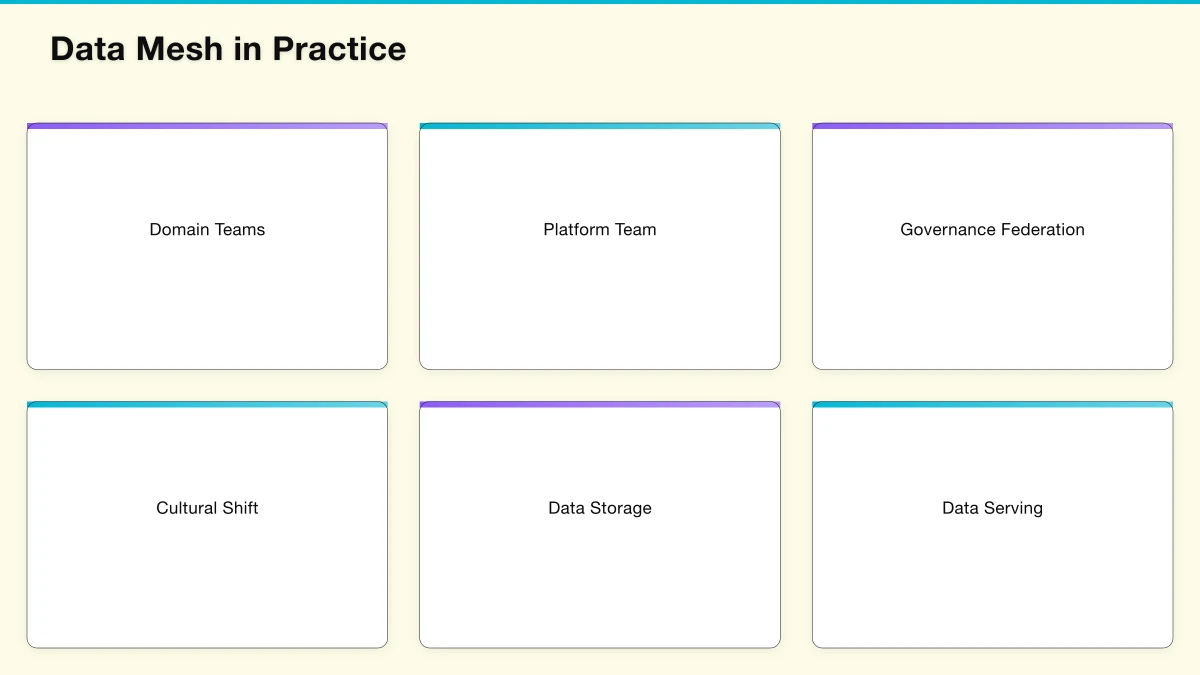
Domain Teams: Domain teams must include data engineering capabilities. This might involve embedding data engineers in domain teams, upskilling existing team members, or both.
Platform Team: A dedicated platform team provides and operates the self-serve data infrastructure. This team serves domain teams as internal customers.
Governance Federation: A federated governance function—potentially a guild or community of practice—establishes and evolves organizational standards.
Cultural Shift: Data mesh requires cultural change. Domain teams must view data as a product, not a byproduct. Quality accountability must be internalized.
Technology Implications
Data mesh is technology-agnostic but has infrastructure implications:
Data Storage: Each domain manages its own data storage, though the platform typically provides standardized storage options (data lakes, warehouses, databases).
Data Serving: Domains expose data through well-defined interfaces—APIs, SQL endpoints, event streams, file-based exchanges—depending on use case requirements.
Metadata Management: A centralized data catalog (tools like Alation, Collibra, or open-source alternatives like Apache Atlas) enables discovery across distributed data products.
Data Quality: Domain teams implement data quality monitoring, often using tools like Great Expectations, Deequ, or custom solutions.
Orchestration: Data pipeline orchestration (Airflow, Dagster, Prefect) is provided by the platform but managed by domain teams for their products.
Implementation Patterns
Organizations implementing data mesh typically follow patterns:
Start with High-Value Domains: Begin with domains that have clear data products, engaged stakeholders, and manageable complexity. Success builds momentum.
Platform Evolution: The self-serve platform evolves incrementally. Start with basic capabilities and expand based on domain team needs.
Gradual Migration: Existing centralized assets don’t disappear overnight. New data products implement mesh principles while existing assets are migrated gradually.
Measure Outcomes: Track metrics including time-to-insight, data quality, consumer satisfaction, and domain team autonomy to validate the approach.
Challenges and Considerations
When Data Mesh Fits
Data mesh addresses specific challenges:
Organizational Scale: Data mesh suits large organizations with multiple domains and complex data landscapes. Small organizations may not benefit from distributed ownership overhead.
Domain Complexity: Data mesh suits environments where domain expertise matters. If data is generic and domains are simple, centralization may remain efficient.
Bottleneck Pain: Data mesh addresses central team bottlenecks. If centralized approaches are working, changing paradigms may not be justified.
Implementation Challenges
Organizations face predictable challenges:
Skills Distribution: Data engineering skills must be distributed across domains. This requires hiring, training, and potentially organizational restructuring.
Platform Investment: Building a self-serve data platform requires significant investment. Premature investment in platform capabilities wastes resources.
Governance Complexity: Federated governance is harder than centralized governance. Achieving consistency without bureaucracy requires sophisticated approaches.
Interoperability: Enabling cross-domain analysis while maintaining domain autonomy creates tension. Interoperability standards must be robust without being constraining.
Cultural Change: Shifting from data as byproduct to data as product requires cultural evolution. Resistance should be expected and addressed.
Avoiding Common Mistakes
Organizations should avoid:
Technology-First Thinking: Data mesh is primarily organizational, not technological. Starting with technology rather than organizational design leads to failure.
Premature Optimization: Over-investing in platform capabilities before domain teams articulate needs wastes resources and creates shelfware.
Governance Abdication: Distributing ownership doesn’t mean abandoning governance. Insufficient governance leads to chaos; excessive governance recreates centralized bottlenecks.
All-or-Nothing Thinking: Data mesh can coexist with centralized capabilities. Pragmatic organizations implement mesh principles where they add value without dogmatic purity.
Strategic Considerations for CTOs
Assessing Fit
CTOs should evaluate data mesh fit based on:
Current Pain Points: Are central team bottlenecks limiting data-driven initiatives? Is data quality suffering from ownership gaps? Is time-to-insight unacceptable?
Organizational Readiness: Can domain teams absorb data engineering responsibilities? Is there executive sponsorship for organizational change?
Strategic Alignment: Does data mesh align with broader organizational direction toward autonomous teams and distributed ownership?
Investment Considerations
Data mesh requires sustained investment:
Platform Team: A capable platform team is essential. Underinvesting in platform capabilities leaves domain teams unsupported.
Domain Team Expansion: Domain teams need data engineering capabilities. This means hiring, training, or restructuring.
Governance Evolution: Federated governance requires thoughtful design and ongoing attention.
Technology Infrastructure: While technology isn’t the primary investment, data catalog, quality monitoring, and infrastructure capabilities require funding.
Measuring Success
Success metrics for data mesh include:
Time-to-Value: How long from data need identification to production data product?
Data Quality: Are quality metrics improving? Are consumer complaints decreasing?
Consumer Satisfaction: Do data consumers find what they need? Can they trust what they find?
Domain Team Autonomy: Can domain teams iterate on data products without central team dependencies?
Conclusion
Data mesh represents a significant evolution in enterprise data architecture thinking. By applying principles from domain-driven design and platform engineering to data, it addresses fundamental challenges that have plagued centralized approaches.
Yet data mesh is not a silver bullet. It requires organizational change, sustained investment, and cultural evolution. It’s not appropriate for every organization, and implementation challenges are real.
For CTOs evaluating data mesh, the key questions are not about technology but about organizational readiness, strategic alignment, and willingness to invest in transformation. Organizations that answer these questions affirmatively—and commit to the journey—may find data mesh enables the data-driven capabilities that centralized approaches have long promised but rarely delivered.
The data mesh paradigm is still young, and practices continue to evolve. Organizations embarking on this path should expect to learn, adapt, and contribute to the emerging body of knowledge. The destination—truly data-driven enterprises with high-quality, accessible, trustworthy data—remains worth pursuing.
Is your organization evaluating data mesh? I’d welcome the opportunity to discuss approaches and share perspectives. Reach out to continue the conversation.
For hands-on guidance on cloud migration and managed IT, my team at Cloud Geeks helps Australian businesses implement these strategies.
As founder of Ganda Tech Services, I work with Australian businesses to align technology investments with business growth — across cloud, web, and mobile.
About the Author
Ashish Ganda is the founder of Ganda Tech Services, a Sydney-based technology consultancy specialising in cloud infrastructure, web development, and mobile app solutions for Australian businesses.
Digital Transformation Roadmap 2026
A 12-month framework for Australian SMBs ready to modernise — phases, tools, and milestones.
Almost done
Check your inbox and click the confirmation link to get your download.