
Data Analytics Trends 2024: What You Need to Know to Stay Ahead
Introduction
A Fortune 500 executive recently asked her analytics team a simple question: “Why are our customers churning in the Northeast region?” Ten years ago, answering this would have required weeks of SQL queries, data warehouse extracts, and analyst reports. In 2024, she typed that exact question into her company’s natural language analytics tool and received a detailed answer—with visualizations—in 15 seconds.
The data analytics landscape has transformed more in the past 24 months than in the previous decade. According to Gartner’s 2024 analytics survey, 87% of enterprises now consider data analytics “critical” or “very critical” to business strategy—up from 58% in 2022. But what’s truly revolutionary isn’t just the increased importance; it’s how dramatically the tools, techniques, and possibilities have evolved.
Research from McKinsey shows organizations at the forefront of analytics adoption achieve 2.5x higher revenue growth and 4x better customer retention than analytics laggards. The competitive advantage once measured in months now compresses to days or hours. Understanding these trends isn’t just about staying current—it’s about organizational survival.
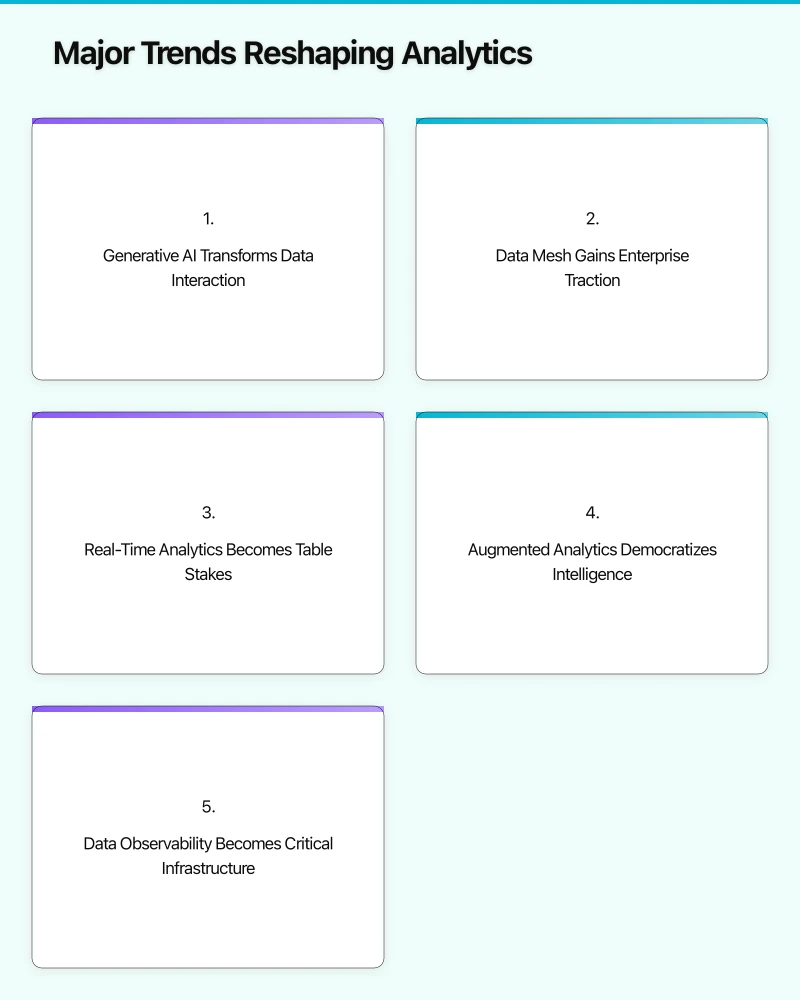
Major Trends Reshaping Analytics
1. Generative AI Transforms Data Interaction
The biggest disruption in analytics isn’t new algorithms—it’s how we talk to data. Large language models (LLMs) are fundamentally changing the analyst-data relationship, democratizing insights that previously required specialized technical skills.
Tableau’s Pulse and Einstein Copilot, launched in late 2023, exemplify this shift. Business users type questions in plain English: “Compare Q4 sales performance across regions and highlight underperforming product categories.” The AI generates SQL queries, creates visualizations, identifies outliers, and suggests follow-up questions—all automatically.
Microsoft’s Copilot for Power BI goes further: describing desired visualizations in natural language (“Show me a waterfall chart of revenue changes from last quarter”), and the system builds it. Early adopters report 60% reduction in time-to-insight for common business questions.
The impact extends beyond convenience. Research from Forrester found that generative AI reduces the “last mile” problem—where 70% of analytics projects never reach business users because insights aren’t accessible or actionable. LLM-powered tools transform this by meeting users where they are: natural language.
Code generation represents another breakthrough. GitHub Copilot and similar tools now write Python, R, and SQL analytics code from descriptions. Data from GitHub shows 55% of code in analytics projects is now AI-assisted, accelerating development cycles by 40%.
2. Data Mesh Gains Enterprise Traction
After years as a theoretical concept, data mesh architecture is achieving mainstream adoption. The traditional centralized data warehouse—where one team owns all data—is giving way to distributed ownership where domain teams manage their own “data products.”
Zalando, Europe’s leading online fashion platform, documented their data mesh journey showing 40% improvement in time-to-insight after transitioning 65 domain teams to own their data products. Each team (marketing, logistics, customer service) became responsible for data quality, documentation, and accessibility—while centralized governance ensured standards.
JPMorgan Chase’s data mesh implementation across trading desks reduced data processing latency by 60% while improving regulatory compliance through better data lineage. The bank’s approach demonstrates that data mesh isn’t just for tech companies—it works in highly regulated industries.
The adoption rate speaks volumes. Gartner predicts that by 2026, 40% of large enterprises will have adopted data mesh principles—up from just 5% in 2023. This 8x growth reflects growing recognition that centralized data teams don’t scale with modern data complexity.
3. Real-Time Analytics Becomes Table Stakes
Batch processing—analyzing yesterday’s data to inform today’s decisions—no longer suffices for competitive advantage. Organizations now demand real-time insights enabling immediate action.
Uber’s real-time analytics platform processes 1.5 trillion events daily, enabling dynamic pricing, fraud detection, and operational optimization within milliseconds. Their architecture combines Apache Kafka for streaming, Apache Pinot for real-time OLAP, and custom ML models—delivering insights as events occur.
Streaming platforms like Confluent and Apache Flink now power analytics for companies needing instant decisions. Netflix uses real-time analytics to adjust video quality instantly based on network conditions, analyze viewer engagement second-by-second, and detect service issues before users report them.
The business impact is measurable. Research from Aberdeen Group found companies using real-time analytics achieve 23% higher customer satisfaction and 19% faster revenue growth than those using batch analytics. Speed-to-insight directly translates to competitive advantage.
4. Augmented Analytics Democratizes Intelligence
Augmented analytics—AI that automates data preparation, insight discovery, and explanation—is moving from luxury to necessity. These systems don’t replace analysts; they amplify their capabilities and extend analytics to non-technical users.
ThoughtSpot’s AI-powered search and insights automatically surfaces hidden patterns in data. When a metric changes significantly, the system proactively generates explanations: “Sales dropped 15% because competitor X launched a promotion in region Y while your website experienced 2-hour downtime.” This eliminates weeks of manual root cause analysis.
Qlik’s AutoML capabilities enable business users to build predictive models without data science expertise. The system suggests relevant variables, selects appropriate algorithms, and explains predictions in business language. Customer data shows 10x increase in predictive analytics projects after AutoML deployment.
The trend accelerates data democratization. Gartner research predicts that by 2026, 75% of business users will regularly use augmented analytics—compared to 30% in 2023. The barriers between business questions and data answers are dissolving.
5. Data Observability Becomes Critical Infrastructure
As data systems grow more complex, ensuring data quality and reliability requires new approaches. Data observability—continuously monitoring data pipelines for issues—has emerged as essential infrastructure.
Monte Carlo’s data observability platform monitors billions of data points daily, automatically detecting anomalies like schema changes, null value spikes, or freshness delays. Early adopters report 80% reduction in data incidents reaching production and 60% less time resolving issues.
Datadog’s data observability offering provides end-to-end lineage tracking—showing how data flows from source to dashboard. When metrics look wrong, teams instantly see which upstream system caused the problem. This visibility slashes mean time to resolution from hours to minutes.
The business case is compelling. Research from Forrester found data observability delivers 237% ROI through reduced downtime, faster incident resolution, and improved data trust. Poor data quality costs organizations an average of $12.9 million annually according to Gartner—observability helps prevent these losses.
Emerging Technologies Shaping the Future
Vector Databases for Semantic Search
Vector databases like Pinecone, Weaviate, and Chroma store data as mathematical vectors capturing semantic meaning rather than just keywords. This enables AI-powered search that understands context and intent.
Companies using vector databases for analytics report 10x improvement in search relevance. Instead of exact keyword matching, users find insights based on conceptual similarity—discovering connections that keyword search would miss.
Knowledge Graphs Connect Disparate Data
Knowledge graphs—networks showing relationships between entities—are revolutionizing how organizations understand data connections. Neo4j’s graph database powers fraud detection, recommendation engines, and impact analysis by revealing hidden relationships.
ICIJ’s use of knowledge graphs in investigations like the Panama Papers demonstrates power at scale: connecting millions of documents, people, and entities to uncover patterns invisible in traditional databases.
Edge Analytics Processes Data at the Source
Rather than sending all data to central systems, edge analytics processes information where it’s generated—IoT devices, retail stores, vehicles. AWS Greengrass and Azure IoT Edge enable real-time analysis on edge devices with millisecond latency.
Manufacturing use cases show 40% reduction in machine downtime through edge-based predictive maintenance—detecting equipment issues instantly without cloud round-trips.
Skills in Unprecedented Demand
The talent landscape has shifted dramatically. LinkedIn’s 2024 Jobs Report identifies the fastest-growing analytics roles:
Data Engineering: Growing 35% year-over-year, data engineers build and maintain pipelines feeding analytics systems. Median salaries now exceed $130,000 as demand outpaces supply.
ML Operations (MLOps): Bridging data science and production systems, MLOps engineers deploy and monitor ML models. This role grew 60% in 2023 according to LinkedIn data.
Analytics Translation: These professionals bridge business and technical teams, translating business questions into analytics requirements. McKinsey research shows organizations with dedicated translators achieve 30% better analytics ROI.
Data Governance: As regulations tighten and data complexity grows, governance specialists ensure compliance and quality. Demand grew 45% in 2023 driven by AI governance requirements.
Preparing for the Analytics Future
Organizations staying ahead in analytics follow five key strategies:
1. Invest in Modern Data Infrastructure: Cloud-native data warehouses like Snowflake and Databricks provide scalability impossible with legacy systems. Migration case studies show 70% cost reduction and 10x performance improvement.
2. Build Analytics Culture: Data-driven organizations achieve 2.5x higher revenue growth. This requires executive commitment, accessible tools, and celebrating data-driven decisions.
3. Develop AI Literacy: Every employee needs basic understanding of how AI and analytics work. LinkedIn Learning data shows AI literacy training correlates with 35% higher analytics adoption.
4. Focus on Data Quality: Gartner estimates poor data quality costs organizations $12.9 million annually. Implementing quality monitoring and governance is foundational.
5. Balance Innovation with Governance: Rapid experimentation must coexist with compliance and security. Ethical AI frameworks and automated policy enforcement enable both speed and safety.
Conclusion
The data analytics landscape of 2024 bears little resemblance to 2020. What once required specialized technical skills—SQL mastery, statistical knowledge, visualization expertise—now happens through natural language conversation with AI. What once took weeks of centralized data team effort now occurs in hours through self-service tools and domain-owned data products. What once required batch processing overnight now happens in real-time, enabling immediate action.
These trends aren’t abstract possibilities—they’re operational realities at leading organizations achieving measurable competitive advantage. The question facing every organization is simple: will you lead this transformation or struggle to catch up after competitors have already pulled ahead?
The analytics revolution isn’t coming—it arrived. Organizations investing in these capabilities today will define their industries tomorrow. Those waiting risk irrelevance in a world where data-driven decisions happen at the speed of conversation.
Sources
- Gartner - 2024 Analytics Survey - 2024
- McKinsey - State of AI 2024 - 2024
- Forrester - Generative AI Boost for Analytics - 2024
- GitHub - Economic Impact of AI-Powered Development - 2023
- Zalando Engineering - Data Mesh Journey - 2024
- Gartner - Data Mesh Predictions - 2024
- Uber Engineering - Real-Time Analytics - 2023
- Aberdeen Group - Real-Time Analytics Impact - 2024
- Gartner - Augmented Analytics - 2024
- Forrester - Total Economic Impact of Data Observability - 2024
- Gartner - Data Quality Costs - 2024
- LinkedIn - 2024 Jobs Report - 2024
Stay updated on analytics trends and innovations.
For the practitioner’s view on web design and digital marketing, explore Cosmos Web Tech — where strategy meets execution.
My consultancy Ganda Tech Services operates three specialist divisions covering cloud infrastructure, web development, and mobile apps for Australian businesses.
About the Author
Ashish Ganda is the founder of Ganda Tech Services, a Sydney-based technology consultancy specialising in cloud infrastructure, web development, and mobile app solutions for Australian businesses.
AI Strategy Primer for Australian Business Leaders
A practical framework for AI adoption in 2026 — cut through the hype and start with what matters.
Almost done
Check your inbox and click the confirmation link to get your download.