Cloud Compliance Automation: Framework for Enterprise Governance
Introduction
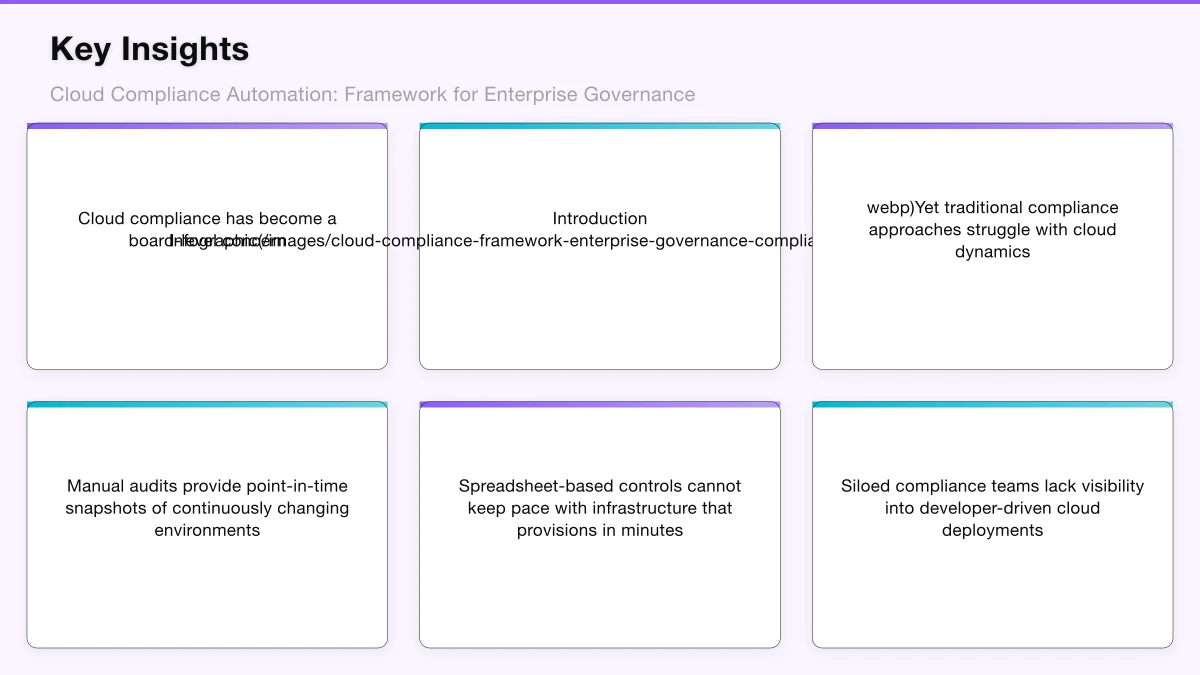
Cloud compliance has become a board-level concern. Regulatory requirements multiply annually, audit scopes expand, and the consequences of compliance failures—financial penalties, reputational damage, operational disruption—have never been higher.
Yet traditional compliance approaches struggle with cloud dynamics. Manual audits provide point-in-time snapshots of continuously changing environments. Spreadsheet-based controls cannot keep pace with infrastructure that provisions in minutes. Siloed compliance teams lack visibility into developer-driven cloud deployments.
The solution lies in automation: policy as code, continuous compliance monitoring, and governance frameworks designed for cloud-native operations. This guide examines how CTOs should approach cloud compliance automation, from strategic framework design to tactical implementation.
The Compliance Challenge in Cloud
Scale and Velocity Mismatch
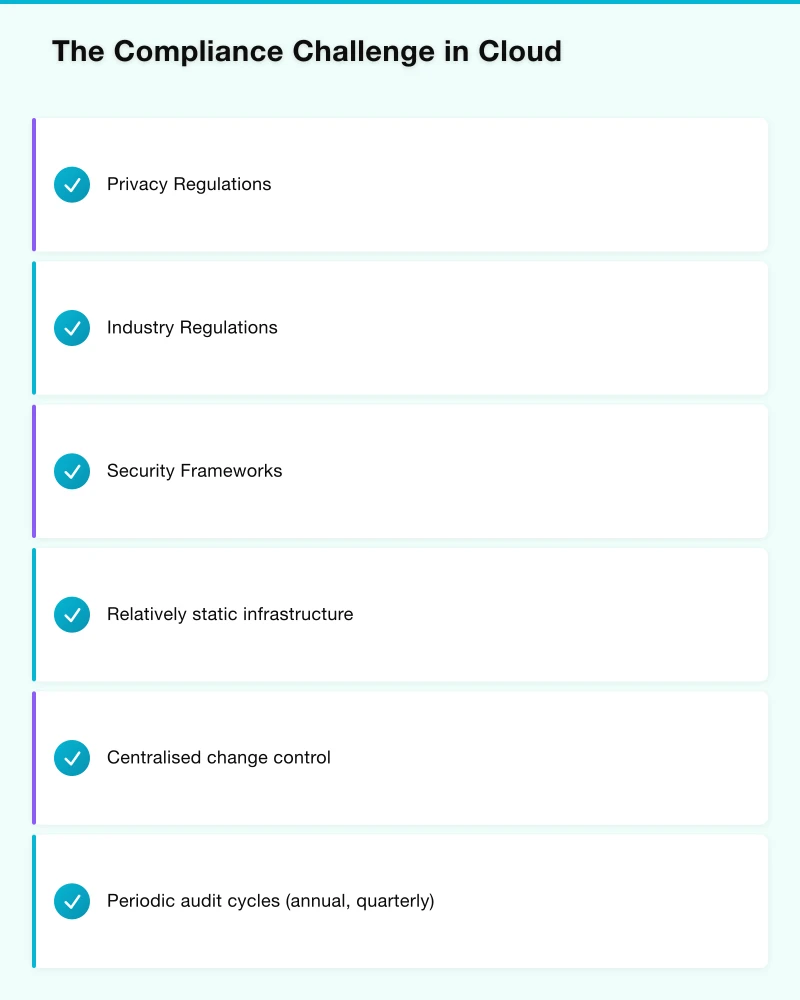
Traditional compliance assumed:
- Relatively static infrastructure
- Centralised change control
- Periodic audit cycles (annual, quarterly)
- Manual review and approval
Cloud operations deliver:
- Infrastructure changes per minute, not month
- Distributed provisioning authority
- Continuous deployment pipelines
- Self-service resource creation
This mismatch creates compliance gaps that widen over time.
Multi-Cloud Complexity
Enterprises now average 2.6 cloud providers, plus private infrastructure:
- Each provider has different security models
- Control implementations vary significantly
- Unified visibility requires deliberate effort
- Skills must span multiple platforms
Regulatory Proliferation
Compliance requirements continue expanding:
Privacy Regulations
- GDPR, CCPA, emerging state laws
- Data residency requirements
- Consent management
- Right to deletion
Industry Regulations
- Financial services (SOX, PCI-DSS, GLBA)
- Healthcare (HIPAA, HITECH)
- Government (FedRAMP, StateRAMP)
- Critical infrastructure requirements
Security Frameworks
- SOC 2 Type II expectations
- ISO 27001 certification
- NIST Cybersecurity Framework
- CIS Controls benchmarks
Each regulation overlaps with others but requires specific evidence and controls.
Audit Burden
Traditional audit preparation consumes enormous resources:
- Weeks of evidence gathering
- Engineering time diverted from delivery
- Point-in-time snapshots that age immediately
- Repeated requests for similar evidence
Organisations with continuous compliance can provide auditors real-time access, dramatically reducing this burden.
Compliance Automation Framework
Policy as Code Foundation
Transform compliance requirements into executable policy:
What is Policy as Code?
Codified rules that evaluate infrastructure and configurations:
- Written in domain-specific languages (Rego, Sentinel, Python)
- Version controlled alongside infrastructure code
- Automatically evaluated during deployments
- Continuously monitored in production
Benefits
- Consistency: Same rules apply everywhere, every time
- Speed: Automated evaluation without human bottleneck
- Documentation: Policies serve as compliance documentation
- Auditability: Complete history of policy changes and evaluations
Example Policy (Rego/OPA)
# Deny S3 buckets without encryption
deny[msg] {
    resource := input.resource.aws_s3_bucket[name]
    not resource.server_side_encryption_configuration
    msg := sprintf("S3 bucket %v must have encryption enabled", [name])
}
Control Framework Mapping
Map regulatory requirements to technical controls:
Layer 1: Regulatory Requirements
- Specific regulation citations
- Control objectives
- Evidence requirements
Layer 2: Control Specifications
- Technical implementation requirements
- Configuration standards
- Monitoring requirements
Layer 3: Policy Implementation
- Automated policy rules
- Detection mechanisms
- Remediation procedures
Example Mapping
| Regulation | Requirement | Control | Policy |
|---|---|---|---|
| PCI-DSS 3.4 | Render PAN unreadable | Encryption at rest | S3 encryption policy |
| HIPAA 164.312 | Encryption | Data encryption | Storage encryption checks |
| SOC 2 CC6.1 | Logical access controls | IAM configuration | IAM policy validation |
Continuous Compliance Architecture
Shift from periodic audits to continuous monitoring:
Prevention Layer
Stop non-compliant resources before deployment:
- Infrastructure as Code scanning in CI/CD
- Pre-deployment policy evaluation
- Approval gates for policy violations
- Developer feedback before merge
Detection Layer
Identify compliance drift in production:
- Continuous configuration monitoring
- Real-time alerting on violations
- Automated compliance scoring
- Trend analysis and reporting
Remediation Layer
Address violations when detected:
- Automated remediation for defined scenarios
- Ticketing integration for manual review
- Escalation procedures for critical violations
- Root cause analysis and prevention
Implementation Components
Policy Engine Selection
Open Policy Agent (OPA)
Open-source policy engine with broad ecosystem support.
Strengths:
- Cloud-agnostic, works everywhere
- Strong community and documentation
- Integrates with Kubernetes, Terraform, CI/CD
- Rego language powerful for complex policies
Considerations:
- Requires policy development expertise
- Self-hosted or embedded deployment
- No built-in UI or management console
HashiCorp Sentinel
Policy as code framework integrated with HashiCorp products.
Strengths:
- Native Terraform Enterprise integration
- Purpose-built policy language
- Commercial support available
- Built-in compliance policy libraries
Considerations:
- HashiCorp ecosystem dependency
- Commercial licensing for full features
- Less flexible outside HashiCorp tools
Cloud-Native Options
Each major cloud offers native policy services:
- AWS: Config Rules, Service Control Policies, IAM Access Analyzer
- Azure: Azure Policy, Blueprints, Defender for Cloud
- GCP: Organisation Policies, Security Command Center
Strengths:
- Deep platform integration
- Managed service simplicity
- Pre-built compliance rule packs
Considerations:
- Cloud-specific, not portable
- Limited customisation for complex scenarios
- Multi-cloud requires multiple implementations
Infrastructure Scanning
Terraform/IaC Scanning
Evaluate infrastructure code before deployment:
- Checkov: Open-source scanner for Terraform, CloudFormation, Kubernetes
- tfsec: Terraform-specific security scanner
- Snyk IaC: Commercial scanner with remediation guidance
- Bridgecrew: Platform with policy management
Integration points:
- IDE plugins for immediate feedback
- Pre-commit hooks for local validation
- CI/CD pipeline stages
- Pull request checks
Container Image Scanning
Evaluate container images for vulnerabilities and misconfigurations:
- Trivy: Open-source vulnerability scanner
- Snyk Container: Commercial with prioritisation
- AWS ECR scanning: Native AWS integration
- Azure Defender for containers: Azure-native scanning
Kubernetes Policy
Enforce policies on Kubernetes deployments:
- Gatekeeper/OPA: Policy enforcement in admission control
- Kyverno: Kubernetes-native policy engine
- Pod Security Standards: Built-in Kubernetes policies
Configuration Monitoring
Cloud Security Posture Management (CSPM)
Continuous assessment of cloud configurations:
Commercial Platforms
- Wiz: Comprehensive cloud security platform
- Orca Security: Agentless cloud security
- Palo Alto Prisma Cloud: Multi-cloud security
- CrowdStrike Falcon Cloud Security
Cloud-Native Options
- AWS Security Hub: Consolidated security findings
- Azure Defender for Cloud: Security posture management
- GCP Security Command Center: Security and risk dashboard
Selection Criteria
- Multi-cloud support requirements
- Integration with existing security tools
- Compliance framework coverage
- Remediation automation capabilities
- Cost model and scaling
Evidence Collection
Automate audit evidence gathering:
Continuous Evidence
- Configuration snapshots at regular intervals
- Policy evaluation results with timestamps
- Change logs for compliance-relevant resources
- Access logs and authentication records
Evidence Management
- Centralised evidence repository
- Retention aligned with audit cycles
- Search and retrieval capabilities
- Chain of custody documentation
Audit Support
- Pre-built evidence packages by framework
- Auditor access portals
- Real-time compliance dashboards
- Exception documentation
Governance Operating Model
Roles and Responsibilities
Cloud Security/Compliance Team
Centralised responsibility for:
- Compliance framework interpretation
- Policy development and maintenance
- Exception review and approval
- Audit coordination and support
- Compliance reporting and metrics
Platform Engineering
Operational responsibility for:
- Policy enforcement infrastructure
- Monitoring and alerting systems
- Remediation automation
- Developer tooling and feedback
Development Teams
Accountable for:
- Compliant infrastructure code
- Responding to policy violations
- Understanding compliance requirements
- Requesting legitimate exceptions
Security Operations
Monitoring responsibility for:
- Real-time security alerting
- Incident response for violations
- Threat intelligence integration
- Forensic investigation support
Exception Management
Not every policy violation requires immediate remediation:
Exception Workflow
- Request: Developer documents business justification
- Review: Compliance team evaluates risk
- Approval: Appropriate authority approves based on risk
- Documentation: Exception recorded with expiration
- Monitoring: Enhanced monitoring during exception
- Review: Periodic reassessment of continuing need
Exception Categories
- Temporary: Time-bound for migration or remediation
- Permanent: Accepted risk with compensating controls
- Inherited: Third-party limitations requiring acceptance
Governance
- Exception authority levels based on risk
- Maximum exception durations
- Required compensating controls
- Escalation for expired exceptions
Compliance Metrics
Track meaningful indicators:
Coverage Metrics
- Percentage of resources under policy evaluation
- Frameworks with automated control coverage
- Policy evaluation frequency
Compliance Metrics
- Overall compliance score by framework
- Violation counts by severity
- Time to remediate violations
- Exception count and aging
Operational Metrics
- Policy evaluation latency
- False positive rates
- Developer feedback integration
- Audit preparation time reduction
Reporting Framework
Executive Reporting
Board and leadership communication:
- Compliance posture summary
- Risk trends and movement
- Significant incidents or findings
- Remediation progress
Operational Reporting
Day-to-day management:
- Violation dashboards
- Team-level compliance scores
- Aging exception reports
- Audit preparation status
Audit Reporting
Auditor-facing deliverables:
- Control evidence packages
- Continuous compliance data
- Exception documentation
- Remediation tracking
Implementation Roadmap
Phase 1: Foundation (Months 1-3)
Assessment
- Inventory current compliance requirements
- Map existing controls to automation potential
- Evaluate current tooling and gaps
- Define success metrics
Quick Wins
- Deploy IaC scanning in CI/CD
- Enable cloud-native security services
- Implement critical policies (encryption, access)
- Establish basic violation alerting
Governance
- Define roles and responsibilities
- Create exception process
- Establish reporting cadence
Phase 2: Expansion (Months 4-8)
Policy Development
- Expand policy coverage systematically
- Map policies to regulatory frameworks
- Develop remediation automation
- Reduce false positives
Integration
- Connect compliance tools to ticketing
- Integrate with change management
- Implement developer feedback loops
- Deploy compliance dashboards
Maturity
- Establish continuous compliance baselines
- Automate evidence collection
- Train teams on compliance requirements
- Conduct internal compliance reviews
Phase 3: Optimisation (Months 9-12)
Automation
- Auto-remediation for low-risk violations
- Predictive compliance analysis
- Self-service exception requests
- Automated audit packages
Efficiency
- Reduce policy evaluation latency
- Optimise alert routing and response
- Streamline exception workflow
- Improve developer experience
Strategic
- Quantify compliance automation ROI
- Expand to additional frameworks
- Contribute policies to community
- Establish compliance as competitive advantage
Common Implementation Challenges
Policy Sprawl
Uncontrolled policy proliferation creates maintenance burden.
Solutions:
- Centralised policy repository
- Policy ownership assignment
- Regular policy review and retirement
- Modular policy design
Alert Fatigue
Too many low-priority alerts desensitise teams.
Solutions:
- Risk-based alert prioritisation
- Alert aggregation and deduplication
- Contextual enrichment
- Regular threshold tuning
Developer Friction
Overly restrictive policies slow delivery.
Solutions:
- Early feedback in development workflow
- Clear remediation guidance
- Legitimate exception process
- Compliance as enablement, not blocker
Multi-Cloud Consistency
Maintaining consistent compliance across clouds.
Solutions:
- Abstract compliance requirements from implementation
- Cloud-agnostic policy engine where possible
- Unified reporting across clouds
- Consistent governance regardless of platform
Vendor Evaluation Considerations
Build vs Buy Analysis
Build (Policy Engines + Custom Development)
When appropriate:
- Unique compliance requirements
- Deep integration needs
- Strong engineering capability
- Cost sensitivity at scale
Trade-offs:
- Development and maintenance investment
- Slower time to comprehensive coverage
- Requires sustained expertise
Buy (Commercial CSPM/Compliance Platforms)
When appropriate:
- Standard compliance frameworks
- Limited security engineering capacity
- Rapid deployment priority
- Broad coverage requirements
Trade-offs:
- Ongoing licensing costs
- Vendor dependency
- Customisation limitations
Selection Criteria
Evaluate platforms against:
Functional Requirements
- Framework coverage (SOC 2, PCI, HIPAA, etc.)
- Multi-cloud support depth
- Custom policy capabilities
- Remediation automation
Operational Requirements
- Deployment model (SaaS, self-hosted)
- Integration capabilities
- Scalability and performance
- Support and documentation
Strategic Requirements
- Vendor stability and roadmap
- Community and ecosystem
- Exit strategy and portability
- Total cost of ownership
Conclusion
Cloud compliance automation is no longer optional for enterprises operating at scale. The combination of regulatory complexity, cloud velocity, and audit burden demands automated approaches to maintain compliance without impeding delivery.
The transformation requires investment across technology, process, and people. Policy as code provides the technical foundation. Continuous monitoring replaces point-in-time audits. Clear governance ensures accountability without bureaucracy.
The organisations that master cloud compliance automation gain competitive advantage: faster audits, lower compliance costs, reduced risk exposure, and the ability to move quickly while maintaining control.
Start with clear requirements, implement incrementally, and build toward continuous compliance as the default operating model.
Sources
- Gartner. (2025). Market Guide for Cloud Security Posture Management. Gartner Research.
- Cloud Security Alliance. (2025). Cloud Controls Matrix v4. https://cloudsecurityalliance.org/research/cloud-controls-matrix/
- NIST. (2024). NIST Cybersecurity Framework 2.0. National Institute of Standards and Technology.
- Open Policy Agent. (2025). Policy as Code Documentation. https://www.openpolicyagent.org/docs/
Strategic guidance for technology leaders building automated compliance capabilities.
If this strategic perspective has you thinking about cloud adoption, Cloud Geeks provides the implementation detail — from AWS setup to security hardening.
Ganda Tech Services is my technology consultancy, bringing together cloud infrastructure, web development, and mobile expertise for Australian businesses.
About the Author
Ashish Ganda is the founder of Ganda Tech Services, a Sydney-based technology consultancy specialising in cloud infrastructure, web development, and mobile app solutions for Australian businesses.
Digital Transformation Roadmap 2026
A 12-month framework for Australian SMBs ready to modernise — phases, tools, and milestones.