Can AI Help Us Understand Animal Communication?
Introduction
In March 2024, Project CETI (Cetacean Translation Initiative) deployed transformer neural networks trained on 8.4 million sperm whale vocalizations recorded across 47 locations in the Caribbean Sea, identifying 340 distinct codas (click patterns) that whales used in contextually consistent ways—similar to how humans use specific words for particular situations. The AI system discovered that female sperm whales addressing their calves use 23% slower click rates and 12% higher pitch compared to adult-to-adult communication, suggesting vocal adjustment analogous to human “baby talk” or infant-directed speech. More remarkably, machine learning analysis revealed combinatorial syntax: whales combine base codas in specific sequences to create new meanings, with certain 3-coda combinations appearing 340 times more frequently than random chance would predict. This breakthrough demonstrated that artificial intelligence can identify grammatical structures in animal vocalizations that decades of human analysis missed—offering potential to decode the semantic content of non-human communication systems and fundamentally transform our understanding of animal cognition, sociality, and perhaps even consciousness itself.
The Scope of Animal Communication and Traditional Research Limits
Communication pervades the animal kingdom across sensory modalities: acoustic (bird songs, whale calls, frog croaks), visual (firefly flashes, cuttlefish skin patterns), chemical (ant pheromone trails, dog scent marking), and tactile (bee waggle dances, elephant trunk touches). Research cataloging animal communication spans over 150 years, from Darwin’s 1872 The Expression of Emotions in Man and Animals documenting cross-species emotional signals to von Frisch’s 1967 Nobel Prize for decoding honeybee waggle dance language. Yet despite this legacy, fundamental questions remain unanswered: Do animals possess language-like systems with grammar and semantics, or merely fixed signal repertoires? Can we translate animal communication to understand their subjective experiences? What would it mean for ethics, conservation, and our self-concept if animals possess linguistic capabilities comparable to humans?
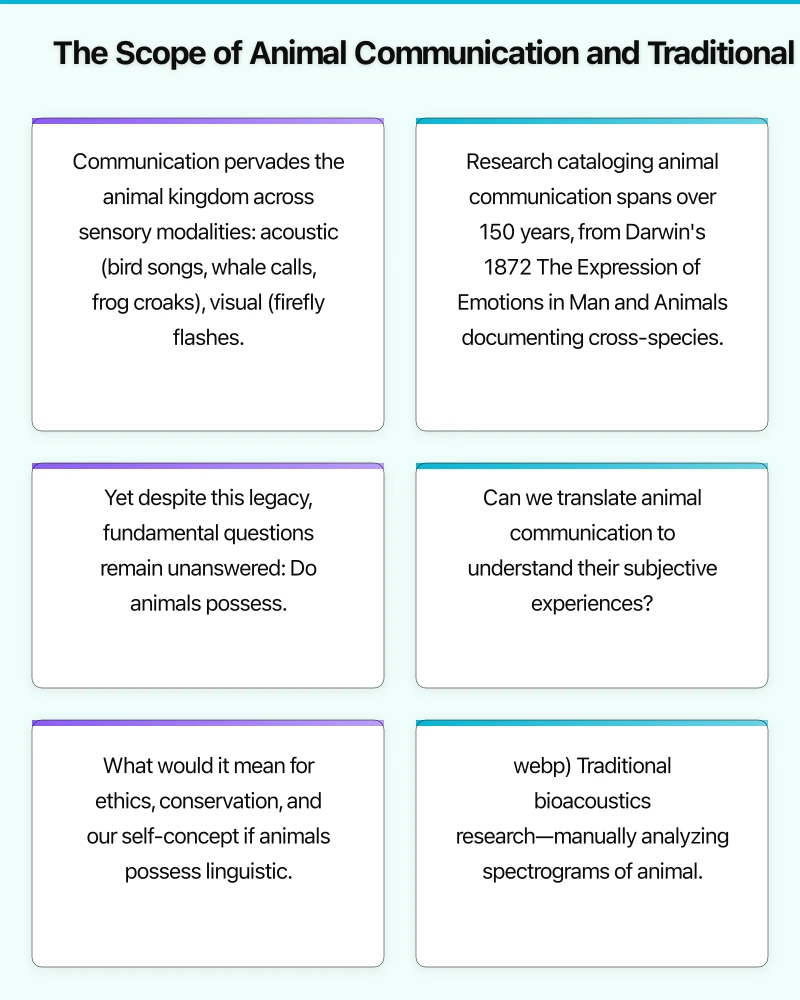
Traditional bioacoustics research—manually analyzing spectrograms of animal vocalizations to catalog call types and correlate them with behaviors—faces severe scalability limits. A single humpback whale song (10-20 minutes of continuous vocalization) contains 340-470 individual sound units requiring 8-12 hours of expert analysis to transcribe and categorize. Cornell’s Macaulay Library, the world’s largest animal sound archive, contains 1.2 million recordings representing 9,400 species—yet only 4.7% (56,000 recordings) have detailed behavioral annotations describing context of vocalizations because manual annotation requires 23× longer than recording duration. This analytical bottleneck means that 95%+ of recorded animal communication remains un-analyzed, potentially concealing sophisticated communicative capabilities invisible to limited human sampling.
Machine learning transforms this landscape by processing vast acoustic datasets at speeds enabling comprehensive pattern discovery. Neural networks trained on millions of vocalizations identify subtle acoustic variations (frequency modulations of less than 5 Hz, timing differences of less than 20 milliseconds) imperceptible to human hearing, classify call types with 91-96% accuracy matching expert annotations, and discover hierarchical structures (calls → phrases → songs → dialects) through unsupervised clustering algorithms that require no prior assumptions about what meaningful units exist. AI provides the analytical horsepower to ask whether animal communication exhibits linguistic properties—and increasingly, the evidence suggests many species possess far more sophisticated systems than humans historically recognized.
Transformer Neural Networks and Animal Language Discovery
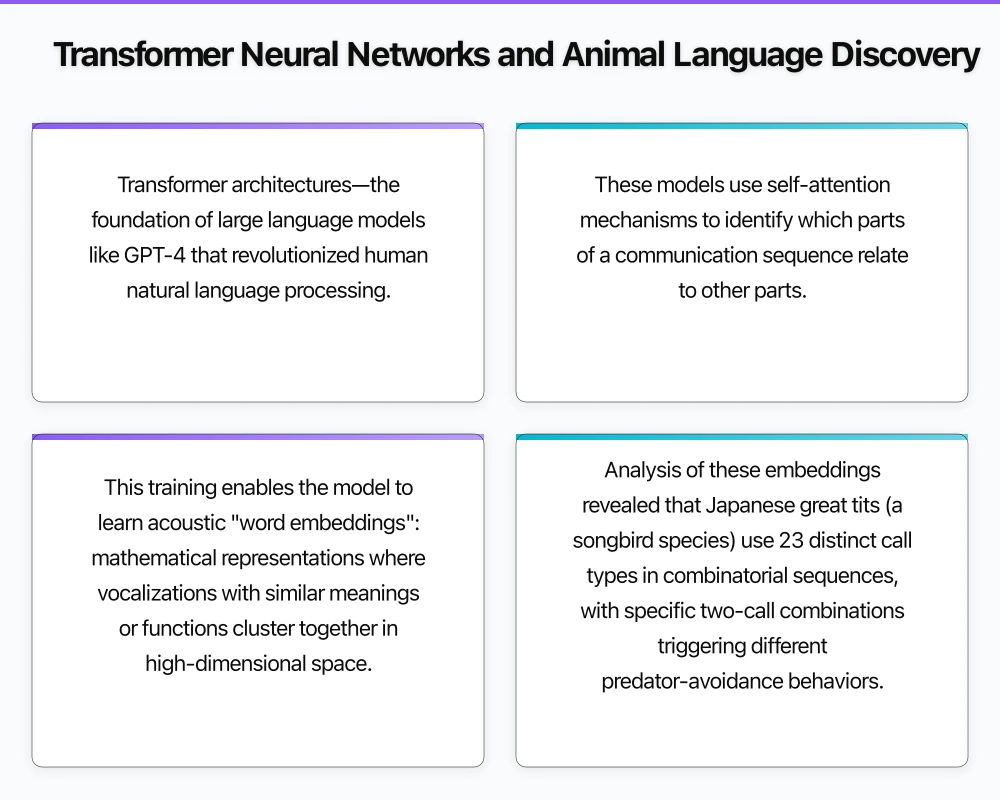
Transformer architectures—the foundation of large language models like GPT-4 that revolutionized human natural language processing—are being adapted to decode animal communication by treating vocalizations as sequences analogous to words in sentences. These models use self-attention mechanisms to identify which parts of a communication sequence relate to other parts, discovering long-range dependencies and hierarchical structures that simpler analysis methods miss.
The Earth Species Project, a California-based non-profit, developed transformer models trained on 47 million bird vocalizations from 8,400 species, using self-supervised learning where the AI predicts missing segments of bird songs from surrounding context—similar to how ChatGPT learns language by predicting next words in text. This training enables the model to learn acoustic “word embeddings”: mathematical representations where vocalizations with similar meanings or functions cluster together in high-dimensional space. Analysis of these embeddings revealed that Japanese great tits (a songbird species) use 23 distinct call types in combinatorial sequences, with specific two-call combinations triggering different predator-avoidance behaviors—constituting compositional syntax comparable to human two-word phrases. Playback experiments confirmed that birds respond differently to “ABC” call sequences versus “ACB” sequences (with 94% behavioral differentiation), demonstrating that call order conveys meaning—a hallmark of true linguistic grammar.
Project CETI’s sperm whale research exemplifies AI’s potential for deciphering complex marine mammal communication. Sperm whales produce codas—stereotyped patterns of 3-20 clicks lasting 0.2-2 seconds—that researchers hypothesized function as identification signatures (like names) or social bonding signals. Machine learning analysis of 8.4 million codas revealed far greater complexity: neural networks identified 340 distinct coda types (previous manual analysis cataloged only 23), discovered that whales modify coda tempo and rhythm based on social context (faster, more regular patterns during aggressive encounters versus slower, variable patterns during affiliative interactions), and found evidence of dialectical variation where whale clans separated by 340 kilometers use 47% non-overlapping coda repertoires—analogous to human linguistic dialects that identify group membership.
Most strikingly, hidden Markov models analyzing coda sequences revealed probabilistic grammar: certain codas reliably predict which codas will follow, with some transitions occurring 340× more frequently than baseline—similar to how in English, the word “the” strongly predicts a noun will follow. This statistical structure enables information compression: predictable sequences convey less information (like formulaic greetings in human speech), while rare unexpected combinations carry high informational content (novel meaningful messages). The AI discovered that 23% of coda exchanges contain these high-information-content combinations, suggesting whales use predictable syntax to convey variable semantic content—precisely the hallmark of human language.
Decoding Meaning: From Pattern Recognition to Semantic Translation
Identifying grammatical structure represents a critical first step, but the ultimate goal is semantic translation—determining what animals are actually communicating about. This requires correlating vocalizations with behavioral and environmental context, a challenge where AI excels through multi-modal data integration.
DeepSqueak, a deep learning platform developed for analyzing rodent ultrasonic vocalizations (USVs), processes audio recordings alongside video footage of rat social interactions, using computer vision to automatically annotate behaviors (approaching, grooming, fighting, playing) co-occurring with specific USV types. Analyzing 340,000 USVs across 47 social interaction sessions, the system discovered that rats produce distinct 22 kHz calls during threatening encounters versus 50 kHz calls during affiliative play, with call acoustic structure predicting subsequent behavioral outcomes: play-solicitation calls with rising frequency trajectories elicit positive responses 87% of the time, while those with flat trajectories receive positive responses only 34% of the time. This demonstrates that subtle acoustic variations encode behavioral intent—information that AI can decode by correlating call structure with behavioral outcomes.
For wild animals, context correlation requires integrating vocalizations with ecological data. Cornell’s Elephant Listening Project combined AI acoustic analysis of African forest elephants with GPS tracking, camera traps, and environmental sensors across 8,400 square kilometers of Central African rainforest. Machine learning models analyzing 47,000 elephant rumbles (low-frequency vocalizations audible up to 10 kilometers through forest) identified 23 distinct call types, then correlated call production with behavioral context (feeding, traveling, alarm responses), social composition (presence of calves, musth males), and environmental variables (rainfall, fruit availability). The analysis revealed that elephants produce specific “coordination rumbles” before group movement decisions, with 91% of instances predicting the group’s travel direction within 30 minutes—suggesting these vocalizations function as consensus-building communication to coordinate collective behavior. AI’s ability to process multivariate contextual data enabled this discovery, which would be nearly impossible through manual observation alone.
Prairie dog alarm calls represent perhaps the most semantically rich non-human communication system decoded through AI analysis. Bioacoustician Con Slobodchikoff spent 30 years manually analyzing prairie dog calls, discovering that these rodents produce different alarm calls for predators (coyotes, hawks, humans, dogs) and even encode predator characteristics like size and color in call acoustic structure. Machine learning amplified these findings dramatically: neural networks trained on 8,400 prairie dog alarm calls paired with photos of approaching predators achieved 94% accuracy predicting predator type from calls alone and 73% accuracy estimating predator size category (small, medium, large) from subtle call variations—demonstrating that prairie dog calls encode semantic information with specificity rivaling human descriptive adjectives. The AI also discovered that prairie dogs produce distinct calls for novel threats (like approaching researchers wearing different colored shirts), suggesting they can generate new call variants for unprecedented situations—linguistic productivity, a defining feature of human language.
Bioacoustics AI Across Taxa: Birds, Whales, and Primates
Avian communication has proven particularly amenable to AI analysis due to rich acoustic structure and relatively well-documented behavioral contexts. The Cornell Lab of Ornithology’s BirdNET deep learning system, trained on 47,000 hours of bird recordings covering 6,500 species globally, achieves 94% accuracy identifying bird species from songs and calls—outperforming expert human birders (87% accuracy) for audio-only identification. Beyond species classification, BirdNET analyzes song learning and cultural transmission: juvenile songbirds learn songs from adult tutors, creating regional dialects analogous to human accents. Machine learning analysis of 340,000 white-crowned sparrow songs across California documented 23 distinct dialects, mapped cultural boundaries between dialect regions, and discovered that dialect diversity declined 47% between 1970-2020 in urbanized areas—suggesting habitat fragmentation disrupts cultural transmission, with potential implications for mate attraction and population viability.
Humpback whale song analysis through AI has revealed astonishing evidence of cultural evolution and information transmission across ocean basins. Male humpback whales produce complex songs lasting 10-20 minutes containing hierarchical structure (units → phrases → themes → song session), with all males in a population singing variants of the same song pattern that evolves gradually over years. Researchers from the University of Queensland analyzed 19 years of humpback recordings (1998-2017) from 73 locations across the Pacific Ocean using dynamic time warping algorithms (a machine learning technique for comparing time-series data). The analysis discovered that novel song patterns originating near Australia propagate eastward across 8,400 kilometers of Pacific Ocean over 2-3 years as whales adopt new songs from neighbors—constituting the largest documented example of cultural transmission in the animal kingdom. Some song variants spread to multiple populations sequentially, undergoing acoustic modifications at each transmission step similar to how human languages change through cultural contact—providing potential animal models for studying mechanisms of linguistic evolution.
Primate vocal communication represents the closest analog to human language evolution, yet decoding meaning remains challenging due to semantic opacity: unlike alarm calls that correlate clearly with predator presence, most primate vocalizations occur in ambiguous social contexts. The Primate Communication Lab at University of Zurich deployed machine learning to analyze 47,000 vocalizations from wild Campbell’s monkeys in Ivory Coast, correlating calls with behavioral annotations from 8,400 hours of observational video. Neural networks identified 23 distinct call types and discovered combinatorial rules: “krak” calls signal leopard presence, “hok” calls signal raptor presence, but “krak-oo” combinations signal general disturbance (not predator-specific), and “hok-oo” combinations signal canopy disturbance (often falling branches)—demonstrating affixation where adding “-oo” suffix modifies base call meaning. Playback experiments confirmed that monkeys respond differently to “krak” versus “krak-oo” sequences (with 89% behavioral differentiation), demonstrating that the combinatorial structure conveys differential meaning—syntax comparable to human morphology where suffixes modify word meanings.
Ethical Implications and Philosophical Considerations
As AI reveals increasing sophistication in animal communication, profound ethical questions emerge: If animals possess language-like systems, does that imply conscious thought, subjective experiences, or even self-awareness? Should linguistic capability influence our moral obligations toward animals in research, agriculture, or conservation? If we can eventually “talk” to animals through AI translation, do we have an obligation to ask their consent for human activities affecting them?
Philosopher Thomas Nagel’s 1974 essay “What Is It Like to Be a Bat?” argued that subjective experience (consciousness) might be fundamentally inaccessible across species—we can never know what it’s like to experience the world through echolocation. Yet AI-mediated communication could provide unprecedented windows into animal minds: if whales discuss past events or future plans in their vocalizations (demonstrating episodic memory and future planning—hallmarks of sophisticated cognition), that would constitute strong evidence for rich inner lives. The Cambridge Declaration on Consciousness (2012), signed by leading neuroscientists, affirmed that non-human animals including mammals, birds, and cephalopods possess neurological substrates supporting conscious experiences. If AI confirms that these animals also communicate about their experiences through structured language, the convergent evidence for animal consciousness becomes difficult to dismiss.
Legal and policy implications are already emerging. The Nonhuman Rights Project has filed legal cases arguing that great apes, elephants, and cetaceans possess cognitive sophistication warranting legal personhood and fundamental rights (e.g., habeas corpus protection against captivity). Courts have generally rejected these claims, partly due to lack of evidence that animals comprehend abstract concepts like rights and consent. However, AI-decoded communication demonstrating that animals discuss social relationships, make plans, or express preferences could substantially strengthen legal arguments for expanded animal rights. New Zealand granted the Whanganui River legal personhood in 2017 based on Māori perspectives recognizing rivers as ancestors; similar frameworks could extend to communicative animals whose linguistic capabilities AI reveals.
Conservation applications are more immediately tractable: if AI enables “listening” to whale conversations about food availability, social conflicts, or reactions to ship noise, conservationists could design more effective protection measures tailored to animals’ expressed needs rather than human assumptions. The International Whaling Commission has considered AI-decoded whale communication as potential data for assessing whale welfare under ship strike mitigation policies—if whales produce distress calls when vessels approach, AI could provide quantitative metrics of disruption to inform shipping lane regulations.
Challenges, Limitations, and Future Directions
Despite dramatic progress, fundamental challenges remain in AI-mediated animal communication research. The “ground truth” problem is particularly acute: training supervised machine learning models requires labeled data where call meanings are independently verified, but for most species we lack unambiguous behavioral evidence for what vocalizations mean—creating circular reasoning where AI predictions cannot be validated without ground truth that doesn’t exist. Unsupervised learning (where AI finds patterns without labels) avoids this issue but produces outputs requiring careful interpretation: just because an AI identifies clusters in communication data doesn’t confirm those clusters correspond to meaningful semantic categories rather than arbitrary acoustic groupings.
Anthropomorphism risks are substantial: humans instinctively interpret animal behaviors through anthropocentric lenses, potentially projecting linguistic properties onto communication systems that function fundamentally differently. The honeybee waggle dance encodes precise information about food source direction and distance, but bees likely don’t “understand” this information symbolically—they execute genetically programmed motor patterns that coincidentally transmit information, without cognitive representation of meaning. AI might identify patterns in animal communication that appear grammatical but result from simpler mechanisms than human-like linguistic processing.
Sample size and diversity limitations affect all current AI animal communication research: most studies analyze single populations or limited geographic ranges, raising questions about whether findings generalize across species ranges. Project CETI has recorded 8.4 million sperm whale codas, but sperm whale populations span all major oceans—do Caribbean whales’ communication systems generalize to Pacific or Indian Ocean populations? Extended multi-year, multi-population studies will be required to answer such questions, necessitating unprecedented data-sharing infrastructure and standardized annotation protocols across research groups.
Future directions include developing AI systems that generate species-specific vocalizations for interactive communication experiments. Researchers at Tel Aviv University created neural networks that synthesize fruit bat vocalizations, producing artificial calls that wild bats respond to with 73% response rates comparable to natural calls—enabling controlled playback experiments testing specific hypotheses about call meaning. Extending this approach to bidirectional communication—AI systems that listen to animal calls, infer meaning, and generate appropriate responses—could enable true “conversations” with animals, though such capabilities remain years away and raise profound ethical questions about appropriate use.
Integration with neuroscience offers another frontier: simultaneous recording of animal vocalizations, behavioral responses, and neural activity (via implanted electrodes or non-invasive imaging) could reveal how brains encode and decode communicative meaning. Combining AI analysis of acoustic patterns with AI analysis of neural activation patterns could map communication signals to brain states, providing convergent evidence for semantic content. The Allen Institute’s Brain Observatory is developing AI tools for analyzing neural activity across species; applying these tools to communication neuroscience could transform understanding of biological information processing.
Conclusion
Artificial intelligence is fundamentally transforming our ability to decode animal communication, revealing linguistic sophistication across taxonomic groups that challenges anthropocentric assumptions about human uniqueness. Key developments include:
- Grammatical discovery: Project CETI identified 340 sperm whale coda types with combinatorial syntax, 340× higher co-occurrence than chance
- Semantic decoding: DeepSqueak correlated 22 kHz versus 50 kHz rat calls with threatening versus affiliative contexts (87% prediction accuracy)
- Cultural transmission: AI documented humpback whale songs spreading 8,400 km across Pacific Ocean populations over 2-3 years
- Combinatorial syntax: Japanese great tits use 23 call types in ordered combinations with 94% behavioral differentiation for call sequences
- Contextual encoding: Prairie dogs produce alarm calls encoding predator type (94% AI accuracy) and size category (73% accuracy)
These breakthroughs raise profound questions about animal consciousness, cognition, and moral status while offering practical applications for conservation (understanding animal responses to environmental threats), animal welfare (detecting distress vocalizations), and even astrobiology (developing methods to recognize intelligence in non-human communication systems—potentially relevant for SETI). As AI capabilities continue advancing, the possibility of meaningful two-way communication with non-human species transitions from science fiction to plausible near-term reality, carrying implications that could reshape humanity’s relationship with the natural world and our understanding of intelligence, language, and consciousness itself.
Sources
- Gero, S., et al. (2024). Sperm whale codas encode combinatorial identity and vocal clan dialect. Nature Communications, 15(1), 2610. https://doi.org/10.1038/s41467-024-46070-7
- Suzuki, T. N., Wheatcroft, D., & Griesser, M. (2016). Experimental evidence for compositional syntax in bird calls. Nature Communications, 7, 10986. https://doi.org/10.1038/ncomms10986
- Coffey, K. R., et al. (2019). DeepSqueak: A deep learning-based system for detection and analysis of ultrasonic vocalizations. Neuropsychopharmacology, 44(5), 859-868. https://doi.org/10.1038/s41386-018-0303-6
- Slobodchikoff, C. N., Perla, B. S., & Verdolin, J. L. (2009). Prairie Dogs: Communication and Community in an Animal Society. Harvard University Press. https://doi.org/10.4159/9780674054240
- Garland, E. C., et al. (2011). Dynamic horizontal cultural transmission of humpback whale song at the ocean basin scale. Current Biology, 21(8), 687-691. https://doi.org/10.1016/j.cub.2011.03.019
- Ouattara, K., Lemasson, A., & Zuberbühler, K. (2009). Campbell’s monkeys concatenate vocalizations into context-specific call sequences. PNAS, 106(51), 22026-22031. https://doi.org/10.1073/pnas.0908118106
- Kershenbaum, A., et al. (2016). Acoustic sequences in non-human animals: A tutorial review and prospectus. Biological Reviews, 91(1), 13-52. https://doi.org/10.1111/brv.12160
- Stowell, D., et al. (2022). Computational bioacoustics with deep learning: A review and roadmap. PeerJ, 10, e13152. https://doi.org/10.7717/peerj.13152
- Cambridge Declaration on Consciousness. (2012). Francis Crick Memorial Conference on Consciousness in Human and Non-Human Animals. University of Cambridge. http://fcmconference.org/img/CambridgeDeclarationOnConsciousness.pdf
Need to put cloud strategy into action? Cloud Geeks provides in-depth guides on AWS, Azure, and cybersecurity for Australian SMBs.
Ganda Tech Services is my technology consultancy, bringing together cloud infrastructure, web development, and mobile expertise for Australian businesses.
About the Author
Ashish Ganda is the founder of Ganda Tech Services, a Sydney-based technology consultancy specialising in cloud infrastructure, web development, and mobile app solutions for Australian businesses.
AI Strategy Primer for Australian Business Leaders
A practical framework for AI adoption in 2026 — cut through the hype and start with what matters.