Building Enterprise Platforms with Backstage
The platform engineering movement has been gaining momentum for the past two years, driven by a recognition that developer productivity depends not just on individual tools but on the integrated experience of using those tools together. As organisations adopt microservices, cloud infrastructure, and diverse technology stacks, the cognitive load on developers increases: they must navigate service catalogues, CI/CD pipelines, monitoring dashboards, documentation wikis, and infrastructure provisioning portals — often with different authentication, different interfaces, and different mental models.
Backstage, originally developed at Spotify and open-sourced in 2020, has emerged as the leading framework for building internal developer platforms that unify these capabilities into a single, extensible portal. Now a CNCF incubating project, Backstage is being adopted by enterprises across industries as the foundation for their developer experience strategy.
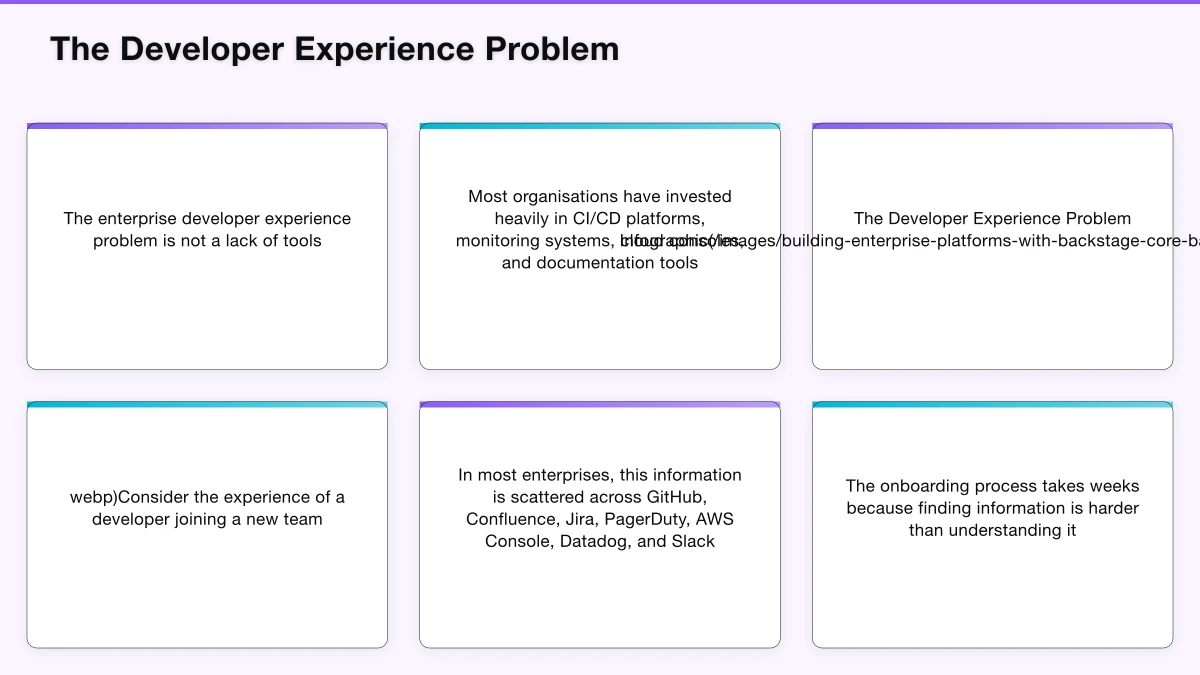
The Developer Experience Problem
The enterprise developer experience problem is not a lack of tools. Most organisations have invested heavily in CI/CD platforms, monitoring systems, cloud consoles, and documentation tools. The problem is fragmentation: each tool operates independently, requiring developers to context-switch between systems, maintain mental maps of which tool serves which purpose, and manually integrate information across platforms.
Consider the experience of a developer joining a new team. They need to understand what services the team owns, where the code lives, how to build and deploy it, what the service dependencies are, who to contact for related services, and where to find documentation. In most enterprises, this information is scattered across GitHub, Confluence, Jira, PagerDuty, AWS Console, Datadog, and Slack. The onboarding process takes weeks because finding information is harder than understanding it.
Backstage addresses this by providing a single portal that aggregates information from multiple backend systems and presents it through a consistent interface. It does not replace existing tools — it integrates them, reducing the cognitive overhead of navigating a complex tool landscape.
Core Backstage Capabilities
Backstage provides three foundational capabilities that address the most common developer experience pain points:
Software Catalogue: The service catalogue is Backstage’s central feature. It provides a searchable registry of all software components — services, libraries, websites, data pipelines — with metadata about ownership, lifecycle stage, dependencies, documentation, and operational status. Each component is defined by a YAML descriptor file (catalog-info.yaml) that lives in the component’s repository, ensuring the catalogue stays synchronized with the actual codebase.
The catalogue transforms “who owns this service?” from a question that requires asking around on Slack to a question answered in seconds. For enterprises with hundreds or thousands of services, this visibility is transformative. It enables:
Ownership accountability: Every service has a documented owner, making it clear who is responsible for maintenance, incidents, and architectural decisions.
Dependency mapping: Understanding which services depend on which others enables impact analysis for changes, incidents, and decommissioning.
Lifecycle management: Tracking which services are in active development, maintenance mode, or scheduled for deprecation helps prioritise investment and migration efforts.
Software Templates: Templates enable teams to create new services, libraries, or infrastructure components from pre-configured blueprints. A template might create a new microservice with the organisation’s standard project structure, CI/CD pipeline configuration, Kubernetes manifests, monitoring dashboards, and documentation scaffolding — all provisioned through a self-service wizard.
Templates encode organisational standards into the creation process. Rather than documenting standards in a wiki that developers may or may not read, the template produces compliant output by default. This is the “paved path” concept realised: the easiest way to create a new service also produces the best-practice result.
TechDocs: Backstage includes a documentation system (TechDocs) that renders Markdown documentation from repositories and serves it alongside the catalogue. This addresses the chronic problem of documentation being separate from the services it describes — stored in a different system, maintained by different people, and frequently out of date.
By pulling documentation from the same repository as the code and displaying it in the catalogue alongside service metadata, TechDocs creates a documentation experience where finding and reading docs is as easy as browsing the service catalogue.
Plugin Architecture and Extensibility
Backstage’s plugin architecture is what makes it a platform rather than a product. The core Backstage framework provides the catalogue, templates, and TechDocs. Everything else is delivered through plugins that integrate with external systems.
The plugin ecosystem is growing rapidly. Existing plugins integrate with:
CI/CD platforms: Jenkins, GitHub Actions, CircleCI, ArgoCD — displaying build status and deployment history within the catalogue.
Monitoring and observability: Datadog, PagerDuty, Grafana, Prometheus — showing operational metrics and incident status alongside service information.
Cloud infrastructure: AWS, GCP, Kubernetes — displaying resource utilisation and infrastructure state.
Security: Snyk, SonarQube — surfacing vulnerability and code quality information within the developer portal.
Cost management: Cloud cost data integrated into service views, enabling teams to see the infrastructure cost of their services.
For enterprises, the ability to build custom plugins is equally important. Every organisation has internal systems, proprietary tools, and unique workflows that off-the-shelf products cannot address. Backstage’s React-based plugin framework enables internal teams to build custom integrations that bring organisational-specific information into the unified portal.
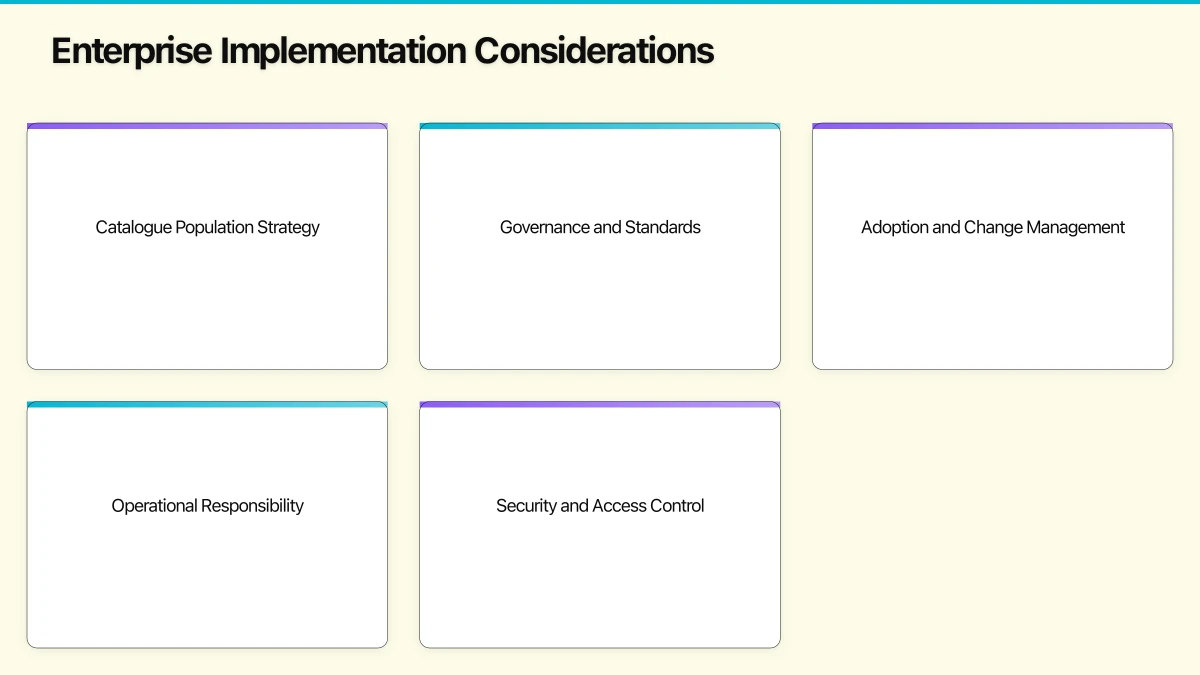
Enterprise Implementation Considerations
Adopting Backstage in an enterprise context involves decisions that go beyond the technical framework:
Catalogue Population Strategy: The catalogue is only valuable if it is comprehensive. A catalogue that contains half the organisation’s services is misleading because users cannot trust it as a source of truth. The population strategy should prioritise breadth: getting basic metadata for all services into the catalogue quickly, then enriching the metadata over time.
Automated discovery — scanning GitHub organisations, Kubernetes clusters, and CI/CD pipelines for service definitions — accelerates initial population. Manual enrichment by service owners adds ownership, documentation, and dependency information that automated discovery cannot infer.
Governance and Standards: Backstage provides the mechanism for enforcing standards, but the standards themselves must be defined. What metadata is required for every service? What templates are available? What plugins are supported? These decisions should be made collaboratively between the platform team and the development teams who will use the platform.
Adoption and Change Management: Backstage succeeds when developers use it voluntarily because it makes their work easier, not when usage is mandated. The platform team should identify early adopter teams, demonstrate tangible value (faster onboarding, easier service discovery, self-service provisioning), and iterate based on feedback before scaling organisation-wide.
Operational Responsibility: Backstage is a web application that requires hosting, monitoring, and maintenance. The platform team that owns Backstage must treat it as a production service with appropriate reliability commitments. A developer portal that is frequently down or slow undermines the developer experience it is supposed to improve.
Security and Access Control: Enterprise Backstage deployments must integrate with the organisation’s identity and access management systems. The catalogue may contain sensitive information about internal services, and access should be controlled appropriately. Backstage supports integration with common identity providers through its authentication framework.
Backstage represents a maturation in how enterprises think about developer productivity. Rather than optimising individual tools, the platform approach optimises the integrated experience. For CTOs, Backstage provides a framework for building a developer platform that reduces cognitive load, encodes organisational standards, and creates a unified experience across a fragmented tool landscape. The investment in a developer platform pays returns through faster onboarding, improved productivity, and better organisational visibility into the technology estate.
For practical web design and SEO guidance, my team at Cosmos Web Tech helps Australian businesses build high-performing websites.
Ash Ganda is the founder of Ganda Tech Services, a Sydney-based technology consultancy delivering cloud, web, and mobile solutions for Australian businesses.
About the Author
Ashish Ganda is the founder of Ganda Tech Services, a Sydney-based technology consultancy specialising in cloud infrastructure, web development, and mobile app solutions for Australian businesses.
Tech Stack Selection Guide 2026
Choose the right tools for your Australian business — without the vendor hype or overlapping spend.
Almost done
Check your inbox and click the confirmation link to get your download.