
The APAC AI Gap: What Australian Business Leaders Are Getting Wrong in 2026
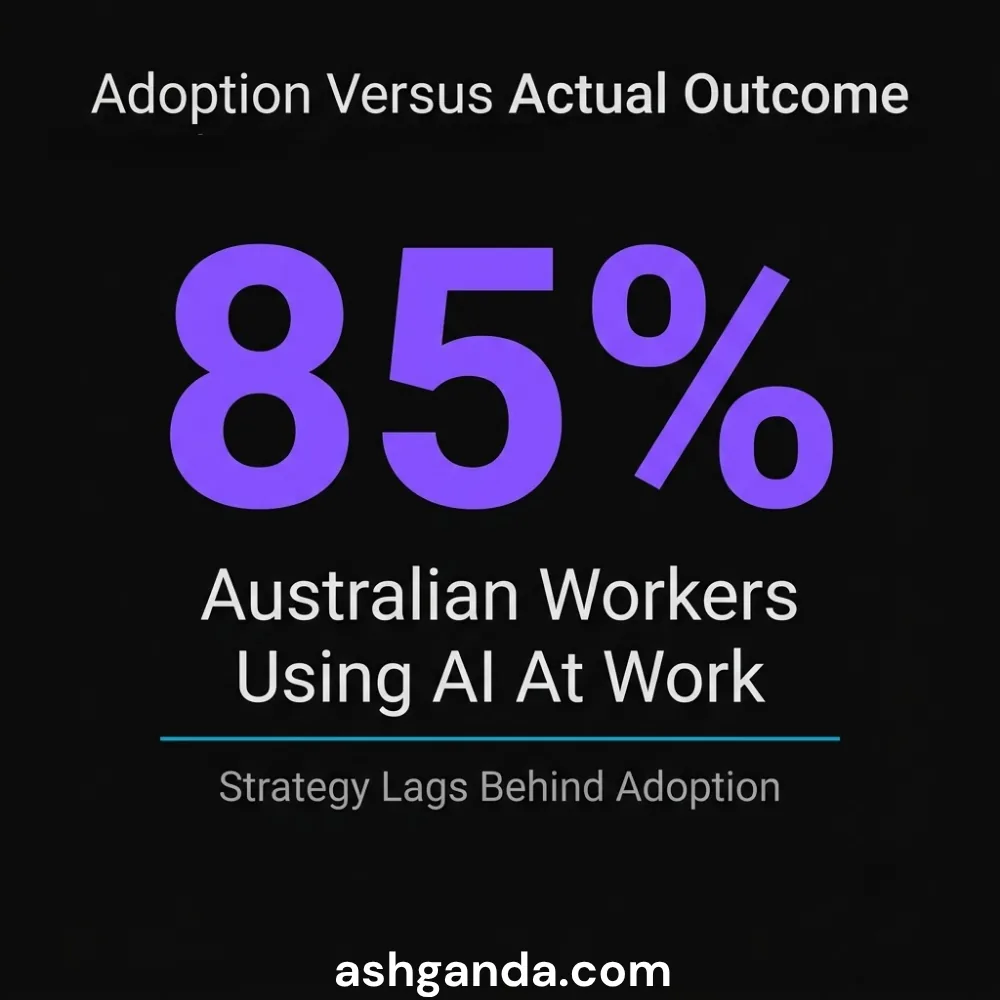
Australian businesses are adopting AI at a faster rate than most of the APAC region. According to Microsoft’s 2025 Work Trend Index, 85% of Australian knowledge workers report using AI tools at work — above the global average of 75%. The adoption curve is real. The strategy behind it, in most organisations, is not.
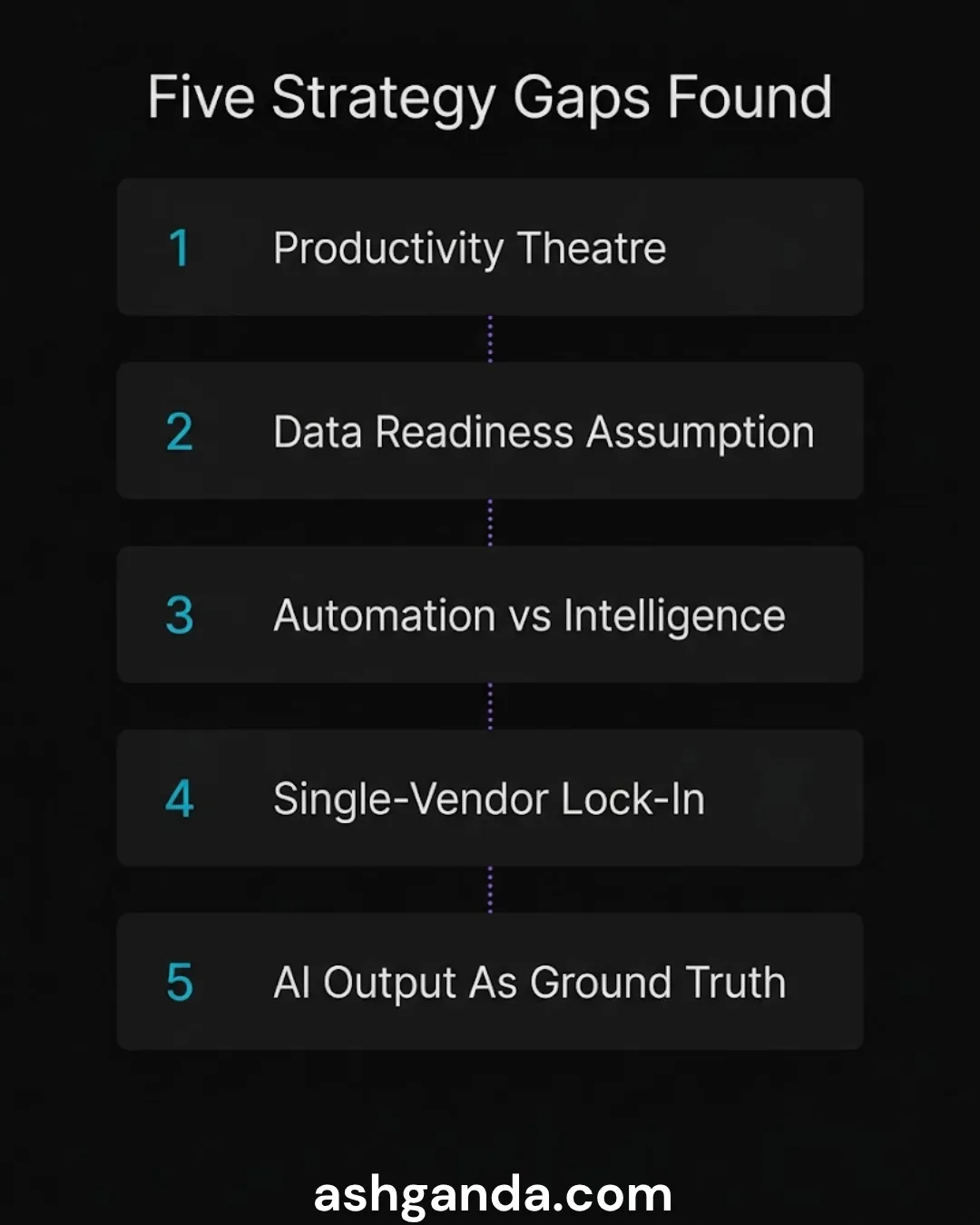
What follows is not a critique of specific companies or leaders. It is a pattern — five patterns — that emerge consistently from conversations at technology forums, from AI deployment post-mortems, and from what I observe in the businesses we work with directly across Western Sydney and the broader Australian market.
Pattern 1: Productivity Theatre
Most Australian businesses that have “adopted AI” have deployed a tool that makes individuals faster at tasks that could be questioned entirely.
The canonical example: marketing teams using AI to produce more content faster. Output doubles. Budget stays the same. The distribution channel — social media, email, organic search — remains unchanged. More content enters the same container. Engagement metrics do not move.
This is productivity theatre. It optimises the rate of doing without questioning whether the doing is the right vector.
The organisations getting value from AI are asking a different question: what decisions can AI help us make faster, or make at all, that we currently cannot? The answer is not usually “write faster.” It is closer to: identify which 20% of clients produce 80% of support tickets, or flag which customer segments have not re-engaged in 90 days, or surface which job postings have the highest application-to-hire conversion.
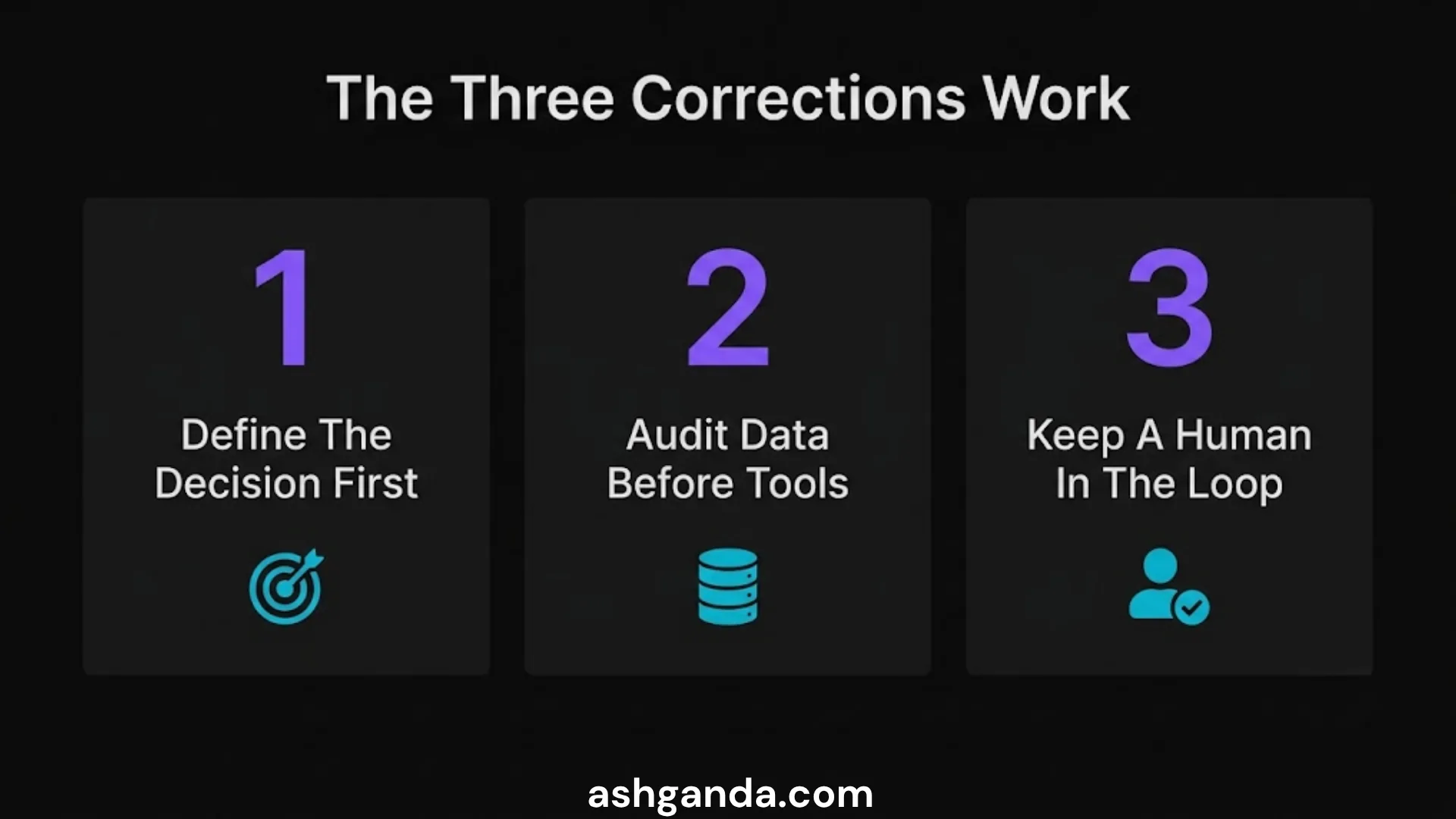
The correction: before deploying an AI tool, define the decision it will improve and the metric that will prove it. If you cannot name the decision, you are buying a productivity prop.
Pattern 2: The Data Readiness Assumption
Every AI vendor presentation contains a slide that assumes your data is clean, labelled, centralised, and accessible.
It is not. Almost no Australian SMB’s data is.
Customer records live in three systems that have never talked to each other. Inventory data is in a spreadsheet. Sales history is in an accounting platform with a non-standard export format. Staff notes are in individual email inboxes.
Large language models can process unstructured text. They cannot retrieve data from systems they are not connected to, and they cannot make decisions based on data they cannot see. An AI assistant that has no access to your CRM, inventory, or customer history is a sophisticated autocomplete — useful for drafting and summarising, but not for operational intelligence.
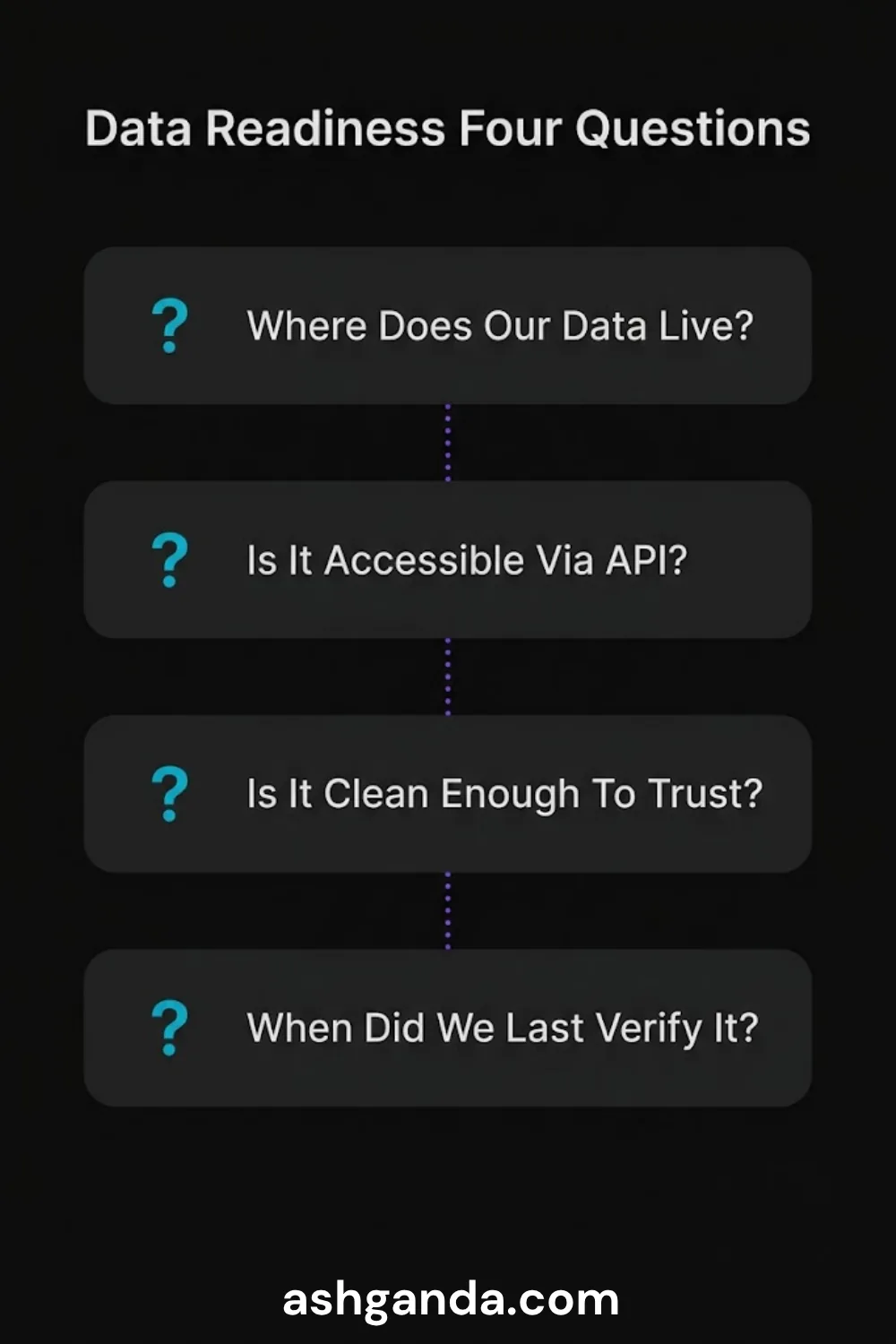
The correction: AI strategy starts with data architecture. Before selecting an AI tool, audit where your operational data lives, whether it is accessible via API, and whether it is clean enough to trust. A 3-month data consolidation project often does more for AI readiness than any model deployment.
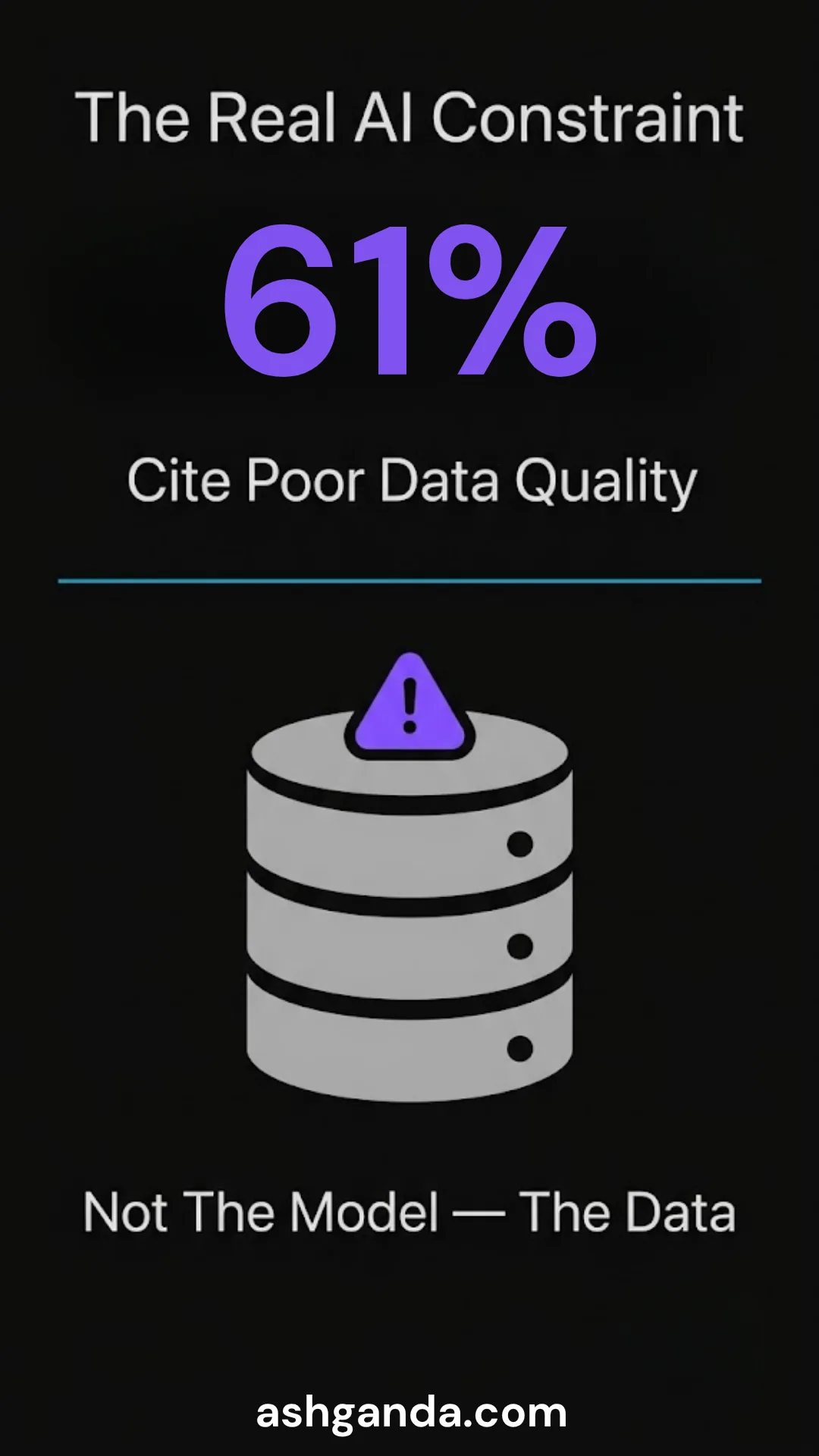
According to IDC’s 2025 APAC Data and Analytics Report, 61% of APAC organisations report that poor data quality is the primary constraint on AI outcomes — ahead of model capability, cost, or talent.
Pattern 3: Confusing Automation With Intelligence
Automation and AI are not the same category. A rule-based workflow that sends an email when a form is submitted is automation. It requires no model, no inference, and no training data. It is reliable, deterministic, and cheap.
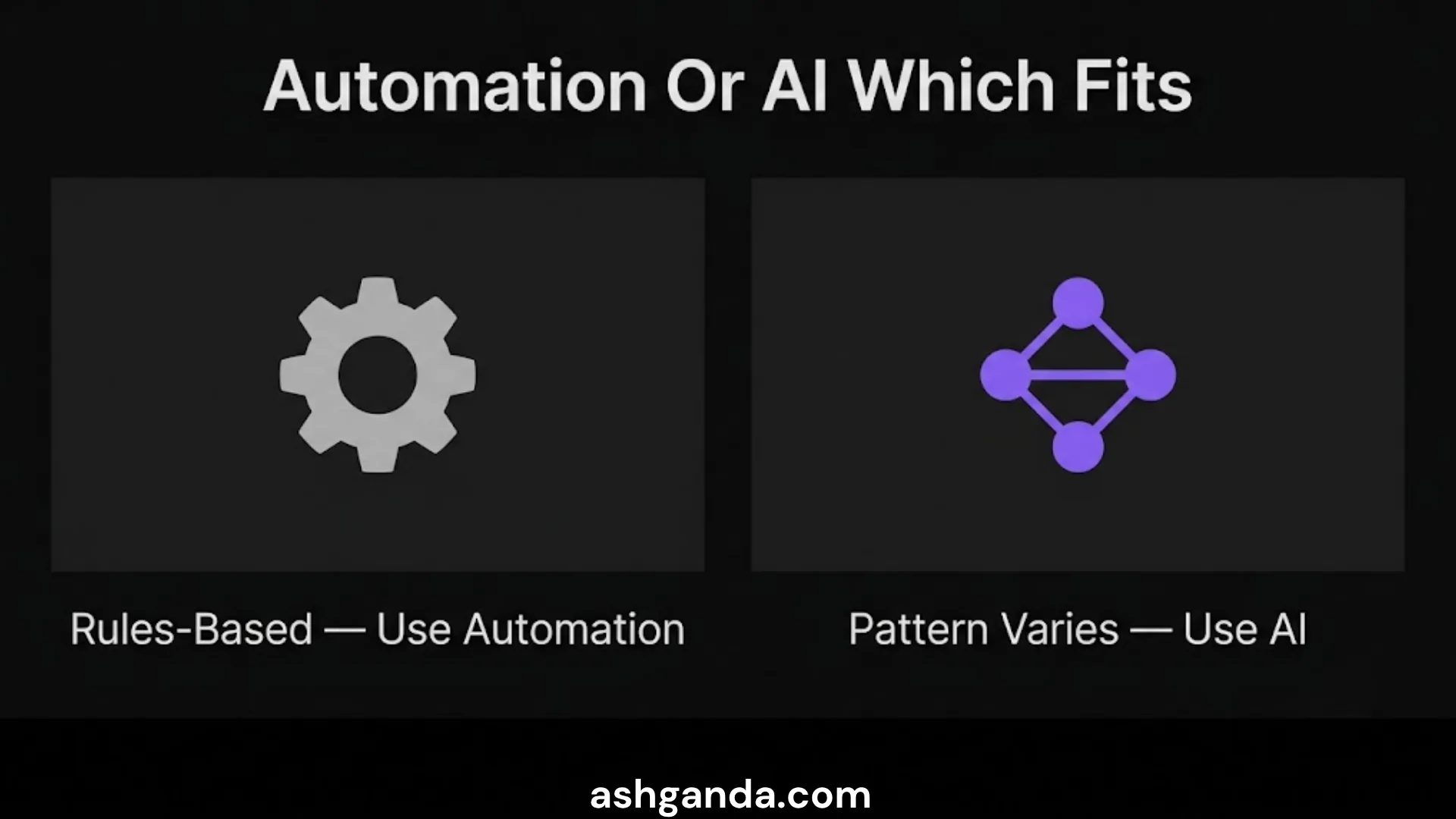
Many Australian businesses are paying for AI tools to do jobs that deterministic automation would do better. Meanwhile, the genuinely intelligent use cases — pattern recognition across large datasets, anomaly detection, natural language interfaces to internal systems — remain undone because the AI budget was spent on automation theatre.
The practical distinction:
| Task Type | Best Approach | Why |
|---|---|---|
| ”Send reminder email 3 days before appointment” | Automation (Zapier/Make/n8n) | Deterministic, zero hallucination risk |
| ”Write a first draft of this proposal” | AI (LLM) | Generative, saves time |
| ”Which of our leads is most likely to convert?” | AI (predictive model) | Pattern recognition across historical data |
| ”Extract this field from every invoice we have received” | AI (document extraction) | Handles variation in document structure |
| ”Route this support ticket to the right team” | Automation (if rules work) or AI (if rules fail) | Depends on how consistent the language is |
The correction: match the tool to the task type. Reserve AI for tasks where the input varies, where pattern recognition over a large corpus is required, or where the output needs to be generative. Use automation for everything that can be described by a finite set of rules.
Pattern 4: Single-Vendor Lock-In at the Model Layer
Most Australian businesses that have built internal AI tools have built them around a single provider’s API — usually OpenAI’s GPT-4 class models. This was the pragmatic choice in 2023. In 2026, it carries meaningful risk.
The AI model landscape shifted dramatically between 2024 and 2026:
- Anthropic’s Claude 3.5 and 4 family now outperforms GPT-4 class models on coding, reasoning, and instruction-following benchmarks
- Google’s Gemini 1.5 Pro offers a 1 million token context window — relevant for businesses that need to process long documents
- Meta’s Llama models provide open-weight alternatives that can be run locally or in private cloud — important for businesses with data sovereignty requirements
- Mistral and other European providers offer GDPR-native options
An application hardcoded to a single model cannot take advantage of capability improvements from competing providers without a rewrite. More importantly, pricing volatility at the API layer is real — OpenAI has changed its pricing structure multiple times since 2022.
The correction: build AI applications with a model abstraction layer — a configuration-driven approach where the model provider and model name are parameters, not hardcoded values. Libraries like LiteLLM or frameworks like LangChain with provider-agnostic interfaces make this straightforward.
Pattern 5: Treating AI Output as Ground Truth
The most dangerous pattern is not a technology choice. It is an epistemic one.
AI models produce confident, well-formatted, plausible text. They do not reliably distinguish between what they know and what they are constructing from pattern. The output looks authoritative even when it is not.
Australian businesses that have deployed AI for customer-facing tasks — chatbots, automated email responses, customer service — without human review loops are accumulating reputational and compliance risk. In regulated industries (financial services, healthcare, legal), this risk is material.
The pattern that works: AI produces, human reviews, system learns from the review signal. The AI is in the loop as a first-pass accelerator, not as the final decision-maker. This is not a temporary workaround for an immature technology — it is the correct architecture for any consequential decision in any consequential domain.
The correction: define the human review gate before deployment, not after the first failure. Decide what decisions require human approval, what decisions can be AI-automated with logging only, and what decisions AI should not be in at all. Write this down. Review it quarterly.
What the Correction Looks Like in Practice
The businesses getting material value from AI in Australia in 2026 share a pattern: they started with a specific problem, a specific success metric, and a specific dataset — not with a tool they wanted to find a use for.
They asked: “We spend 40 hours a week triaging inbound emails. Could AI categorise and draft responses for the 60% that are routine?” They measured before: average response time, volume per category, error rate in categorisation. They deployed a narrow system. They measured after.
That is not glamorous. It is not the AI transformation narrative that gets conference keynotes. It is how organisations are actually building competitive advantage with this technology — one specific problem at a time, with measurement before and after.
The APAC leaders who are ahead are not the ones who adopted AI earliest. They are the ones who asked the right questions first.
Frequently Asked Questions
What percentage of Australian businesses have adopted AI?
According to Microsoft’s 2025 Work Trend Index, 85% of Australian knowledge workers report using AI tools at work, above the global average of 75%. However, adoption rate and strategic value are different measures — most Australian AI adoption is at the individual tool level (writing assistants, meeting summarisers) rather than at the operational or decision-making level.
What is the most common AI mistake Australian businesses make?
The most common is deploying AI to make existing processes faster without questioning whether those processes should exist or how they should be redesigned. A close second is assuming data is ready for AI without auditing its quality, accessibility, and structure. IDC’s 2025 APAC report cites poor data quality as the primary constraint on AI outcomes for 61% of APAC organisations.
How do Australian businesses avoid AI vendor lock-in?
Build AI applications with a model abstraction layer where the provider and model name are configuration parameters rather than hardcoded values. Libraries like LiteLLM allow switching between OpenAI, Anthropic, Google, and open-source models with minimal code changes. Evaluate providers annually — capability gaps that justified a particular choice in 2023 may have closed or reversed.
When should a business use automation instead of AI?
Use automation (rule-based workflow tools like Zapier, Make, or n8n) when the task can be fully described by a finite set of rules and the input is predictable. Reserve AI for tasks where input varies significantly, where pattern recognition across historical data is needed, or where the output needs to be generative. Many tasks described as “AI use cases” are better and more reliably handled by deterministic automation.
AI Strategy Primer for Australian Business Leaders
A practical framework for AI adoption in 2026 — cut through the hype and start with what matters.