AI and Virtual Reality: Creating Immersive Learning Environments
Introduction
Imagine learning surgery without risking a patient’s life. Or practicing public speaking in front of thousands without the anxiety. This isn’t science fiction—it’s happening right now through the combination of artificial intelligence and virtual reality.
The global VR in education market reached $3.7 billion in 2023 and is expected to grow to $32.9 billion by 2030, according to Grand View Research. This explosive growth is driven by AI-enhanced VR systems that create learning experiences previously impossible in traditional classrooms.
The Power of Immersion
Why VR for Learning?
Virtual reality taps into how our brains naturally learn. According to a study published in Nature, students using VR for learning showed 30% better retention compared to traditional methods. The reason? VR engages multiple senses simultaneously, creating stronger memory connections.
When you practice a skill in VR, your brain treats the experience as real. This phenomenon, called “embodied cognition,” means VR training transfers effectively to real-world situations. Medical students who practice procedures in VR demonstrate 40% faster skill acquisition than those using traditional methods, according to research from Stanford Medicine.
AI Enhancement
AI transforms VR from a passive viewing experience into an intelligent learning partner. Modern AI systems analyze your every movement, decision, and interaction within the virtual environment. They detect when you’re struggling and adjust the difficulty. When you master a skill, they introduce new challenges.
PwC’s 2023 study on VR learning found that AI-enhanced VR training is 4 times faster than classroom learning and 275% more confident in applying skills learned. The AI component makes this possible by personalizing each learner’s journey based on their performance data.
Key Technologies
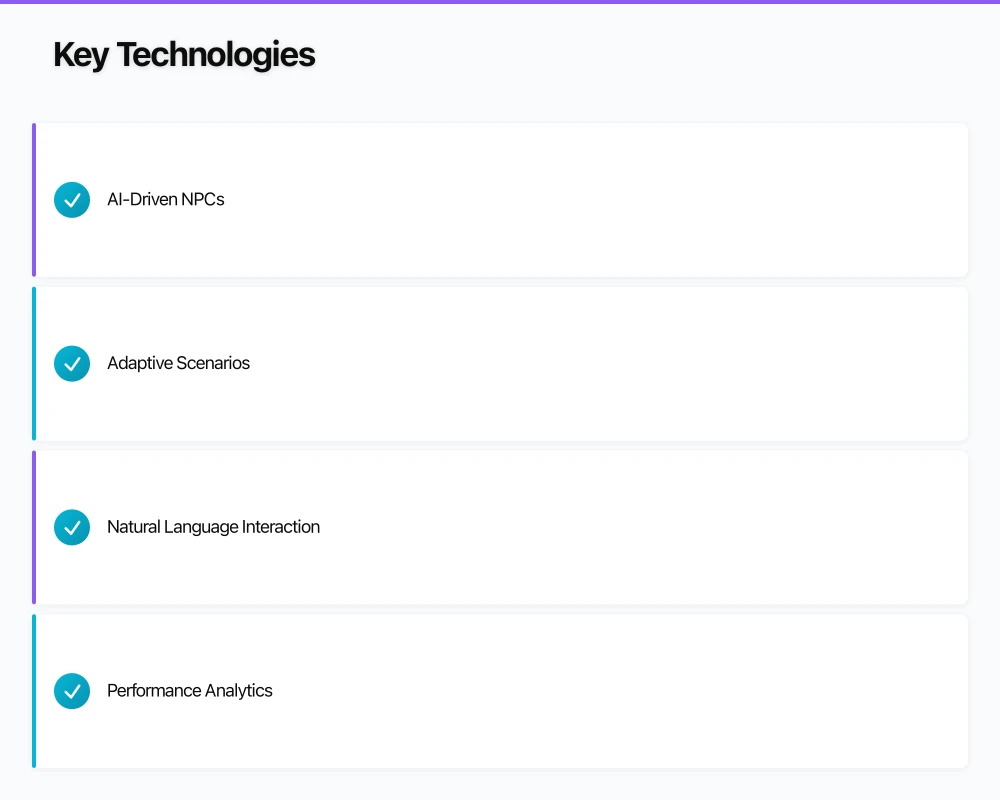
AI-Driven NPCs
Non-player characters (NPCs) in AI-enhanced VR act like real people. They use natural language processing to understand your speech, respond contextually, and remember previous interactions. Unity’s ML-Agents toolkit now powers NPCs that learn from thousands of interactions, creating increasingly realistic training scenarios.
For example, medical students at Johns Hopkins use VR systems where AI-powered patients describe symptoms naturally. The AI adjusts patient responses based on the student’s diagnostic approach, teaching clinical reasoning skills that would take years to develop through traditional methods.
Adaptive Scenarios
AI algorithms monitor 200+ data points per second during VR training sessions. They track eye movement, hand gestures, decision speed, and accuracy. This data feeds machine learning models that adjust scenario difficulty in real-time.
Meta’s research on adaptive VR learning shows that adaptive scenarios reduce training time by 60% compared to fixed-difficulty programs. The AI ensures learners stay in what psychologists call the “zone of proximal development”—challenged but not overwhelmed.
Natural Language Interaction
Voice interaction makes VR learning feel natural. Modern AI voice systems, powered by large language models, understand context and intent. You can ask questions, give commands, or have conversations with virtual instructors who respond intelligently.
According to Gartner’s 2024 Emerging Technologies report, 78% of VR training platforms now integrate conversational AI, up from just 23% in 2021. This shift makes VR training accessible without complex controllers—you simply talk and interact naturally.
Performance Analytics
AI analyzes your VR training sessions to identify strengths and weaknesses you might not notice. These systems use computer vision to track precise movements, like a surgeon’s hand steadiness or a welder’s torch angle. Machine learning algorithms compare your performance against thousands of expert sessions, providing specific improvement suggestions.
Walmart’s VR training program, which trains 1 million employees annually, uses AI analytics to personalize learning paths. Their data shows employees trained with AI-analyzed VR perform 70% better in assessment tests compared to traditional training methods.
Applications
Medical Training
Medical schools worldwide now use AI-enhanced VR for surgical training. The technology allows students to practice hundreds of procedures before touching real patients. The Lancet Digital Health published research showing VR-trained surgeons completed procedures 29% faster with 6x fewer errors.
Privacy is crucial in medical VR training. These systems follow HIPAA guidelines in the United States and GDPR in Europe, ensuring patient data used in scenarios is properly anonymized and encrypted.
Industrial Training
Companies like Boeing use VR to train technicians on complex aircraft maintenance. The AI system guides workers through 3D models, highlights potential errors before they happen, and tracks skill development over time. This approach reduced Boeing’s training costs by $15 million annually while improving safety outcomes.
Soft Skills Development
AI-powered VR excels at teaching interpersonal skills. Employees practice difficult conversations—like giving feedback or handling angry customers—with AI characters that react realistically. PwC’s study found VR learners were 40% more confident applying soft skills than video-trained peers.
Historical Education
Students can walk through ancient Rome, experience the signing of the Declaration of Independence, or explore prehistoric Earth. AI adds historical accuracy by powering characters who speak period-appropriate language and respond to student questions with contextual information.
Benefits and Implementation
The combination of AI and VR delivers measurable improvements:
According to IEEE’s 2024 survey on educational technology, institutions using AI-enhanced VR report 83% student engagement rates compared to 40% with traditional lectures. Students also show 35% better knowledge retention after three months.
Safety is another major benefit. Training for dangerous jobs—firefighting, high-voltage electrical work, chemical plant operations—can happen in VR without any risk. AI systems can simulate rare emergency scenarios that would be impossible to recreate safely in real life.
The scalability advantage is significant. One AI-enhanced VR program can train thousands of learners simultaneously, each receiving personalized instruction. Traditional one-on-one training simply can’t match this scale.
Challenges and Considerations
Hardware costs remain a barrier, though prices are dropping. Professional VR headsets cost $400-$1,000, while specialized systems for medical or industrial training can exceed $10,000. However, Gartner predicts prices will fall 40% by 2026 as production scales.
Motion sickness affects 25-40% of first-time VR users, though AI is helping solve this problem. Modern systems use machine learning to predict and prevent motion sickness by adjusting frame rates and movement patterns based on individual tolerance levels.
Content development remains complex and expensive. Creating AI-enhanced VR training programs requires teams of developers, AI specialists, and subject matter experts. A single high-quality training module can cost $100,000-$500,000 to develop.
The Future
The next generation of AI-VR learning looks even more promising. Brain-computer interfaces are entering testing phases, potentially allowing VR systems to adapt based on your thoughts and stress levels. Facebook Reality Labs is developing haptic gloves that provide realistic touch feedback, making VR training even more effective.
Social VR learning platforms are emerging where students worldwide can learn together in shared virtual spaces, guided by AI tutors. These systems break down geographical barriers while maintaining personalized learning paths for each participant.
Conclusion
AI-enhanced VR learning is transforming education from something that happens to you into something you experience. The technology makes learning faster, safer, and more engaging while providing unprecedented personalization. As costs decrease and capabilities improve, this combination will become standard in schools, universities, and corporate training programs worldwide.
The question isn’t whether AI and VR will transform learning—it’s how quickly institutions will adopt these powerful tools to give their students and employees the best possible educational experience.
Sources
- Grand View Research - VR in Education Market - 2023
- Nature - VR Learning Effectiveness Study - 2021
- Stanford Medicine - VR Medical Training Research - 2023
- PwC - Virtual Reality and Learning Study - 2023
- Gartner - Emerging Technologies Report 2024 - 2024
- The Lancet Digital Health - Surgical VR Training - 2023
- IEEE - Educational Technology Survey - 2024
- Meta Reality Labs - Adaptive Learning Research - 2023
Explore more educational technology innovations.
For technical deep-dives on the cloud and IT topics I cover strategically, visit Cloud Geeks — our specialist IT infrastructure blog.
These insights are drawn from my work leading Ganda Tech Services — helping Australian businesses navigate digital transformation through cloud, web, and mobile.
About the Author
Ashish Ganda is the founder of Ganda Tech Services, a Sydney-based technology consultancy specialising in cloud infrastructure, web development, and mobile app solutions for Australian businesses.
AI Strategy Primer for Australian Business Leaders
A practical framework for AI adoption in 2026 — cut through the hype and start with what matters.
Almost done
Check your inbox and click the confirmation link to get your download.