Which is Better: Willow or Majorana 1?
Introduction
A quantum computing researcher faced a critical purchasing decision in December 2024: Google just announced their Willow chip achieving below-threshold error correction, while Microsoft revealed Majorana 1 using topological qubits. Both represented years of investment and fundamentally different technological bets. But his research budget couldn’t accommodate both platforms—he needed to choose.
His dilemma mirrors what organizations worldwide now face: which quantum computing approach offers the better path forward? The answer isn’t straightforward because “better” depends entirely on timeline, use case, and technological risk tolerance.
Google announced Willow in December 2024 as a 105-qubit superconducting processor achieving exponential error reduction—the first demonstration of below-threshold quantum error correction at scale. Microsoft revealed Majorana 1 as their first topological qubit chip, representing a decade of research into inherently stable quantum systems.
Nature’s coverage of the announcements describes this as a “pivotal moment” where quantum computing splits into two distinct technological paths: brute-force error correction versus topological protection. Understanding the tradeoffs between these approaches is essential for anyone planning quantum computing investments.
Google’s Willow Chip
The Technology
Willow represents Google’s eighth-generation superconducting qubit processor, incorporating years of refinement in qubit design, control systems, and error correction. The chip contains 105 physical qubits arranged in a two-dimensional grid optimized for surface code error correction.
The breakthrough achievement: exponential error reduction as qubit array size increases. According to Google’s Nature paper, moving from a 3×3 qubit array to a 7×7 array reduced error rates by a factor of 2—demonstrating that adding more qubits actually improves performance rather than degrading it, as previous systems experienced.
Coherence times reached approximately 100 microseconds—nearly 5× improvement over previous generations. This extended coherence window enables more complex quantum algorithms to complete before qubits lose their quantum state.
The headline benchmark: Willow completed a random circuit sampling calculation in under 5 minutes that would require the world’s fastest classical supercomputer approximately 10 septillion years (10^25). While critics note this particular calculation has limited practical application, it demonstrates quantum advantage at unprecedented scale.
Key Advantages
Proven Manufacturing: Google’s Santa Barbara facility has produced eight generations of superconducting processors, developing sophisticated fabrication and quality control. This manufacturing maturity enables consistent qubit performance—critical for scaling beyond 1,000 qubits.
Below-Threshold Error Correction: The exponential error reduction crosses the critical threshold where adding more physical qubits to create logical qubits reduces total error rates. Research from Yale estimates this threshold around 1% physical error rate—Willow achieves 0.1% on certain gates.
Clear Scaling Roadmap: Google’s quantum roadmap targets 1,000 logical qubits by 2029 using surface code error correction with approximately 1,000 physical qubits per logical qubit. The Willow results validate this approach’s viability.
Cloud Access: Willow processors integrate with Google Cloud’s quantum computing service, enabling researchers worldwide to access quantum hardware without building their own dilution refrigerators. Over 10,000 researchers currently use Google’s quantum systems via cloud.
Limitations
Extreme Cooling Requirements: Willow operates at approximately 15 millikelvin—0.015 degrees above absolute zero. Dilution refrigerators achieving these temperatures cost $1-3 million and consume significant power (typically 15-25 kW). This infrastructure requirement limits deployment locations.
Complex Calibration: Each qubit requires individual tuning of multiple parameters: frequency, anharmonicity, coupling strengths. Calibration procedures run continuously, consuming 20-30% of system time. As qubit counts increase, calibration complexity grows superlinearly.
High Error Rates on Certain Operations: While single-qubit gate errors reach 0.1%, two-qubit gate errors remain around 0.4%. Quantum algorithms requiring many two-qubit operations accumulate errors rapidly, limiting practical algorithm depth.
Energy-Hungry Infrastructure: The complete system—dilution refrigerator, control electronics, classical computing support—consumes approximately 25 kW per processor. Scaling to thousands of processors raises sustainability concerns.
Microsoft’s Majorana 1
The Technology
Majorana 1 represents Microsoft’s first functional topological qubit chip, culminating over a decade of research into Majorana fermions—exotic quasiparticles that exist at the boundary between superconductors and semiconductors. The chip contains approximately 8 topological qubits, though Microsoft has released limited technical specifications.
The revolutionary insight: topological qubits encode quantum information non-locally across multiple Majorana zero modes. This topological protection means that local perturbations (noise, thermal fluctuations, electromagnetic interference) cannot directly corrupt the quantum state—errors require moving Majorana fermions around each other, an energetically unfavorable process.
Microsoft’s Azure Quantum platform provides cloud access to Majorana 1, though currently limited to select research partners. The company hasn’t released detailed benchmarking data comparable to Google’s random circuit sampling, focusing instead on demonstrating fundamental topological properties.
Operating temperature sits around 20 millikelvin—slightly warmer than Willow but still requiring dilution refrigeration. The hybrid superconductor-semiconductor architecture uses aluminum and indium arsenide nanowires, combining materials in ways that create conditions for Majorana fermions to emerge.
Key Advantages
Inherent Stability: Topological protection provides error resistance without active correction. Theoretical calculations suggest topological qubits could maintain coherence for seconds rather than microseconds—a 10,000× improvement over superconducting qubits.
Scalability Efficiency: Error-resistant topological qubits require far fewer physical qubits per logical qubit. Estimates suggest 10-100 physical topological qubits could create one logical qubit versus 1,000-10,000 physical superconducting qubits—a 100× resource advantage.
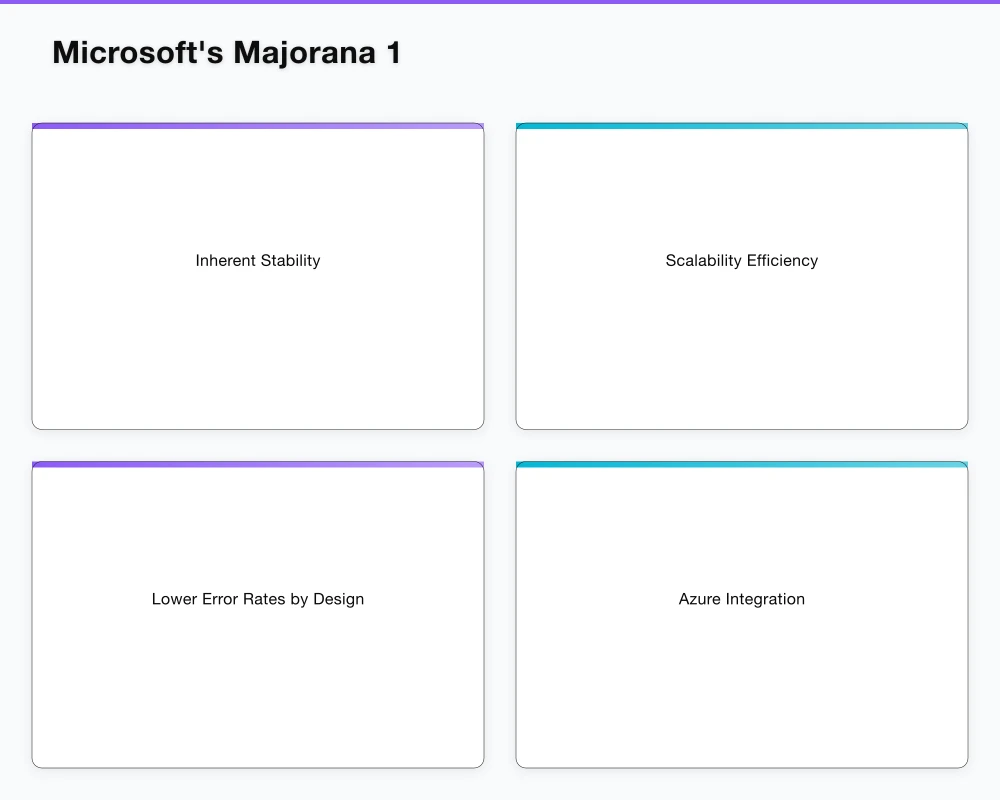
Lower Error Rates by Design: Rather than fighting errors with active correction, topological qubits prevent errors from occurring. Microsoft’s research claims topological qubits could achieve error rates below 10^-6 compared to superconducting qubits’ 10^-3 baseline.
Azure Integration: Majorana 1 integrates with Azure’s quantum development kit, enabling hybrid classical-quantum workflows. Microsoft’s Q# language optimizes specifically for topological qubits’ characteristics.
Long-Term Potential: If topological qubits achieve their theoretical performance, they could enable quantum algorithms requiring millions of operations—currently impossible on superconducting systems. Algorithms like Shor’s factoring require error rates below 10^-4 for practical key lengths.
Limitations
Unproven at Scale: With only 8 qubits demonstrated, Majorana 1 hasn’t shown that topological protection works in large-scale systems. Scaling from 8 to 1,000 qubits introduces new coupling and crosstalk challenges.
Manufacturing Complexity: Creating reliable Majorana fermions requires precise nanowire fabrication and superconductor-semiconductor interfaces. Yield rates remain low—most fabricated devices don’t exhibit clear Majorana signatures.
Limited Benchmarking: Microsoft hasn’t published computational benchmarks comparable to Google’s random circuit sampling. Independent verification of topological properties remains an active research question.
Longer Development Timeline: Topological quantum computing is 5-10 years behind superconducting approaches in maturity. Microsoft’s roadmap targets useful quantum computers in the “late 2020s” versus Google’s near-term goals.
Uncertain Practical Performance: Theoretical advantages assume perfect topological protection. Real-world systems may exhibit “quasi-topological” behavior with error rates between superconducting and ideal topological qubits.
Head-to-Head Comparison
| Feature | Willow (Google) | Majorana 1 (Microsoft) |
|---|---|---|
| Qubit Type | Superconducting transmon | Topological (Majorana fermions) |
| Physical Qubits | 105 demonstrated | ~8 demonstrated |
| Coherence Time | ~100 microseconds | Seconds (theoretical) |
| Error Approach | Active correction (surface code) | Passive topological protection |
| Single-Qubit Error | ~0.1% | less than 0.0001% (theoretical) |
| Two-Qubit Error | ~0.4% | less than 0.001% (theoretical) |
| Physical→Logical Ratio | ~1,000:1 | ~10-100:1 (theoretical) |
| Maturity Level | Production-ready (8th generation) | Early research phase |
| Operating Temperature | ~15 millikelvin | ~20 millikelvin |
| Power Consumption | ~25 kW per system | Similar (dilution refrigerator) |
| Cloud Access | Google Cloud Quantum (public) | Azure Quantum (limited partners) |
| Benchmark Demonstrated | Random circuit sampling (10^25 advantage) | No published computational benchmarks |
| Estimated Cost | $10-30M per system | Unknown (research phase) |
| Timeline to 1,000 Qubits | 2-3 years | 5-10 years |
Which Should You Choose?
Choose Willow If:
You Need Results Now: Google Cloud Quantum provides immediate access to Willow-class processors for algorithm testing and development. Organizations needing quantum computing capabilities in 2025-2026 have no alternative—topological qubits won’t reach production maturity for 5+ years.
Your Use Case Tolerates High Error Rates: Applications like quantum machine learning, optimization heuristics, and hybrid quantum-classical algorithms can function with current 0.1-0.4% error rates. NISQ algorithms (Noisy Intermediate-Scale Quantum) specifically target this performance range.
You Value Proven Technology: Eight generations of superconducting processors demonstrate Google’s ability to manufacture, calibrate, and operate quantum systems reliably. Manufacturing yields exceed 80% for working qubits meeting specifications.
You’re Building on Existing Research: Over 10,000 papers have been published on superconducting qubits. This vast knowledge base accelerates development and troubleshooting versus topological qubits’ nascent literature.
Budget Constraints Exist: Superconducting processors have established supply chains and multiple vendors (IBM, Rigetti, IonQ alternative technologies). Topological qubits remain single-source from Microsoft with uncertain pricing.
Choose Majorana 1 If:
You’re Planning for Long-Term Quantum Advantage: If your roadmap extends to 2030 and beyond, topological qubits’ superior theoretical error rates could enable algorithms impossible on superconducting systems. Shor’s algorithm for 2048-bit RSA requires error rates below 10^-4—achievable with topological but not superconducting qubits.
Your Application Requires Many Gates: Topological protection enables algorithms with millions of operations. Drug discovery, materials simulation, and cryptography analysis need this depth. Current superconducting systems limit algorithms to ~10,000 gates before error accumulation overwhelms results.
Research Partnership Opportunities: Microsoft offers collaboration agreements providing early access to topological quantum technology. Organizations willing to co-develop applications gain first-mover advantages when topological systems mature.
You Value Future-Proof Investment: If topological qubits achieve theoretical performance, early investments position organizations ahead of competitors stuck on superconducting architectures. Quantum cryptography applications particularly benefit from ultra-low error rates.
Efficiency Matters Long-Term: The 100× advantage in physical qubits per logical qubit translates to smaller, cheaper, more power-efficient quantum computers at scale. Data center constraints favor efficient architectures.
The Bigger Picture
The Willow versus Majorana 1 choice mirrors historical technology transitions: proven incumbents versus revolutionary challengers. Similar dynamics played out with vacuum tubes versus transistors, hard drives versus solid state storage, and internal combustion versus electric vehicles.
Google’s Bet: Brute-force error correction using massive qubit arrays can reach useful quantum computing before topological approaches mature. With 105 qubits achieving below-threshold error correction, Google’s roadmap targets 1,000 logical qubits (1,000,000 physical qubits) by 2030.
Microsoft’s Bet: Topological protection provides the only path to fault-tolerant quantum computing at practical scales. Rather than fighting noise with correction, eliminate noise at the physics level. Microsoft’s strategy accepts slower near-term progress for superior long-term architecture.
Both companies are betting billions. Both could be right—superconducting qubits may deliver near-term applications while topological qubits enable long-term capabilities. Or one approach may prove fundamentally superior, making the other obsolete.
Market analysts from Gartner predict quantum computing will reach $15 billion annually by 2030, driven initially by superconducting systems transitioning to topological architectures if Microsoft’s bet pays off.
Conclusion
The researcher from our introduction chose Willow—he needed results within his 3-year grant timeline. But he’s watching Majorana 1’s progress closely, ready to shift if topological qubits demonstrate practical advantages.
There is no universal “better” between Willow and Majorana 1. The right choice depends entirely on timeline, application requirements, risk tolerance, and strategic positioning.
For near-term applications (2025-2027), Willow provides the only viable path. Practical quantum computing delivering business value in drug discovery, optimization, and machine learning runs on superconducting processors today.
For long-term advantage (2028+), Majorana 1’s topological approach could prove transformative. Applications requiring millions of quantum operations—cryptography, complex simulation, quantum search—need topological qubits’ ultra-low error rates to function.
The quantum computing field benefits from both approaches. Competition accelerates progress, diverse architectures reduce risk, and the eventual winner (or synthesis of both) will emerge through technological evolution rather than speculation.
The real question isn’t which chip wins—it’s whether your quantum computing strategy positions you to benefit from both pathways as they unfold.
Sources
- Google Research - Willow Quantum Chip Announcement - December 2024
- Microsoft - Majorana Topological Qubit - December 2024
- Nature - Quantum Computing Breakthrough 2024 - 2024
- Nature - Google Willow Error Correction - December 2024
- Google Quantum - Coherence Documentation - 2024
- MIT Technology Review - Google Willow Quantum Supremacy - December 2024
- Google Quantum Hardware - 2024
- arXiv - Quantum Error Correction Thresholds - 2024
- Google Quantum Roadmap - 2024
- Nature - Topological Quantum Computing Review - 2024
- Azure Quantum Platform - 2024
- Microsoft Research - Quantum Computing - 2024
- Gartner - Quantum Computing Market Analysis - 2024
Stay updated on quantum computing developments.
For hands-on web development and SEO advice, visit Cosmos Web Tech — our specialist web design and digital marketing blog.
Ganda Tech Services is my technology consultancy, bringing together cloud infrastructure, web development, and mobile expertise for Australian businesses.
About the Author
Ashish Ganda is the founder of Ganda Tech Services, a Sydney-based technology consultancy specialising in cloud infrastructure, web development, and mobile app solutions for Australian businesses.
Digital Transformation Roadmap 2026
A 12-month framework for Australian SMBs ready to modernise — phases, tools, and milestones.
Almost done
Check your inbox and click the confirmation link to get your download.