When the Layout Became a File the Renderer and the Gate Both Read
We had the same argument every few weeks, on different videos, for long enough that we stopped noticing it was the same argument. Someone reviewing a rendered frame would say the caption sat too close to the platform’s UI chrome, or the logo had drifted out of the safe area. Someone on the code side would say it matched the brief. Both people were looking at the same picture. Neither of them had measured it.
That is not a complaint about anyone involved. It is what happens when the only artefact two sides share is a rendered image, and a rendered image invites a verdict rather than a check. “Is this correct” is a hard question to close when the thing being judged is a frame and the thing being defended is whatever the code was supposed to have done to produce it. There was no third object either side could point to and say: measure it against this.
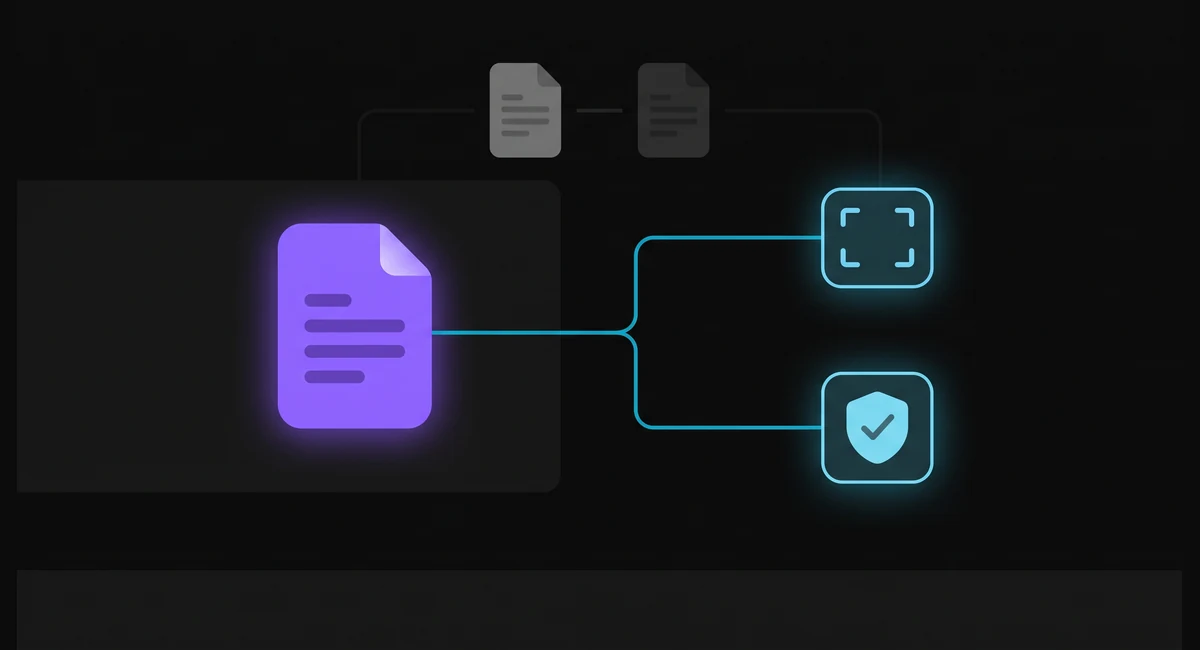
On 15 September we shipped the third object. It is a frame specification file, 422 lines, and its size is not the point. The point is who reads it. The renderer reads it to produce the frame. The verification gate reads the same file — not a copy, not a document meant to describe it — to check the frame the renderer produced. Two separate pieces of code, with no reason to agree with each other except that they are parsing identical structured data.
The disagreement that goes away
Before the file existed, correctness lived in two places that had no formal connection: the renderer’s internal logic, and a reviewer’s memory of what the layout brief said. Those two things drift. Not through negligence — through the ordinary mechanism of a brief getting reinterpreted every time someone reads it. The renderer’s author reads “logo in the top-right corner” one way. The reviewer, six weeks later, reads the same sentence and pictures a slightly different corner. Nobody is wrong. Nobody has anything to be wrong against.
Once both sides read the same file, “is this correct” stops being a question about a rendered frame and becomes a question about whether the frame matches the file. That is a question with one right answer, and — more usefully — it is a question a computer can answer without a person looking at a picture at all. If the frame does not match, either the file is wrong, which is visible and fixable by whoever authored it, or the renderer has a bug reading a file the gate reads identically, which is also visible, because the gate would flag the same mismatch the renderer produced.
We had, in effect, been arguing about a photograph when what we needed was a blueprint both parties had agreed to read the same way. We had made almost exactly this mistake before, on a completely different part of the pipeline: treating a number as ground truth before checking whether the thing producing the number and the thing reading it agreed on what it meant.
Fail closed, on purpose
The less glamorous half of the 15 September change is the part that actually removes risk: gates fail closed on any combination of channel and video form that has not been authored in the specification file. If nobody has written an entry for a given pairing, the pipeline does not fall back to a generic layout, does not guess at reasonable defaults, and does not render something and mark it “needs review.” It renders nothing.
That sounds like it should be the obvious choice, and in hindsight it is, but the obvious choice is not what most systems do under pressure. The easier failure mode — the one we’d have shipped without thinking about it — is to render something, because a partially wrong frame at least gives you a starting point to argue about, and an empty output looks like the pipeline is broken rather than working correctly. We had to actively choose the option that looks worse on a status dashboard, because the alternative is a rendered frame nobody authored and nobody can check against anything. That frame would have looked fine in a screenshot and been wrong in a way the gate had no way to catch, because there was nothing in the specification file to catch it against.
This is the same shape of decision we described in a meta-gate making checks un-bypassable: a system that can silently produce unverified output is worse than a system that visibly produces nothing, even though the second one generates more support tickets in the short term. Loud failure is a feature. Quiet failure is the thing that eventually reaches a viewer.
What this doesn’t fix
We are not going to overstate this. The frame specification file does not make layout decisions correct — it makes them checkable. A badly designed layout, faithfully declared and faithfully rendered, passes the gate every time. The gate verifies fidelity to the file, not the quality of the file’s contents. Somebody still has to look at a channel-and-form pairing at least once, decide it is right, and write it down. What changes is what happens after that: the decision gets made once, gets recorded, and every subsequent render either matches it or gets refused. Before, every render was a fresh opportunity to drift from a decision nobody had written down anywhere a machine could read.
There is also a cost we didn’t fully appreciate until we were living with it: every new channel or new video form is now a piece of authoring work before it can render at all. That is the trade we made, deliberately, and it is worth naming rather than pretending the fail-closed behaviour was free. A system that refuses to render undeclared combinations is a system where declaring combinations is now on the critical path, not an optional nicety you get to eventually. We watched this play out almost immediately in a related piece of the same work — the actual authored set of channel-and-form pairs, and what happens to everything outside it, is documented separately because it deserves its own account rather than a paragraph here.
We’d made a version of this same trade before and gotten it wrong in the opposite direction — see the quality gates that drifted for months before two posts shipped at 300 words and nobody had noticed the gate wasn’t checking what everyone assumed it was checking. The lesson we’re applying here is the same one from that post-mortem, just applied earlier: a check is only as good as the thing it’s checking against, and if that thing lives in someone’s head instead of a file, the check is decorative.
The actual shift
None of this is a claim that automated rendering is now “solved” for video layout. It is a narrower claim: the specific argument we used to have — is this frame correct, according to whom, measured against what — no longer has a version where both sides are right and disagreeing. The file is either matched or it isn’t. That single change moved a recurring, low-grade dispute out of every review cycle and into a one-time authoring step per channel-and-form combination, which is a trade we’d make again.
If you’re running into the same shape of problem — a rendering pipeline where “correct” currently lives in a reviewer’s head rather than in anything the code reads — it’s worth comparing notes; you can get in touch here.
Digital Transformation Roadmap 2026
A 12-month framework for Australian SMBs ready to modernise — phases, tools, and milestones.