
The Future of AI Regulation: Global Frameworks Taking Shape
Introduction
In August 2024, the European Union’s AI Act officially entered into force, establishing the world’s first comprehensive regulatory framework for artificial intelligence affecting every company deploying AI systems within the EU’s 450 million person market. The regulation categorizes AI systems by risk level—from minimal risk (AI-powered spam filters) to unacceptable risk (social scoring systems, real-time biometric surveillance)—with requirements scaling proportionally: high-risk systems like medical diagnostic AI or credit scoring algorithms must undergo conformity assessments, maintain technical documentation demonstrating compliance with safety and transparency requirements, and implement human oversight mechanisms before market deployment. Companies violating the Act face fines up to €35 million or 7% of global annual revenue, whichever is higher—penalties comparable to GDPR enforcement, which has levied €4.2 billion in fines since 2018. Early compliance data from the first six months shows 340+ companies registered AI systems for regulatory review, with 23% receiving conditional approvals requiring modifications to transparency disclosures, 8% facing deployment delays pending additional safety testing, and 3% denied market access for non-compliance with fundamental rights requirements. This regulatory milestone signals a broader global trend: governments worldwide are transitioning from aspirational AI ethics principles to enforceable legal frameworks, creating a complex landscape where organizations must navigate divergent requirements across jurisdictions while managing the inherent tension between enabling innovation and ensuring safety, fairness, and accountability.
The Global Regulatory Landscape: Divergent Approaches and Common Themes
AI regulation has evolved from voluntary industry self-governance to binding legal frameworks over the past five years, driven by high-profile AI failures including discriminatory hiring algorithms (Amazon’s recruiting tool showing gender bias), deadly accidents involving autonomous systems (Uber’s self-driving vehicle fatality in Arizona), and manipulative AI applications (Cambridge Analytica’s algorithmic voter profiling). However, regulatory philosophies vary significantly across major jurisdictions, reflecting different cultural values, economic priorities, and governance traditions.
The European Union’s risk-based approach, codified in the AI Act approved in March 2024, represents the most comprehensive framework globally. The regulation establishes four risk categories: unacceptable risk (prohibited applications including social scoring by governments, real-time biometric identification in public spaces except narrow law enforcement exceptions, manipulative AI exploiting vulnerabilities, subliminal techniques beyond conscious perception), high risk (applications affecting safety or fundamental rights including critical infrastructure, education/employment decisions, essential services access, law enforcement, migration/asylum decisions, justice administration), limited risk (requiring transparency disclosures, such as chatbots where users must know they’re interacting with AI, deepfakes requiring clear labeling), and minimal risk (no specific obligations beyond existing laws). High-risk AI systems face stringent requirements: risk management systems throughout the lifecycle, high-quality training data meeting representativeness standards, technical documentation for regulatory review, detailed logging enabling traceability, human oversight capabilities preventing automated decision-making without review paths, robustness and accuracy thresholds verified through testing, and cybersecurity measures protecting against adversarial attacks. Compliance costs vary dramatically by risk category: minimal-risk systems face negligible burdens while high-risk systems require €500,000-2 million in initial compliance investment plus ongoing monitoring costs—creating significant barriers for startups while established enterprises possess resources to navigate complexity.
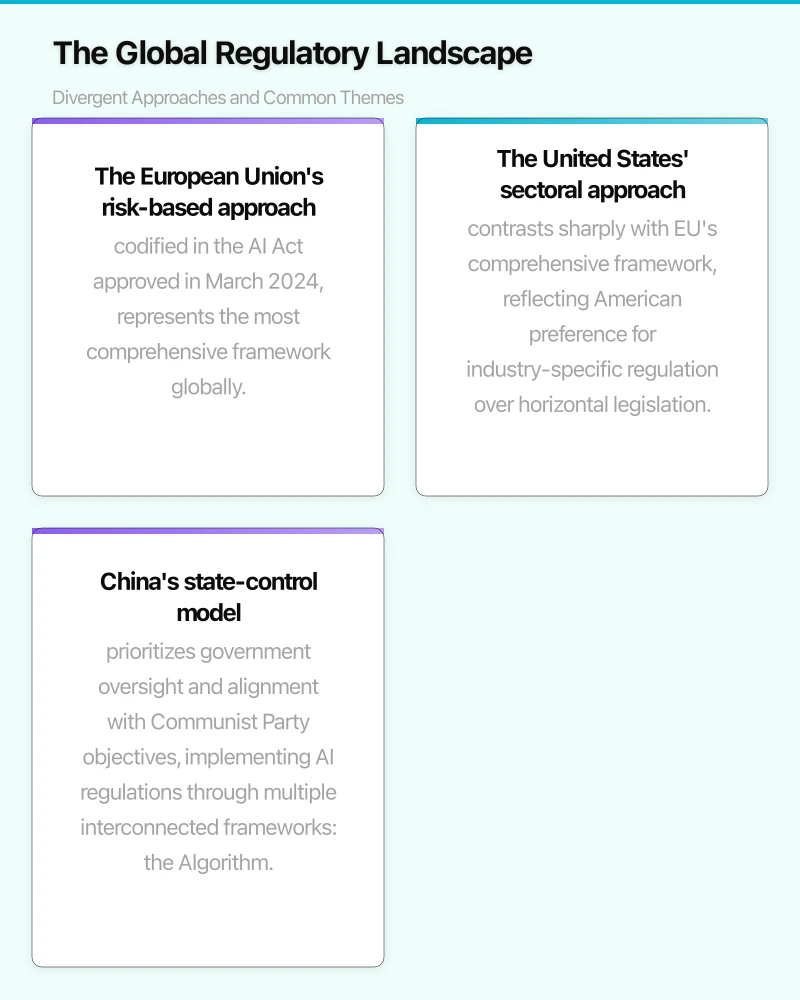
The United States’ sectoral approach contrasts sharply with EU’s comprehensive framework, reflecting American preference for industry-specific regulation over horizontal legislation. Rather than one omnibus AI law, the US has developed multiple sector-focused initiatives: the FDA regulates medical AI through its Software as Medical Device framework (requiring clinical validation, adverse event reporting, and post-market surveillance), the EEOC and Department of Justice enforce civil rights laws prohibiting discriminatory AI in hiring and lending, the FTC applies consumer protection authority to prevent deceptive AI practices, and NIST develops voluntary AI Risk Management Framework adopted by federal agencies through executive orders. The Biden Administration’s October 2023 Executive Order on Safe, Secure, and Trustworthy AI established reporting requirements for foundation models trained on >10^26 FLOPs (computational power threshold targeting frontier systems like GPT-4, Claude, Gemini), safety testing standards for dual-use models with potential bioweapon or cyberattack applications, and red-teaming requirements where independent evaluators probe systems for dangerous capabilities. However, US regulation remains primarily voluntary outside specific sectors, with enforcement fragmented across agencies and compliance often driven by litigation risk rather than proactive regulatory approval—creating flexibility enabling rapid innovation but also regulatory uncertainty and inconsistent standards. Stanford’s AI Index 2024 found that while EU companies cite regulatory clarity as primary concern (67% identify compliance costs as innovation barrier), US companies emphasize liability uncertainty (58% report litigation risk shapes development decisions more than regulatory requirements).
China’s state-control model prioritizes government oversight and alignment with Communist Party objectives, implementing AI regulations through multiple interconnected frameworks: the Algorithm Recommendation Management Provisions (requiring registration of recommendation algorithms with Cyberspace Administration, transparency about algorithmic parameters, and user rights to opt out of algorithmic curation), Generative AI Measures (mandating content moderation preventing generation of “illegal content” including political dissent, security review for large models before public deployment, watermarking to identify AI-generated content), and pending comprehensive AI legislation establishing liability frameworks. Chinese regulation emphasizes ideological control alongside technical safety: generative AI systems must “embody core socialist values,” avoid generating content undermining state power, and implement real-name registration linking users to government IDs—requirements foreign companies find incompatible with operations elsewhere. However, China has also invested $47 billion in AI development through state subsidies, creating dual mandate of controlled innovation where government simultaneously restricts and accelerates AI deployment. This approach has produced 340+ AI unicorn startups and world-leading deployment in surveillance (600 million facial recognition cameras nationwide), while companies like ByteDance, SenseTime, and Baidu compete globally despite domestic content restrictions through parallel international and domestic product versions.
The EU AI Act: Deep Dive into Requirements and Implementation
The EU AI Act represents the most detailed and consequential AI regulation globally, meriting deeper examination of requirements, enforcement mechanisms, and implementation timeline affecting organizations worldwide (any company deploying AI in EU regardless of headquarters location).
High-risk AI system requirements create eight mandatory obligations that organizations must demonstrate before market deployment. Risk management systems must identify and mitigate foreseeable risks throughout the AI lifecycle—from data collection through model training, validation, deployment, and ongoing monitoring—with documented risk assessments updated as systems evolve. Clearview AI’s facial recognition system, deployed by law enforcement agencies, exemplifies high-risk classification: the system processes biometric data for identification purposes (explicitly listed as high-risk), affects fundamental rights (privacy, non-discrimination), and operates in law enforcement context. Under the AI Act, Clearview would need documented risk assessments addressing accuracy disparities across demographic groups (research by MIT and Stanford found facial recognition error rates 34× higher for dark-skinned women versus light-skinned men), privacy risks from mass biometric data collection, misuse potential if deployed beyond authorized purposes, and security vulnerabilities enabling unauthorized access. The system would require ongoing monitoring detecting accuracy degradation over time and mechanisms for individuals to contest identifications—requirements Clearview’s current design doesn’t meet, explaining why EU regulators have fined the company €30 million and banned operations in multiple member states.
Data governance obligations mandate that training data be “relevant, representative, free of errors and complete” relative to the AI system’s intended purpose—a deceptively simple requirement with complex implementation. For medical diagnostic AI trained to detect skin cancer from images, representativeness means training data must include adequate samples across skin tones (Fitzpatrick scale types I-VI), age groups, anatomical locations, lesion types, and image capture conditions (lighting, camera quality, angles) reflecting real-world deployment diversity. However, research published in The Lancet Digital Health analyzing 70 medical AI systems found that 67% failed to report demographic composition of training data, and among systems reporting demographics, 89% underrepresented darker skin tones relative to clinical populations—suggesting widespread non-compliance with representativeness requirements. Organizations must implement data quality management systems validating sufficiency before training, with documented procedures for addressing identified gaps through targeted data collection or deployment restrictions (e.g., limiting AI to demographic subgroups where performance has been validated).
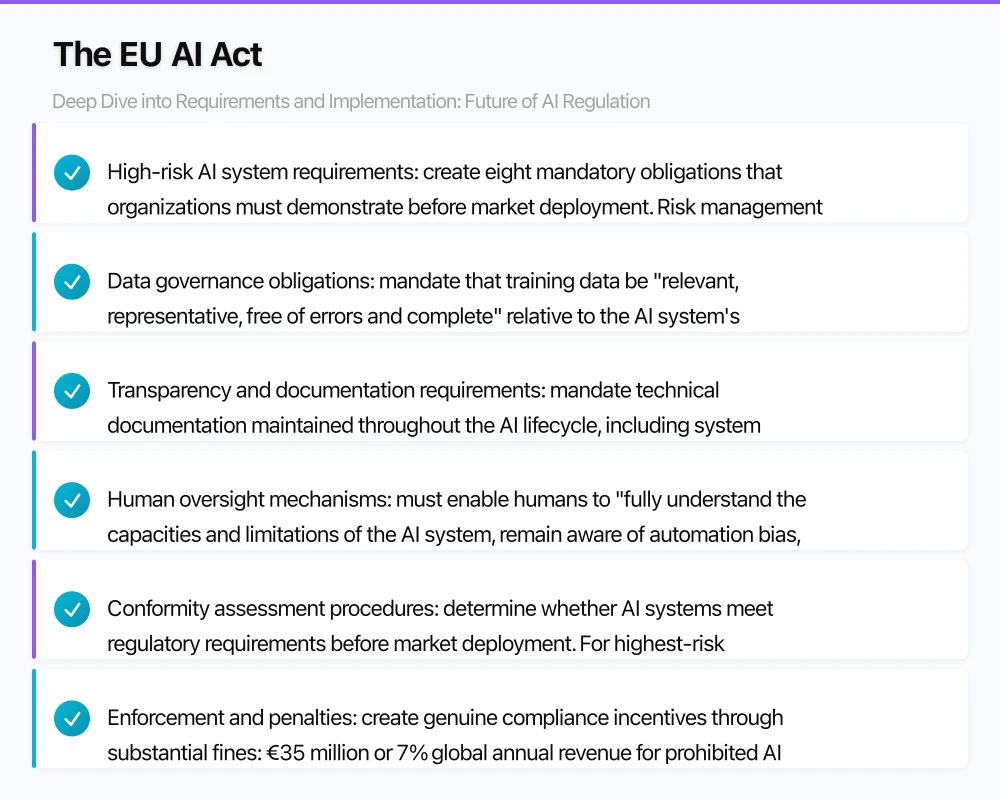
Transparency and documentation requirements mandate technical documentation maintained throughout the AI lifecycle, including system architecture specifications, training datasets and procedures, validation results and limitations, risk management documentation, human oversight mechanisms, and cybersecurity measures. For complex systems like large language models, documentation runs to thousands of pages. Anthropic’s “Constitutional AI” paper describing Claude’s training methodology spans 47 pages covering training data sources, reinforcement learning from human feedback procedures, safety evaluations, and known limitations—representing minimal documentation for high-risk LLM deployment under EU standards. Organizations must provide this documentation to regulators upon request and update it as systems evolve, creating significant ongoing compliance burden. The Act also requires user-facing transparency: deployers must inform users when interacting with AI systems, explain decision-making logic in understandable terms, and provide contact points for human review—requirements that many current AI implementations don’t meet.
Human oversight mechanisms must enable humans to “fully understand the capacities and limitations of the AI system, remain aware of automation bias, interpret the system’s output, and override or disregard the system’s output when necessary.” This requirement proves challenging for systems exhibiting emergent capabilities or operating at speeds/scales beyond human comprehension. In medical contexts, oversight might involve clinicians reviewing AI diagnostic suggestions before finalizing diagnoses—but research finds that human reviewers defer to AI recommendations 73% of the time even when AI is incorrect, a phenomenon called “automation bias.” Effective oversight requires interface design highlighting uncertainty, training humans to critically evaluate AI outputs, and workflows ensuring sufficient time for thoughtful review rather than rubber-stamping AI decisions. Some organizations implement “AI pause buttons” enabling humans to suspend automated systems when behavior seems anomalous, though this creates tension with AI’s efficiency value proposition.
Conformity assessment procedures determine whether AI systems meet regulatory requirements before market deployment. For highest-risk systems, third-party “notified bodies” (accredited testing labs designated by EU member states) conduct assessments verifying compliance—analogous to medical device certification processes. Lower-high-risk systems allow self-assessment where developers attest to compliance without third-party validation, though regulators retain audit authority. Assessment costs range from €50,000 for straightforward systems to €2 million+ for complex AI requiring extensive testing, creating significant barriers for startups and SMEs. The EU has established regulatory sandboxes in 23 member states providing streamlined approval processes and regulatory guidance for innovative AI systems, attempting to balance safety requirements with innovation concerns.
Enforcement and penalties create genuine compliance incentives through substantial fines: €35 million or 7% global annual revenue for prohibited AI use, €15 million or 3% revenue for high-risk AI non-compliance, €7.5 million or 1.5% revenue for providing incorrect information to regulators. Early enforcement activity has targeted facial recognition (€30 million fine to Clearview AI), employment screening AI exhibiting gender bias (€8 million penalty to Dutch recruitment platform), and credit scoring algorithms lacking transparency (€12 million fine to German fintech). These enforcement actions signal that regulators treat AI regulation seriously rather than symbolic compliance theater—companies cannot ignore requirements without substantial financial risk.
Emerging Regulatory Frameworks in Other Jurisdictions
While the EU pioneered comprehensive AI regulation, other jurisdictions are developing frameworks reflecting local priorities and governance approaches, creating a fragmented global landscape requiring multinationals to navigate conflicting requirements.
United Kingdom’s post-Brexit approach deliberately diverges from EU risk-based regulation, favoring “pro-innovation” principles-based governance. The UK government’s March 2024 AI White Paper proposes regulatory framework built on five principles (safety/security, fairness, transparency/explainability, accountability/governance, contestability/redress) implemented through existing sector regulators (Ofcom for AI in telecommunications, FCA for financial services AI, CQC for healthcare AI) rather than creating unified AI regulator. This approach provides flexibility but creates coordination challenges: different regulators interpret principles differently, leading to inconsistent requirements across sectors. However, UK’s lighter-touch regulation has attracted AI investment, with London hosting 34% of European AI startups despite representing 13% of Europe’s population—suggesting regulatory competitiveness affects innovation geography. The UK also established £100 million AI Standards Hub developing technical standards for AI testing and evaluation, attempting to lead standard-setting even while avoiding prescriptive regulation.
Canada’s Artificial Intelligence and Data Act (AIDA), part of broader Bill C-27 pending parliamentary approval, would establish risk-based framework similar to EU but with key differences. AIDA focuses on “high-impact systems” affecting health, safety, or human rights, requiring impact assessments before deployment, mitigation measures for identified risks, mandatory record-keeping, and government reporting obligations. However, AIDA grants broader discretion to administrators defining “high-impact” through regulations rather than legislating specific criteria—creating flexibility but also uncertainty. The framework emphasizes algorithmic impact assessments (AIAs) analyzing systems’ effects on different demographic groups, with requirement to publish summaries enabling public scrutiny—transparency mandate exceeding EU requirements that permit confidential regulatory submissions. AIDA also establishes Commissioner of AI with investigation and enforcement powers, criminal penalties for reckless AI causing serious harm (up to C$25 million fines or 5% revenue), and individual director liability for corporate AI violations—personal accountability provisions creating strong compliance incentives.
Singapore’s Model AI Governance Framework represents Asia-Pacific’s most developed AI governance approach, though it remains voluntary rather than legally mandated. The framework emphasizes practical implementation guidance for responsible AI, including tools for algorithmic impact assessment, explainability evaluation, and human oversight design. Rather than prescriptive requirements, Singapore provides best practices and industry-specific guidance, with government agencies like the Monetary Authority of Singapore (MAS) incorporating AI governance expectations into financial services supervision. This soft-law approach has established Singapore as Asia’s AI governance leader while preserving regulatory flexibility, though critics argue voluntary frameworks lack enforcement teeth to prevent AI harms. Singapore has also launched AI Verify testing toolkit enabling organizations to validate AI systems against governance principles through standardized technical tests—providing practical implementation support rather than theoretical compliance obligations.
Brazil’s AI Bill (PL 2338/2023), under congressional consideration, would establish rights-based framework focused on protecting individuals affected by AI systems. The bill creates rights to information about AI decision-making, explanation of automated decisions affecting rights, human review of consequential AI determinations, opt-out from automated decision-making in high-stakes contexts, and compensation for AI-caused harms. Brazil’s approach emphasizes individual empowerment and remedies rather than ex-ante system approval, reflecting civil law tradition prioritizing rights protection over regulatory licensing. The framework would apply extraterritorially to AI systems affecting Brazilian individuals regardless of provider location—mirroring GDPR’s territorial scope—and establish National AI Authority coordinating policy implementation. However, the bill has faced business opposition concerned about compliance costs and innovation restrictions, with ongoing negotiations balancing rights protection with economic competitiveness.
Technical Challenges in Regulatory Compliance
AI regulation creates novel technical challenges beyond traditional software compliance, reflecting AI systems’ probabilistic behavior, opacity, emergent properties, and continuous learning—characteristics that resist conventional testing and validation methodologies.
Auditing and testing AI systems for regulatory compliance requires measuring properties like fairness, robustness, and explainability that lack universally accepted definitions or measurement standards. Consider fairness requirements: the EU AI Act mandates that high-risk AI avoid discrimination, but computer science research has identified 21+ mathematical definitions of fairness—many mutually exclusive. An employment screening AI cannot simultaneously satisfy demographic parity (selecting candidates from protected groups at same rate as overall population), equalized odds (error rates equal across groups), and predictive rate parity (positive predictions equally accurate across groups)—achieving one fairness definition often violates others. Organizations must choose which fairness metric aligns with legal requirements and ethical obligations for their specific context, a determination requiring legal, ethical, and technical judgment that many companies lack capacity to make rigorously.
Robustness testing—verifying that AI performs reliably under distribution shift, adversarial inputs, and edge cases—faces similar definitional ambiguity. Autonomous vehicle AI must handle situations not present in training data (unusual weather, construction zones, unpredictable pedestrian behavior), but comprehensively testing all possible scenarios is infeasible (10^40+ potential driving situations according to RAND Corporation analysis). Industry has developed scenario-based testing methods evaluating performance on representative edge cases, but no consensus exists on what constitutes sufficient testing for regulatory approval. Tesla’s Full Self-Driving system has driven 340 million miles under supervision, yet continues encountering situations it handles unsafely—suggesting that mileage-based validation doesn’t guarantee comprehensive robustness. Regulators require organizations to demonstrate “appropriate level of accuracy, robustness, and cybersecurity,” but translating qualitative requirements into quantitative thresholds suitable for testing remains unresolved challenge.
Explainability and transparency requirements conflict with technical characteristics of modern AI systems, particularly deep neural networks whose decision-making emerges from millions of parameters in ways that resist human comprehension. The EU AI Act requires that high-risk AI provide “an appropriate level of transparency to enable users to interpret the system’s output and use it appropriately”—but GPT-4 contains an estimated 1.76 trillion parameters, and no existing methodology can translate this parameter space into explanations comprehensible to non-experts. Research has developed post-hoc explainability techniques like attention visualization (highlighting input features the model focused on), counterfactual explanations (showing how changing inputs would alter outputs), and surrogate models (approximating complex models with simpler interpretable alternatives)—but these explanations are incomplete, sometimes misleading, and don’t constitute true transparency about internal decision processes. Organizations face tension between deploying most accurate AI (often complex deep learning) and meeting explainability requirements (favoring simpler models with worse performance), with no regulatory guidance on acceptable tradeoffs.
Continuous learning and model updates create compliance challenges for regulations designed for static products. Traditional medical devices undergo pre-market approval and remain fixed unless manufacturers file for recertification—but adaptive AI systems improve through ongoing learning from new data, potentially altering behavior in ways requiring revalidation. The FDA’s AI/ML Medical Device Action Plan addresses this through “predetermined change control plans” where manufacturers pre-specify what modifications are allowed (data sources, retraining frequency, performance thresholds) and obtain approval for the modification protocol rather than each individual update—enabling continuous improvement within approved boundaries. However, implementing predetermined change control requires accurately predicting how AI will evolve, identifying all risks that might emerge, and establishing monitoring sufficient to detect when systems drift beyond approved parameters—non-trivial requirements for systems exhibiting emergent behaviors. The EU AI Act’s post-market monitoring obligations similarly require ongoing compliance validation, but implementation details remain unclear as regulatory precedents develop through early enforcement actions.
Navigating the Global AI Regulatory Patchwork
Organizations deploying AI across multiple jurisdictions face fragmented compliance landscape with inconsistent requirements, creating operational complexity and strategic dilemmas about standardization versus localization.
Conflicting requirements across jurisdictions force difficult tradeoffs. China’s content filtering mandates for generative AI (requiring systems to block “illegal content” including political dissent) are incompatible with EU transparency requirements (users must know when AI filters content and on what basis) and US First Amendment norms (government-mandated content filtering raises constitutional concerns). Companies cannot simultaneously comply with Chinese censorship mandates and Western transparency requirements using the same system—necessitating parallel product versions with different capabilities by market. OpenAI, Anthropic, and Google have chosen not to deploy consumer AI products in China rather than implementing mandatory content filtering, while Chinese companies like ByteDance maintain separate content moderation rules for Douyin (domestic TikTok version) versus international TikTok. This fragmentation increases development costs, complicates feature parity across markets, and raises questions about digital sovereignty—whether nations can impose their governance norms on global information infrastructure.
Data localization requirements create additional conflicts. China’s Personal Information Protection Law and Data Security Law restrict transfer of data collected from Chinese users to overseas servers, requiring local processing—but EU GDPR facilitates data portability and prohibits restrictions on data movement within adequacy framework. An AI system processing European and Chinese user data simultaneously cannot comply with both regimes without architectural changes separating data pipelines by jurisdiction. Organizations implement “data residency architectures” where compute infrastructure in each jurisdiction processes only local data, with regional models trained on geographically specific datasets—but this prevents training unified global models on comprehensive cross-market data, potentially limiting accuracy and capabilities. Financial services AI analyzing transaction patterns for fraud detection performs worse when trained only on single-market data versus global datasets revealing international fraud schemes, yet regulatory constraints prevent pooling data across borders—forcing companies to choose between regulatory compliance and technical performance.
Standardization strategies attempt to simplify compliance by adopting most stringent requirements globally rather than tailoring to each jurisdiction. If an organization builds AI systems meeting EU AI Act requirements (most comprehensive framework), those systems likely exceed compliance thresholds in jurisdictions with lighter regulation—creating single compliance burden rather than parallel efforts. However, standardization imposes unnecessary costs in less-regulated markets, potentially creating competitive disadvantage against local competitors not subject to stringent requirements. Moreover, standardization proves infeasible when requirements are truly conflicting (content filtering example) rather than merely varying in stringency. Research from Stanford analyzing multinational AI deployments found that 67% of organizations adopt hybrid approach: standardize core risk management and governance processes globally (risk assessments, documentation, human oversight) while localizing market-specific features (content moderation rules, transparency disclosures, data handling) to comply with conflicting requirements—balancing efficiency with legal necessity.
Regulatory arbitrage—structuring operations to minimize compliance burden by locating activities in favorable jurisdictions—has emerged as strategic consideration. Companies might conduct AI research in permissive jurisdictions (US, UK) while deploying consumer applications from EU to benefit from regulatory clarity and single market access, or locate high-risk AI development in regulatory sandboxes offering streamlined approval. However, arbitrage has limits: extraterritorial application of frameworks like GDPR and EU AI Act means that serving EU users triggers compliance regardless of headquarters location, and regulatory shopping damages corporate reputation as stakeholders expect responsible AI governance independent of legal minimums. Leading AI companies increasingly embrace “voluntary compliance” with emerging international standards (NIST AI Risk Management Framework, ISO/IEC AI standards) to demonstrate commitment to responsible AI even when not legally required—an approach that simplifies global operations while building stakeholder trust.
The Road Ahead: AI Regulation in 2025 and Beyond
AI regulation continues evolving rapidly as governments gain implementation experience, technology capabilities advance, and high-profile incidents reveal new risks requiring policy responses. Several trends will shape the regulatory landscape over the next 2-5 years.
International coordination and standards convergence may reduce regulatory fragmentation as countries learn from each other’s approaches. The OECD AI Principles, endorsed by 69 countries, establish baseline commitments (inclusive growth, sustainable development, transparency, accountability) that could evolve into harmonized international framework—analogous to how Basel banking standards created common regulatory baseline despite national implementation differences. The Global Partnership on AI (GPAI), involving 29 countries plus the EU, develops shared technical standards for AI testing, evaluation, and risk assessment, creating common methodologies even where legal requirements differ. However, geopolitical tensions between US and China limit coordination, with both powers competing for AI governance leadership rather than deferring to international consensus—suggesting that rather than single global framework, we’ll see “regulatory blocs” with internal harmonization (EU-UK-Canada convergence, China-aligned Southeast Asian standards) but persistent divergence across blocks.
Risk-based frameworks will proliferate and mature as more jurisdictions adopt EU’s tiered approach distinguishing unacceptable, high-risk, limited-risk, and minimal-risk AI. Australia’s proposed AI regulation framework (released November 2024) adopts risk-based model, as does India’s draft Digital India Act and South Korea’s Framework Act on Artificial Intelligence. However, risk categorization will remain contested: is social media recommendation AI high-risk given concerns about mental health impacts, or minimal-risk given discretionary usage? Regulatory evolution will refine risk definitions through case law and regulatory guidance, establishing precedents that provide clarity over time. Industry anticipates that initial over-inclusive risk categorization (classifying systems as high-risk out of caution) will narrow as experience demonstrates which applications genuinely require stringent oversight versus which can be safely treated as lower-risk—though advocacy groups resist loosening protections, creating political tension between innovation and precaution.
Enforcement actions will establish precedents translating abstract regulatory principles into concrete compliance expectations. Early AI Act enforcement by EU member states, FTC consumer protection cases in the US, and Cyberspace Administration actions in China will demonstrate what regulators actually prioritize, which violations trigger enforcement, and what evidence suffices for compliance defense. Organizations closely monitor enforcement trends to calibrate compliance investments: if regulators focus on transparency violations, companies will prioritize documentation; if fairness testing predominates, investments will flow to bias detection tools. However, enforcement also creates uncertainty as novel cases raise questions without clear answers—does an AI-generated deepfake violate existing fraud statutes, or does it require new AI-specific legislation? Court decisions and regulatory interpretations will build AI law doctrine gradually, analogous to how decades of cases established modern interpretation of telecommunications and broadcasting regulation.
Technical standards will operationalize legal requirements, translating qualitative regulatory obligations into measurable technical specifications. NIST, ISO/IEC, IEEE, and industry consortia are developing standards for AI risk management, testing methodologies, documentation formats, and governance processes that organizations can adopt to demonstrate compliance. As standards mature and gain regulatory acceptance, compliance becomes more mechanistic—organizations implement technical specifications and validation procedures specified by standards, reducing legal uncertainty. However, standards development lags technological advancement: by the time a standard is finalized, AI capabilities have evolved, potentially rendering specifications obsolete or insufficiently comprehensive. Adaptive standards using principle-based requirements rather than rigid technical specifications may better accommodate rapid AI evolution, though at cost of reduced specificity and increased interpretation requirements.
Conclusion and Strategic Implications
The future of AI regulation is taking shape through emerging frameworks worldwide, with the EU AI Act establishing comprehensive risk-based model that influences global policy development despite jurisdictional limits. Key insights include:
- Regulatory fragmentation is reality: Organizations deploying AI globally face conflicting requirements across jurisdictions, necessitating hybrid strategies combining standardized governance with localized compliance
- Risk-based frameworks predominate: Regulatory approaches increasingly distinguish AI systems by risk level, with requirements scaling from minimal (voluntary) to high-risk (mandatory conformity assessment, ongoing monitoring, substantial penalties)
- Technical compliance challenges remain unresolved: Measuring fairness, robustness, and explainability for regulatory compliance requires methods that computer science research hasn’t yet developed—creating gap between legal obligations and technical capabilities
- Enforcement establishes precedents: EU AI Act fines averaging €8-30 million, FTC consumer protection actions, and Chinese content violations demonstrate that regulators treat AI governance as serious obligation rather than aspirational guidelines
- Proactive compliance creates competitive advantage: Organizations that embrace “voluntary compliance” with emerging international standards (NIST AI RMF, ISO/IEC AI standards) build stakeholder trust and simplify global operations
As AI capabilities expand and deployment accelerates across sectors, regulatory frameworks will continue tightening—organizations that build compliance capabilities now while requirements remain relatively flexible will outperform those scrambling to retrofit governance onto existing systems when enforcement intensifies. However, effective regulation requires balancing safety with innovation, preventing genuine harms without stifling beneficial AI development—a balance that policy-makers are still learning to strike through iterative refinement of frameworks based on implementation experience. The organizations that succeed in this regulatory environment will be those that treat compliance not as legal checkbox but as strategic capability, building AI governance into development processes from inception rather than bolting it on before deployment.
Sources
- European Commission. (2024). Regulation (EU) 2024/1689 on Artificial Intelligence (AI Act). Official Journal of the European Union. https://eur-lex.europa.eu/legal-content/EN/TXT/?uri=CELEX:32024R1689
- White House. (2023). Executive Order 14110 on Safe, Secure, and Trustworthy Development and Use of Artificial Intelligence. Federal Register, 88(210). https://www.federalregister.gov/documents/2023/11/01/2023-24283
- Brundage, M., et al. (2024). Global AI Regulation: A Comparative Analysis. Stanford Institute for Human-Centered AI. https://hai.stanford.edu/global-ai-regulation-2024
- NIST. (2023). Artificial Intelligence Risk Management Framework (AI RMF 1.0). National Institute of Standards and Technology. https://doi.org/10.6028/NIST.AI.100-1
- Cihon, P., Maas, M. M., & Kemp, L. (2023). Should artificial intelligence governance be centralised? Design lessons from history. Global Perspectives, 4(1), 68361. https://doi.org/10.1525/gp.2023.68361
- European AI Office. (2024). First Six Months of AI Act Implementation: Preliminary Report. Brussels: European Commission. https://digital-strategy.ec.europa.eu/ai-act-implementation
- Raji, I. D., et al. (2020). Closing the AI accountability gap: Defining an end-to-end framework for internal algorithmic auditing. FAT 2020*, 33-44. https://doi.org/10.1145/3351095.3372873
- Buiten, M. C. (2019). Towards intelligent regulation of artificial intelligence. European Journal of Risk Regulation, 10(1), 41-59. https://doi.org/10.1017/err.2019.8
- OECD. (2024). AI Governance in Practice: A Stocktaking of National AI Strategies and Policies. Paris: OECD Publishing. https://doi.org/10.1787/1b0e7d51-en
Strategy without a web presence is invisible. Cosmos Web Tech publishes practical guides on building websites that attract and convert Australian customers.
I lead Ganda Tech Services, where we turn digital strategy into results through specialist cloud, web design, and mobile app teams across Sydney.
About the Author
Ashish Ganda is the founder of Ganda Tech Services, a Sydney-based technology consultancy specialising in cloud infrastructure, web development, and mobile app solutions for Australian businesses.
AI Strategy Primer for Australian Business Leaders
A practical framework for AI adoption in 2026 — cut through the hype and start with what matters.