Smart Routes, Smarter Mining: AI's Role in Haulage Optimization
Introduction
A single mining haul truck carries 400 tons of ore and burns through $2,000 worth of diesel every day. Multiply that by 200 trucks running across a mine site, and you’re looking at $400,000 in daily fuel costs alone. Now imagine cutting that by 15-20% while increasing productivity. That’s exactly what AI-powered haulage optimization is delivering to mining operations worldwide.
According to McKinsey’s 2024 mining report, haulage costs account for 50% of total mining operational expenses. AI systems are now tackling this challenge head-on, using machine learning to optimize every aspect of material movement—from route planning to predictive maintenance.
The Haulage Challenge
Scale and Complexity
Modern mining operations are massive. A typical iron ore mine in Australia’s Pilbara region operates 150-300 haul trucks simultaneously, moving 200 million tons of material annually. These trucks travel predetermined routes between pit and processing facilities, but conditions change constantly—new dig sites open, roads deteriorate, weather shifts, and equipment breaks down.
Traditional dispatch systems can’t keep up with this complexity. According to Caterpillar’s mining division research, mines using manual dispatch systems operate at only 60-70% efficiency. Trucks wait in queues, travel empty unnecessarily, and follow routes that made sense yesterday but waste fuel today.
Cost Impact
The numbers are staggering. Deloitte’s 2024 mining industry outlook found that fuel costs represent 38% of haulage expenses, while tire replacement adds another 15%. A single tire for a 400-ton haul truck costs $42,000, and improper load distribution or routing can reduce tire life by 30%.
Labor costs compound the problem. Skilled haul truck operators earn $120,000-150,000 annually in remote mining regions. Getting trucks to operate autonomously—or at least more efficiently—delivers immediate bottom-line impact.
AI Optimization Approaches
Dynamic Route Planning
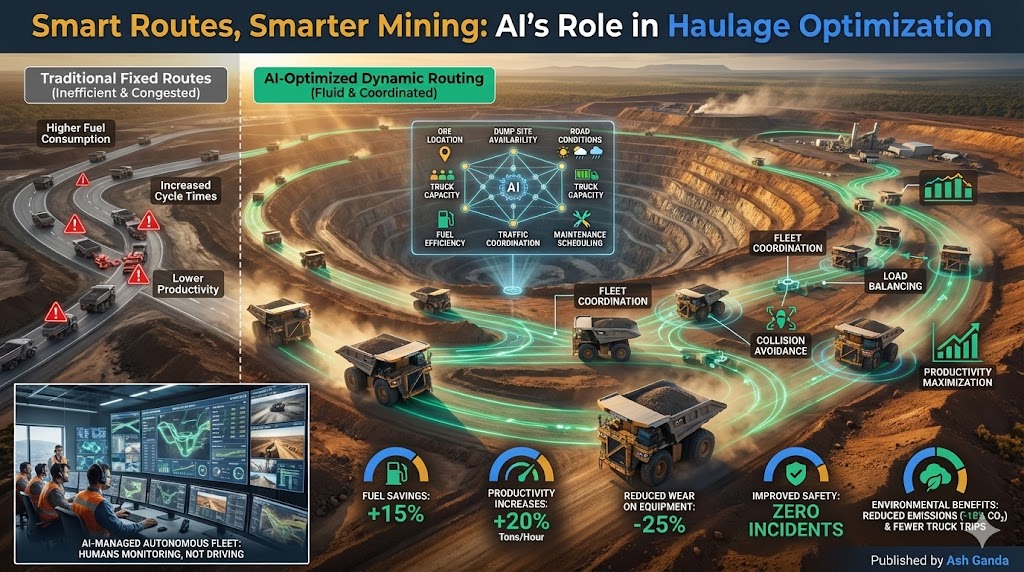
AI systems don’t just follow static routes—they recalculate optimal paths every few minutes. Rio Tinto’s autonomous haulage system, deployed across their Pilbara iron ore operations, uses machine learning to analyze real-time data from GPS, weather sensors, and road condition monitors.
The system considers dozens of variables: current traffic density, road gradient, surface conditions, truck load weight, fuel remaining, and scheduled maintenance windows. According to Rio Tinto, this dynamic routing reduced average cycle times by 12% and fuel consumption by 13% compared to traditional fixed-route systems.
Intelligent Fleet Management
AI dispatch systems act like an air traffic control tower for haul trucks. Komatsu’s FrontRunner AHS coordinates hundreds of autonomous trucks, assigning them to dig sites based on production priorities, truck capacity, equipment availability, and processing facility capacity.
The system learns from historical data. If a particular loading shovel averages 3 minutes per truck during morning shifts but slows to 4 minutes in afternoon heat, the AI adjusts schedules accordingly. Data from BHP’s Jimblebar iron ore mine showed AI dispatch increased productivity by 15% simply through better vehicle assignment and reduced idle time.
Predictive Maintenance
Traditional mining maintenance follows fixed schedules—service every 250 operating hours regardless of actual wear. AI changes this by monitoring real-time sensor data from engines, transmissions, brakes, and suspension systems.
Hitachi’s ConSite mining technology tracks 200+ parameters per vehicle, using machine learning to predict component failures 2-4 weeks before they occur. This prevents catastrophic breakdowns that can sideline a $5 million truck for weeks. According to IEEE’s mining automation research, predictive maintenance reduces unplanned downtime by 35-50% compared to reactive repair approaches.
Key Technologies
Autonomous Haulage Systems
Self-driving haul trucks aren’t future technology—they’re operating today. Rio Tinto runs over 400 autonomous trucks in Western Australia, logging more than 7 billion tons of material moved autonomously as of 2024.
These trucks use lidar, radar, GPS, and computer vision to navigate mine roads safely. They operate 24/7 without fatigue, maintain consistent speeds for optimal fuel efficiency, and follow routes with centimeter-level precision. The safety record is impressive: Rio Tinto reports autonomous trucks have 4x fewer safety incidents than human-operated equivalents.
Digital Twin Simulation
Before changing real-world operations, mining companies now test decisions in virtual replicas of their mines. Hexagon’s mining simulation platform creates digital twins that mirror every road, truck, shovel, and processing facility.
Operators can simulate “what if” scenarios: What happens if we add 20 trucks? Should we build a new haul road? Which maintenance schedule optimizes uptime? The AI runs thousands of scenarios per hour, identifying optimal configurations before spending millions on physical changes.
Benefits and Results
Productivity Gains
The productivity improvements are measurable and significant. According to Gartner’s 2024 industrial AI analysis, mines using AI-optimized haulage systems report:
- 15-20% productivity increase through reduced cycle times
- 18% reduction in fuel consumption via optimized routing
- 12% decrease in tire costs through better load distribution
- 24/7 operations without shift changes or fatigue
BHP’s South Flank iron ore mine in Australia provides a real-world example. After deploying autonomous haulage in 2023, they reported moving 280 million tons annually with 120 autonomous trucks—work that would have required 180 human-operated trucks under traditional dispatch.
Safety Improvements
AI systems eliminate the most dangerous jobs in mining. Human-operated haul truck accidents—often caused by fatigue, visibility issues, or human error—cause serious injuries and fatalities. Autonomous systems don’t get tired, maintain perfect situational awareness through sensors, and follow safety protocols consistently.
Mining industry safety data from 2024 shows autonomous operations have 85% fewer safety incidents than traditional operations. Workers transition from operating trucks to monitoring systems remotely from control centers, removing them from hazardous environments entirely.
Implementation Examples
Rio Tinto - Pilbara Operations
Rio Tinto’s autonomous haulage journey began in 2008. Today, their fleet of over 400 autonomous trucks operates across 16 mine sites, controlled from a central operations center 1,500 kilometers away in Perth. The system has moved over 7 billion tons autonomously—the equivalent of 14,000 Great Pyramids of Giza.
BHP - South Flank Mine
BHP’s newest iron ore mine was built from the ground up for autonomous operations. The site uses Caterpillar’s autonomous trucks integrated with custom AI dispatch software. Within 12 months of full deployment, the mine exceeded production targets by 8% while using 15% fewer vehicles than originally planned.
Fortescue Metals - Integrated AI System
Fortescue took a different approach, developing their own AI optimization system that integrates autonomous trucks with AI-powered drills, AI dispatch, and predictive maintenance. The integrated system optimizes the entire value chain from blast hole drilling through ore processing, delivering 23% improvement in ore recovery rates.
Challenges and Considerations
Implementing AI haulage systems isn’t simple. Initial capital investment runs $50-100 million for a mid-sized operation. Mining companies face integration challenges connecting new AI systems with decades-old equipment and infrastructure.
Workforce transition requires careful management. While autonomous systems create new high-skilled monitoring and maintenance jobs, they eliminate traditional operator roles. Industry data shows successful implementations involve 18-24 months of workforce training and transition planning.
The Future
The next generation of mining AI goes beyond optimizing individual processes. Research from MIT’s mining consortium points toward fully integrated mine optimization where AI coordinates drilling, blasting, haulage, processing, and maintenance as one interconnected system.
Climate considerations are driving innovation too. AI systems now optimize for carbon footprint alongside productivity, selecting routes and speeds that minimize emissions. Some mining companies are testing electric autonomous haul trucks, with AI managing battery charging schedules to maintain 24/7 operations.
Conclusion
AI-powered haulage optimization has moved from experimental technology to operational necessity. The combination of autonomous vehicles, predictive maintenance, and intelligent dispatch delivers 15-20% cost reductions while improving safety and productivity.
As mines face pressure to cut costs, reduce emissions, and improve safety records, AI haulage systems provide measurable solutions to all three challenges. The question for mining operations is no longer whether to adopt AI optimization, but how quickly they can implement it before competitors gain an insurmountable efficiency advantage.
Sources
- McKinsey - Reimagining the Mine with AI - 2024
- Caterpillar Mining Products - Autonomous Haulage - 2024
- Deloitte - Mining Industry Outlook - 2024
- Rio Tinto - Autonomous Haulage Milestone - 2024
- Komatsu FrontRunner AHS - 2024
- BHP - Autonomous Mining Technology - 2024
- Hitachi ConSite Technology - 2024
- IEEE - Mining Automation Research - 2024
- Hexagon Mining Solutions - 2024
- Gartner - Industrial AI Analysis - 2024
- ICMM - Mining Safety Data - 2024
- Fortescue Metals - Autonomous Haulage - 2024
- MIT Mining Consortium - 2024
Explore more industrial AI applications.
Explore more industrial AI applications.
The strategic frameworks I discuss here come to life through execution. Cloud Geeks covers the practical side of cloud infrastructure and IT management.
Ash Ganda is the founder of Ganda Tech Services, a Sydney-based technology consultancy delivering cloud, web, and mobile solutions for Australian businesses.
About the Author
Ashish Ganda is the founder of Ganda Tech Services, a Sydney-based technology consultancy specialising in cloud infrastructure, web development, and mobile app solutions for Australian businesses.
AI Strategy Primer for Australian Business Leaders
A practical framework for AI adoption in 2026 — cut through the hype and start with what matters.