A Gate That Cannot Go Red Is Decoration
There is a comment near the top of a file in one of our pipelines that has done more for the quality of that system than any of the checks it introduces:
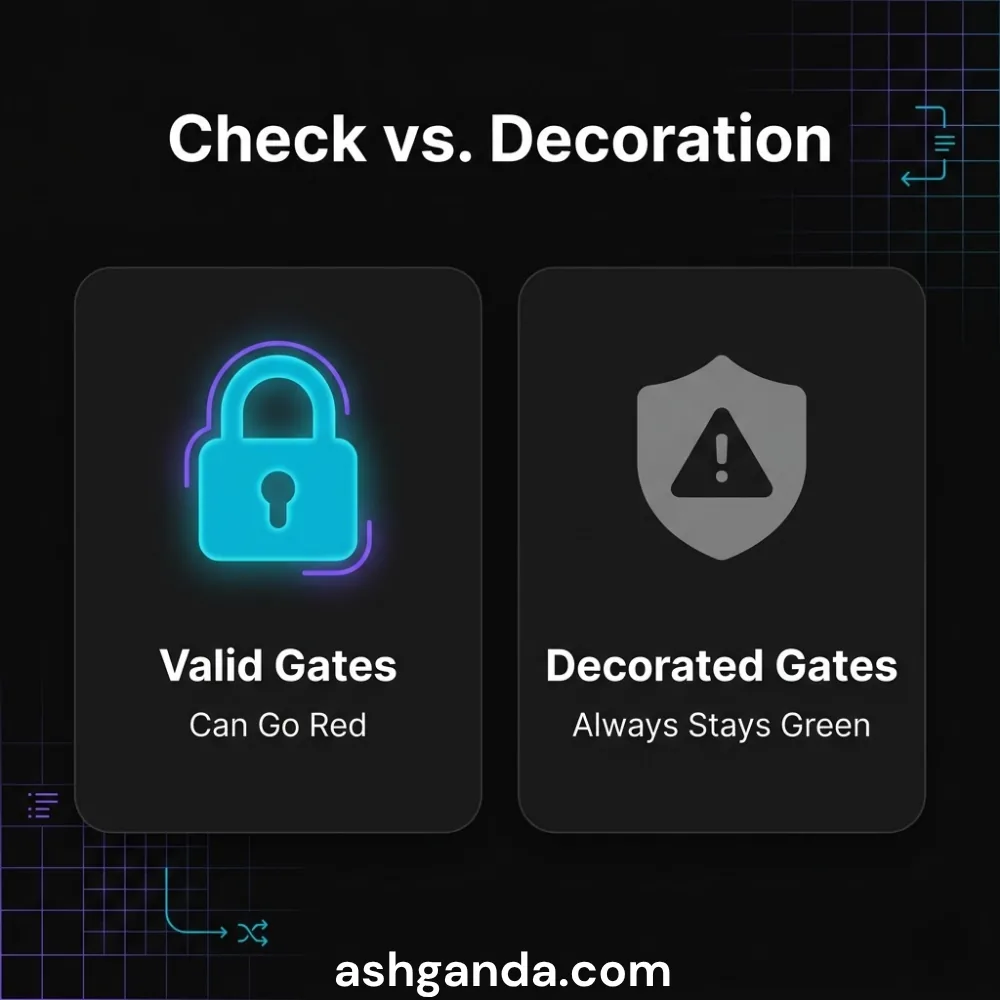
A gate that cannot go RED is decoration.
The file defines nine gates. Every one of them can be made to fail on command, deliberately, by a mode that exists for no other purpose. Run it and the pipeline feeds each gate an artifact engineered to violate exactly the thing that gate exists to catch. A gate that passes that test is reported as broken.
This is the part of quality engineering that almost everyone skips, and the reason to care is not theoretical.
The failure mode nobody instruments
Teams invest heavily in checks. Linters, schema validation, contract tests, CI gates, review checklists, and increasingly a layer of automated review over machine-generated work. All of it produces the same artifact at the end: a green result.
The question no one asks is whether that green result was available to be red.
A check that can only produce one answer is not a check. It is a ritual that runs on a schedule and returns reassurance. And it is strictly worse than having no check at all, because an absent check leaves you appropriately nervous, while a green one spends confidence you never earned — on decisions made downstream by people who reasonably assume something was verified.
I have hit this personally more times than is comfortable. A recent one: a batch job wrote 369 files into a directory that no other part of the system reads, and reported 369 written, 0 failed. Every word was true. The writes succeeded. The check asked whether the operation completed, not whether the result was where it needed to be, and it could never have answered the second question no matter what happened.
There was no bug in the check. The check was answering a question one step to the left of the one that mattered, and nothing about a passing result revealed that.
What mutation of gates looks like in practice
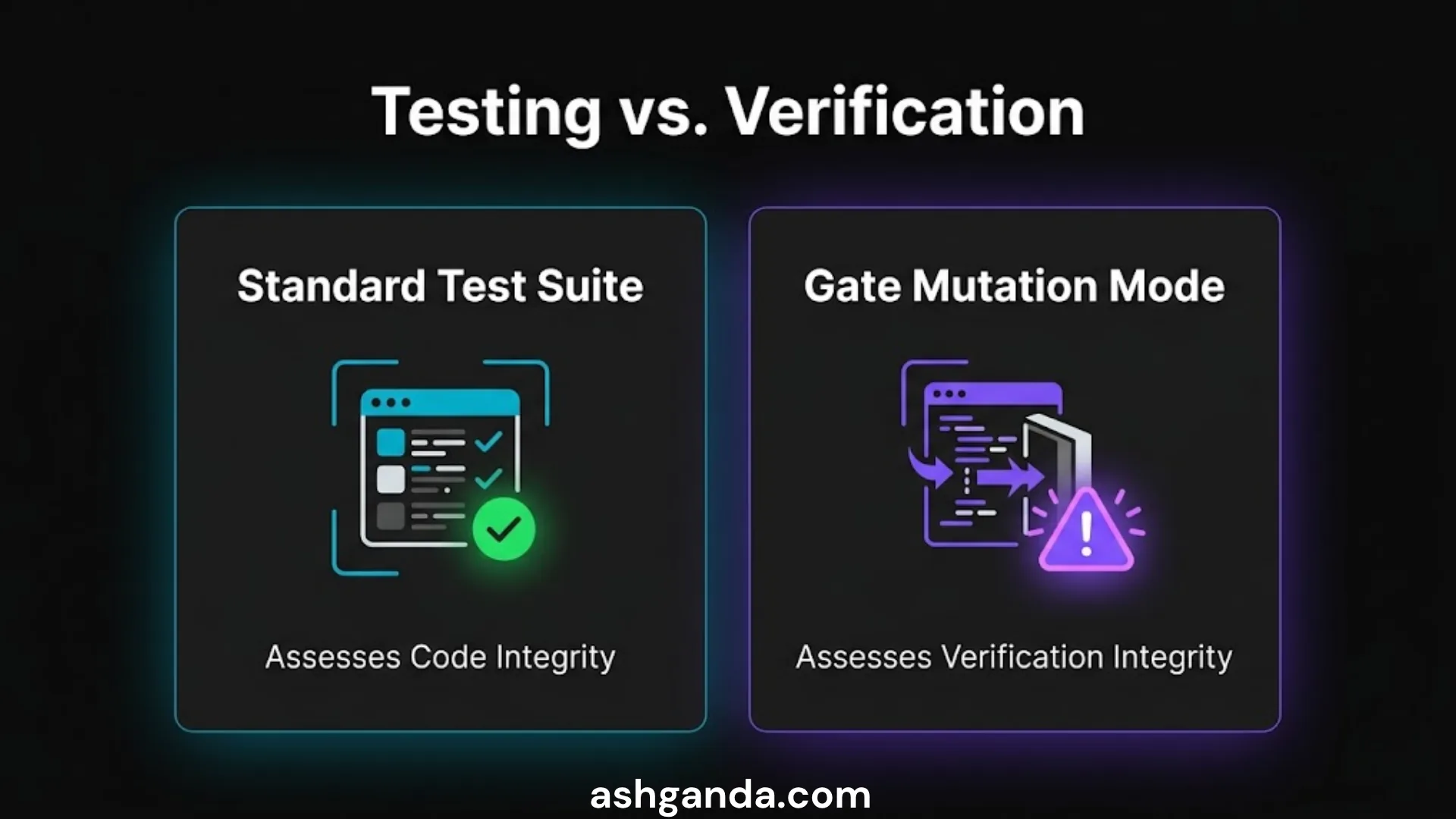
The technique is old in one narrow context — mutation testing, where you introduce faults into production code to confirm your unit tests notice. Almost nobody applies the same idea to the operational checks guarding a pipeline.
The implementation is unglamorous. Each gate gets a case that violates it:
def mutate() -> int:
    """Feed every gate a deliberately violating artifact.
       A gate that PASSES here is broken."""
    cases = [
        ("line-complete", lambda: line_complete_gate(
            published_url=None, moral="x", assets=["a"])),
        ("utm", lambda: utm_gate(
            '<a href="https://blog.example/x?utm_source=blog">internal but tagged</a>',
            site_host=BLOG_HOST)),
        ("utm-outbound", lambda: utm_gate(
            '<a href="https://example.com/x">untagged</a>', ...)),
        ...
    ]
Note what the cases encode. utm and utm-outbound are two probes against the same gate from opposite directions — an internal link that has been wrongly tagged, and an external link that has wrongly not been. A single probe would have proven the gate can fire, which is a much weaker claim than proving it fires on each distinct thing it promises to catch.
The other nine cover provenance fields missing from a citation, a citation present in the metadata but absent from the rendered page, reproduction of source text beyond a permitted allowance, an asset embedded in the manifest but not in the HTML, coverage falling below a floor, and a rotation selection that repeats when it should not.
Run the mode, and every gate must block. If one does not, the run fails — not because the content is bad, but because a guard has stopped guarding.
Why this catches things review does not
The gates in that list are not hypothetical. Several exist because something got through.
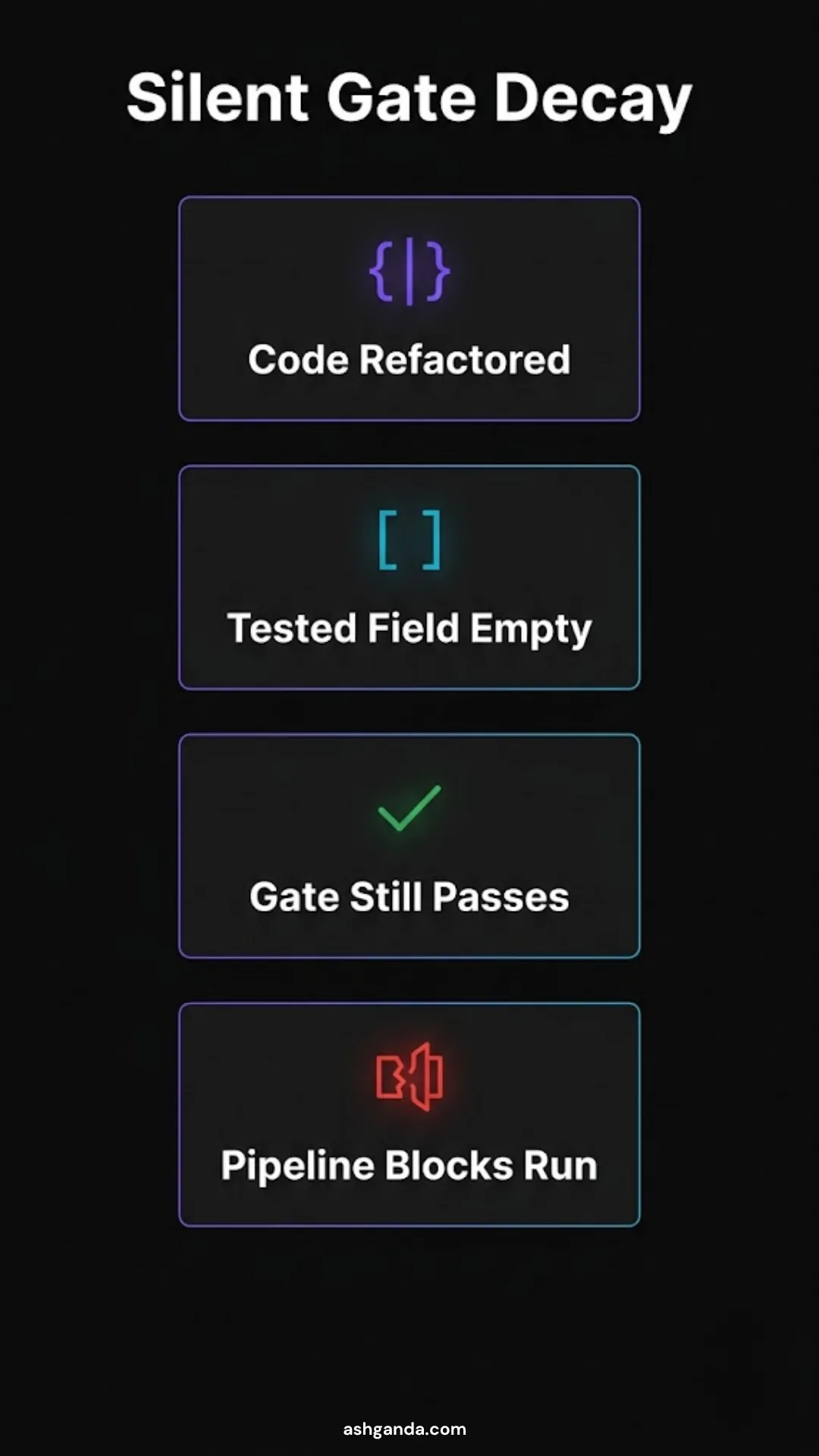
The value of the mutation mode is that it keeps catching a specific and nasty class of regression: a gate that silently stops applying. A refactor changes the shape of the object a gate inspects, and the gate now reads a field that is always empty. It does not error. It passes. Every run after that is green, and the thing it was protecting is unprotected.
Nothing else in a normal test suite finds this. Unit tests for the gate’s own logic still pass, because the logic is fine. Integration tests pass, because the pipeline still runs. The only signal is that a check which used to be able to fail no longer can — and the only way to observe that is to try to make it fail.
I watched exactly this happen recently in a different system: a review process where the specification handed to the reviewers had drifted from the artifact they were reviewing. Three of four independent reviewers reported the mismatch. One of them raised a confident, well-argued, entirely wrong blocking defect, because the document said the design used one typeface and the renderer had been deliberately changed to another months earlier.
The reviewers were competent and the process ran exactly as designed. But once the contract and the artifact disagree, every possible verdict is uninformative. A pass might mean the work is good or the spec is lenient. A failure might mean the work is broken or the spec is stale. You cannot tell which from the verdict, so the review produced no information at all while appearing to produce a great deal.
Four principles worth stealing
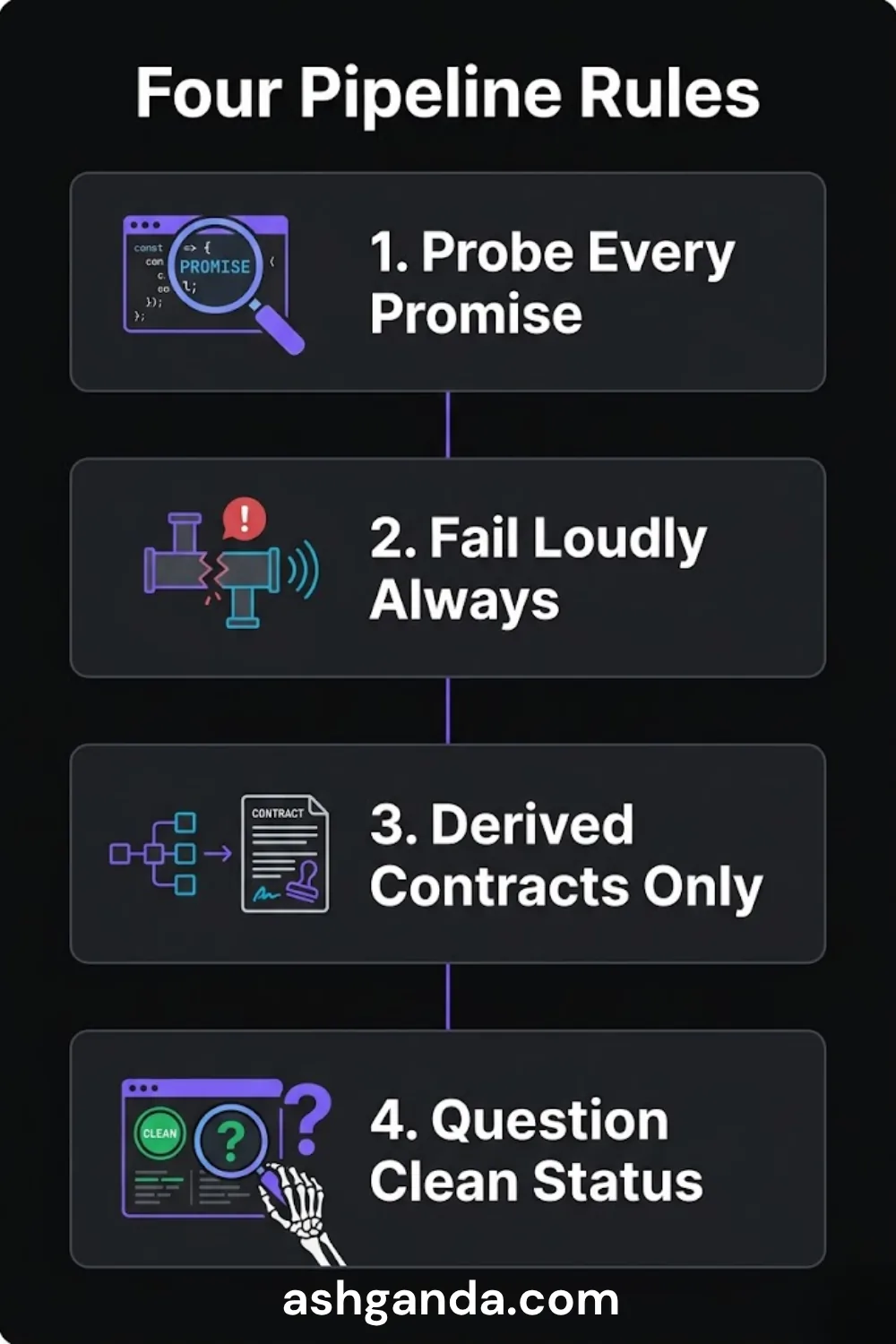
Probe each promise, not each gate. A gate that claims to catch two things needs two mutation cases. One probe proves only that the function is reachable.
Treat a passing mutation as a build failure. If a gate does not block its own violation, the run should fail loudly, at the same severity as a real defect. This is the difference between a practice and a document nobody reads.
Derive your contracts; never transcribe them. Anything maintained in two places is maintained in zero. Where a spec can disagree with an implementation, eventually it will, and every review conducted in the interval is wasted effort that felt productive.
Ask what a green result would look like if the system were broken. If the answer is “identical”, you have not built a check. This is the single most useful question I know for auditing a quality process, and it takes about ten seconds per check.
The cost, honestly
The mutation mode in that pipeline is maybe eighty lines. The gates themselves are around two hundred. The ratio is roughly one line of gate-testing for every two and a half lines of gate.
That is not free, and I would not add it to a system where a wrong answer is cheap. It earns its cost when three conditions hold together: the output is generated faster than a human can review it, mistakes are expensive or irreversible once shipped, and the checks are the only thing standing between generation and publication.
That combination is increasingly the normal case rather than an exotic one. When production stops being the bottleneck, verification becomes the entire job — and the verification layer becomes the thing most worth verifying.
The uncomfortable implication is that your quality process deserves the same scepticism you apply to your code. Most teams have never once asked whether their checks are capable of failing. It is a cheap question with an occasionally alarming answer.
Ash Ganda writes about AI, cloud architecture and engineering practice at ashganda.com.
AI Strategy Primer for Australian Business Leaders
A practical framework for AI adoption in 2026 — cut through the hype and start with what matters.