
Platform Engineering vs DevOps: When to Make the Transition
The DevOps revolution transformed how enterprises ship software. But as organizations scale beyond 50 engineers, the cracks begin to show. Teams spend more time wrestling with infrastructure than building features. Your CI/CD pipelines have become snowflakes. Every squad has reinvented deployment workflows. Sound familiar?
Enter platform engineering—the strategic evolution of DevOps that’s reshaping enterprise technology organizations. Gartner predicts that by 2026, 80% of large software engineering organizations will establish platform engineering teams. The question isn’t whether to make this transition, but when and how to execute it effectively.
Understanding the DevOps-to-Platform Engineering Evolution
DevOps broke down silos between development and operations, enabling faster delivery cycles and shared ownership. It succeeded brilliantly at companies with 10-30 engineers. But scaling DevOps culture across 200 developers reveals fundamental limitations.
The DevOps scaling challenge manifests in three ways. First, cognitive load overwhelms development teams. Every engineer becomes a part-time infrastructure specialist, context-switching between business logic and Kubernetes YAML. Second, tribal knowledge fragments across teams. Squad A configures AWS differently than Squad B, creating maintenance nightmares and security gaps. Third, toil multiplies exponentially. What worked for three microservices becomes unsustainable at thirty.
Platform engineering addresses these challenges by treating internal infrastructure as a product. Instead of every team building deployment pipelines, a dedicated platform team creates self-service capabilities that abstract complexity while maintaining flexibility.
Key distinction: DevOps is a cultural practice emphasizing collaboration and automation. Platform engineering is an organizational structure that operationalizes DevOps principles through product thinking. You don’t abandon DevOps when adopting platform engineering—you evolve it.
Consider Spotify’s approach. Their platform teams built Backstage, an internal developer portal that standardizes service creation while preserving team autonomy. Engineers deploy services without Kubernetes expertise, yet retain full observability and debugging capabilities. This isn’t abandoning DevOps culture—it’s scaling it through deliberate platform design.
The transition requires fundamental mindset shifts. Your infrastructure team stops thinking “how do we operate this?” and starts asking “how do we enable others to operate this themselves?” This product mentality—complete with user research, roadmaps, and customer feedback loops—separates successful platform teams from rebranded ops groups.
Assessment: Is Your Organization Ready for Platform Engineering?
Not every organization needs platform engineering. The wrong timing wastes resources building platforms nobody uses. The right timing accelerates delivery and reduces operational burden. Here’s how to assess readiness.
Organizational scale indicators provide clear signals. If you have fewer than 30 engineers, pure DevOps culture likely suffices. Between 30-100 engineers, you’re in the evaluation zone—watch for pain points. Above 100 engineers, particularly across multiple product teams, platform engineering becomes strategically essential.
Technical complexity thresholds reveal infrastructure strain. Multiple cloud environments (hybrid AWS-Azure, multi-region deployments) significantly increase cognitive load. More than 50 microservices suggests service management overhead justifies platform investment. If you’re running Kubernetes across multiple clusters, platform abstraction delivers immediate value.
Developer productivity metrics quantify the problem. Track time-to-first-deployment for new services—if onboarding a new microservice takes weeks instead of days, you’re losing competitive velocity. Measure infrastructure-related incidents and mean-time-to-recovery. Are developers debugging YAML more than business logic? These signals justify platform investment.
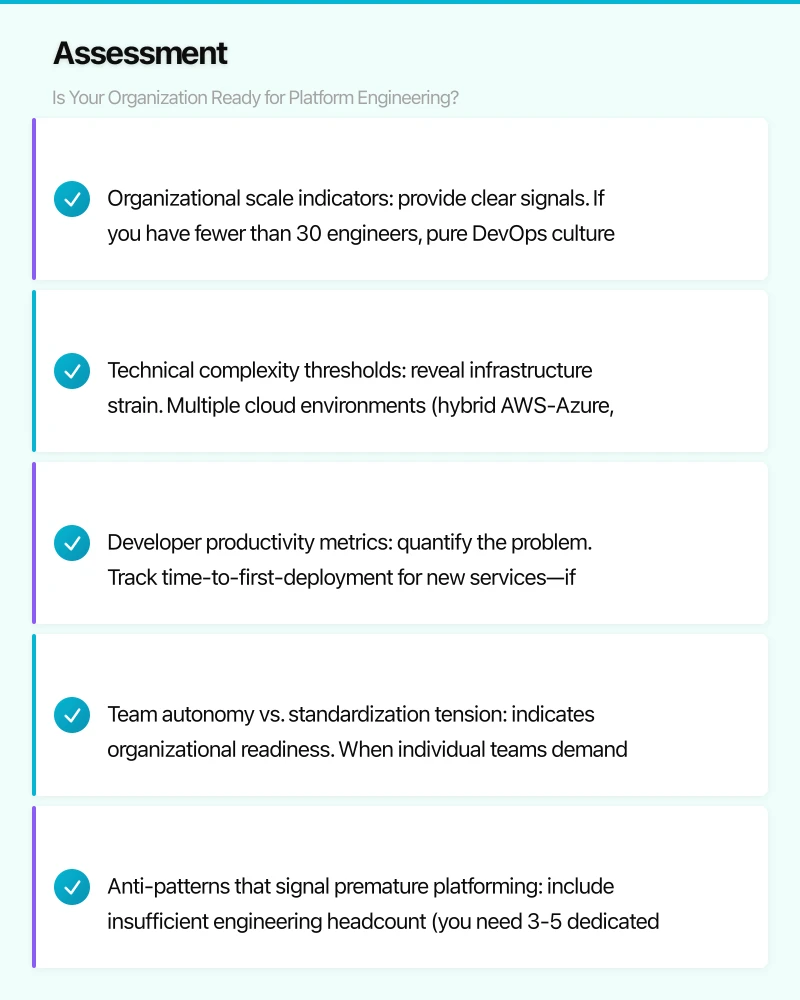
Team autonomy vs. standardization tension indicates organizational readiness. When individual teams demand freedom to choose tools (resulting in 5 different CI/CD platforms), you face governance challenges. Conversely, if central ops teams bottleneck all infrastructure changes, you’ve over-centralized. Platform engineering resolves this tension through “paved paths”—opinionated golden paths with escape hatches.
Airbnb exemplifies this assessment framework. By 2019, they had 200+ services across multiple AWS regions, with deployment times stretching to days. Their infrastructure team spent 80% of time on tickets rather than strategic work. These indicators justified building their internal platform, which reduced service creation from weeks to hours.
Anti-patterns that signal premature platforming include insufficient engineering headcount (you need 3-5 dedicated platform engineers minimum), lack of executive sponsorship (platforms require 18+ month investment horizons), and unclear product teams (if you’re still defining product architecture, platform abstractions are premature).
Run this diagnostic: survey your engineering teams monthly about time spent on infrastructure vs. features. If the ratio exceeds 30% infrastructure work, you’ve crossed the threshold where platform engineering ROI becomes compelling.
Implementation Roadmap: Building Your Platform Team
Transitioning to platform engineering isn’t a big-bang migration—it’s a strategic evolution executed in deliberate phases.
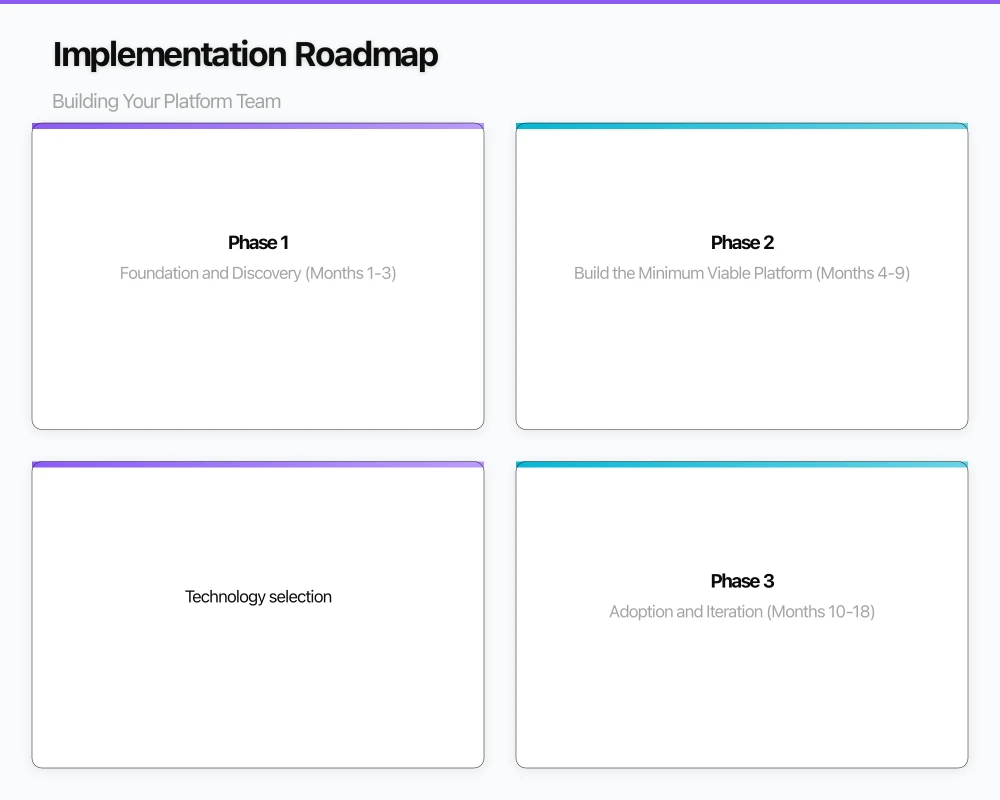
Phase 1: Foundation and Discovery (Months 1-3)
Start by forming a small platform team—2-3 senior engineers with both development and operations expertise. This team’s first mission: deep user research. Interview engineering teams to understand their biggest infrastructure pain points. Don’t guess at solutions; discover actual problems.
Common pain points discovered in this phase include inconsistent deployment workflows, fragmented observability across services, unclear security compliance requirements, and difficulty reproducing production environments locally. Prioritize based on impact and feasibility.
Establish platform team principles early. Adopt a product mindset—your users are internal developers, but treat them with the same rigor as external customers. Define service level objectives (SLOs) for platform capabilities. If you’re building a deployment platform, commit to 99.9% uptime and <5 minute deployment times.
Phase 2: Build the Minimum Viable Platform (Months 4-9)
Resist the urge to build everything. Start with the 80% use case—typically service scaffolding, deployment automation, and basic observability. Your goal: make the most common developer workflow self-service and delightful.
Stripe’s approach illustrates this principle. Their initial platform focused exclusively on service creation and deployment. Engineers could spin up a new microservice, complete with CI/CD and monitoring, in under an hour. Only after adoption validated demand did they expand to advanced capabilities like feature flagging and canary deployments.
Technology selection matters less than you think—but pick wisely. Leading platforms leverage proven components: Kubernetes for orchestration (whether you expose it directly or abstract it), Terraform for infrastructure-as-code, ArgoCD or Flux for GitOps deployments, and developer portals like Backstage or custom-built solutions for self-service interfaces.
The critical success factor: golden paths, not golden cages. Provide opinionated defaults that work for 80% of cases, but allow escape hatches for the 20% with special requirements. Netflix exemplifies this—their platform provides default deployment patterns, but teams can customize when justified.
Phase 3: Adoption and Iteration (Months 10-18)
Launch with volunteer early adopters—typically newer teams without legacy infrastructure baggage. Collect feedback ruthlessly. Your first platform iteration will be wrong in subtle ways; iterate based on actual usage patterns.
Measure adoption metrics: percentage of services using platform capabilities, time-to-deployment for platform vs. non-platform services, developer satisfaction scores (NPS), and reduction in infrastructure-related incidents. These metrics justify continued investment and reveal gaps.
Provide migration support for legacy services. Don’t mandate platform adoption immediately—demonstrate value first. When platform-deployed services ship faster with fewer incidents, adoption becomes organic.
Phase 4: Scale and Governance (Months 18+)
As adoption grows, establish platform governance. Create a platform roadmap driven by user feedback and strategic initiatives. Institute regular office hours where platform engineers provide direct support. Build self-service documentation and video tutorials—reduce synchronous communication overhead.
Consider the platform team’s organizational structure carefully. Should they report to engineering leadership, infrastructure, or CTO directly? The answer depends on your organization, but platform teams need sufficient authority to enforce standards while remaining responsive to user needs.
Measuring Platform Engineering Success
Platform teams fail when they build in isolation, measuring output instead of outcomes. Success requires deliberate metrics aligned with business objectives.
Developer productivity metrics form the foundation. Track deployment frequency—successful platforms increase deployment velocity by 2-5x. Measure lead time for changes (commit to production)—platforms should reduce this to hours or minutes. Monitor change failure rate and time to restore service—platforms should decrease both through standardization and automation.
These four metrics, derived from the DORA research, directly correlate with organizational performance. High-performing organizations deploy multiple times daily, with lead times under one hour, change failure rates below 15%, and recovery times under one hour.
Developer experience metrics capture qualitative value. Survey teams quarterly on infrastructure satisfaction using Net Promoter Score methodology. Track platform adoption rate—percentage of eligible services using platform capabilities. Measure time-to-first-deployment for new services—successful platforms reduce this from weeks to days or hours.
Shopify publicly shares their platform metrics: 100% of services use their platform, time-to-first-deployment dropped from 2 weeks to 90 minutes, and developer satisfaction scores increased from 6.2 to 8.7 out of 10 over two years. These outcomes justify their platform investment.
Operational efficiency metrics demonstrate cost and reliability improvements. Track infrastructure costs per service—platforms should reduce this through standardization and resource optimization. Measure on-call burden reduction—fewer infrastructure incidents mean less operational toil. Monitor security compliance rates—platforms enforce standards automatically rather than through manual audits.
Business outcome metrics connect platform engineering to strategic objectives. Faster deployment velocity enables competitive differentiation—features reach customers weeks sooner. Reduced infrastructure complexity allows engineers to focus on value-creating work rather than toil. Improved reliability directly impacts customer satisfaction and revenue.
Establish baseline metrics before platform launch, then track monthly. Expect 6-12 months before significant improvements manifest—platforms require adoption before delivering value. Leading indicators include early adopter satisfaction and usage growth; lagging indicators include deployment frequency and reliability improvements.
Anti-patterns to avoid: measuring platform team output (features shipped) rather than customer outcomes (developer productivity improvements), optimizing for platform complexity rather than user simplicity, and ignoring qualitative feedback in favor of quantitative metrics alone.
Strategic Considerations for CTOs
Platform engineering represents significant organizational change requiring executive leadership and long-term commitment.
Investment timeline and resource allocation demand realistic expectations. Budget for 3-5 dedicated platform engineers initially, scaling to 1 platform engineer per 20-30 application developers at maturity. Expect 12-18 months before substantial ROI—platforms require building, adoption, and iteration cycles.
The opportunity cost is real: these engineers could build features instead. Justify the investment through productivity multipliers. A platform team of 5 engineers supporting 100 application developers can increase overall productivity by 20-30% through reduced toil and faster deployment cycles—equivalent to adding 20-30 developers.
Organizational design challenges require careful navigation. Should platform engineers sit within central IT or embed with product teams? The answer: central team with strong user feedback loops. Embedded models fragment platform development; purely centralized models lose touch with user needs.
Create platform product managers—not traditional project managers, but user-focused product thinkers who prioritize roadmap based on developer needs and strategic initiatives. This role bridges platform engineering and application teams.
Cultural transformation from DevOps to platform thinking succeeds through clear communication. Emphasize that platform engineering extends DevOps principles rather than replacing them. You’re not re-siloing operations—you’re creating leverage through shared capabilities.
Address common objections proactively. When teams resist standardization, emphasize golden paths with escape hatches. When executives question ROI timelines, present case studies from similar organizations. When operations teams fear irrelevance, position platform engineering as elevating their work from toil to strategic enablement.
Vendor vs. build-your-own platform decisions require strategic analysis. Building internal platforms provides maximum customization but demands significant engineering investment. Adopting vendor platforms (AWS App Runner, Google Cloud Run, Heroku, Render) accelerates time-to-value but constrains flexibility.
The pragmatic approach: leverage vendor platforms where possible, building custom layers only where competitive differentiation demands it. Use managed Kubernetes (EKS, AKS, GKE) rather than self-hosting. Adopt Backstage rather than building developer portals from scratch. Focus internal platform engineering on orchestration and integration, not reinventing commodity infrastructure.
Competitive implications extend beyond operational efficiency. Organizations with mature platforms ship features faster, respond to market changes more rapidly, and attract engineering talent more effectively. Platform engineering has become a competitive differentiator in talent-dense markets—developers prefer companies with sophisticated internal tooling.
The Path Forward
Platform engineering represents the maturation of DevOps practices into scaled, product-driven infrastructure capabilities. For CTOs leading organizations beyond 50-100 engineers, the strategic question isn’t whether to adopt platform engineering, but how quickly you can execute the transition effectively.
Start small. Form a 2-3 person platform team focused on solving one critical pain point—typically deployment automation or service scaffolding. Measure relentlessly, both quantitatively (deployment frequency, lead time) and qualitatively (developer satisfaction). Iterate based on user feedback, not architectural purity.
Platform engineering succeeds when treated as a product, not a project. This means continuous investment, user research, roadmap prioritization, and outcome-focused metrics. The organizations winning this transition view their internal developer platform as critical infrastructure—equally important as their customer-facing products.
The next decade of software delivery will be defined by organizations that master platform engineering. Those that execute this transition effectively will deploy faster, innovate more rapidly, and attract top engineering talent. Those that cling to pure DevOps culture at scale will drown in complexity and toil.
The evolution from DevOps to platform engineering isn’t a rejection of DevOps principles—it’s their ultimate expression at enterprise scale.
Ready to elevate your enterprise technology strategy? At Ashganda, we help CTOs navigate complex platform engineering transformations, from assessment through implementation. Let’s discuss your platform engineering roadmap.
For hands-on guidance on cloud migration and managed IT, my team at Cloud Geeks helps Australian businesses implement these strategies.
As founder of Ganda Tech Services, I work with Australian businesses to align technology investments with business growth — across cloud, web, and mobile.
About the Author
Ashish Ganda is the founder of Ganda Tech Services, a Sydney-based technology consultancy specialising in cloud infrastructure, web development, and mobile app solutions for Australian businesses.
Tech Stack Selection Guide 2026
Choose the right tools for your Australian business — without the vendor hype or overlapping spend.
Almost done
Check your inbox and click the confirmation link to get your download.